The sad thing about ad blocking is the advertisers and website owners essentially forced me into using it.
I didn't use any adblocker software until earlier this year (much to the surprise of many other developers I talk with who adopted it much earlier). While I also didn't click many ads, I figured the least I could do for all the free content I was consuming was keep the ads showing.
Then the line between what used to be "real" sites and clickbait sites began to blur rapidly (see, for example, the weather channel site which is now basically a clickbait digital tabloid) and advertisements on "real" sites got really pushy in ways that would previously only be done on sketchier sites, popping open tabs I never requested, etc.
I eventually hit an annoyance level where I was forced to install an adblocker just to keep using the web.
Yeah, I couldn't stand seeing all of those content marketing advertorial blocks with the photoshopped-to-be-eyecatching/vaguely disturbing pictures anymore. I finally gave in earlier this year.
Same here, I always liked to support sites by having ads on or buying things I like on them.
But I have recently switched to ad blocking as well due to tracking and worse due to broadband caps.
I refuse to fill up my 400GB Cox cap with ads except on sites that deserve it. The content and marketing industries need to lobby hard against broadband caps to limit cuts into their industries, the broadband mafia wants their cut of every download and all ads run.
Yeah I would never want to sell a software product to attorneys (for liability reasons) or to software engineers (for piracy reasons).
When I was a computer consultant, I helped an attorney client install a software package that was specifically designed for attorneys to use. It didn't work as he had intended it to when he purchased it. So he asked for a ridiculous concession from them, was denied it so he filed a lawsuit against them. I imagine the company probably gets sued a few times per week with their litigious client base.
Most developers I know buy software if they like it, or perceive it to add value to them. Stealing software, as a developer - especially if it's good, and you depend on it, makes you a massive hypocrite if you get paid to create software other people use, and I think most of us have at least one time thought "Someone's job depends on purchasing this".
But you're spot on with attorneys. Worst customers I ever had was in the legal space. Not only do they get lawsuit happy, but there are a lot of attorneys out there being paid a lot of money because a very bad paper based system is still in place, and tech is not their friend.
I agree that software engineers certainly have more ability to pirate software, but I doubt that the rates of piracy are any higher than with the general population. For one thing, developers tend to have fairly good salaries, so there's less financial incentive for piracy. Also, you're depriving people in your own industry of income—I certainly wouldn't appreciate it if people pirated my products.
Regarding attorneys: I can't imagine that it's really that prevalent. Anyone who was that litigious would quickly gain a representation as such among the legal community.
The unscrupulous advertising practices out there (e.g. straight-up malware deliver) make it too dangerous to not run ad-blockers. Until the security issues around advertising are addressed adequately, I consider blocking entirely ethical. Compare it to the idea of Target shaming users for not trusting them with their credit card info.
Besides, I expect direct patronage models to supplant advertising for smaller sites sooner rather than later. And yes, I already use Patreon.
I can't think of any reading off the top of my head, but Patreon and other services usually work this way: many creators provide their primary work (the web comic, the podcast, etc.) for free, regardless of backing. Backers typically get extras. For example: I received a digital sketch of my choice for backing a comic artist.
Look-up Patreon.com. It works by people opting to either donate money for a specific project, a certain amount of money a month, or a certain amount of money per article/comic/video etc.
There are no paywalls, it is like a wealthy patron paying for a public concert.
> Yes, and if everybody will do like you you'll soon find nothing interesting to read, because every free content website will end like DrDobbs.
Ad-blocking is a necessary form of protection from corporate stalking.
It wouldn't be necessary if advertisers would restrict themselves to tracking what's necessary to create a functional ad (browser, capability, etc.). But they are bound and determined to mine for every possible bit of information they can and that's where I draw the line.
If you wouldn't want an individual doing that, why on <deity>'s green earth would would want some anonymous company doing it in an automated fashion such that they can almost guarantee a far more exact picture of you? Does this not completely subvert the idea of privacy? Especially when security is not absolute guarantee?
I think if people really, truly understood just how easy it is to collect the data, store the data and then still manage to get it wrong, they'd be horrified beyond belief. I'm sure a lot of people here have some inkling of how that's done, but if that could be communicated to the people who aren't as tech-savvy ...
Well, sad to say, there'd be a lot of pitchforks and torches and still nothing would be truly done about it.
But it's nice to think about burning down some corporations and lining up a few executives against the wall.
> Ad-blocking is a necessary form of protection from corporate stalking
To give a concrete example in support of your statement, here is what Dr.Dobb's does in the web page of the article on topic (and I did have click-to-play enable, might have been worst without it) for someone without a blocker:
Also, this load error. If your user name is dblake, watch out! "Not allowed to load local resource: file:///Macintosh%20HD/Users/dblake/.launchpad/cm001.ubm-us.net/cache/defau…ache/default/main/Images/ddj/WORKAREA/ddj/v2/css/SeanStuff/superfooter.css"
I like you, think that ad tracking is a little "overbearing". That said, I'm interested in knowing if you have any type of rewards cards or saver-club cards (super market, clothing stores, etc) from the physical stores you shop at?
Not the addressed poster, but regarding rewards cards (that I avoid as well) vs ad tracking: You only show your rewards card when buying something in the store the card is valid in/offered by, not when entering a random 3rd party building or when crossing the street. But ad tracking (especially retargeting) spies on you whenever you browse the web without precaution.
No, I don't have rewards cards, etc. Aside from my grocery store, I don't shop at any one store regularly enough for the savings to overcome my queasiness about the information gathering. I have had so-called Loyalty Cards in the past, but they didn't increase my loyalty. My opinion is that the stores are instead ripping off the people who don't have them.
There's no need for my grocery store to know that I, personally, use a particular type of condiment or toothbrush. The aggregate sales should be enough to determine what they need to buy and advertise.
None of this should suggest I'm some kind of altruist, except in the sense that I believe in level playing fields. Also, I'm human so some irrationality or self-interest is sometimes OK.
In the internet era you simply don't need a multinational corporation to publish your blog post for you. They're already being published for free.
You still need a trusted editor to collect and curate... but that editor certainly doesn't need the multinational corporation, not anymore. Its not 1975 and ink on paper.
The future probably looks a lot like "Clojure Gazette", which is a curated edited list of links to blog posts and projects focusing on a rather small field, and THE (emphasis, "the") only human involved is a trusted editor and he gets beer money plus considerable fame out of being the editor.
Reading between the lines, at Dr Dobbs a small team can pull down less than a million bucks. To a multinational megacorporation, thats hopeless, sunset it. Divided among a very small team, however, that's one heck of a lifestyle business...
You could make exactly the same comment in regard to clicking ads and buying things from ads. If everybody stopped doing that then ads would become valueless and ad revenue would go away. The thing is, a lot of people who use ad block never click on ads to start with.
The idea that people should be forced to suffer, by viewing ads that are useless to them, in exchange for viewing free content is a very silly concept born of puritanical ideals. If a site can't sustain itself with users running ad block then it needs to figure out a better business model, period.
No, there will be left free some small percentage of useful content, maybe 00,01% or less. And personally for me, these several tens of millions of pages left will be enough.
Certain circles but I don't install AdBlock because of the huge performance hit and because I've seen plenty of false bug reports caused by malfunctioning ad-blocking extensions.
It's much easier, not to mention safer, to uninstall Flash and stop visiting sites which don't respect their audience.
I'm one of the few then. I feel so special! (To be fair, I have to click to start Flash, because I haven't updated it and Firefox says it has security holes, which helps a lot.)
Well, it seems that vendors have decided web advertising is not valuable even among user demographics that don't block ads. AdBlock may not be making all that much difference if the basic problem is that people ignore ads even when they see them.
That said, there must still be some value in brand recognition. I guess it's just not as much value as vendors had previously ascribed to these ads.
I think the reach is well beyond tech now. People have figured out they can watch youtube without ads by installing adblock. For me that was a huge incentive and it effectively have made my online experience better.
For those that claim this is stealing, that would imply that there was an explicit price with click to purchase button to view the webpage. There is no entitlement to the website operator, any ad click or donation is completely up to the discretion of the visitor. To claim people are stealing by using adblock is arrogance.
> People have figured out they can watch youtube without ads by installing adblock
I've seen AdBlock Plus fail on YouTube in a particularly annoying way--the ads that consist of a long video (often 2 minutes or more) with a "you can skip this ad in 5 seconds" overlay that counts down and turns into a skip button are shown--but with that overlay and skip button removed!
I recently installed AdBlock (at home) and AdBlock Plus (at work), and I'm not really impressed. At most sites, ads did not bother me. I installed these because of one particular site that was getting too obnoxious. That was gocomics.com. They started running frequent ads that expand on the left side of the page, which would often push the end of the comic I was reading off the right side of the page.
I'd much prefer if I could have these off for most sites, and only block ads on specific sites that I find overly aggressive. They support this, but there doesn't seem to be a good interface to manage it, and it looks like it would get impractical to deal with a lot of sites that way.
On your commute, you're passing a McDonald's store every day. You know it's there, but you never buy food there for whatever reason. Are you stealing?
I'd rather pay the site directly if they'd stop displaying ads.
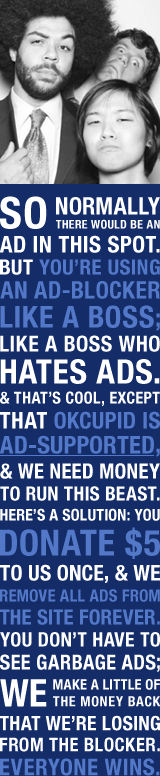
Several companies experiment with those kinds of revenue stream: OkCupid shows you this [1] banner encouraging you to pay 5$ if you're using an ad blocker.
Reddit has the "gilding" concept. While I don't know if that pays out at the end of the day, I'd rather pay the site directly than having them to rely on distracting and sometimes malicious ads which load 3 embedded flash player objects and destroy the site's performance.
By relying on ads, sites naturally introduced a terrible usability. Notice how many times you encounter a complete page reload where a simple AJAX call would have done the job better? That's because you sell a certain number of page impressions to advertisers, and the sooner they're used up, the sooner you get paid. The complete system is a mess.
> On your commute, you're passing a McDonald's store every day. You know it's there, but you never buy food there for whatever reason. Are you stealing?
That analogy doesn't work very well in this context. A more realistic example would if they were giving away cookies in exchange of you getting inside and see their advertising and one friends of yours gets inside and take several cookies so you and your other friends don't have see the ads.
It wouldn't be stealing because the cookies are "free" but still you might feel like taking advantage.
I am agree with you and I would rather pay for the site but many people won't and that's exactly why several content providing are having troubles with ad-blockers.
If you want a physical cookie analogy, its more like going to a real estate open house knowing you have no interest whatsoever in buying that house, yet still eating a free cookie. You walk in, the house reeks of cat pee, no Fing way, but those are tasty looking cookies...
I wouldn't break into your house and steal your cookies, but if you put up signs all over advertising your open house with free cookies, if you twist my arm enough I'll cave in and show up and eat a cookie. Just don't be annoyed at me when I don't buy the house. Practically no one purchases, anyway.
> Just don't be annoyed at me when I don't buy the house. Practically no one purchases, anyway.
Exactly my point... just are just taking advantage of the "free content". And everybody go for the cookies. Then they will be stop offering cookies (even though there were really good cookies)
I've never purchased through an online ad, I don't have any disposable income. If you don't want me to visit your site then you're welcome to paywall it - but I'm saving resources by blocking ad loading. If you put content on a website then you put it there free, that's the ethos of the web, I do it too - you're welcome to put up adverts of course but there's no contract between us that necessitates my consumption of those ads.
If you want to block those using adblockers then it's possible, any indication that those with adblockers are unwelcome will certainly be respected by me; I'll just find another source, maybe Google's cache. Oh, you don't want Google to cache your site, well you know what to do, it's easy to prevent.
Personally I started with adblockers when ads went dynamic, motion distracts my eye too much and means I can't read the content. In-your-face-ads make me determined not to buy from those companies - most of which don't sell in my country anyway, it seems.
If Adblocking is stealing then so is shutting your eyes during ads at a cinema, or going to the toilet in a broadcast-TV advert break, or looking at an amusing billboard without checking who the advertising company is, ....
Not even close to it. You could say the opposite, in that some of these more obtrusive ads are stealing from the business they are supposed to be advertising with. Many times a small banner ad can inline flash objects, all kinds of mess to take over real-estate on a site, and the owner may not even know it. Then, an ad collects usage data on you, and sells it, without your consent, or worse?
And you say people with ad blockers have no integrity?
Content producers whose stream of income comes from ads.
I don't use an ad blocker. It's a form of piracy like torrents are. Getting content without paying. I'm also a content producer and i know it really hurts the already weak sustainability of content websites.