I don't know if this is an appropriate question, but:
Why would a well-known site be sunset by its owner? In one word, revenue. Four years ago, when I came to Dr. Dobb's, we had close to $3 million in revenue, almost all of it from advertising. Despite our excellent growth on the editorial side, our revenue declined such that today it's barely 30% of what it was when I started.
A friend of mine's small business observed almost this same phenomenon. Can you elaborate why revenue has declined, even though page views have continued to grow? Is advertising fundamentally changing, and page views are no longer nearly as valuable as they once were? Or is it specifically because of Dr. Dobbs' context as a software dev news/blog site?
In particular, click fraud seems to be stinging my friend's business, but I assume it's not something that simple for Dr. Dobbs. Also, apologies if this sounds stupid. I don't have a background in advertising or marketing, but I find the subject fascinating and have been trying to learn about it.
EDIT: The next part addresses this:
This is because in the last 18 months, there has been a marked shift in how vendors value website advertising. They've come to realize that website ads tend to be less effective than they once were.
What I'm asking is, in what ways has the landscape changed?
EDIT 2: Thank you for Dr. Dobbs. It's been wonderful over the years, and I'm sad to see it go.
During the last 18 months, vendors have come to realize that advertising on Websites doesn't work at all. You can verify this by counting the number of times you've bought anything by clicking on an ad you saw on a website. Most people I've asked say 0, 1, or 2 items, with a heavy skew towards zero.
For publications in markets with a large number of vendors, the pool of vendors who still see advantage in web ads (such as ads that don't expect purchases, say, as for an upcoming movie) will sustain them. But the software development tools market is small with fewer than 100 vendors, many of which don't advertise at all.
So, essentially, there just was not enough advertising to keep us going.
Andrew, in fairness this is incorrect. Web advertising on content is no more, nor any less, effective than web advertising in a printed magazine. Rather than ask the question "How many of you have clicked on something and bought it." a more relevant question is "How many of you have bought something, or from someone, you have seen as an advertisement on a web page?" Digikey ads showed up on Dr. Dobbs and I've bought a ton of stuff from them. Sometimes reading an article there, will show an ad, and it will remind me of something I was supposed to get. Then I will go over there and buy it. Almost exactly as I did with the magazine version.
That said, click fraud has really burned a lot of advertisers. That is why advertising on content needs to shift to a performance based model, ads that let you know that someone went to a site after they saw the ad on your page, and bought it. That should net you a few $. As it stands, advertisers bid for 10,000 clicks at a nickel ($500 ad spend) and compare that to what they sell, and they come up poorly. If they set aside $500 to reward the first 100 people who clicked through and bought something you would find things to be very very different. Click fraud doesn't work if the value isn't in the click. But this migration is currently not happening as quickly as we would like.
> Web advertising on content is no more, nor any less, effective than web advertising in a printed magazine.
1) Things like AdSense? You're right. The real money is in sponsored content. Just ask BuzzFeed, Forbes, Huff, etc. There's a saying from advertisers when you confront them about traditional print/broadcast advertising success "when sales go up, it just works, you don't question it".
> That is why advertising on content needs to shift to a performance based model
2) Not all advertising is about direct click through to purchasing. Coca-cola, Pepsi and every car manufacturer in the world spend billions a year on advertising simply for brand recognition alone. No one is buying a coke because they saw an ad on Facebook, but they sure as hell associate drinking a coke with happiness because that brand association is pretty ubiquitous nowadays.
I think the OP is insuitating that they should have never been a $3mil business in the first place, which is consistent with your story about your purchase behavior. How many ChuckMcM's are there gonna be have to be that purchase products on Digikey in order to provide $3mil worth of business?
   > How many ChuckMcM's are there gonna be have to be
   > that purchase products on Digikey in order to provide
   > $3mil worth of business?
In this case we've got the numbers from the article, 10.3 million page views means they need a nearly $300 RPM in order to make $3M a year. So yeah, even Google doesn't make $300 RPMs. I wonder if that is the correct number. When I first read it I read 10M page views a DAY not a YEAR. At 10M page views a day they need an RPM of about $0.82 to make $3M/year.
Where does that leave us? Well wondering things. Alexa says they see about "40k visits/day" so 1.2M a month, (that would be closer to 14M/year). 40K visits a day though and clearing $83K/month (1M annual run rate) is like close to $69 RPM. That is pretty good for a content web site.
It means that if they can keep half the visitors going to a paid model, they need to charge 2 USD a year to make 3M. Not counting what they save on not having to run or sell ads. Who here wouldn't pay quite a lot more than that not jus for Dr. Dobbs - but a much more independent (or obly beholden to its readership) Dr. Dobbs?
There's two types of advertising (probably really more):
1) We don't care where you buy the thing we make, just buy it. (Mazda)
2) You want that thing in #1, come buy that thing from me! (Mazda dealership)
I don't think there's ever been a question of the efficacy of #1, but #2 is probably nearly useless online. Anecdotally, an advertisement might remind me I want something, but it isn't going to change my habits in how/where I buy it. Bob's House of Laptop Batteries could offer me a price that's $2 less than Amazon, but if I see Bob offering the exact battery I need at exactly the moment I need it, there's still a pretty good chance I'll buy it from Amazon because of 1) ease, 2) trust, 3) Prime, etc.
> That said, click fraud has really burned a lot of advertisers.
THIS
> That is why advertising on content needs to shift to a performance based model,
As someone in the ad biz,it's something hard to do.You still need ways to track(I understand people don't like it but...) accurately where the traffic comes from.We really need innovative tools in that domain!
Finally,I think the biggest disappointment in web marketing comes from the (un)ability of social medias to really influence sells.FB and co ad services are way worse than classic web advertising.It's borderline scammy.
analyze what happens. You can compare normal behavior - time on page, number of pages viewed etc occurring from normal organic traffic against traffic generated by the ad campaign. Did one site or group of sites send 90% of your clicks, but almost zero real traffic?
Another thing I've seen happen through Adwords was a large percentage of traffic coming through with default language set to Arabic and spending 0 time on site. (on a site intended for English speakers)
Indeed, magazine readers greatly prefer print ads as their most favorite way to be marketed to (61%, Nov 2014). More than twice the percentage as the #2 way which is trade shows, and way more than annoying banner ads (13%).
And why not> Print ads gently invite you to investigate a product on your own terms. Didn't you all look at the ads in Dobbs and every other special interest magazine? It's universal, still is today.
But since online advertising became more measurable than print, print slowly disappeared. In a nutshell.
Ted Bahr
Founder
SD Times
Last Man Standing (almost)
> That is why advertising on content needs to shift to a performance based model, ads that let you know that someone went to a site after they saw the ad on your page, and bought it.
Is't that what affiliate programmes are?
I must've gone about using them in the wrong way, but I didn't make any more money from then than I did from displaying Adwords.
The problem with performance-based model is that is it simply a slower race to the bottom (of quality). Publishers will continue to find ways to trick people into responding and advertisers now consider a lead to be a lead to be a lead. Lowest common denominator wins. Quality loses.
Example: HuffPost. You consider any of that eye-ball grabbing stuff to be quality? (not making a political statement)
I agree with this point. The purpose of an ad need not always be to make a immediate action (like a purchase or signup), but also about creating awareness and reminding people about a brand and its products. This is what most ads in printed form do anyway. RIP DDJ.
> During the last 18 months, vendors have come to realize that advertising on Websites doesn't work at all.
I think that's the wrong conclusion to draw.
Advertising on web sites works very, very well and thousands of companies depend on it on a daily basis.
What doesn't work so well is advertising on a web site that's just an online version of a magazine. The problem has a lot more to do with the magazine part than the web site aspect.
I've been reading DrDobbs for a couple of decades and I'm a fan, but the simple truth is that it's become less relevant these past years. First switching to a download only model and then progressively nagging me pretty aggressively to download my own issue (which I stopped doing because the summaries I saw in the email were of little interest to me).
Andrew, reading your editorials has always been a pleasure and you should be proud of what you accomplished.
There is a bit of a feeling that advertising on web sites, much like SEO, is a bit of snake oil business....I agree with the op's statement-- when have you bought anything from a web advertisement anywhere? Maybe you have signed up for a service from one? But bought something? Even something very targeted.... although it does seem that "paid placement" in search -- (google search advertising) does provide some sales... Dvorak has been calling this out for some time.... advertisers seem to be catching up.
I think the irony is that the ability to see a path from view->CTR->action has severely devalued online advertising even though the theory behind it is no different from other, less introspectable forms of advertising.
In other forms of advertising, the advertisor is forced to confront the fact that the connection between advertising and purchasing is not a direct process because they can't see it anyways. They can see that they advertise and somewhere down the line they can observe a general rise in sales or brand knowledge, but they can almost never tie that to even a campaign, let alone a particular impression.
So you have this market for advertising where the advertisers can point to abysmal CTRs and say "See? I shouldn't be paying this much for such terrible action!" while still reaping the benefits of less tangible brand recognition down the road. And thus is born a race to the bottom.
Something that shouldn't be ignored is how many publishers have burned themselves by taking advantage of the technical aspects of online publishing to sell dozens of ads where print media would have sold one. It's enough to compare a magazine article to its online edition. The magazine edition might have four ads if the article spans three pages. Online, the article will span 10 with half a dozen ads on each page. These animated, aggressive ads will vie for the readers eye to the point that they will start using ad blocking software just to be able to actually read the article.
Yes, but those publishers are getting dimes, nay, pennies, compared to the print ad revenue (should say "were" in terms of print).
Publishers did not burn themselves. They were desperate for survival. If they only ran, say 3 banners through an online article they would have simply been out of business. There was nowhere else to turn for many of them as the advertising disappeared. Evolution.
You could also make the argument that publishers are getting pennies for those ads because they're running thirty of them on a page. I've done tons of ad work online, many specs have limits on how taxing the ads can be for the end user's computer not because they don't want to degrade the experience, but so they can run 10 ads on a page at once.
That is silly, so I see why /r/technology liked it.
Of course lots of ads are never seen. Lots of newspaper ads and magazine ads -- if you were to count each individual printing of the ad as its own entity -- are never seen by a human being before the thing ends up in the recycling bin.
This is completely separate from the old saying in marketing, "half my advertising budget is completely wasted, but I don't know which half." That's saying that half of all ad buys are completely worthless.
The only thing Google did wrong was to actually measure if their ads were viewable (for more than a second, mind you).
It's obviously difficult to generalize about ads and I don't think ads were the way to promote Dr. Dobbs.
My personal experience with Google AdWords (take it as an anecdote) is depressing. 10 years ago I had a real and measurable ROI using it. Fastforward a few years and I didn't receive a single customer from them until one day I turned off all my campaigns. In parallel I received many customers from our blog articles, links, etc.
There is another force against ads: AdBlock. The use of adblockers is growing, more in our field.
I don't quite follow the difference between an "online magazine" and any other content site.
But I think I see where you're going. There are a lot of ways to reach developers with ads online. And, frankly, developers are not a very good demographic for advertisers. As a group, they don't spend all that much money. (Compare to e.g. CIOs who may be in charge of million dollar IT budgets.)
At the same time, I don't buy a coke by clicking on the ad' when it airs on TV... The impact of commercial is beyond the simple immediate relation "click & buy".
Yes, but with so many alternative online advertising vehicles that can be measured more precisely, or that can be attributed to purchase in a shorter and more direct cycle, website display advertising gets deprioritized in media plans.
There's a very real value to awareness campaigns, but awareness campaigns are out of fashion at the moment. It's all about attribution and measurable response right now. The pendulum has swung too far in that direction, if you ask me. But it's very hard to argue with numbers you can tool around with and impact directly, or with placements that you can buy into programmatically, and not on fixed sales cycles. Also, no one site or publication -- no matter how valuable its readership niche -- can outcompete the scale and the addressibility of the dozens and dozens of ad networks out there these days. (Or, at least, very few sites are perceived to be able to outcompete networks.)
Ad-supported publishing is in an unfortunate and precarious position, as this piece sadly but correctly identifies.
There are different goals of advertising. Brand awareness and purchase oriented (I forget the technical names). Most online advertising has revolved around driving purchases, with brand awareness only establishing even a non-negligible online presence fairly recently.
When someone creates the ads the ad almost always focuses on one of those two things. Purchase oriented ads are expected to produce a certain number of actual purchase, have metrics to measure their success, and have one set of techniques. Brand awareness has different metrics and generally takes different means to be successful.
My understanding (as an outsider who doesn't work directly in advertising) is that failed purchase-oriented ads are not viewed as successful brand awareness ads. If they wanted brand awareness they'd do a separate ad campaign that targets that specifically and would do a better job. So if a purchase ad fails to drive purchasing, it's still considered a failure.
> There are different goals of advertising. Brand awareness and purchase oriented (I forget the technical names). Most online advertising has revolved around driving purchases, with brand awareness only establishing even a non-negligible online presence fairly recently.
What?
> My understanding (as an outsider who doesn't work directly in advertising)
Aah. Yeah, in our market, you're not correct about brand awareness campaigns being a) recent and b) neglible. Most of our biggest spending campaigns are branding campaigns, and have been since 2007. Big caveat - I'm not in the US market.
The technical terms tend to be CPM/CPC/CPx/CPO, depending on who you're talking to - cost per thousand impressions (branding), cost per click, cost per conversion, cost per order.
Yeah, I am in the US market. My impression was that impressions were much less popular campaigns to run. But that's really an aside, and I might be wrong. :-)
My point was that (by my understanding) an ad aimed at generating clicks or conversions was measured for success by whether it generated clicks or conversions. It wouldn't be redeemed by being getting a lot of impressions if it failed on those counts. If the advertiser cared about impressions, they'd be running a campaign targeted at impressions.
Well, CPC/CPx/CPO campaigns only pay on those events, so yeah, impressions are a cost only.
But those campaigns tend to predominate on low-value inventory, whereas the branding campaigns naturally want a higher end of the market for impressions and the demographics viewing them.
Non-CPM is where Google really shines, their click-through on CPC is, AFAIK, an order of magnitude above the industry average.
As I mentioned elsewhere in this thread, you're quite correct. However, that kind of advertising works primarily in the consumer market, where repeated exposure via many different channels ultimately leads to a purchase. In software development, which is dominated by small vendors, that approach is not as workable.
In order to make you actually want to view an advertisement, though, the cost of doing so has to be low in comparison to the cost of skipping it. For TVs, this means that short spots and commercials on live content work well, and others not as well (which is reflected in the pricing for 30 second spots). For the web, adblock and "click to skip" means not even seeing an ad for the many (most?), which removes the chance to have any positive impact.
The ways forward as I see them are
Make your advertising compelling in and of itself, so that people want to see it.
Make the content that is being shown after or around the advertising so compelling that people will put up with your attempts to advertise to them (there's been a lot of pushback on such attempts on the web; does anyone bother with popups any more?).
>During the last 18 months, vendors have come to realize that advertising on Websites doesn't work at all.
Adsense seems to do pretty well (~$12 billion/year). It's been dropping a bit, and many individual sites don't do well with it, but some do quite well. Did you guys ever experiment with it and test the earnings? Adsense and networks like it have the benefit of showing retargeted ads, so you can get considerably better CTR's and ad inventory relevant to each individual user than you would get from just showing static IDE maker ads.
Closing down an institution like Dr. Dobb's can't be something you're doing lightly, but I cannot believe that there isn't some way to generate revenue from millions of engineers visiting your site every month. There are other tech publications that seem to do quite well.
Adsense for publishers worked about 10 years ago. My revenue (sdtimes.com) was about $700/month in 2004-5 or so. Not bad for virtually no work and 100% profit margin. Then $600/mo. Then $400. Then 2-3 years later down to $200/mo - meanwhile we were generating 3x the pageviews! When it got down to $140,mo we said forget it, not worth it. As did many many other publishers.
There are trillions more ad venues (pages) to advertise on vs 10 years ago. Digital advertising may have gone way up, but it's way more spread out.
How much would you need keep an operation like Dr. Dobb's alive, or to setup a similar type of operation? I have no experience around content generation or media management, so am curious if figures could be shared around the cost structure.
I've never clicked on a TV commercial, I've never clicked on a magazine, and yet both do influence purchasing behaviour.
Would you say that the online marketing fixation on hard metrics, like click-throughs, conversion rates, and page views have poisoned the well here? The engagement metrics for print and television are far softer because the complete data isn't available, they have to extrapolate from samples.
I'm surprised that sponsorship isn't more of a thing. The rise of crowd-funded projects should be studied to see if a similar thing can't be done for magazines like this journal except instead of person to creator, more company to company.
True. However, brand recognition ads occur more in the consumer space than in technical market. Especially in a market of mostly small vendors, they're trying to sell, rather than establish a perception of the brand.
I'm not sure why DDJ should be limited to software tools vendors as its core of advertisers. There are hundreds of companies with solid budgets who want to get in front of developers in general to influence technology choices and purchase decisions - especially in the SaaS, platforms, infrastructure and cloud spaces.
I don't think the problem is yours, editorially, but being a little blunter than I like to be.. I wonder if the right company owns DDJ, because this is as much as a gold rush period as any other and DDJ remains in the upper echelons of its niche.
(Disclaimer: I sell advertising of this nature on developer related properties.)
But why serve house ads repeatedly when you can tap into programmatic exchange and monetize at least a portion of those impressions? Programmatic doesn't need to be first look on all impressions.
If I'm on drdobbs.com in one tab and only being served house ads, but in my second tab I have retargeted ads being served to me, that's lost revenue for drdobbs.com
I disagree with your conclusion. I am familiar with several sites who have no problem taking in significant ad revenue on content websites. The problem is that you can't just dump random ads on a site and expect that to work, it takes a lot of effort. The best ads tends to be curated to the point of being recommendations basically, but that may or may not work for every site.
Truthfully, I've never run an ad blocker before, until over the summer I got extremely fed up with a particular web site that I keep going to out of old habit (slashdot.org). A couple times I left a browser tab on the site, and in the middle of the night some video ads started playing through the computer speakers. And over the summer, I was at the camper on a hotspot connection, and accidentally burned through my entire month's bandwidth allotment because accidentally left their front page open when I went hiking for a few hours. Again, those aggressive video ads.
So I installed an ad blocker, which actually made my 3g wifi hotspot usable over the summer. (Yes, I should stop visiting sites that get too annoying with aggressive ads, or I should just selectively block those sites).
Omg, what the hell kind of dark pattern is it that waits 10 minutes to start playing an audio ad?
Slashdot's audio ads don't wait 10 minutes to start. Slashdot's much hated auto-refresh "feature" is to blame.
It periodically refreshes the page and brings you a new crop of ads, some of which might be audio ads.
The auto-refresh "feature" merely exists to increase their ad revenue. Nobody I know likes the auto-refresh feature, as it just causes you to lose your place on the page.
Truthfully, I've never run an ad blocker before, until over the summer I got extremely fed up with a particular web site that I keep going to out of old habit (slashdot.org). A couple times I left a browser tab on the site, and in the middle of the night some video ads started playing through the computer speakers. And over the summer, I was at the camper on a hotspot connection, and accidentally burned through my entire month's bandwidth allotment because accidentally left their front page open when I went hiking for a few hours. Again, those aggressive video ads.
Slashdot's auto-refresh, which can't be disabled without some technical tinkering, is horrible, just horrible. I've left feedback that they should include an option to disable auto-refresh, but was ignored. I guess it's more profitable to ignore your users and force more ads on them.
I installed Adblock Plus and tweaked some Chrome settings to get the system to mostly ignore Slashdot's horrible auto-refresh. It still sometimes scrolls my page a bit, though, which is still annoying.
3. Are quite tired of highly intrusive, epileptic-seizure-inducing flash ads (some of them with audio).
4. Security reasons ( I personally use Noscript which has the side-effect of blocking ads)
5. Simply refuse to accept tracking cookies.
I wouldn't mind viewing unobtrusive text or image ads without tracking cookies (eg: StackOverflow) but very few websites actually implement those. I asked the owner of Phoronix.com about this a while back (who also seems to be having issues with the financial side of things)- Basically unobtrusive ads have much lower value than the obtrusive ones.
- Many websites these days are designed to get you to "accidentally" click on ads if you're using a mobile device. I'm not at all surprised that advertisers are catching on to this.
- Websites (CNN, I'm looking at you) that move around to trick you into clicking on ads.
- Autoplay video ads that almost make ad blocking software mandatory.
The view I've seen chucked round a lot is that social ads (i.e. Facebook) are much more effective than almost anything except a Google ad that is on a Google search results page. This is especially the case if you're trying to build awareness of a product a viewer would have no reason to otherwise search for in the first place.
This point is likely to prove very contentious thanks to a critical mass of HNers with vested interest on either side.
Agreed; social ads are just a more refined version of banner ads. You can push ads at your target demographic until the cows come home, but ultimately the effectiveness of that strategy will be upper bounded by that of sending Shutterfly link to somebody who just Googled "photo prints". Anecdotally, the only ads I have ever clicked and not regretted it were served up by Google.
The ads I clicked and actually found a lot of value in were for small speciality stores on small specialized websites. The thing is, I never see most ads because I run ghostery and https everywhere (no adblock necessary, not sure which of the two does the job though). The ones I see are mostly the useful ones not served by a network.
The sad thing about ad blocking is the advertisers and website owners essentially forced me into using it.
I didn't use any adblocker software until earlier this year (much to the surprise of many other developers I talk with who adopted it much earlier). While I also didn't click many ads, I figured the least I could do for all the free content I was consuming was keep the ads showing.
Then the line between what used to be "real" sites and clickbait sites began to blur rapidly (see, for example, the weather channel site which is now basically a clickbait digital tabloid) and advertisements on "real" sites got really pushy in ways that would previously only be done on sketchier sites, popping open tabs I never requested, etc.
I eventually hit an annoyance level where I was forced to install an adblocker just to keep using the web.
Yeah, I couldn't stand seeing all of those content marketing advertorial blocks with the photoshopped-to-be-eyecatching/vaguely disturbing pictures anymore. I finally gave in earlier this year.
Same here, I always liked to support sites by having ads on or buying things I like on them.
But I have recently switched to ad blocking as well due to tracking and worse due to broadband caps.
I refuse to fill up my 400GB Cox cap with ads except on sites that deserve it. The content and marketing industries need to lobby hard against broadband caps to limit cuts into their industries, the broadband mafia wants their cut of every download and all ads run.
Yeah I would never want to sell a software product to attorneys (for liability reasons) or to software engineers (for piracy reasons).
When I was a computer consultant, I helped an attorney client install a software package that was specifically designed for attorneys to use. It didn't work as he had intended it to when he purchased it. So he asked for a ridiculous concession from them, was denied it so he filed a lawsuit against them. I imagine the company probably gets sued a few times per week with their litigious client base.
Most developers I know buy software if they like it, or perceive it to add value to them. Stealing software, as a developer - especially if it's good, and you depend on it, makes you a massive hypocrite if you get paid to create software other people use, and I think most of us have at least one time thought "Someone's job depends on purchasing this".
But you're spot on with attorneys. Worst customers I ever had was in the legal space. Not only do they get lawsuit happy, but there are a lot of attorneys out there being paid a lot of money because a very bad paper based system is still in place, and tech is not their friend.
I agree that software engineers certainly have more ability to pirate software, but I doubt that the rates of piracy are any higher than with the general population. For one thing, developers tend to have fairly good salaries, so there's less financial incentive for piracy. Also, you're depriving people in your own industry of income—I certainly wouldn't appreciate it if people pirated my products.
Regarding attorneys: I can't imagine that it's really that prevalent. Anyone who was that litigious would quickly gain a representation as such among the legal community.
The unscrupulous advertising practices out there (e.g. straight-up malware deliver) make it too dangerous to not run ad-blockers. Until the security issues around advertising are addressed adequately, I consider blocking entirely ethical. Compare it to the idea of Target shaming users for not trusting them with their credit card info.
Besides, I expect direct patronage models to supplant advertising for smaller sites sooner rather than later. And yes, I already use Patreon.
I can't think of any reading off the top of my head, but Patreon and other services usually work this way: many creators provide their primary work (the web comic, the podcast, etc.) for free, regardless of backing. Backers typically get extras. For example: I received a digital sketch of my choice for backing a comic artist.
Look-up Patreon.com. It works by people opting to either donate money for a specific project, a certain amount of money a month, or a certain amount of money per article/comic/video etc.
There are no paywalls, it is like a wealthy patron paying for a public concert.
> Yes, and if everybody will do like you you'll soon find nothing interesting to read, because every free content website will end like DrDobbs.
Ad-blocking is a necessary form of protection from corporate stalking.
It wouldn't be necessary if advertisers would restrict themselves to tracking what's necessary to create a functional ad (browser, capability, etc.). But they are bound and determined to mine for every possible bit of information they can and that's where I draw the line.
If you wouldn't want an individual doing that, why on <deity>'s green earth would would want some anonymous company doing it in an automated fashion such that they can almost guarantee a far more exact picture of you? Does this not completely subvert the idea of privacy? Especially when security is not absolute guarantee?
I think if people really, truly understood just how easy it is to collect the data, store the data and then still manage to get it wrong, they'd be horrified beyond belief. I'm sure a lot of people here have some inkling of how that's done, but if that could be communicated to the people who aren't as tech-savvy ...
Well, sad to say, there'd be a lot of pitchforks and torches and still nothing would be truly done about it.
But it's nice to think about burning down some corporations and lining up a few executives against the wall.
> Ad-blocking is a necessary form of protection from corporate stalking
To give a concrete example in support of your statement, here is what Dr.Dobb's does in the web page of the article on topic (and I did have click-to-play enable, might have been worst without it) for someone without a blocker:
Also, this load error. If your user name is dblake, watch out! "Not allowed to load local resource: file:///Macintosh%20HD/Users/dblake/.launchpad/cm001.ubm-us.net/cache/defau…ache/default/main/Images/ddj/WORKAREA/ddj/v2/css/SeanStuff/superfooter.css"
I like you, think that ad tracking is a little "overbearing". That said, I'm interested in knowing if you have any type of rewards cards or saver-club cards (super market, clothing stores, etc) from the physical stores you shop at?
Not the addressed poster, but regarding rewards cards (that I avoid as well) vs ad tracking: You only show your rewards card when buying something in the store the card is valid in/offered by, not when entering a random 3rd party building or when crossing the street. But ad tracking (especially retargeting) spies on you whenever you browse the web without precaution.
No, I don't have rewards cards, etc. Aside from my grocery store, I don't shop at any one store regularly enough for the savings to overcome my queasiness about the information gathering. I have had so-called Loyalty Cards in the past, but they didn't increase my loyalty. My opinion is that the stores are instead ripping off the people who don't have them.
There's no need for my grocery store to know that I, personally, use a particular type of condiment or toothbrush. The aggregate sales should be enough to determine what they need to buy and advertise.
None of this should suggest I'm some kind of altruist, except in the sense that I believe in level playing fields. Also, I'm human so some irrationality or self-interest is sometimes OK.
In the internet era you simply don't need a multinational corporation to publish your blog post for you. They're already being published for free.
You still need a trusted editor to collect and curate... but that editor certainly doesn't need the multinational corporation, not anymore. Its not 1975 and ink on paper.
The future probably looks a lot like "Clojure Gazette", which is a curated edited list of links to blog posts and projects focusing on a rather small field, and THE (emphasis, "the") only human involved is a trusted editor and he gets beer money plus considerable fame out of being the editor.
Reading between the lines, at Dr Dobbs a small team can pull down less than a million bucks. To a multinational megacorporation, thats hopeless, sunset it. Divided among a very small team, however, that's one heck of a lifestyle business...
You could make exactly the same comment in regard to clicking ads and buying things from ads. If everybody stopped doing that then ads would become valueless and ad revenue would go away. The thing is, a lot of people who use ad block never click on ads to start with.
The idea that people should be forced to suffer, by viewing ads that are useless to them, in exchange for viewing free content is a very silly concept born of puritanical ideals. If a site can't sustain itself with users running ad block then it needs to figure out a better business model, period.
No, there will be left free some small percentage of useful content, maybe 00,01% or less. And personally for me, these several tens of millions of pages left will be enough.
Certain circles but I don't install AdBlock because of the huge performance hit and because I've seen plenty of false bug reports caused by malfunctioning ad-blocking extensions.
It's much easier, not to mention safer, to uninstall Flash and stop visiting sites which don't respect their audience.
I'm one of the few then. I feel so special! (To be fair, I have to click to start Flash, because I haven't updated it and Firefox says it has security holes, which helps a lot.)
Well, it seems that vendors have decided web advertising is not valuable even among user demographics that don't block ads. AdBlock may not be making all that much difference if the basic problem is that people ignore ads even when they see them.
That said, there must still be some value in brand recognition. I guess it's just not as much value as vendors had previously ascribed to these ads.
I think the reach is well beyond tech now. People have figured out they can watch youtube without ads by installing adblock. For me that was a huge incentive and it effectively have made my online experience better.
For those that claim this is stealing, that would imply that there was an explicit price with click to purchase button to view the webpage. There is no entitlement to the website operator, any ad click or donation is completely up to the discretion of the visitor. To claim people are stealing by using adblock is arrogance.
> People have figured out they can watch youtube without ads by installing adblock
I've seen AdBlock Plus fail on YouTube in a particularly annoying way--the ads that consist of a long video (often 2 minutes or more) with a "you can skip this ad in 5 seconds" overlay that counts down and turns into a skip button are shown--but with that overlay and skip button removed!
I recently installed AdBlock (at home) and AdBlock Plus (at work), and I'm not really impressed. At most sites, ads did not bother me. I installed these because of one particular site that was getting too obnoxious. That was gocomics.com. They started running frequent ads that expand on the left side of the page, which would often push the end of the comic I was reading off the right side of the page.
I'd much prefer if I could have these off for most sites, and only block ads on specific sites that I find overly aggressive. They support this, but there doesn't seem to be a good interface to manage it, and it looks like it would get impractical to deal with a lot of sites that way.
On your commute, you're passing a McDonald's store every day. You know it's there, but you never buy food there for whatever reason. Are you stealing?
I'd rather pay the site directly if they'd stop displaying ads.
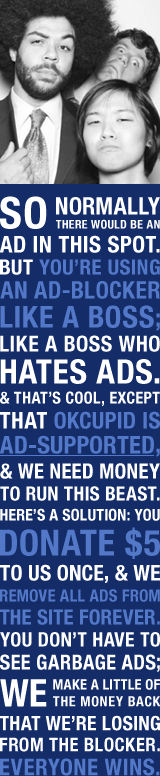
Several companies experiment with those kinds of revenue stream: OkCupid shows you this [1] banner encouraging you to pay 5$ if you're using an ad blocker.
Reddit has the "gilding" concept. While I don't know if that pays out at the end of the day, I'd rather pay the site directly than having them to rely on distracting and sometimes malicious ads which load 3 embedded flash player objects and destroy the site's performance.
By relying on ads, sites naturally introduced a terrible usability. Notice how many times you encounter a complete page reload where a simple AJAX call would have done the job better? That's because you sell a certain number of page impressions to advertisers, and the sooner they're used up, the sooner you get paid. The complete system is a mess.
> On your commute, you're passing a McDonald's store every day. You know it's there, but you never buy food there for whatever reason. Are you stealing?
That analogy doesn't work very well in this context. A more realistic example would if they were giving away cookies in exchange of you getting inside and see their advertising and one friends of yours gets inside and take several cookies so you and your other friends don't have see the ads.
It wouldn't be stealing because the cookies are "free" but still you might feel like taking advantage.
I am agree with you and I would rather pay for the site but many people won't and that's exactly why several content providing are having troubles with ad-blockers.
If you want a physical cookie analogy, its more like going to a real estate open house knowing you have no interest whatsoever in buying that house, yet still eating a free cookie. You walk in, the house reeks of cat pee, no Fing way, but those are tasty looking cookies...
I wouldn't break into your house and steal your cookies, but if you put up signs all over advertising your open house with free cookies, if you twist my arm enough I'll cave in and show up and eat a cookie. Just don't be annoyed at me when I don't buy the house. Practically no one purchases, anyway.
> Just don't be annoyed at me when I don't buy the house. Practically no one purchases, anyway.
Exactly my point... just are just taking advantage of the "free content". And everybody go for the cookies. Then they will be stop offering cookies (even though there were really good cookies)
I've never purchased through an online ad, I don't have any disposable income. If you don't want me to visit your site then you're welcome to paywall it - but I'm saving resources by blocking ad loading. If you put content on a website then you put it there free, that's the ethos of the web, I do it too - you're welcome to put up adverts of course but there's no contract between us that necessitates my consumption of those ads.
If you want to block those using adblockers then it's possible, any indication that those with adblockers are unwelcome will certainly be respected by me; I'll just find another source, maybe Google's cache. Oh, you don't want Google to cache your site, well you know what to do, it's easy to prevent.
Personally I started with adblockers when ads went dynamic, motion distracts my eye too much and means I can't read the content. In-your-face-ads make me determined not to buy from those companies - most of which don't sell in my country anyway, it seems.
If Adblocking is stealing then so is shutting your eyes during ads at a cinema, or going to the toilet in a broadcast-TV advert break, or looking at an amusing billboard without checking who the advertising company is, ....
Not even close to it. You could say the opposite, in that some of these more obtrusive ads are stealing from the business they are supposed to be advertising with. Many times a small banner ad can inline flash objects, all kinds of mess to take over real-estate on a site, and the owner may not even know it. Then, an ad collects usage data on you, and sells it, without your consent, or worse?
And you say people with ad blockers have no integrity?
Content producers whose stream of income comes from ads.
I don't use an ad blocker. It's a form of piracy like torrents are. Getting content without paying. I'm also a content producer and i know it really hurts the already weak sustainability of content websites.
Considering the Veronica Mars movie[1] hit 5MUSD funding, I wonder what it would take for a subscriber-only Dr. Dobbs journal to hit 3M with the premier tier being a one year subscription? At 10 USD/month, that's 25 000 backers?
[Edit: I forgot a big thank you! I still remember reading the article on red-black trees in my teens. Took me many years to realize the significance - but we learn best by streching up, to that which is just out of reach.]
>Dr. Dobb's, we had close to $3 million in revenue, almost all of it from advertising
Is that actual quote from the site? Since now it just says: "Dr. Dobb's, we had healthy profits and revenue, almost all of it from advertising"
I'm just curious how they would manage to spend $3 MILLION in 4 years and how it wouldn't be profitable to run a website that was ONLY $1 million revenue.
I've never even heard of the site until now, so I have no idea what they are doing, but it really seems odd that money was an issue if you are raking in millions.
It's mostly before my time, but they used to be a prominent tech journal, started in the late 70s and were fairly popular in the 90s.
In my head I picture them as a small company, not just "some website". $1m in revenue doesn't make for a very large company. I'm curious how they morphed in size over time and what their expenses were.
$1 million per year is plenty to just keep a website online. It's not that much if you also want to pay people a decent wage to produce world class content to put on the site.
I'm guessing the choices they faced was between a slow multi-year slide along:
and simply seeing the writing on the wall and calling it quits before they hit rock bottom. I guess a third option would be to take The New Republic route and throw out everything the current audience loved about the magazine and try to create a new, entirely different product, with the same name but focusing a potentially more profitable market. But I respecting for not wanting to go that route either.
Jeez, I'd be pretty happy with $1 million in revenue.
I guess if that doesn't cover the expenses to create the kind of content that gets you $1 million in revenue, then the numbers are wrong, but I find that hard to believe.
We paid our authors, columnists, and bloggers. And paid a staff of 2.5 full-time employees and a salesperson. Add benefits, insurance, rent, hosting costs, and taxes--and you're not looking at a lot of profit left over.
That's the sad thing: you're saying that it still turns a net profit after paying all of its staff and costs, and yet that's apparently not enough to keep it running.
Personally I would do like RailsCasts.com and ThatGuyWithTheGlasses.com (now ChannelAwesome.com), two sites I frequent, did... offer pro accounts.
Pro accounts could:
1) remove all advertising from the site.
2) have access to content early like drafts of upcoming articles
3) have access to revised or updates to articles
4) allow people to recommend articles
the list could go on, you'll probably think of a thousand things that I couldn't since I'm not in marketing.
At first, I was wondering why not just sell the business?
Who knows, you might have tried? After thinking about it some more,
since it's your baby--why take the chance of letting some
with more money than taste/knowlege blow it up? I understand your
decision to close it down. I hope you keep talking about
the efficacy of Internet advertising--the real truth. I'll
follow you on Twitter.


Why would a well-known site be sunset by its owner? In one word, revenue. Four years ago, when I came to Dr. Dobb's, we had close to $3 million in revenue, almost all of it from advertising. Despite our excellent growth on the editorial side, our revenue declined such that today it's barely 30% of what it was when I started.
A friend of mine's small business observed almost this same phenomenon. Can you elaborate why revenue has declined, even though page views have continued to grow? Is advertising fundamentally changing, and page views are no longer nearly as valuable as they once were? Or is it specifically because of Dr. Dobbs' context as a software dev news/blog site?
In particular, click fraud seems to be stinging my friend's business, but I assume it's not something that simple for Dr. Dobbs. Also, apologies if this sounds stupid. I don't have a background in advertising or marketing, but I find the subject fascinating and have been trying to learn about it.
EDIT: The next part addresses this:
This is because in the last 18 months, there has been a marked shift in how vendors value website advertising. They've come to realize that website ads tend to be less effective than they once were.
What I'm asking is, in what ways has the landscape changed?
EDIT 2: Thank you for Dr. Dobbs. It's been wonderful over the years, and I'm sad to see it go.