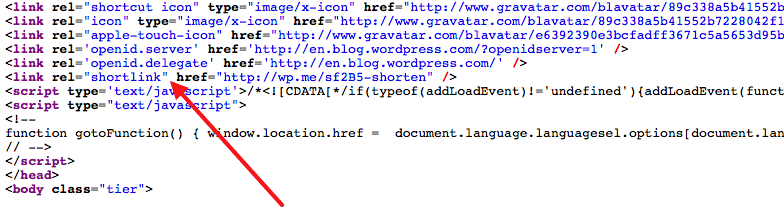
Correct me if I'm wrong, but the way I read this is on any page I own I would have to define a short url for it in the head section of the html.
So with this standard no one could short link to a site I control without me going through and making up a short link for every page.
In addition to that, this standard assumes that your url is somewhat short and not something like "thelongesturlintheworld.com" in which case it wouldn't help at all.
Twitter needs to just make it's own URL shortening service and put an end to all this.
Correct, you'd need to add it to each page, but that shouldn't be a huge deal these days unless you just have tons of static html pages on your site. If your site uses some kind of templating system (Wordpress, ASP.NET Master Pages, Smarty, etc.) you should be able to dynamically add the shortened link into the document header without too much trouble.
I understand that it's not a huge deal, but that's not really the point. Do we really need to update every page on the internet with a short url? Just in case it gets linked on twitter or a shorter version is needed for some reason?
The idea isn't that every page will define its own URL. The idea is that some pages will, and things-that-shorten-URLs should then use their preference in shorter URL when linking to them. For all other pages regular URL shorteners like tinyurl and bit.ly can be used just as they are now.
Consider it in a different light -- you're running your own url shortener on the same server that the content is on. This helps to avoid "linkrot" caused by unavailable/disappearing url shorteners.
If this isn't a concern for you, don't provide this service. People will continue using other shorteners that are susceptible to these problems.
If you support shortening, you reduce a dependency. You can still use tinyurl or bit.ly or whatever in this model, but if you don't, it'll be done for you.
They basically have. It's called bit.ly (which is the official/default URL shortener and whose servers are housed in Twitter's data center). For all intents and purposes, Bit.ly is Twitter's own URL shortener.
But not every Twitter client and site uses Bit.ly (HootSuite uses ow.ly, for example, and Digg uses, well, digg.com). And, you know, not every short URL is made for Twitter.
(Note: this isn't supposed to be a response to the original post, which I only skimmed.)
Short URLs aren't just about twitter. URL shortening is useful in a variety of situations, and tinyurl was widely used for years before twitter came along.
In addition to space constrained applications such as SMS (and artificially space constrained applications like Twitter) shortlinks are also required anywhere humans are required to remember and/or enter them - that is, when they are printed, recited over radio or displayed on televisions. This is a very important use case that people often ignore.


So with this standard no one could short link to a site I control without me going through and making up a short link for every page.
In addition to that, this standard assumes that your url is somewhat short and not something like "thelongesturlintheworld.com" in which case it wouldn't help at all.
Twitter needs to just make it's own URL shortening service and put an end to all this.