I live near Carmel, Indiana, the roundabout capital of the US. Small ones, large ones, figure 8's, figure... double-peanut-looking things with elevated crossovers near interstate junctions. They work well and keep traffic moving.
But there is a learning curve. Every new roundabout causes a significant jump in crashes for a short time. Though, those crashes tend to be "glancing blows" that cause less serious injuries due to the angle of attack imposes by the roundabout.
Smaller cities and towns in Indiana are adopting more roundabouts near congested areas. It's important to introduce them gradually and give drivers time to acclimate.
I'm near Carmel too. I remember when the roundabouts started going in. They replaced four-way stops that backed up for miles at rush hour. The roundabouts made traffic flow SO much better.
Now Carmel is replacing some stoplights with roundabouts. This man's opinion is that they are not always better. But so far, they've never been worse.
They absolutely suck when a train of cars forms and you can't enter the loop. Those are the dumbest roundabouts in the country. They don't adequately force cars to slow down enough to let gaps develop in the flow.
I'm not sure that slowing the cars down would help more. Its much easier to drive literally right behind a car at a slower speed than a higher speed.
Afaik, the general trend is to put a stoplight going into the roundabout for the few directions that cause a problem so that the "side streets" get a chance to go.
The other stupid thing about Carmel roundabouts is where they put them at every 3rd road crossing when it would have worked absolutely fine just to have the traffic going one way stop, because it's a neighborhood with thoroughfares and cross streets, and there is NEVER traffic on the cross streets.
It just makes the thoroughfares slower for no clear reason.
A failing activity I've seen with roundabouts is when there is no physical barrier but instead just a bump in the road that everyone is supposed to go around. In those cases, a LOT of people end up treating the round about like a 4 way intersection with the worst of all world (because you don't know if someone is going to go against the roundabout rules to turn left).
There HAS to be a lump big enough to cause someone to go the right way around.
Ours typically have a bit in the middle that's usually grass behind a curb, then a lower raised bit with a bevelled curb that's all concrete surrounding that, or else just an area around the center-grassy-bit that's even with the rest of the pavement but marked off with "don't drive here" stripes. The ordinary lanes are outside both.
I assume those are affordances so buses (say, school buses), trucks towing trailers, and stuff like that, can actually use the roundabouts. They'd be damn tricky for them to navigate, otherwise.
Kinda off topic, but this reminds me of a racing game I played which had a track that featured a roundabout with a bump just perfect for Dukes of Hazarding it.
So ideally the roundabout also doesn't encourage sweet jumps. (Unless there's a very well-designed designated landing spot that prevents damage to the vehicle. Probably tax dollars can be spent on better things.)
All anecdotal but hey: The roundabouts I've seen fail (we have many) are those with not enough and too much obstruction. The versions with some form of gradual grace (curved edges around a center platform or lots of grass and a bump) tend to work best. One of the worst ones was a very large one with a meter high round wall as center barrier which caused lots of damage to those who made a mistake. The too small ones are just intersections with minor obstacles to navigate.
Tall stuff impedes vision. The gental slope around tends to be accommodating for tractor trailers. Short stuff, even just a regular curb inside of the sloped area should be enough to stop cars from driving through it. Some short flowers or plants can help draw attention.
That's only potentially true with very large circles. Small round abouts are so small that you want to be able to see obstacles before you even get to the point of preparing merging.
> I live near Carmel, Indiana, the roundabout capital of the US. Small ones, large ones, figure 8's, figure... double-peanut-looking things with elevated crossovers near interstate junctions. They work well and keep traffic moving.
But there is a learning curve. Every new roundabout causes a significant jump in crashes for a short time. Though, those crashes tend to be "glancing blows" that cause less serious injuries due to the angle of attack imposes by the roundabout.
I have a reason to visit Indiana now! Cool. I wonder how I can sell the family on a trip to Carmel or similar city :).
The town I grew up started adopting roundabouts as I started driving. They're awesome and so much faster than red lights! They annoy my older relatives and coworkers as well.
Carmel is basically a suburb of Indianapolis, and all kinds of things happen at the Indianapolis Convention Center. Surely you can sell your family on one of them!
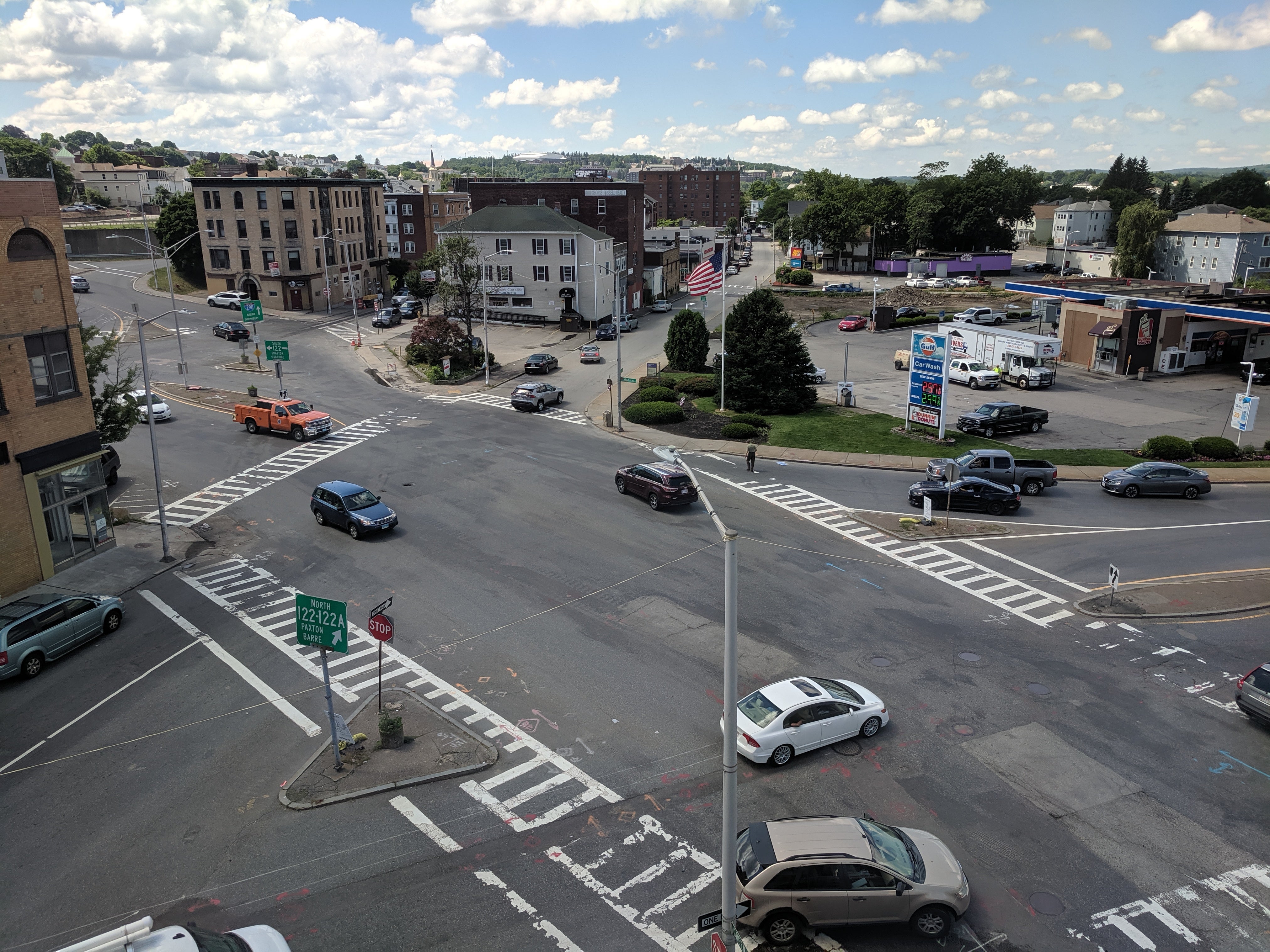
Adding some sort of pseudo-rotary has made Worcester, Massachusetts's Kelley Square go from Massachusetts's most dangerous intersection down to its eighth most dangerous intersection lol
Somehow still never had any traffic lights at any point.
It looks like they reconfigured the intersection into a roundabout, which eliminated the weird geometry of the previous design and reduced the options available to drivers to just entering and exiting roundabout.
Traffic lights aren't the main problem: four way intersections are.
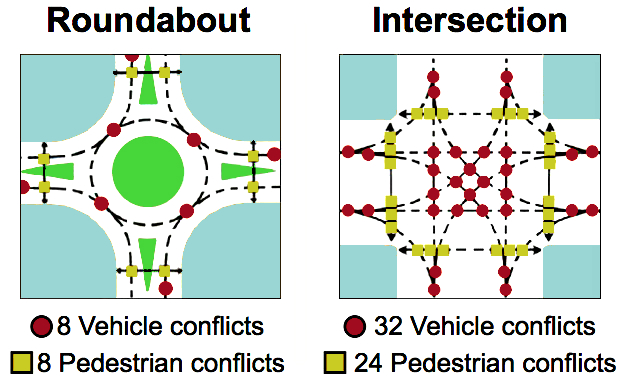
Roundabouts, offset T-intersections and grade separation all make traffic safer by removing conflict points - it's not the removal of traffic lights that improves the safety. Four way intersections put traffic directly on collision paths at high speed, meaning if anyone makes an error (missing the light or otherwise), you have an awful crash.
It's relatively rare in the UK to have four way stops or high speed four way signal controlled intersections. One of the weird things about driving in the US for me was the prevalence of both of those things.
This the most salient point to me, it is absolutely unbelievable to me that the US continues to use four-way intersections despite the huge risk, loss of life and suffering they cause.
They are exceptionally rare in Australia too, if they do exist it is only on a road with a speed limit of 60km/h (at least in my region).
Coincidentally, where I live is known for its many many roundabouts and not only are they safer but they also offer superior cross-way throughput when traffic is heavy. And they allow the "middle" of the intersection to store a chunk of traffic who are protected from full speed impacts while still letting vehicles flow slowly through the perpendicular axis.
I live in Australia too and while roundabouts are OK for low to medium sized road and even larger roads with even traffic they absolutely do not work for heavy and uneven traffic. I have seen a number of large roundabouts become a congestion point once the traffic became heavy and mostly coming from one or two directions. Once they converted those roundabouts to intersections with traffic lights, the congestion eased significantly.
So, roundabouts can work but not in all instances.
Yes, this is one of the few areas that traffic lights excel. I’ve been stuck for 20-30 minutes at a small roundabout in Poland where two highways intersect in a rural area simply because of heavy traffic.
US could stand to gain massively by replacing about 90% of their intersections with roundabouts - but the remaining 10% could probably stay lights and everyone would win.
I grew up near Skelmersdale which is a ‘new town’ built in the 60’s without traffic lights, all roundabouts. Traffic is segregated from pedestrians using underpasses and footpaths don’t follow roads generally.
Some aspects of it work well. It’s pleasing and efficient not to have to stop much when you’re getting places.
The underpasses have become magnets for anti social behaviour though.
The mistake is that the cars should use the subways/underpasses since they are inherently antisocial already. The antisocial types can then all hang out together.
How does that work for bicycles? As a cyclist most roundabouts are OK but busy multi-lane ones can be pretty terrifying if you need to turn against the traffic flow (i.e., taking the 3rd exit, right for me, but left if in the US or any country you drive/ride on the right side of the road). I've yet to see a decent solution to that.
The best answer is a completely separate bikeway that crosses outside the roundabout, or passes over/under the road.
But, if that's not possible, the bike is either acting like another car (in the roundabout) or a pedestrian (crossing several entry/exit points). Less than ideal, but still better than getting t-boned at >30kph as happens at 4-way stops in the US.
Here's an example, but it relies on drivers yeilding to cyclists (they're supposed to but usually don't in the US, regardless of intersection and signage).
https://www.youtube.com/watch?v=wEXD0guLQY0
Yeah even that Netherlands one (which is only possible if there's a lot of space available) relies way too much on drivers actually bothering to look out for bikes. I'd rather have traffic lights to be honest.
One of the large benefits of roundabouts is the reduction in serious crashes. 90% reduction in deaths, 76% reduction in injuries, and 35% reduction in all crashes. [1]
1) Cars need to slow down to go through the roundabout safely, 2) If there is an accident it is more of a side-swipe type accident than a t-bone or head-on accident.
But as others have said they aren't the best solution for all situations but they could be used a magnitude more than they currently are here in the U.S.
I'm from New Zealand where we have lots of roundabouts. My observation is that they work well, even with heavy traffic except some unbalanced conditions that can happen at rush hours.
Imagine this. Driving on the right.
Roundabout with four exits. North, East, South, West.
Heavy streams of traffic entering from north and west.
Most traffic exits at east therefore nothing to slow north enterers.
West enterers hopefully get the breaks in north entering traffic.
Trying to enter from south is really difficult because north and west enterers keep it full.
Im from a chunk of Australia known for a tonne of roundabouts and observed the same issue. My theory is that this is actually roundabouts working as intended, despite the frustration of the South-Enterers.
Basically, if the flow of traffic is both moving too fast and with too great a vehicle density to allow for safe entry (even if slow, like 1 SouthBound Vehicle for 5x Northbound + 5x Westbound) then the traffic organism is actually distributing resources based on need, rather than convenience.
The flow WILL automatically correct itself as the population of vehicles diminishes, the question is if the WAIT time for Southbounders (and the population of Southbounders) is sufficiently large that interfering with their flow is actually delaying more people than the North and West routes, but that is more of an issue of roundabout placement than it is the roundabout itself being inefficient.
(^^The above is all 100% observation and guesswork, anyone with some education on the matter want to chime in?)
It's a good load balancer for sure, but that doesn't help the poor sod who is in the minority who has to wait for ages simply for not needing to go the same direction as the majority.
I have seen a few roundabouts with metering traffic lights that are only enabled during peak traffic times to occasionally allow the “blocked” directions in. It seems to be a reasonable compromise.
Yes. We should start everywhere with turning them off and introducing four way stops. Then re-assess which intersections need that light, or need a roundabout.
Traffic lights invite aggressive driving because drivers want to make it through the green (or orange) light. Basically, drivers end up accelerating into the intersection, rather than slowing down and be more careful. It's the _exact_ opposite of what should happen.
Traffic lights are the result of a misplaced obsession with efficiency and high technology. The idea we can perfectly manage complex systems (very mid 20th century mindset). We need a value shift. Safety is more important than speed.
Came here to comment this. I've seen two-lane stop signs and if you imagine traffic on all four sides, just think of the number of other drivers you have to coordinate with if nobody is sure who has the right of way.
I've also seen two lane roundabouts which aren't bad, but now there are roundabouts where you go from two to one, or two to three lanes driving inside the roundabout! Definitely safer than stop signs but the most un-intuitive intersection for new drivers.
mostly agree but as other posters have mentioned I would imagine that any crashes that occur in in mulit-lane 4-ways are likely to be less severe/likely to injure people.
Traffic is easily modeled as buffers and context switching. As traffic flows through an intersection, the buffer for that direction drains. When it switches, there is a penalty to context switch (the traffic must come to a stop, some traffic must finish through the intersection). The perpendicular buffer (which has been filling), requires the intersection to clear completely before proceeding. Then its buffer can empty.
4-way stop signs introduce context switching for every car (the intersection must clear before proceeding) and you must stop every intersection, buffer stalls.
Round-abouts ensure more rapid context switching (only wait for the car to your left to clear), no waiting for an empty buffer to continue to be empty, and fewer buffers per intersection (think left turn buffer, right turn buffer).
That's exactly what I said. Traffic lights for governing car traffic are the result of a modernist obsession with efficiency; in this case a pre-occupation with car travel speeds, throughput, ... as if these are the only things that matter. I gather you view that as a positive, but I see it as a very impoverished monomaniacal mindset. That technocratic value system has poisoned (literally and figuratively) the public realm. We need less of it.
travel speeds and throughput aren't necessarily related. Recall that car spacing is usually instructed to be "2s". the throughput is 1 car/2s. thats regardless of speed. Speed dictates the length of the yellow light, often about 1s for every 10mph, but the actual throughput is the same regardless of speed.
Efficiency, well... Sometimes / somewhere they seem set up to maximize driving time and pollution by turning the next light to red when one has just gone green. I wish they could use computer vision to turn traffic lights to red only when two cars approach the intersection from perpendicular directions.
Around here, typical light cycles are 2-3 minutes, and intersections often sit idle for 60+ seconds. When there are power outages, and the lights switch to four way stop mode (blinking red), traffic usually improves. Also, the California state government has basically mandated programs that intentionally increase congestion.
They call it traffic quiescing, or say they want to reduce commute miles driven per year. No, they aren't providing meaningful improvements to public transit or bike safety.
No. Phased out over time in some places maybe, not abolished. Implemented in some new developments, absolutely.
While roundabouts can work more efficiently they require the roads and traffic usage patterns to accommodate them. Additionally existing intersections designed for lights and putting in roundabouts would require cities in many cases to use eminent domain to acquire the land around them or to buy out land/properties from people. The excessive use of eminent domain would lead to endless legal battles that would deplete city budgets.
Some existing large intersections could be retrofitted for a roundabout and some small cities are in fact doing this. I've also witnessed this occurring in rural areas that have intersecting highways where the state already owns the land around the highways. This reduces brake dust, engine brake noise and keeps freight moving.
The UK "mini-roundabout" does not take up additional space.
Roundabouts work best when the traffic is below a certain critical level; above that and you're still stuck for ages except with no automated system trying to bring "fairness". In some cases this can be solved by .. adding traffic lights to the roundabout.
> The UK "mini-roundabout" does not take up additional space.
There are plenty of small intersections with traffic lights that aren't any wider than two opposite lanes with no median and no shoulder, only big enough for two vehicles to pass in opposite directions. They would need to be expanded to put a circle of any size in the middle, especially if a big truck was expected to make it through safely.
A mini-roundabout is a centre circle painted (not curbed), plus the priority rules (give way to your right - would be your left in the US).
They don't take up any extra space, but they do probably require drivers to intuitively understand the concept and priorities before they can be introduced.
That definitely takes up extra space. Notice all the room between the lanes. In many places in the US, you don't have even that. The intersection is literally only wide enough for two cars to go past each other, and _any_ amount of space taken up in the center means you need to widen the road.
Here's another one from Scotland. They don't have to take extra space. The version shown above only has extra space because they installed pedestrian islands - a nice touch but not required in many intersections.
Additionally, there is frequently extra space in the existing intersection. From parking lanes, shoulders, etc.
This is a much better example, thanks. That does indeed look like it doesn't really take up any more room -- the painted roundabout mostly seems to serve as a reminder of the yield order that people should take. In a way, its almost like a yield-controlled intersection here in the US. Those work relatively well as long as everyone follows the rules. In many places, this would just be inviting aggressive drivers to blow through intersections.
Worth noting this particular roundabout is in a small farming town on the edge of the highlands. Already slow speed road and low volume. But, shows that many 4-way stops within the US suburbs could easily be swapped with a roundabout during normal road repaving without much additional cost (yield signs to replace stops, some paint).
Yeah... I don't think those will work in the US until roundabouts are a lot more common.
The issue I've seen with them in the US is many US drivers ignore pretty much everything about the painted circle which creates a really dangerous situation. They treat those intersections like 4 way stops (including driving over the circle) and that's a major problem.
You're still supposed to drive around the circle though, right? Or am I misunderstanding?
That intersection you showed is clearly big enough. This one doesn't look big enough. Or is it? There are smaller intersections than this one, also. (And I realized that this one might be a bad example because it's not four directions.)
At some intersections in the UK, the roundabout is literally a small circle of paint. The car doesn't really go "around" it because it's so small. It mostly exists as a visual cue that the intersection follows roundabout rules.
Ok, I was working under the impression that one must drive around the circle. If that requirement isn't there and it just changes how we work out who goes when then I can see that expansion wouldn't be necessary.
The north and south exits to the roundabout are 10.5m across, including the traffic islands; the west exit is 5m across. The 4-way junction you've linked to, the exits are 9.5-11 meters across.
Yes, they recently rebuilt a large roundabout here - it connects two busiest roads in town - it was nerve-wracking to enter on a motorcycle before. Now they rebuilt it with trafic lights and a straight lane underpass for the main road and it's much more pleasant.
At the same time, I took "abolish traffic lights" as a North Star for future design as well as making changes to existing infrastructure where economically and physically feasible (i.e. stay practical). Not rip out all traffic lights everywhere and replace them with roundabouts or rotaries, as the case might be.
My city has been going roundabout happy over the past few years. One issue they've had to contend with is existing intersections in congested urban areas don't have enough space to replace with a roundabout. Therefore it's been primarily the suburban areas that have been able to implement them.
And then you get roundabouts with traffic lights like in the UK. I'm sure there are good reasons for that, but, as someone that hardly drives in the UK, I was very very surprised the first time I encountered them.
You generally get these when the roundabout has one or more clear 'through traffic' routes, to the point that you're always 'giving way to the right' and not able to enter the roundabout.
If you imagine traffic on a motorway going North/South and an A-road running East-West, at busy times, the traffic going from East to West and West to East will be significant enough that traffic coming off the motorway is not able to find enough space to enter the roundabout (or, not enough to meet the demand). Without traffic lights, traffic will soon back up down the slip road onto the motorway, or worse, will try to force its way onto the roundabout instead of giving way to the right.
Or some arrangement of flyovers, ramps, etc (double diamond interchange being the current flavor of the month here in the US mid-Atlantic). Obviously, only makes sense for actual motorways, not going to get one in mid-town London, hopefully.
In addition, in areas with very high traffic, like London, area-coordinated adaptive traffic light systems (see SCOOT/SCATS) are used to keep traffic flowing smoothly, stop congestion from blocking junctions, prioritise emergency services and more. These systems are very good at what they do.
Traffic lights are also used to give priority to pedestrians and cyclists on junctions where it would be unsafe to rely on zebra crossings or pedestrian priority - think sharp and low visibility corners.
As far as roundabouts go, the UK has been replacing big multi-lane roundabouts in areas with lots of pedestrians and cyclists with two-way-traffic horse shoes (e.g. Old Street and E&C, plus others outside of London). This allows the centre of the roundabout to be used as public space, and has been found to be safer for vulnerable road users.
I'm all for light-free junctions where possible, and light-free roundabouts work REALLY well in low/medium traffic. But you can't just abolish traffic lights - unless we also abolish cars at the same time.
Do you have a link to one of these "two-way horse shoes" on Google maps or similar?
I'm curious how they solve the problem of needing to taking the 3rd exit on a multi-lane roundabout while on a bicycle.
Look up the Old Street roundabout and Elephant and Castle Roundabout.
The essence of of is segregated cycle lanes with cycle-only traffic lights. Nothing magic.
Neither of them are fully separated (yet at least - they're still being worked on), but they're a lot better than what came before.
Trafalgar Square also used to be a roundabout back in the day, though it got converted to a peninsula before bicycles were fashionable so that's not a great example.
Highbury Corner is another example you can look at.
Pretty simple. The section of road between 3rd exit and the 4th (which is also where you enter) is completely removed.
So taking the 3rd exit on a bike either means following the road all the way around, or just going directly from the entrance to the 3rd exit, as cycle lane is usually preserved where the road used to be.
I looked at that E&C "horseshoe" - it still looks hairy if you're riding north on the A3 and want to turn right into the A201, given the number of crossings of busy roads with no traffic signals. But better than some of the busy 3-lane roundabouts I've had to navigate here with no provision for bicycles (or pedestrians really) at all.
Every junction on the E&C horseshoe if traffic light controlled, including all the cycle crossings.
The safest route for bikes is to take the segregated bike route at the bottom of the horseshoe, then using the mixed bike and pedestrian crossing to go directly over the mixed used paved area, then use the mixed crossing on the other side to join the A201. Either that, or use the segregated cycle path, then horseshoe near London Rd.
But honestly, on a bike you would just avoid the horseshoe completely. There’s usually better cycle routes that are more direct, and avoid large junctions like the E&C horseshoe.
When traffic is light, traffic lights make you wait a long time for no reason. When traffic is heavy they add insult to injury by taking 2 or 3 cycles to clear out the stack of traffic you're waiting in -- and that's just the immediate intersection, frequently traffic stacks up to the point that traffic flow is impaired in preceding intersections. That's how traffic lights turn a 5 minute drive into a 50 minute drive.
Only if you have idiots for traffic planning. By now you can have sensors that detects vehycles on lanes and change it depending on the situation.
only two lanes are in use: permanent green until a car on the other lanes come.
We are definitely stuck with idiots for local traffic planning. And those clever sensors - there is a huge difference between (A) a traffic light checking that Feature Box in PowerPoint (or Flash, or Microsoft Bob, or whatever software the local traffic planners use), and (B) traffic sensor technology being usefully implemented at the light's real-world location.
I've see a lot of sensor failure modes which that algorithm would handle poorly - complete failure, failure to notice small/light vehicles (especially motorcycles / scooters / bikes), mis-reading which lane a vehicle is in, ...
I've also seen fancy sensor-equipped traffic lights where the traffic flow was improved by a power outage turning the intersection into a (legal default) 4-way stop. Major intersections. During rush hour.
> I've also seen fancy sensor-equipped traffic lights where the traffic flow was improved by a power outage turning the intersection into a (legal default) 4-way stop. Major intersections. During rush hour.
That fits one of the main points made in this article: traffic lights slow down traffic. Another one is that decreasing speed on intersections increases safety.
The magic of roundabouts is that they accomplish the latter without needing the former.
There is one of these on a backroad near me. I wish the sensor were farther away from the intersection so I wouldn't have to come to a complete stop just as it turns green.
The general traffic is probably 95% favored to the direction I am going, and I really wish they would just leave it green until the other direction actually needs it.
Maybe they have it this way on purpose to indirectly prevent speeding? I wonder if that's a consideration for traffic light logic or not
When traffic is light (e.g. at night), the traffic light can be scheduled to blink red in all directions. Then it is treated like a simple stop-sign intersection.
The Netherlands is stuffed with these things. The amount of traffic lights I have to go trough to get to work is: 1. This is a 30km trip from town to town.
The only part of my route that I always have to stop, is the traffic light. Roundabouts are awesome. Our complete infrastructure is pretty awesome to be honest. Other countries could learn.
I've discovered the game Mini Motorways on Apple Arcade recently and this has opened my eyes to how much more efficient roundabouts are in traffic management :) I've been enjoying the game a lot! It's a very enjoyable thought experiment made into a game. If you haven't tried it, I'd recommend it.
The thing that's happening right now is that many large cities have more or less enabled the possibility of carless transport. Cycling is now completely viable and even better, costco has a foldable ebike for like $400. Weather sucks? Work from home instead. Gotta go? Taxis and buses exist. What do you pay in car insurance? $1000/year? How many trips in the bus is that? Many! You also dont pay for parking anymore. Cycling is great exercise burning fat instead of money. It's a huge net benefit to society which is 70% overweight. National wealth will certainly increase.
Which brings me to traffic lights. Cyclists already don't obey them. Why don't we just abolish them? Traffic lights function just fine when they go out or blink red.
If stop signs replacing all traffic lights is an inconvenience for cars... might I recommend a bike?
Why do anti-car people not seem to understand that people don't want to ride a bike everywhere? You can't just tell someone to completely change their lifestyle to avoid potential problems, and then act like they are the insane ones for not wanting to listen. I want a car. I like my car. Demanding that people give up their ability to get in a car and drive somewhere so that all of America's infrastructure can be changed is insanity.
>The thing that's happening right now is that many large cities have more or less enabled the possibility of carless transport.
I actually like to leave the cities I live in sometimes. Or maybe I don't live in a city, and I want to visit it with my car.
The issue is that cars do not scale well. It's like running a tech company where IT manually triages every single ticket, with no self-service system: after a certain point, you just can't scale it up. Think of public transit, walking, cycling, scooters, etc. as the real-world transportation equivalent of automation. Cars take up a massive amount of space for a single person and dump tons of CO2, pollutants, and noise into their surroundings. And they routinely kill and/or maim people.
It's fine to own a car, park it in your garage space in a city, and use it to drive out of the city from time to time. It isn't OK for cars to dominate 50% of the space in modern American cities for roads, free street parking, and parking lots. Particularly because it comes at the expense of space that could be used for more scalable transportation solutions.
> Or maybe I don't live in a city, and I want to visit it with my car.
Sure, feel free to drive to the other city by car. But in a more scalable world without hellish traffic, you'll have to get around on foot, by bike/scooter, or using public transit in the city. Because cars aren't scalable.
> It isn't OK for cars to dominate 50% of the space in modern American cities for roads, free street parking, and parking lots. Particularly because it comes at the expense of space that could be used for more scalable transportation solutions.
50% sounds extremely generous. There are 8 parking spots per car and one car per person which is around 350m^2 of area per person (some portion of which is stacked).
This is one median lot per household on parking alone.
Because anti-car people understand that it is absurd to (mainly in cities) sacrifice so much space, environment, and health to accommodate car people's laziness. People living in the city have to sacrifice clean air to support the suburban car commutes. This is absurd. Many car-minded people are simply to lazy to take alternative modes of transportation, even if they exist and are really well implemented (as they are in most European cities).
The Netherlands does this properly. But as a European having traveled to the USA it is mind boggling how car centric cities are. With all the inefficient and extremely costing infrastructure investments car centric cities require.
A solution for people like you would be to park your car near the city borders and take public transport. But I don't know a single car owner who isn't too lazy to just drive straight into the city.
Having designed our cities around the car will be really frowned upon in the future. It's crazy how much people who use alternative modes of transportation sacrifice (in tax and health) to support this.
I live in central valley, California. When I want to visit downtown san Francisco, or SFO Airport, 99% of the times I park at first Bart Station, and use Bart from there. The only time I go not is if I am picking a couple of family with lots of luggage.
So, now you know a car driver who drives about 16k miles a year, and also is not lazy enough to park at city borders & use public transport. & Bart Parking is almost always 60+% full.
Empirically, most people care more about making the trip efficiently then how exactly it's done. If all those people are motivated to not use cars, think of how much less traffic there will be for everyone else? It turns out that bike and pedestrian friendly cities are also some of the most car friendly ones for this reason.
>Why do anti-car people not seem to understand that people don't want to ride a bike everywhere?
To be upfront, I'm a car guy. My last car had >700hp, currently a hot hatch. Soon I have to go dadmobile, vw camper id buzz... oh do tell me more.
My bike? I bought one of those huge/wide bike seats. My bike seat is worth more than my bike lol. I find it crazy there are people with ultra light carbon fiber sport bicycles about to be stolen any moment. Nobody stealing my piece of shit bike.
>You can't just tell someone to completely change their lifestyle to avoid potential problems, and then act like they are the insane ones for not wanting to listen.
Because of the boon on cycling. We suddenly have big lobbying and activism toward promoting cycling.
The thing is, don't just write off this factor. There's lots of good benefits to society if we all move to bikes and shared infrastructure to rental vehicles or transportation services.
>I want a car. I like my car. Demanding that people give up their ability to get in a car and drive somewhere so that all of America's infrastructure can be changed is insanity.
I don't think anyone is going to that extent to say you can't drive anymore.
>I actually like to leave the cities I live in sometimes. Or maybe I don't live in a city, and I want to visit it with my car.
Nobody is saying you cant drive. No politician will survive assassination if they banned cars.
There are ebikes with >100km electric range that can go 35km/h. Going to be hard to tell me that setup won't do what you want it to do.
Are you sure? A city that’s unwelcome to commuting workers, local visitors coming in for entertainment, shopping, dinners etc. may not be a city that the city dwellers want. Of course they’re welcome to discourage visitors however they want.
My city has throngs of people coming in via transit whenever there’s a major sporting event or concert. I know, I’ve shared trains with them many times. You don’t have to get there by car.
In my experience most are coming from nearby suburbs, not exurbs. While I might take the commuter rail in for a major sporting event or concert even if it might mean waiting around—or park at an outlying transit lot—It’s pretty impractical for most evening events and this is a major city with pretty good transportation options generally.
City residents can do whatever they want but I for one will simply not come in in general if it’s too big a hassle. And that’s fine. I have plenty of other things to do.
> City residents can do whatever they want but I for one will simply not come in in general if it’s too big a hassle. And that’s fine. I have plenty of other things to do.
Agreed, it is fine. As a city resident I would rather have fewer people coming in and a more walkable environment than more people coming in and streets clogged with cars. We should make sure the transit is excellent, but if some people don’t want to come in because they want to drive and it’s difficult, that’s fine! Too many people driving in makes the city an unpleasant place to be in.
Virtually every city in America destroyed itself in the pursuit of what you suggest: everyone will live out in Whiteville and they'll just drive downtown for culture, commerce, and employment. It didn't work. The freeways and parking lots cost too much, and the commuters don't pay enough taxes to balance it out.
And many don't mostly need to come downtown for commerce or employment any longer. And culture can be a handful of times a year. That's my situation. I rarely come into the nearest major city any longer. It's not that I don't come in but I'm very selective.
Well it sounds like we agree then. There's no reason for a city to hollow out its neighborhoods to make space for the cars of people who drive into town once a year.
The bike vision of the future features all of these tanned, lean people cycling everywhere (and even making turn signals with their hands, which happens so infrequently IRL that I generally note it at once a year), and I guess everyone else just hopes they don't get stabbed if they ride our quasi-subway.
I live in Victoria, Australia, and we’ve had roundabouts for ages. I think they are very good for a certain scale of road/traffic. Mostly intersections with moderate amounts of traffic on average, and not high-speed. e.g., the main intersections within housing estates. Having too many of them instead of give-way signs drive you a little batty (I’m looking at you, Warrnambool) while really heavy traffic, major intersections work better with traffic lights.
When teaching my kids to drive, they found roundabouts one of the trickier intersections to navigate. You have to read the traffic flow. This person about to enter on your right is going straight ahead, so will block you entering the roundabout[1], but they have to wait for that person coming the other way from you and going straight through, so you can slip in the gap that creates without cutting anyone else off. As with many things it is familiarity and practice that makes them work[2]. I think roundabouts work very well here for the most part. It’s not rocket science[3].
The science of roads and traffic I imagine is a surprisingly nuanced expertise involving a lot of physics and psychology. I find when I cross over the border to New South Wales I feel like a long-tailed cat in a room full of rocking chairs. I eventually figured out it was because the signage was a different distance before the intersection compared to my home state. Once I was aware I could adapt.
[1] We drive on the left side of the road because Australia is in the southern hemisphere.
[2] I bet the first traffic lights caused an uproar. “Why the hell should I stop just because there’s a red light?!”
By now designing and mass producing the smart traffic light should be possible for not too much extra beyond the cost of the dumb traffic light. A smart traffic light system could effectively eliminate most traffic. A traffic light that is aware of oncoming traffic or the absence of it will remove the annoying instances of being stopped at a traffic light when there is no cross traffic, or of remaining on a timed green waiting for traffic that isn't there. Some cars nearly drive themselves now. Everything has a computer in it, why not traffic lights and intersections? Why hasn't traffic light technology advanced beyond timers and switches in the road? They need to have eyes and decent logic built into them. Imagine the fuel/cost/carbon savings alone if we had these things widely installed 20 years ago.
Simple things fail less often, require less maintenance, and are less likely to be hacked. I'm not saying these concerns are the most important, but they deserve consideration.
These exist in many different generations (sensor-based traffic control devices) but as there are state and/or local certifications each solution and implementation must meet to be deployed, plus the additional cost of installing and periodically calibrating sensors, they are not warranted unless the situation calls for it. The inconvenience of waiting an extra minute at a minor cross-street doesn't usually cut it.
If you live where there is a light that causes disruption or accidents because it needs sensors based on the traffic flows nearby, you should bring it to the attention of your local government. At the very least you could get them to do a study on it.
In my area people complain about needing new lights all the time. They theorize that there would be fewer accidents if they put in a light at certain intersections. The real problem are the drivers. Almost all the accidents I see at those intersections are from people being impatient and making bad choices. Those same people are going to do the same stuff by trying to beat the light or make a right on red and screw up. We can try to make the road design better, bit the biggest benefit would be to address where the ultimate responsibility for safety lies - with the driver.
Yet the people will complain and get their new light, and we'll impose largely arbitrary restrictions on new drivers while letting the chronic crash causers slide and the people who would objectively fail better testing drive.
In what ways do we let "chronic crash causers slide"? What changes would meaningfully alter their behavior? I'd argue that most bad drivers know what they're supposed to do, and can be on their best behavior during a driving test, but don't care about anyone other than themselves. As soon as they can they'll start cutting people off, dangerously passing, running red lights, etc.
In the US, the penalties for crashing your car at this point is often being forced to buy a new car since even low speed accidents can total your vehicle, then you also have your insurance rates skyrocket, and you're often on the hook for a lawyer and showing up to court where you can face being responsible for hundreds of thousands in medical expenses. It's a pretty damn punishing system for people who cause accidents. I suspect that most people (alcoholics aside) are not going around getting into one car crash after another after another. It's just vast numbers of assholes each of which thinks it won't happen to them until it does.
I know a kid who totalled 3 cars before the end of high school and had one or two fender benders. Whether he was physically unable (ADHD) or actually knew what he was able to do but didn't, this is the type of person that shouldn't be on the road.
It can be as punishing as you say, but rarely is. People buy cheap used cars so it's not expensive as you might think. Basic liability insurance isn't crazy either. You'll rarely go to court unless you are uninsured. And insurance will typically cover medical expenses, and comprehensive will even help you buy a new car.
It would be pretty simple to revoke people's license if they cause more than one accident in 5 years.
I'd recommend driving classes/suspension before revocation on a second offense over 60 months, but at a certain point, I'd agree some people shouldn't be on the road.
A teenager who gets into repeated accidents is probably a good example of someone who'll probably turn out fine once they grow up a little, but something like ADHD could easily continue to be a problem if they don't get it addressed. I'm not sure if there are places where a person can be required to be medicated to drive (like some people are required to have glasses/contacts or supplemental oxygen anytime they are driving) but it wouldn't be a bad idea.
It'd be nice if the people installing roundabouts in the United States could stop their habit of splitting lanes of traffic into multiple lanes, each with different rules for which direction you can exit with about 20 feet of notice before you enter.
This is a feature, not a bug. Once you learn the general philosophy, you will be fine. For a 2-lane roundabout: Use right lane if you want to turn right. Use left lane if you want to turn left. Either lane is fine if you want to go straight.
It's like when you approach a traditional 4-way intersection, some of which add a left-turn-only lane and some of which add a right-turn-only lane: once you learn the general philosophy, you will be fine.
> It's like when you approach a traditional 4-way intersection, some of which add a left-turn-only lane and some of which add a right-turn-only lane: once you learn the general philosophy, you will be fine.
Those bug the shit out me to too. Sure, you get used to them quickly enough when you drive on those roads all the time, but everyone who hasn't encountered it has to figure it out and depending on how well marked it is even people familiar with the rules have to deal with confused people who haven't figured it out yet.
I especially hate those left-turn-only lanes which leaves people who could have turned right on red stuck behind people who just want to go straight. The people who want to go straight would have to wait for a green light anyway, so why not leave them stuck behind the left turners who also have to wait and let traffic flow for the people making right hand turns?
I agree with that. I used to be one of VERY, VERY few drivers that ever when straight at a certain intersection with a left turn only lane, and a straight and right turn lane. The other direction was bigger, and there was a relatively long wait for the light to change once a vehicle detection was triggered. I always felt bad for the people behind me because I was blocking from making a right on red.
It would have been so much better if it was a right only, and straight+left lane.
There is of course an exception to this. If there is a protected left turn cycle, then the left turn lane needs to be its own lane, but that was not the case at the intersection in question.
> For a 2-lane roundabout: Use right lane if you want to turn right. Use left lane if you want to turn left. Either lane is fine if you want to go straight.
This is simply not universally true. I've seen roundabouts with different lane routing assignments even within the same neighborhood. It's incredibly hostile to visitors.
All the roundabouts near me certainly have to already be known to use them. You can tell how many people are just passing through every time you use them as they hurriedly weave in and out of lanes
> could stop their habit of splitting lanes of traffic into multiple lanes
Even worse are the roundabouts that are wide enough for multiple lanes, but with no lane markers. Just kind of a circular flood of cars, with people on the inside suddenly realizing they need to get off, etc.
I find the traffic roundabouts a great solution for seattle residential streets. It allows a slow down through the neighborhood, a way to negotiate the four way intersections, and helps with the narrower than normal roads.
Roundabouts are great on back streets where you'd naturally be going slowly, and okay on the meeting point between two major roads, but in my extremely limited experience they don't work so well in the case where you have a major road (light would usually be green to let large amounts of traffic through) crossed by a street (light would usually be red, intermittently green for a few cars).
Perhaps in that case you're meant to use overpasses, or maybe the data says that roundabouts work fine, but they don't seem to.
If you’d like to simulate traffic light abolishment with no replacement, visit beautiful Denver, Colorado, where the sun is strong, the beer is cold, and the red lights are purely decorative.
I love how people say "abolished" so easily and don't realize the magnitude of change it would require. /aside
In any case, Arizona has a LOT of roundabouts. They take considerably more land so it would basically be impossible for the vast majority of existing in-city street corners. Arizona uses them more in rural/not yet developed areas. Definitely help speed up things, but I would say at this point, it will only be useful for new, very spread out cities.
California made a (tiny) push into roundabouts a couple of decades ago, but for some inexplicable reason usually pair them with stop signs. What's the point?
The only roundabouts I've seen in CA with stop signs are the big ones (like the "traffic circle" in Long Beach) where the roundabout is almost a street unto itself.
It works in some places. This intersection is way, way better to walk and cycle through since the traffic lights (and all signs!) were removed, and I have never seen cars stuck or delayed:
I am curious at what traffic levels roundabouts stop being more efficient. I know in Cities Skylines, the roundabouts will deadlock over a certain traffic level.
Like, would roundabouts work on the 4 lane roads that are always packed with traffic here in Los Angeles?
Roundabouts are best with a range of traffic from very sparse to intermittent. Always packed from all directions doesn't work because throughput is structurally limited and worst case wait time is infinite. It's kind of like a cloverleaf junction, very functional until you hit capacity limits, then not very functional.
In most of the Los Angeles area, there's not room to drastically expand intersections to build usable roundabouts, compressed roundabouts are even worse at throughput.
Multilane roundabouts exist, but they're tricky to navigate and would be tough to have high throughput for if most people want to continue traveling in the same direction after the intersection.
Doubtful. The roundabouts placed in some places in the IE still had people going the wrong way and just generally not understanding how they worked. You'd need to do education along with implementation for something like that to help.
Personally I doubt it would help traffic in any significant manner but who knows.
lol, roundabouts in Tokyo or Manhattan... imagine... a skyscraper in the middle... underground entrances to it... mechanicals on the ground floor because nobody wants to have cars coming straight at them...
I mean, if you want all your roundabouts to be demolished by semi trucks and other construction vehicles. And the price for the transportation of goods increased due to increased damage to trailers and the semi trucks themselves.
Personally, I love roundabouts. They're fun to drive around. But I have seen (and there's lots of reports about) semi tucks crawling over them at 5mph or less because they're all built too small to support a semi with a 50' trailer.
My vote is, once we eliminate the need for Semi trucks for deliveries in the city, sure. Roundabouts everywhere. But until then, let's keep infrastructure sane for all the users of it.
I suppose you could make the inner part something safe and non destructive to drive on but still uncomfortable so trucks could still make it through. Maybe Make rumble strips? Still have a structure in the very middle to prevent head on crashes though.
Most roundabouts have a very short skirt around the middle island thats like 10 feet wide just for this reason. Theres a curb so normal cars don't go on it, but it allows wide trailers to cut over them just fine.
They do indeed. And those still damage trailers and require semis to slow way down. The aprons also get damaged by the heavy trailers since they're not built to the same standards of roadways.
The automatic transmission should be abolished first. And all energetic cars should be in golf cart pedal mode.
Whether it's on the highway or around neighborhoods with speed bumps and pedxing, you see (and hear) cars speeding away only to endanger the next person at the next stop sign or traffic light, or car in front of them.
(I can "1 pedal drive" my manual down a hill in 2nd or 3rd, go a reasonable speed, automatically be slowing to go over a speed bump)
I have no idea with pedal driving is, but if you mean that traffic lights invite that pathetic type-A kind of driving, accelerating to the next lights only to immediately have to break because the next light is turning red, yes, that's totally dumb and needlessly endangering others. Drivers should totally smooth out their speed, slow acceleration, slow deceleration. When you drive like a gentleman, you'll find out you rarely have to break.
I live in the UK which is primarily manual cars. Trust me that plenty of people race between speed bumps and pointlessly go at max speed to a visible red light hardly any distance away. I doubt the gear box is making much difference to whether people want to be selfish and discourteous or not.
Wow, I just looked it up and 70% of cars in the UK are still manual "stick shift" transmission. Though for new car sales it's slightly below 50%. Compare Australia where at most 25% or so of vehicles currently on the road are manual (*), and barely 3% of new car sales are.
Obviously will become irrelevant with EVs.
(*) actually I couldn't find an official stat for this. The number of registrations is slightly higher but a fair number are "collector" cars that are very rarely driven, or mostly in very rural areas. I'd actually suggest in the cities where the vast majority of us live, among cars that are driven regularly manual transmission is a good deal rarer, certainly less than 20%.
Many electric vehicle can do 1 pedal drive, but what is the gain?
I once calculated for my Polestar that it can save something like 1 meter of braking distance or less from 100km/h, so not super impressive.
1 Pedal driving, ie, regen brakes apply whenever there is no pressure on the gas.
In a manual transmission this is from engine braking, without gas applied, it immediately starts slowing down.
This makes traffic flow better by reducing the need for last minute stopping, predicting when you need acceleration, reducing speed automatically when the driver is cautious, and generally increased attention and awareness.



But there is a learning curve. Every new roundabout causes a significant jump in crashes for a short time. Though, those crashes tend to be "glancing blows" that cause less serious injuries due to the angle of attack imposes by the roundabout.
Smaller cities and towns in Indiana are adopting more roundabouts near congested areas. It's important to introduce them gradually and give drivers time to acclimate.
https://www.nytimes.com/2021/11/20/climate/roundabouts-clima...