I "made" a very crude treadmill desk a few months ago and I love it. I can comfortably go 2.0-2.5mph while programming and I try to use it for 2-3 hours on most days. Here's a photo:
It's a cheapie treadmill that seems to have been discontinued. The model is Proform Crosswalk 400E.
Based on my experience, I'm guessing any kind of treadmill would work as long as it has a regular sized belt. You want to have enough space behind the "desk", otherwise your feel will be falling off the back of the treadmill when you walk.
I, too, was concerned that going from an all-sitting to all-standing arrangement was simply trading one set of bad effects for another, so I split my desk into two heights and put a monitor on each (mirrored). With a wireless keyboard and mouse I can move between sitting and standing whenever I feel the need. Interestingly, I find myself wanting to stand when I'm writing new code from scratch, whereas to debug or merge I want to sit. I don't track my weight so I can't speak quantitatively about that aspect of it, but overall it feels much better. When I'm stuck working at an office away from home I actually miss it.
Are motorized height-adjustable desks really so hard to come by in the states? I ask because they are the norm here in Denmark and most office workers use them to stand up for part of their workday.
I'm always surprised to see guys set up improvised standing desks on filing cabinets and stuff like that. From several years of experience: You need to be able to sit OR stand at your desk. In a very short time, you will automatically alternate between these positions whenever you feel tired in the back (from sitting) or feet (from standing).
I would never work somewhere that didn't provide a motorized desk. I have gotten so used to it that I even have one in my home office (http://imgur.com/A1eS2), set me back about a thousand bucks, an amount most of us would spend on gadgets without blinking.
My company (in the US) has just started upgrading to adjustable height desks in the past year or two; they're not motorized, but have a mechanical system that allows you to adjust it easily despite the weight of the desk and monitors. I tried alternating between sitting and standing, but I've fallen back into the habit of sitting again. Perhaps I should give standing another try.
I am very interested in this info as well. Between work, contract gigs, and my own projects I spend too much time sitting.
I had a habit of going for a mid-day mile or two walk to help balance things out, but the weather has been so toasty lately that I just can not bring myself to do that anymore.
I am definitely feeling the effects of the sedentary lifestyle.
I disagree with the notion that you "need" to sit or stand. I've been standing while working for over a year now. I stand for 8+ hours a day, and even when I take a lunch break I find myself standing while eating.
My standing desk is just a normal desk put on top of cinder blocks so my drawers and surface are all setup for standing.
Can you wear tenis shoes all the time? I know part of the issue with my old desk was it was required I look nice for some meetings (and wore "nice" shoes with wooden heels) or sandals because the room had a stupid cooling system (and the dev area was almost 80F).
Both of those cut down on the time I could handle standing.
The Galant series of IKEA desks are available in motorized form in Sweden, and I assume in Denmark too. They cost about $800. They don't seem to be available in the US though.
I have been standing for about a year. As far as I can tell there are no bad effects from standing. It does take time to build the stamina to stand constantly for a day, but that is just a matter of temporary fatigue while your stamina improves. Once your stamina is to the point that you can stand all day every week, there are no downsides as far as I can tell.
It's important to ergonomically adjust your desk so that it's in the correct position, of course. Stand normally with your arms limp at your sides. Now, without moving your elbows, bring your hands up such that your forearms are horizontal, hands straight in front of you. Your hands now indicate where your keyboard should be -- roughly an inch or two below your elbow. Your mouse should also be reachable from that position without moving your elbow.
Six months into it and I can't go back. Seriously, I can't.
After a few months I tried sitting again a couple of times but that was totally destructive for my neck and shoulders now that they've actually relaxed while I've been using the standing desk. Few hours later I had to revert back to standing which exhibits virtually no pain points. The only painful thing were my feet in the beginning but now I simply stand on a carpet, and further I've also folded the carpet these days. That helps me vary the position of my feet: I can use the folded carpet to tilt my feet forward, backward, or level and the same for both feet. I unconsciously keep changing my posture a few times a minute so I won't stick into bad positions.
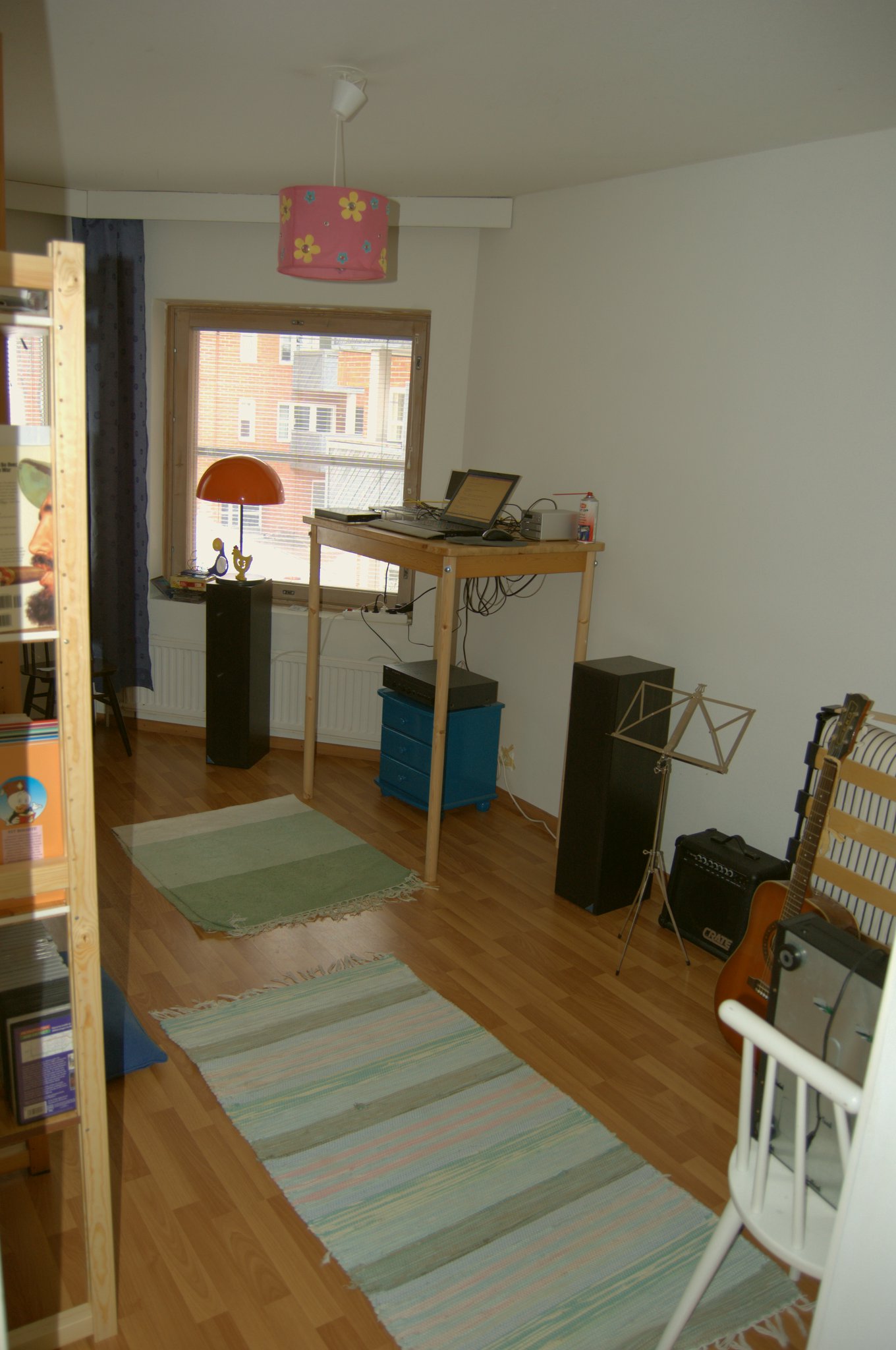
Built the desk from an ordinary kitchen table by replacing the legs with longer ones, costing roughly 30€ or so at the hardware store. Here's a picture: http://yason.kapsi.fi/tmp/codingdesk.jpg
Yes, it's been shown that looking "up" causes increased eye fatigue, since the tear ducts have to work harder. 0-20 degrees below horizontal is optimal.
Yes, it was. I did get an external display quite soon after the picture was taken. I now look only about 10-15 degrees (guesstimate) downwards from the level horizontal angle; a slight nod. No hurting.
A good dose of common sense regarding standing desks is in order. Basically you're trading one set of hazards for another.
"Individuals spending most of the day on their feet every working day are at greater risk of health problems including varicose veins, poor circulation and swelling in the feet and legs, foot problems, joint damage, heart and circulatory problems and pregnancy difficulties."
"Chronic heart and circulatory disorders are linked to prolonged standing at work. Prolonged time in an upright posture at work may cause hypertension comparable to 20 years of aging."
Second month of my standing experiment and I love it. Right now it's a temporary setup so I have my keyboard and mouse on a desk pad on top of a plastic file drawer for height. A gel standing mat for comfort. But when I get the chance I'll upgrade to a more permanent solution.
Typically about 60-70% of the time standing. I try to stretch every hour or so. I also shift my standing position quite a bit, from a wide stance to a normal stance. When I'm thinking or watching a video, I march in place. Whether standing or sitting, I try to not be any one position for more than an hour at a time.
I started the standing desk around 3 months ago and noticed an almost immediate improvement in my posture and back discomfort. I tried to be realistic and try 1 hour, then 2, then 3. I then moved to getting a treadmill desk at the office: http://bit.ly/nHuCRr now that's baller. You can easily code walking at 1mph, just enough to keep your legs moving. I try to get 1-3 hours a day on the treadmill desk these days.
Some keys to success, make sure your monitor is eye level and you're typing at a 90 degree angle, and get a gel pad to stand on, makes a huge difference.
A couple of other observations from a year of standing:
1) no butt pimples
2) ghetto foot and back relief: a brick. A trick learned from a friend who is a brick sculptor, who learned it from a guy at a brickyard, after complaining about standing at the brick easel all day. Just put a brick under one foot. Alternate as needed.
I switched to a standing desk after developing a bulging disc in my lower back (crappy!)
It's great until about hour five or so, at which point my legs and knees start crying uncle. I've found that I can last longer if I sprinkle in some sitting throughout the day, during lunches or meetings, and I can go even further if I stand on a foam activity mat.
I think that taking frequent breaks to walk is the best way to get a little relief for the legs and back, and some exercise, at the same time.
I'm using a chef's gel floor mat bought at Lowes or Home Depot (not sure of the store or brand, my wife got it for me). The standing desk experiment almost ended on day three with seriously aching arches, but the gel mat solved that problem entirely.
I bought one on that book site with a river name. Don't skimp on it (there are cheapies available but avoid them). Also, I wish I had bought a 6 foot one to improve pairing (right now, the person with the keyboard gets the mat).
I have been using a standing desk for almost a year now. I would recommend the Utby from Ikea for a more economical and permanent solution. My current Utby setup: http://post.ly/2hqhN
I'm doing the same and love it. I don't use it 8 hours a day, when I get tired I move over to a couch elsewhere in the office, or head out to a coffee shop.
I also moved to a standing desk about two months ago. I already had a rather narrow shelf cabinet whose top was used for the printer. I moved the printer down to the regular desk and the monitor up there.
I started this set up as an experiment to see if standing will work for me. And thus far I love it very much. If I were to write an article myself, it would be quite similar to Leo's. I don't track my weight as I'm not overweight but I agree about the focus effect and the general "more energy to work" benefit. Standing has eliminated the post-lunch heaviness that I used to experience, especially when I was working in a corporate environment, before going indie, working at home.
So far I had no negative impacts, except temporal lower back pain while I adjusted in the first couple of weeks and occasional sore feet. On the other hand, I believe I had several benefits, related to the occasional back and neck pain which is often the result of sitting. Plus the increased energy, like I wrote previously.
My verdict, I recommend everyone at least to try it as an experiment for a month or so and see if it works for you.
Doesn't seem like quite what I'm looking for, though. I built a quick mockup using cardboard and string, and although obviously the pro version has much more comfortable straps, I feel like it still places the laptop too low, while the strap around your shoulders encourages you to look down. Not good for posture— and moving the laptop up makes it uncomfortably close to the face.
What I really want is a harness that suspends the laptop at about the place I hold it up to use it, which is significantly higher and further from me than my waist— and ideally it should be supported from my waist rather than my shoulders.
I think this is actually a feasible thing to make— I'm going to play around with cardboard some more.
Edit: Okay, my second prototype consists of a board, about 8"x12", which sticks up from my waist the long way at about a 30˚ angle. A strap connects the far end of the board around my lower back, which holds the board up; the laptop sits away from me on the board, with the front end resting on the straps.
I'm typing this using it right now. The laptop ergonomics themselves are pretty nice, exactly the holding-the-laptop-but-type-with-both-hands feeling I was going for. The prototype apparatus is obviously way uncomfortable, though. A padded waist piece and strap would probably make it perfect, but I would still want to investigate the effect of the shear forces on my spine before using this full-time. (Proposal: Trade in the strap for a rigid structure, counterweight the back. Better proposal: Counterweight the back with extra battery for the laptop.)
Honestly, aside from more comfortable and adjustable pieces, this is pretty much what I want. So, uh... does anyone make something like that? :) (Another crucial feature would be a non-load-bearing safety strap that does go around my neck— I tested the harness pretty carefully before trusting the laptop to it, and it was sturdy as a rock, but it still feels flimsy.)
At my six-month point I have benefits and drawbacks from the experience.
On the good side, my back and legs feel much better than when I sat all day. I have lost some weight, though not enough to use that as a reason for standing. I am more likely to use my whiteboard for jotting down and sketching ideas. I find that I can think about plans and ideas more easily.
On the bad side, my feet hurt. Not when I'm standing, but when I wake up or get up from resting. This pain started about 3 - 4 months into the experiment. I wear thin-soled shoes which probably exacerbates the problem. Reading is more difficult, unless I have hardcopy.
Surprisingly, it didn't seem to affect my coding, neither positively nor negatively. I thought it would help by increasing focus. It also seems to make visitors a bit uncomfortable, unless I sit down to talk to them.
Going forward, I will try losing a bit more weight and using an anti-fatigue mat to stand on. Also, I will switch more often between standing and sitting, depending on the task at hand.
FWIW: Had no discomfort when I started standing up. I think my Vibram Five Fingers are to thank for that; About a month after I started using them, I noticed that knee aches that have been there for years have virtually disappeared, that my calf muscles are much stronger, and that the weight distribution on my feet is much different (balls instead of heel).
I've been experimenting with lots of different things. By far the most useful thing I've found is to take a running break for three to ten miles in the middle of the workday to break it in half. I have a standing desk and a sitting desk, and I've made a habit of standing or walking around when I have something to spend a long time reading. I tried sitting on an exercise ball at my desk and found it too distracting, but I found having a small exercise ball under the desk to kick around while working still lets me focus. And I've paid more attention to when I start losing focus while sitting and then to hop up and spend at least a few minutes walking around.
Has anyone successfully done this in an office environment? I love my standing desk (actually just a bookshelf) at home, but have a hard time picturing how it would work with surrounding coworkers sitting down.
I've done this for about a year in an office environment. A few other coworkers subsequently switched as well. I'm in an office, so there's no big difference for me, but one of my coworkers was the only standing person in a cube area. No problem for him. My company supports this by custom building desks of the appropriate height.
I did. I was even in a shared cube environment so I couldn't even raise the desk surface. So instead I got some boxes and put a piece of plywood on top, then put my monitor/keyboard/mouse on top of the platform. It looked pretty weird, but after about 3 days two other guys on my floor copied my bit. Now I'm at home so I have a better setup, but I'll never go back to sitting no matter where I work.
Still the broken link (you fixed it in another thread) here.
I wonder how loud that treadmill is though? I see no problems with people standing instead of sitting (might something you need to get accustomed to if it's rare/if you're the first, but it shouldn't be disturbing), but I'm not sure if I'd be happy with a constant 'whirr' coming from beneath a coworker's table..
"The participants were asked the question about their leisure sitting time, not their time sitting at work ... My friends who wrote this study also pointed out that the more you sit and watch TV the chances are you will eat more and gain weight."
That doesn't prove anything, but shows that potentially they are focusing on sitting along with other activities like eating fatty "leaisure" foods rather than sipping on a coffee coding all day.
Timout is amazing. Dramatically improved my daytime energy levels and in the evening I feel much more clear and awake so I have much more productive time overall. Donate!
Although it only works for a single person (or a very compromising SO), my solution for the space limited apartment was to buy a bar height Ikea dining table for 4 people for my 'dining space'. With some 10 foot power and monitor cables, and wireless keyboard/mouse I can use this desk for standing or sitting. When friends come over I shuffle the keyboard and monitors off the desk and it's ready for entertaining.
My transition from sitting to standing took a little less than a month to get used to. I would recommend placing your desk next to a wall so you have something to lean on. It is a great way to prolong your standing time when starting the transition.
As for initial discomfort it was fairly minimal. In fact I soon began to appreciate the soreness as it allowed me to fall asleep faster as well as improving the quality of my sleep.
Another point to be noted. Wearing any sort of shoes with heels will increase the pain in the legs. So it's better to wear flat soled shoes. Am talking from my personal experience. I took to the extreme end of standing all day but I couldn't sustain with that regimen for more than a week. Perhaps standing for 4-5 hours works in the long run.
I tried this on a whim a few months back by sticking a few empty water bottle cases under my table. I never want to go back...for precisely the same reasons as described in this article, the main one being that my afternoon "energy crash" at 3 pm simply stopped entirely if I was standing. That alone is worth the switch.
I converted my home office to a standing desk about a year ago and now I won't turn back. @ work, I still have a sit down desk at my office, but I'm in and out of meetings more of late, so I'm not fixed to by desk for more than a couple of hours at a time. it ends giving me a good 60 / 40 (sit / stand) solution
The Desk
I'm using is a slightly older Ikea office desk that allows me to set it to any particular height. Sadly, it looks like they don't carry it anymore and the closest option that I see currently is the Frederick.
http://www.ikea.com/us/en/catalog/products/60111123
I've also been standing at my desk for the last 3 weeks. I put my screen on a speaker, and my keyboard and mouse on some stacks of books.
For the first few days, my lower back hurt like hell, but the pain went away after a week or so. When I used to sit at my desk all day, I wouldn't eat very much. But since I started this, my appetite has doubled and I feel a lot healthier.
I'm only 22, but I'm a bit overweight (NZ overweight, not US overweight), and I think that small changes like this can really affect your health in the future. I feel like I'm tackling back problems before they have a chance to start. So if you're thinking about it, I'd recommend it.
I've been standing for about 5 months now [1]. Assuming the research continues to stay the same (that sitting all the time, in spite of getting regular exercise, increases all-cause mortality), I will never go back.
I'd like to convert to a standing desk, but the prices are ridiculous. I don't need a motor and am not paying $795-1500 for a plank of wood and four metal legs. I'll build the thing myself before I go that route.
Took my standard oak desk, bought $5 in cinder blocks and some MDF (even had homedepot cut it to the footprint of the desk bases) and that was it. Insta-standup-desk for like $30 and all my drawers are standup height also, which you don't get if you do what some people do and just put a riser on top of their desk.
Thanks guys. I'm willing to spend a few bucks for something that looks nice, just dont want to get swindled. Gonna try a foldable drafting desk I think. Will blog the results.
Also, a four-drawer dresser is about the same height as the table above. They are very easy to find at flea markets or estate sales for next to nothing, and are perfect for standing with a laptop.
I know those drafting tables well, as I once was a wannabe illustrator. They are ok, but you are paying a premium for the ability to adjust it into a non-flat drawing surface. There's also a lot of extra space that you don't need if you're just using it as a laptop. Honestly, if it didn't have the adjustable top, it should cost about $30 at IKEA. They are easy to find on craigslist in big cities, though.
Regarding the bistro table, I would say it's about 20% more stable than you would expect.
Pretty good for a laptop. I wouldn't put a 27" iMac on it, though.
They just say that but in fact you can mount the desk anywhere. They assume you'll mount the 2 smaller surfaces above the main one but I mounted them underneath. The side rails have uniformly shaped mounting holes along the entire surface, top to bottom.
I've been using a standing desk for almost a year now. I'm a software engineer. It's great; I will recommend it to anyone.
It takes a while to build up the stamina to stand. When you first switch you need frequent breaks during the day. Having a high chair is crucial during this time. As your stamina improves, you begin to be able to handle standing an entire day, but you're still sore after a few days or a week. You're a bit more tired on the weekend. After a few months, you can stand all day long for days on end with no fatigue. That's the point where you get the benefit.
After switching to a standing desk months ago, I found that I had vastly more energy during my vacation to Europe. I would walk and explore a city and be active all day long with virtually no fatigue at all. My stamina beat out my companions' significantly, even people who are otherwise much more active than I am. Standing for 8 - 10 hours per day provides a huge stamina boost when you adjust to it.
It's important to ergonomically adjust your desk so that it's in the correct position, of course. Stand normally with your arms limp at your sides. Now, without moving your elbows, bring your hands up such that your forearms are horizontal, hands straight in front of you. Your hands now indicate where your keyboard should be -- roughly an inch or two below your elbow height. Your mouse should also be reachable from that position without moving your elbow.
Standing burns twice as many calories as sitting, and is overall much healthier as a daily habit. There was a study I circulated around my work (I'll see if I can find a link; it may be the same one as at author included) which compared two groups of people who were active, healthy, and fit, and did the same sort of work. One group of people sat at their job, and the other group of people stood. The study showed that people who stood had a lower incidence of heart disease, diabetes, and other ailments. Conclusion: standing is healthier, and regular exercise outside work doesn't make up for it.
Lastly, I've found standing more ergonomic. With a chair, you're likely to find yourself slumping somehow, on the armrest, or on the desk. With a standing desk, it's easy to follow correct posture. With a Kinesis keyboard and 3M Ergonomic Mouse (the one which looks like a joystick) I haven't experienced any ergonomics issues in a long time.
Regarding the article:
> There’s no question, standing takes more energy and tends to make you sore compared to sitting.
No, it does not. That's just the author building up sufficient stamina to stand. You will build the stamina, and will not be sore whatsoever, even after a week of standing all day long.
> For the past three weeks I’ve been standing while I work, instead of my usual sitting.
Not nearly long enough to adjust! I'd say it took me 3 months to become completely comfortable.
It took about two weeks for my lower back to adjust to standing all day. I too have been standing for about a year. One of the best decisions I ever made.
I wanted to try a standing desk on the cheap. I checked out all the suggestions I could find, including various Ikea desks and custom builds from Ikea parts. I ended up using a $10.97 plastic 4-tier shelving unit from Wal-Mart.
It was just the right height, snapped together in 2 minutes, and the top shelf is just wide enough for my laptop and a glass of water. It stands right next to my normal desk so I can choose which I want to use.
Sitting all day always lead to me feeling pretty "blah" by the end of the day. I put an end table on top of my desk. My external monitor keyboard and mouse site on top of the end table, and my laptop sits below the end table on my desk. I alternate between sitting and standing throughout the day. I feel much better at the end of the day, now.
I have been using a stand-up desk for about 6 years now. One advantage that is not always mentioned, is that when tackling a tough problem, it actually encourages you to pace around the room a bit. In my experience, the increased blood flow from doing this has helped with focus and concentration.
A while back I converted my big IKEA desk into a standing desk by extending the legs all the way and putting books under it. It worked out amazingly well and I got a ton of stuff done, but you definitely need a tall stool of some kind so you can sit on occasion or it's easy to get burned out.
I've been doing the standing desk thing for about six months now. Most of my leg and foot discomfort has gone now.
My leg strength stays much higher than it used to, as you might imagine. One bike ride per week sustains the muscle that used to require three rides, if you see what I mean.
I'm generally more alert while standing up. When I sit, I have to tap a foot or something, otherwise I'll start getting sleepy. This has always been the case, it's just a bit more noticeable when I spend more of the day standing.
The standing desk has helped tremendously with my posture, but has, to some degree, exacerbated my shoulder/neck issues. Specifically, holding good posture in a standing position lends itself to a knot in a trapezius muscle, which causes pain and nerve irritation.
I'm currently thinking that switching between standing and sitting will yield the best results. To that end, I'm considering building a sliding desk platform out of 8020 parts (http://www.8020.net/).
What about the lying position? I have a couch next to me and i tend to relax with my ipad when reading stuff. Lying down feels more natural than the sitting position, so how about adding that one to the mix?
From my experience it seems that too much lying is also bad, the key is to change your position often enough so that parts of your body on which you sit/lie don't become stale.
I don't think that standing is better or healthier than sitting while working. As a matter of fact I think it's even worse - you get to stand in one place 8 hours five times a week, how can that do any good? It's totally unnatural.
I am expressing my opinion. In the last few years I noticed this "fashion" spread through blogosphere. Does it exist a single long period during human evolution when people stand in place for 40 hours a week? As far as I know most of the time people spent lying, then sitting/squatting, walking and running. You really get to stand in one place when there is no other option available. But to each his own I guess.
I think the difference here is that you imagine people standing still for 8 hours straight. Obviously that would be a bad idea. No one seems to promote that.
One part of the 'more healthy' claim I've read about is that you're bound to move a lot more if you're standing. You'll shift weight more. You might wander off for a second, thinking. It comes more natural instead of lifting your rear out of a comfy chair.
"I think the difference here is that you imagine people standing still for 8 hours straight. Obviously that would be a bad idea. No one seems to promote that."
Why is that obviously bad? I stand for 9-10 hours straight. It took probably two weeks to get up to that point, but I rarely even sit down when taking a lunch break. I don't use a gel pad and I stand barefoot at home, or in some form of barefoot (vivo's to look nice) when I worked in a office. I almost constantly shift my weight. And every 10-20 minutes I do calf raises, stand on one foot, do free squats, something to move some blood. I'm still standing in all of those exercises though and most are just second nature. I stand still while typing, but move quite a bit when I'm reading.
I know a lot of people that have jobs with requirements to stand almost all the time. All of them prefer and would like to have a job where they would be allowed to sit. And a bunch of them have a problems with veins in legs after years spent in standing positions.
Of course it can't be healthy to sit 8 hours straight without some pause for walking or stretching. Combine that with some exercises 2-3 times a week and you would eliminate almost all of the health problems related with sitting.
As far as I know, before agricultural and industrial revolution, people in hunter gatherer societies spend a majority of their time resting. They spent maybe 4-5 hours a day on hunting, gathering and other stuff. The rest of the day is spent with family and napping/lying/resting.
To answer your question I think that sitting 8 hours every day is not very healthy, but it's far better than standing 8 hours. Break long period of sitting with some walking, stretching or some light exercise, and you would eliminate almost all negative effects of prolonged sitting.




http://leopolovets.com/img/treadmill_desk.jpg
Basically it's four five-dollar plastic bins on each side of a treadmill, and then a ~2'x4' plank on top. It looks awful but works very well.