Okay, so you are confusing concepts like "what is a signature", "what is an original", and "what would a court accept as valid evidence".
We are going to mostly put aside the third for now.
First: A signature does not change form once created. A physically signed document is a physically signed document, regardless of whether i scan it in. An electronically signed document is electronically signed regardless of whether i print it.
Period. The form does not change once created. Only it's originalness and acceptability as evidence.
So then what is electronic.
Second: Your definition of electronic is ... not encompassing enough.
Let's go to the E-SIGN act:
"ELECTRONIC– The term 'electronic' means relating to technology having electrical, digital, magnetic, wireless, optical, electromagnetic, or similar capabilities."
That's a lot.
"ELECTRONIC SIGNATURE– The term 'electronic signature' means an electronic sound, symbol, or process, attached to or logically associated with a contract or other record and executed or adopted by a person with the intent to sign the record."
Note that because of the definition of electronic in the first part, the second is a lot broader than it looks despite it also being fairly expansive.
It only has to be associated with and then executed/adopted by a person with intent to sign a record. Note that it does not say electronic record (which the act defines) or electronic contract. Other parts of the act are restricted to electronic records/contracts, but given the duality, no court i'm aware of has read the limitation into this part of the act (the opposite is in fact true).
So what i gave you what a clear electronic signature. It was electronic process associated with a contract or record, executed by a person with intent to sign it.
It doesn't matter if it was later printed. The act itself will even support this.
Now we move on to what does the act say about such signatures or contract or ... ;
"
(1) a signature, contract, or other record relating to such transaction may not be denied legal effect, validity, or enforceability solely because it is in electronic form;
(2) a contract relating to such transaction may not be denied legal effect, validity, or enforceability solely because an electronic signature or electronic record was used in its formation.
...
(g) Notarization and Acknowledgment.--If a statute, regulation, or
other rule of law requires a signature or record relating to a
transaction in or affecting interstate or foreign commerce to be
notarized, acknowledged, verified, or made under oath, that requirement
is satisfied if the electronic signature of the person authorized to
perform those acts, together with all other information required to be
included by other applicable statute, regulation, or rule of law, is
attached to or logically associated with the signature or record.
...
(h) Electronic Agents.--A contract or other record relating to a
transaction in or affecting interstate or foreign commerce may not be
denied legal effect, validity, or enforceability solely because its
formation, creation, or delivery involved the action of one or more
electronic agents so long as the action of any such electronic agent is
legally attributable to the person to be bound.
"
Remember again our definition of electronic is very broad here.
The first says the signatures and contracts are valid even when they were in electronic form. That is again true even if i print it out and later mail it.
You may run into the issue about what is acceptable evidence to a court for the document itself, but you will not run into the issue of "is the signature on this document, which was originally electronic, valid as a signature".
The second says that a contract (again, very broad definition, definitely includes letter like this one!) can't be denied validity just because you used an electronic record or signature in forming it.
The printing it out doesn't make it less of an electronic signature.
The section on notarization makes this even more clear.
It doesn't even require an electronic record (as other parts of the statute explicitly do), it says you can electronically notarize a regular record, as long as you attach or associate it somehow.
Even further, e-sign destroys the argument that you didn't make the contract. It even allows me to use an electronic agent to make, form, and deliver contracts if i like, as long as it's attributable to me.
UETA is even more straightforward (though inapplicable in this particular case):
"
(c) If a law requires a record to be in writing, an electronic record satisfies the law.
(d) If a law requires a signature, an electronic signature satisfies the law.
"
It even says email does not change form:
"“Electronic mail message” means an electronic message or computer file that is transmitted between two or more telecommunications devices; computers; computer networks, regardless of whether the network is a local, regional, or global network; or electronic devices capable of receiving electronic messages, regardless of whether the message is converted to hard copy format after receipt, viewed upon transmission, or stored for later retrieval."
Note the last sentence.
There are lots of state court and federal court opinions on this.
Outside of other laws, etc, clicking a button on this form will be considered mailing a physical copy of an electronically generated signature.
I have some questions about this model. Big ask I know but I am wondering if you'd reach out to me to discuss your interpretation of it (contact info in profile). I think there are some missing pieces here, and I'd really like to discuss this issue in depth with someone who understands the tech and the law as I think there may be a startup in some other places this law is applicable.
Thank you a ton for taking the time to patiently explain all this. So here's where I'm currently stuck. Or actually, I'm stuck in a few places right now:
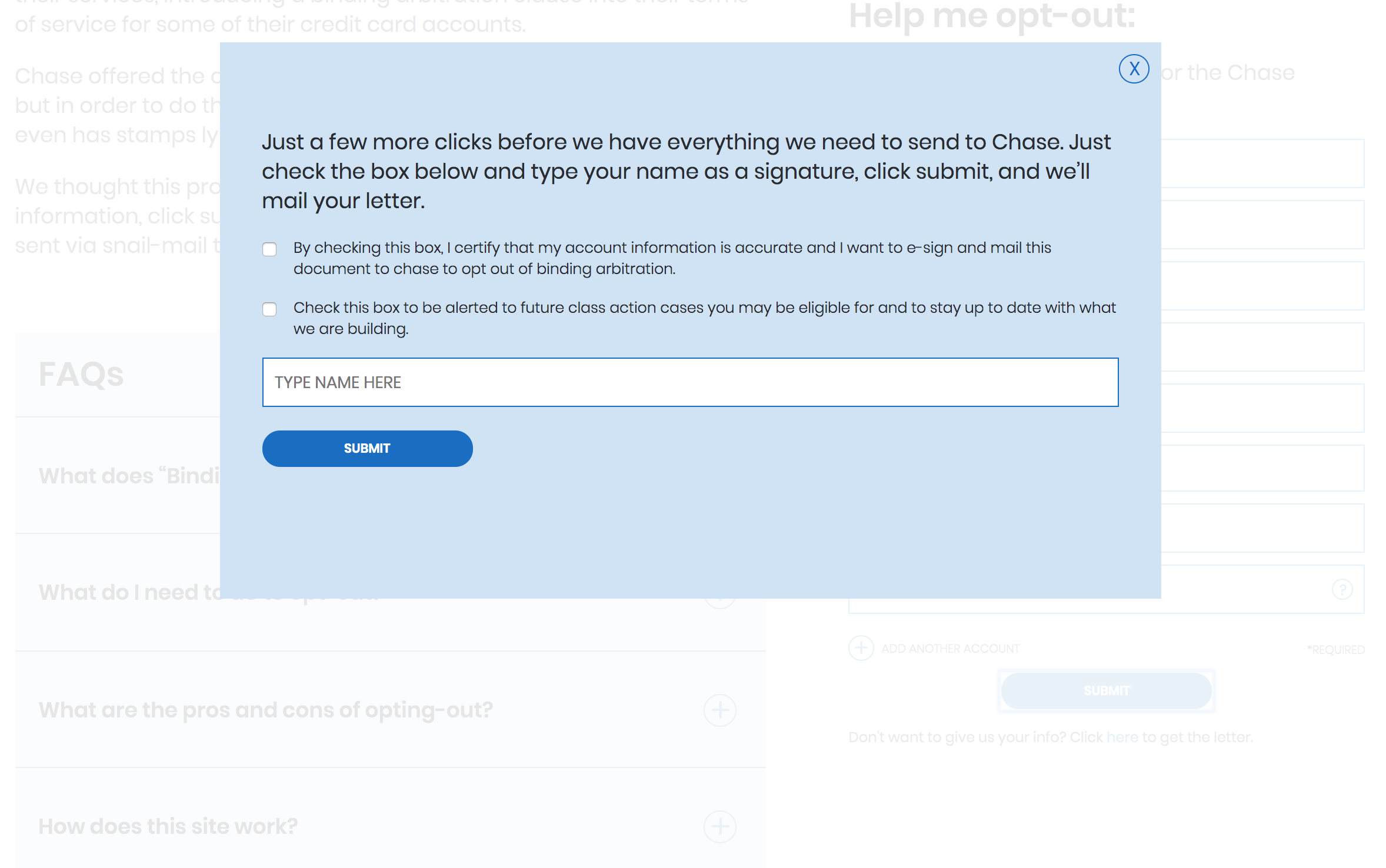
(1) This is less relevant to this particular debate, but it's highly relevant to the actual opt-out page. On the webpage, I don't see the word "sign" at all. I imagine merely filling in your name into that box and clicking "Submit" doesn't turn your name into your signature. In fact the page explicitly says "the information for the Chase account holder"... which need not be you, so it definitely can't account as the account holder's signature... right? So regardless of the electronic vs. paper issue we still seem to have a pretty fundamental problem that even this page hasn't been signed by the account owner in any shape or form.
(2) This is more specific to our discussion. So if there were a signature box on that form and you put your name in as your electronic signature, what exactly would you have electronically signed? I never (I think) said that you wouldn't have electronically signed anything at all, but rather, that what you signed electronically would not have been the agreement of interest, i.e. the one to be sent to Chase. Rather, as I see it, you would have signed something separate from that -- more like a contract (if it even counts as a contract... not sure how considerations play into this, given it's free) with whoever's running that website, to write your intended letter, put a copy of your signature on it, and basically impersonate you in sending this to Chase. Leaving aside the question of whether this is fraud (which is also something I've been pondering, since Chase would seem to think it came from you), that would mean you never signed that agreement at all. At best, I feel you could only try to argue you gave this site a power of attorney to represent you... not sure how valid a court would find that with the form currently as-is. So I'm still struggling to see how you could claim to have signed the agreement sent to Chase.
(3) The "electronic agent" thing seems like a red herring (I'm not sure why you brought it up) since it seems to refer the software, not the human on the other side.
(4) Is this really a question of whether the agreement is valid "solely because it is in electronic form"? In my view it's a question of whether it's valid "because its terms for it taking effect are followed". One of the terms was signing it in electronic form, but that's just (if you will) an implementation detail the way I see it. This may be my CS-y brain but the law sounds like it's intended to address governmental "discrimination" against electronic signatures (if you will), not private decisions on how to form valid agreements. It seems kind of like how, even though the law requires that a $100 bill be valid as legal tender for all private debts, no store owner is obligated to accept a $100 bill as a payment of $100 for goods you haven't officially bought yet.
You assumed that the process is done when you click that first Submit button, but it is not. There is an e-signing step that makes it clear what you are doing and what you are signing. [0]
I also did not realize this and it probably would have prevented me from posing the question in the first place. Seems like it would be clearer for the first button say "Click to sign" or something (other than "Submit").


We are going to mostly put aside the third for now.
First: A signature does not change form once created. A physically signed document is a physically signed document, regardless of whether i scan it in. An electronically signed document is electronically signed regardless of whether i print it. Period. The form does not change once created. Only it's originalness and acceptability as evidence.
So then what is electronic.
Second: Your definition of electronic is ... not encompassing enough. Let's go to the E-SIGN act:
"ELECTRONIC– The term 'electronic' means relating to technology having electrical, digital, magnetic, wireless, optical, electromagnetic, or similar capabilities."
That's a lot.
"ELECTRONIC SIGNATURE– The term 'electronic signature' means an electronic sound, symbol, or process, attached to or logically associated with a contract or other record and executed or adopted by a person with the intent to sign the record."
Note that because of the definition of electronic in the first part, the second is a lot broader than it looks despite it also being fairly expansive.
It only has to be associated with and then executed/adopted by a person with intent to sign a record. Note that it does not say electronic record (which the act defines) or electronic contract. Other parts of the act are restricted to electronic records/contracts, but given the duality, no court i'm aware of has read the limitation into this part of the act (the opposite is in fact true).
So what i gave you what a clear electronic signature. It was electronic process associated with a contract or record, executed by a person with intent to sign it.
It doesn't matter if it was later printed. The act itself will even support this.
Now we move on to what does the act say about such signatures or contract or ... ;
"
(1) a signature, contract, or other record relating to such transaction may not be denied legal effect, validity, or enforceability solely because it is in electronic form;
(2) a contract relating to such transaction may not be denied legal effect, validity, or enforceability solely because an electronic signature or electronic record was used in its formation.
...
(g) Notarization and Acknowledgment.--If a statute, regulation, or other rule of law requires a signature or record relating to a transaction in or affecting interstate or foreign commerce to be notarized, acknowledged, verified, or made under oath, that requirement is satisfied if the electronic signature of the person authorized to perform those acts, together with all other information required to be included by other applicable statute, regulation, or rule of law, is attached to or logically associated with the signature or record.
...
(h) Electronic Agents.--A contract or other record relating to a transaction in or affecting interstate or foreign commerce may not be denied legal effect, validity, or enforceability solely because its formation, creation, or delivery involved the action of one or more electronic agents so long as the action of any such electronic agent is legally attributable to the person to be bound. "
Remember again our definition of electronic is very broad here.
The first says the signatures and contracts are valid even when they were in electronic form. That is again true even if i print it out and later mail it. You may run into the issue about what is acceptable evidence to a court for the document itself, but you will not run into the issue of "is the signature on this document, which was originally electronic, valid as a signature".
The second says that a contract (again, very broad definition, definitely includes letter like this one!) can't be denied validity just because you used an electronic record or signature in forming it.
The printing it out doesn't make it less of an electronic signature. The section on notarization makes this even more clear.
It doesn't even require an electronic record (as other parts of the statute explicitly do), it says you can electronically notarize a regular record, as long as you attach or associate it somehow.
Even further, e-sign destroys the argument that you didn't make the contract. It even allows me to use an electronic agent to make, form, and deliver contracts if i like, as long as it's attributable to me.
UETA is even more straightforward (though inapplicable in this particular case):
" (c) If a law requires a record to be in writing, an electronic record satisfies the law. (d) If a law requires a signature, an electronic signature satisfies the law. "
It even says email does not change form:
"“Electronic mail message” means an electronic message or computer file that is transmitted between two or more telecommunications devices; computers; computer networks, regardless of whether the network is a local, regional, or global network; or electronic devices capable of receiving electronic messages, regardless of whether the message is converted to hard copy format after receipt, viewed upon transmission, or stored for later retrieval."
Note the last sentence. There are lots of state court and federal court opinions on this.
Outside of other laws, etc, clicking a button on this form will be considered mailing a physical copy of an electronically generated signature.