This is not a situation limited to solar energy. In India we have the social technology to organize men and build large projects. The US had this technology 100 years ago, but we've lost it.
Trains
Delhi metro, phase 2: 77 miles of track, 85 stations, $2.9B, 3 years.
Hudson Yards NYC: 1 mile of track, 1 station, $2.5B, 9 years.
Green line expansion, Boston: 4 miles of track, 4 stations, $3.1B, 7 years (if all goes according to plan).
Space exploration
Mangalyaan mission to mars: $74M.
A movie about Matt Damon getting stuck on mars: $108M.
Labour costs and safety levels are going to be a huge part of this discrepancy. As are things like legal safeguards on eminent domain and environmental impact.
Labor costs rarely make it into the double digits when it comes to percent of total costs of large infrastructure projects. And even if they were, that wouldn't explain the discrepancy. The infrastructure construction costs in very first-world Western Europe are closer to the costs found in India than they are to the costs found in the US.
To say it's not labor is not entirely true. I'm just claiming that labor isn't a huge part...at best it contributes in the single digit percentages.
The real answer is much more complicated and there is no easy one-size-fits-all answer. Environmental regulation, litigious environment in the construction industry, overuse of contractors and consultants instead of in house expertise, buy america provisions, labor scheduling rules, poor planning, supplier market that has been drastically cut off due to bidding complexity and procurement regulation, bad incentives, poor oversight, corruption, incompetence, etc ad infinitum. If you had to sum it up, you could say that the US is uniquely incompetent in all aspects of government-sponsored infrastructure projects.
The Mangalyaan comparison is not really fair as it's just a technology demonstrator (not to minimize the achievement btw, getting to Mars on the first try is a big accomplishment) whereas NASA's Mars Science Laboratory with Curiosity Rover is much more advanced. You also need to factor in the much lower employee costs in India.
Labor is about 1/10th the cost in India compared to the states. This came up during our quarterly ISRO vs NASA commentaries. NASA engineers average $100,000+ while ISRO engineers make a whooping 600,000 rupee! Which is only about $10,000.
I imagine the salary difference in the solar and construction industries are similar. Also the cost of land, high taxes, safety and environmental regulations, and other external factors that are less of an issue in third-world countries.
Its simply not feasible to compare the cost of living and the cost of capital projects in one of the world's richest countries compared to one of its poorest. The same way you can't compare the cost of manufacturing domestically to manufacturing in, say, Vietnam where factory workers get paid $200 a month. Factory wages in the US are around $42.82/hour.
Topaz was started in 2011, completed in 2014. There have been double digit percentage cost efficiency improvements in solar with every year that has passed in that range. You're comparing apples to oranges.
Yes, must be mainly that: labour cost + efficiency improvement (I think they said efficiency improved 80% over last 7 years; can't check because the website is down?). Impressive.
What I hope is that early adopters are not penalised so much by this fact. Ie. that panels are easily swappable (scaffolding and the rest can stay as is; maybe batteries need to be swapped) and there will be marked for old, less efficient panels (and used batteries?) to be sold to late adopters or subsidised recycling?
It is cost efficiency that has improved dramatically in the last 7 years, not device efficiency. Maybe 7 years ago you bought a module with a 14% sunlight-to-electricity conversion efficiency and today the same manufacturer would have a 16% efficient panel in the same part of their lineup. That is not a dramatic change. It's certainly not worth the cost of replacing panels that work just fine with this year's model.
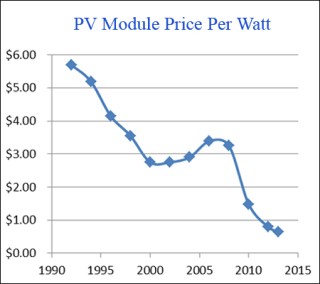
You'd pay 75% less per watt of panel capacity today compared to 7 years ago, due to manufacturing improvements up and down the supply chain plus brutal market competition between manufacturers. That is a dramatic change.
Module price per watt is about 50 cents right now IIRC and would have been something like $1.25 when Topaz was built. Labor and installation is obviously more expensive in California than India.
I'd guess the typical overhead of material and contracting could be drastically different between the two markets. Also, it seems the complexity and size are far less in the Indian project. 9m modules on 4700 acres in California vs 2.5m modules on 1270 acres in Tamil Nadu.
It's 9.5 square miles. 6080 acres. Even in California scrub land isn't going to cost $10,000 an acre, so the land costs of the US project shouldn't exceed $100 million.
edit: tack on another couple hundred million for power line easements and you still haven't explained all that much of the cost difference. And I really doubt that they spent anywhere near $300 million on land and easements.
In 2015 in the US, installation labor accounted for only 11% of the cost for utility scale fixed tilt PV farms like this one ($0.19 out of $1.77 per watt project costs): http://www.nrel.gov/docs/fy15osti/64746.pdf
Your comparison is almost like comparing apples with oranges.
India, although has achieved some good results, is mostly a third world country [1] (barring few metro places), and thus various project costs are mostly insignificant as compared to US California. Also cutting corners regarding project safety issues, labor safety issues is not uncommon in third world countries.
It is also similar to China being able to manufacture things at a cheaper price, with almost forced labor and no minimum wages comparable to USA.
It is also similar to Bangladesh being able to manufacture clothes at a cheaper price, with almost forced labor and no minimum wages comparable to USA.
Do you remember what happened in Bhopal? [2]
Granted, the company UCIL was American, but it was the Indian govt which allowed it to go scot-free.
Not saying I disagree that the comparison is a bit odd, I just want to add that I did find OP's information / the discussion around the costs of infrastructure projects in the US [1] interesting to say the least.
Looking at those sources in does indeed sound plausible that the US has some issues with costs of infrastructure projects compared to other (even first world) countries.
I didn't find a good explanation why OP thinks this is because of the lack of Social Technology though.




Tamil Nadu, India - 648 MW - cost $677 mln - built in 8 months
...wait, what?