This is not a situation limited to solar energy. In India we have the social technology to organize men and build large projects. The US had this technology 100 years ago, but we've lost it.
Trains
Delhi metro, phase 2: 77 miles of track, 85 stations, $2.9B, 3 years.
Hudson Yards NYC: 1 mile of track, 1 station, $2.5B, 9 years.
Green line expansion, Boston: 4 miles of track, 4 stations, $3.1B, 7 years (if all goes according to plan).
Space exploration
Mangalyaan mission to mars: $74M.
A movie about Matt Damon getting stuck on mars: $108M.
Labour costs and safety levels are going to be a huge part of this discrepancy. As are things like legal safeguards on eminent domain and environmental impact.
Labor costs rarely make it into the double digits when it comes to percent of total costs of large infrastructure projects. And even if they were, that wouldn't explain the discrepancy. The infrastructure construction costs in very first-world Western Europe are closer to the costs found in India than they are to the costs found in the US.
To say it's not labor is not entirely true. I'm just claiming that labor isn't a huge part...at best it contributes in the single digit percentages.
The real answer is much more complicated and there is no easy one-size-fits-all answer. Environmental regulation, litigious environment in the construction industry, overuse of contractors and consultants instead of in house expertise, buy america provisions, labor scheduling rules, poor planning, supplier market that has been drastically cut off due to bidding complexity and procurement regulation, bad incentives, poor oversight, corruption, incompetence, etc ad infinitum. If you had to sum it up, you could say that the US is uniquely incompetent in all aspects of government-sponsored infrastructure projects.
The Mangalyaan comparison is not really fair as it's just a technology demonstrator (not to minimize the achievement btw, getting to Mars on the first try is a big accomplishment) whereas NASA's Mars Science Laboratory with Curiosity Rover is much more advanced. You also need to factor in the much lower employee costs in India.
Labor is about 1/10th the cost in India compared to the states. This came up during our quarterly ISRO vs NASA commentaries. NASA engineers average $100,000+ while ISRO engineers make a whooping 600,000 rupee! Which is only about $10,000.
I imagine the salary difference in the solar and construction industries are similar. Also the cost of land, high taxes, safety and environmental regulations, and other external factors that are less of an issue in third-world countries.
Its simply not feasible to compare the cost of living and the cost of capital projects in one of the world's richest countries compared to one of its poorest. The same way you can't compare the cost of manufacturing domestically to manufacturing in, say, Vietnam where factory workers get paid $200 a month. Factory wages in the US are around $42.82/hour.
Topaz was started in 2011, completed in 2014. There have been double digit percentage cost efficiency improvements in solar with every year that has passed in that range. You're comparing apples to oranges.
Yes, must be mainly that: labour cost + efficiency improvement (I think they said efficiency improved 80% over last 7 years; can't check because the website is down?). Impressive.
What I hope is that early adopters are not penalised so much by this fact. Ie. that panels are easily swappable (scaffolding and the rest can stay as is; maybe batteries need to be swapped) and there will be marked for old, less efficient panels (and used batteries?) to be sold to late adopters or subsidised recycling?
It is cost efficiency that has improved dramatically in the last 7 years, not device efficiency. Maybe 7 years ago you bought a module with a 14% sunlight-to-electricity conversion efficiency and today the same manufacturer would have a 16% efficient panel in the same part of their lineup. That is not a dramatic change. It's certainly not worth the cost of replacing panels that work just fine with this year's model.
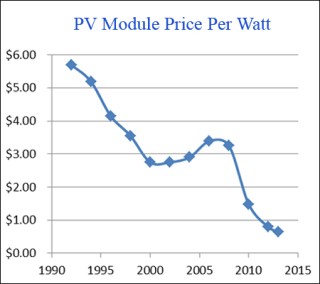
You'd pay 75% less per watt of panel capacity today compared to 7 years ago, due to manufacturing improvements up and down the supply chain plus brutal market competition between manufacturers. That is a dramatic change.
Module price per watt is about 50 cents right now IIRC and would have been something like $1.25 when Topaz was built. Labor and installation is obviously more expensive in California than India.
I'd guess the typical overhead of material and contracting could be drastically different between the two markets. Also, it seems the complexity and size are far less in the Indian project. 9m modules on 4700 acres in California vs 2.5m modules on 1270 acres in Tamil Nadu.
It's 9.5 square miles. 6080 acres. Even in California scrub land isn't going to cost $10,000 an acre, so the land costs of the US project shouldn't exceed $100 million.
edit: tack on another couple hundred million for power line easements and you still haven't explained all that much of the cost difference. And I really doubt that they spent anywhere near $300 million on land and easements.
In 2015 in the US, installation labor accounted for only 11% of the cost for utility scale fixed tilt PV farms like this one ($0.19 out of $1.77 per watt project costs): http://www.nrel.gov/docs/fy15osti/64746.pdf
Your comparison is almost like comparing apples with oranges.
India, although has achieved some good results, is mostly a third world country [1] (barring few metro places), and thus various project costs are mostly insignificant as compared to US California. Also cutting corners regarding project safety issues, labor safety issues is not uncommon in third world countries.
It is also similar to China being able to manufacture things at a cheaper price, with almost forced labor and no minimum wages comparable to USA.
It is also similar to Bangladesh being able to manufacture clothes at a cheaper price, with almost forced labor and no minimum wages comparable to USA.
Do you remember what happened in Bhopal? [2]
Granted, the company UCIL was American, but it was the Indian govt which allowed it to go scot-free.
Not saying I disagree that the comparison is a bit odd, I just want to add that I did find OP's information / the discussion around the costs of infrastructure projects in the US [1] interesting to say the least.
Looking at those sources in does indeed sound plausible that the US has some issues with costs of infrastructure projects compared to other (even first world) countries.
I didn't find a good explanation why OP thinks this is because of the lack of Social Technology though.
While by no means I mean to minimize this announcement, if the press was publishing an article every time a Coal plant opens in India, we would have an article every few days or so on HN.
Just to put things into perspective:
- A plant like Topaz, California generates ~1100 GWh/year. [3]
- "India was the third top electricity producer in the world 1272 TWh in FY 20014-15" [1]
- "India was the third top coal producer in 2015 with 283.9 Mtoe (7.4% global share)." [1]
- "Nearly 80% of total electricity generated (utility and captive) in India is from coal." [1]
So we're about at 3 orders or magnitude, in terms of generated electricity, between what you currently get from coal plants and this new Tamil Nadu plant. While the penetration rate of renewables is faster than coal [2], the same thing cannot be said of generated capacity. Globally an unit of power from renewables has a far lower EROI compared to Coal [4].
So I support what kumarski said below, this is much of a hype. If India wants to be serious about climate change, they should at least stop building Coal plants.
Can you explain how it's relevant for this story context?
For comparison, a typical coal power plant is 500MW.
The new Indian plant is a real first step toward coal capacity replacement.
EDIT: BTW, the article cites Topaz's nominal (or max?) capacity at 550MW; that means its real capacity is 4-5 times lower. I didn't even realize the turndown due to sunlight (un)availability was so high.
Topaz is of the same magnitude as this Tamil Nadu plant, in terms of "rated power". However, many people seem to miss that "rated power" does not equal "actual output". Please see capacity factor [1].
For a solar plant like this one, the capacity is about at ~25%. If it was 100%, for a 650MW plant, you would get 650 * 365 * 24 = 5694 TWh / year. In practice, you will get 5694 * .25 = 1423 TWh / year.
If this was a nuclear plant, you would get 5694 * .90 = 5124 TWh / year. Continously, day and night. Without back-end storage required. Big difference.
The electricity penetration and per-capita usage in India is abysmal. If Quality of Life for Indians is a concern (which it rightfully should be), India should open more coal plants.
US and Europe's path to prosperity went through Coal and to demand Indians and Chinese sacrifice while not making any thing substantial themselves (i.e. in US and Europe) is hypocrisy.
Indian population : 16% of world pop
US population : 5% of world pop
> US and Europe's path to prosperity went through Coal and to demand Indians and Chinese sacrifice while not making any thing substantial themselves (i.e. in US and Europe) is hypocrisy.
Regardless of whether hypocracy is involved, wanting India and China to avoid the mistakes the West made is entirely reasonable. If nothing else, the US and Europe built coal plants before better technologies were available. India has access to modern natural gas plants, fuel cells, wind, solar, etc if it wants them. No one would suggest that India or China build lots of steam engines, after all.
> Regardless of whether hypocracy is involved, wanting India and China to avoid the mistakes the West made is entirely reasonable. If nothing else, the US and Europe built coal plants before better technologies were available. India has access to modern natural gas plants, fuel cells, wind, solar, etc if it wants them. No one would suggest that India or China build lots of steam engines, after all.
Building steam engines and maintaining them was more expensive than building fuel based / electric trains. Even the initial cost was less. So the transition was faster and made a lot of economic sense.
Solar energy prices dropped to around parity with coal for the first time this year, hitting 4.34 rupees (about 6 US cents) a kilowatt-hour (kWh), while coal tariffs range usually range in between 3–5 rupees/kWh (about 5–8 US cents). It wasn't possible until April of this year to even consider Solar a viable alternative. With prices dropping (and hopefully continuing to drop until at least 2030) we can now think of installing new power plants backed by solar.
However, what happens to the old coal based power plants that power 20% of Indian populace (that is close to 3/4th of the population of the United States)? It is going to be super expensive to transition those old power plants to solar. Also, what about 24/7 power? Solar power plants don't guarantee 24/7 power. So you can't completely get rid of coal plants anyways. India has to do quite a bit of balancing act to provide energy for it's 1.3 billion and growing population.
It's not as easy as you make it out to be. If that was the case, United States would have already transitioned to 100% clean energy like it did with steam engines in the 19th-20th century.
European and Americans made mistakes during the industrial revolution for sure. However this is not a good excuse for other countries to make the same mistakes.
Also Europe and US had a much smaller population than India during the industrial revolution and we can imagine that the pollution produced during those years was significantly lower than the pollution produce by china and India (hopefully some technology advances made this point wrong); in a finite world this does makes a difference.
Finally I am not sure how well know were the implications of environmental pollution during the industrial revolution; for sure such implications weren't well know as they are today.
Granted it is a complex problem and tradeoffs will be necessary, however claim that the western world did the same is not a good motivation to destroy the environment.
> European and Americans made mistakes during the industrial revolution for sure. However this is not a good excuse for other countries to make the same mistakes.
Well, there's nothing preventing EU and US from atoning for those mistakes by paying for Solar installations in India. So why don't they?
Your question, while interesting, is not a counter argument to any of my points.
Anyhow, western countries do not have enough resource to finance clean energy in India. Or, at least, there are more pressing issue from the point of view of the average elector/citizen.
> Anyhow, western countries do not have enough resource to finance clean energy in India.
Then they should refrain from advising India on it's energy program. The biggest polluter, after China, is the United States and the EU. Emission per capita is 16.5t and 6.7t in comparison to India's 1.8t. That is pretty crazy considering that the population of US is not even 1/3rd of India. If US isn't serious about moving to clean energy why would India be?
Every country has "pressing issues" of it's own and that includes India as well. The country needs energy and lots of it. It would be great if moving to clean energy was faster and cheaper than setting up coal based plants. It's just not the case.
Dude, you know this "oh well they shat in the river so we get to do so too", is not a really great argument when our cities like Delhi are covered in dangerous smog, our coastal villages are regularly flooded with sea water and the cancer incidence rates in our population are skyrocketing.
And as far as cities like Delhi being covered in dangerous smog: it has more to do with city/town planning than climate change alone. Most of India's "pollution-creating" populace is situated in cities. You and I both know how congested our cities are. The only way to fix this issue is decongestion. One positive outlook is the "100 smart cities plan" announced by Prime Minister. That should enable urban population to spread out. Factories will automatically move out of these over-populated cities reducing pollution.
Coastal villages being flooded with sea water is definitely a big concern. That is the direct impact of climate change and the only way to fix it is reducing CO2 emissions. However, the fix for it doesn't lie with India alone. India produces only 1.8t of emissions per capita. US, China, EU have to take the lead. Only then will it have any meaningful impact. With the US threatening to back out of Paris climate deal, the silver lining that existed for reversing/stopping climate change is at the verge of disappearing. Trump's climate change denial is going to cost the World dearly. It may not affect you and I today, but the impact will definitely be felt by future generations.
I'm talking about "seriousness" of moving to clean energy. The emissions per capita is highest in China, US and EU. India comes 4th. Asking India to move quickly towards clean energy while these bigger emitters continue polluting doesn't work. It is plain hypocrisy.
Even if India alone accomplished it's goal of 100% clean energy it won't stop climate change. Even though I like some of Trump's policies I don't think he is correct when it comes to US contribution to fixing the climate issues. He has already said that he will be pulling out of Paris climate deal. That means not only will US back out of funding third-world countries in tackling climate change, it will itself not move towards clean energy at the pace it would have. If US does back out of the deal, forget reversing global warming and achieving the 2 degree celsius magic number.
While I agree - people from western world live way over what is needed - there's an issue with demography also in Asia. Kaya's identity [1] shows that the factor P, global population, is by far the most important. Control demography, you will raise the Quality of Life. At least while we have high EROI energy sources (like fossil fuels); without high EROI energy, demography will become (again) a dominant energy source.
I completely agree with you on this point. The exploding population esp. that is not well trained is a BIG headache for India, and they are not addressing it the right way.
The PPM250 levels in Dehli are worse than Beijing. The Indian government needs to regulate air quality or deal with a generation suffocated by its failures beyond the remains of the license Raj.
If Quality of Life for Indians is a concern they should stop burning coal, because they a currently slowly killing their citizens with air pollution. Also US and Europe used coal because they didn't knew better but gave the world nuclear energy, just use it already.
Yes, India is also building many Russian Nuclear reactors. Because of sanctions India is stuck with Gen2 reactors and they are upgrading them to the latest. As an net energy deficit country, India's energy policy is both realistic and future focused. Its not perfect but it is hitting all the right notes, balancing short-term and long-term.
IMHO the only way India will stop building coal plants is when it's going to be better investment to not build one and build solar farm instead, for example.
Actually completing the project so much cheaper than Topaz (for whatever reasons) gives hope and it's great news.
I wonder how far are we from situation where investing into solar farm project is genuinely a very good deal? Are we there yet?
Why can't they just use Nuclear? Surely, there are inhabited places that can be used for it. Correct me if I'm wrong - nuclear power should produce more reliable power at a fraction of the cost of solar.
Nuclear requires huge up front investment, may not be so easy for gvmnt.
Solar farms (I believe) can scale slowly even after being operational.
I may be wrong but it's also likely that deeper analysis of the cost for solar doesn't look that bad as you're probably spending most, if not all of the money on your own people - giving jobs and pouring money back in, not out of the country.
That's $3.58 per real annualized watt assuming 90% capacity factor. If this new solar farm operates at 27% capacity factor (like Topaz did in 2015) that will be $3.88 per real annualized watt. So nuclear is still cheaper than solar in India in terms of construction costs. That might be offset by higher O&M costs; in the US at least, PV O&M costs come to $25/kilowatt/year while nuclear is $198/kilowatt/year: http://www.power-technology.com/features/featurepower-plant-...
Again adjusting for capacity factor (PV 27%, nuclear 90%), that means spending about $220/kilowatt/year on nuclear O&M and $93/kilowatt/year on PV O&M. I wouldn't expect the absolute numbers to be the same in India but the ratios may still be similar.
I'd say that the instantaneous generation costs for solar and nuclear projects that start generating in India now or next year are going to be pretty close. In the future, nuclear still has the advantage of working around the clock. But if the next 14 years see even a modest fraction of the solar cost reductions of the past 14 years, the next Kudankulam unit to come online will be far more expensive per annualized watt than a solar farm completed at the same time. 10 years ago it was a lot easier to figure out the lowest cost mix; nuclear power was cheaper than utility scale solar always and everywhere. It will be an interesting balancing act, in India and elsewhere, to determine just how much cheap-but-intermittent power you can use instead of expensive-but-steady power.
EDIT: I might have overestimated how well nuclear power performs in India. I assumed 90% capacity factor but it looks like all but one of India's nuclear reactors have a cumulative capacity factor below 80%. Kudankulam-1 was at 40% last year: https://www.iaea.org/PRIS/CountryStatistics/ReactorDetails.a...
WTF.
If future Indian reactors continue to operate at dreadful capacity factors like this, a new utility scale PV plant is already cheaper per real annualized watt.
On further reflection, whatever issues cause dreadful under-performance of Indian nuclear reactors might also affect solar plants. Solar needs significantly less maintenance than other kinds of generating capacity but if it gets no maintenance then the output will fall even in areas with excellent solar resources. For the US the Energy Information Administration publishes detailed information about all utility-scale generators so it's easy to track performance over time but I don't know where or if equivalent data is available for India.
The reason for under performance of nuclear is lack of fuel (due to sanctions imposed long back). Its only recently that India is signing up with many nuclear producers so this should improve drastically.
>"India was the third top coal producer in 2015 with 283.9 Mtoe (7.4% global share)."
And the US was the second top coal producer, at 50% more coal produced and while also using 96% of the coal that India used in the same time.
>"Nearly 80% of total electricity generated (utility and captive) in India is from coal."
If 80% of the electricity in India is generated from coal and America used 96% of the coal of India in the same time period, and America generates 22% of energy from coal and 71% from all fossil fuels[1] why is this hype?
The plant is far more effective to reduce India's use of fossil fuels than any solar plant that has been installed in the United States.
Not exactly, you can't do that kind of calculation. Solar panels work only in full sunlight, and only during the day. When there's cloud coverage, the electricity production goes down drastically. I was giving Topaz solar farm in California as a reference, because it's a solar plant of the same magnitude, in about the same sunlight conditions as India. There's about 3 years of track record for Topaz, and so far its best year (2015), it generated 1.3 TWh/year. We're far from the 5.67 TWh/year that you mention. The best upper limit (theoretical) in a solar farm is about 7 hours of sunlight/day, but that's just the theory. In practice it's always lower.
648 megawatts is peak capacity. A fixed-tilt solar PV farm in a good location, like Topaz Solar Farm (and presumably this one) can output 27% of peak capacity averaged over a whole year: https://en.wikipedia.org/wiki/Topaz_Solar_Farm
a 648MW solar power plant produces 5.67 TWh/year (648 365 * 24).*
Is it reasonable to assume that a solar power plant will operate at peak capacity 24 hours per day? (hint: what happens to its output during night hours?)
Nothing happens at night, there's no electricity output. You need some kind of storage on the back-end if you want to store the day's surplus electricity. Molten salt or hydro work well and can store the electricity, in order to distribute it at night time.
But in practice, this is mitigated by the actual power grid, another plant(s) somewhere else would take over at night. On a coal plant it is harder to adjust the load factor on the fly, it is not instantaneous. On a gas plant or a hydro dam, it is a matter of minutes, the turbines can start very quickly. That's why usually when such utility-scale renewable plants are installed, they need to be paired with another load-following plant, such as gas. Nevertheless, a renewable+gas/coal plant means less CO2 emissions, so I guess it's a good thing.
The West is very good at pointing to the equation that benefits them while sidelining the historical path that was taken to get here. The narrative and finger pointing is strongest if the focus is on per-country impact versus per-person impact. Very "electoral college-ish", and inappropriate when the core underlying problem has no borders.
The choice of words and numbers have made it plausible for an 'us' versus 'them' scenario. You do have to give credit to the wing of the PR machine that runs this so effectively.
Going forward, controlling the narrative, and the associated "baseline" on geopolitical issues is going to be huge. Western countries have an unparalleled advantage thanks to the English and other Euro-languages which can reach a large portion of the globe.
The historical path is completely irrelevant. We need to stop producing CO2 (completely stop) within the next 30+-30 years if we want to limit global warming to ~2 degrees. The fact that "first world" countries have historically polluted much more during their development doesn't change that. We have to stop pointing fingers and start massively investing in change.
There's no way avoid finger pointing. There are tens of millions of people without electricity for their basic needs (think warming a babies milk or light for security), yet there are people in the west dumping a single use coffee cup (unheard of in poorer nations). People cannot continue to drive 5 liter vehicles for fashionable reasons and still expect poorer nations to live in abject poverty. What i'm saying is that finger pointing is exactly what we need to do.
FWIW, you can train most babies to accept cold or room temperature milk or formula by simply not offering it warmed. This saves a lot of parental effort of warming bottles, although the energy savings are minimal. Maybe refrigeration would be a better critical energy use? Storing milk (human or otherwise) safely is a big enabler.
> We need to stop producing CO2 (completely stop) within the next 30+-30 years if we want to limit global warming to ~2 degrees.
It could be cool if you could provide a reference for this statement (both because I don't know what the current best source of such information is and because the climate discussion is entirely dependent on scientific research).
It's pretty simple. CO2 emissions need to be 0 in (say) 2050. So each year we need to reduce emissions by about 3%. Make it 5% for a safety margin. If we miss the target, we're not investing enough. I think some variant of Cap-and-Trade can be a reasonable strategy to achieve that.
Very unlikely in the near term. US at least, has enough meddling through lobbies killing solar based projects (eg: Florida). Do checkout David Letterman's show on NGC that kind of delves into this issue.
If west starts talking in terms of per capita consumption instead of per country consumption, the reality will smack them in the face and get them moving. But they don't.
Really? If I believe my relatives sharing things on my Facebook feed, we should do nothing because China has a billion times more polluting coal plants than we do and are building hundreds more in the next year alone.
A fan or open windows are likely to replace central heating/aircon, a bicycle or public transport a car, a radio a television, and locally sourced wood-fired stoves electricity and gas in the kitchen.
Your global 'energy consumption' figure probably includes stupid things like American industrial agriculture, Dubai, the US military, people's calories from food, ~free geothermal power in volcanic zones, established hydropower, etc.
The UAE as a whole only consumes 15% more energy per capita than the US. Given how much smaller it's population is (around the size of NYC), it seems unfair to include it in the list. I assume that number also includes how much energy is needed to produce oil, which is exported worldwide.
The country is heavily investing in renewables, Dubai wants to supply 7% of power by solar from 2020, and 75% by 2050.
OK so good point - as usual looking at real numbers is far more informative... Qatar is way worse, yadda yadda.
That said, the US is a pretty bad yardstick. Another way to look at it would be to say that the average UAE citizen uses 250% of what an Iranian uses, or the average Qatar citizen uses 650% of what an Iranian uses, despite a (very) broadly similar climate and self-sufficient energy production.
The US citizen uses 11x more than an Indian, who is only slightly ahead of a North Korean (despite a horrific climate), both of whom are ~3x more than a Bengali.
Compared to the eco footprint of a nuclear plant with fuel and waste handling, or coal plant with associated mining and transport?
I'd be astonished if it wasn't clearly the least impactful.
What the world needs is easier ability to compare true impact of building, and running our stuff. Without all the hidden externalities and hidden subsidies.
What the world needs is easier ability to compare true impact of building, and running our stuff. Without all the hidden externalities and hidden subsidies.
Yeah. I tried to create a (potential) transaction-oriented economic 'markup' system a few years ago... http://www.ifex-project.org/our-proposals/ifex ... despite some early interest via the IRTF, it never received any other developers and my then-employer asked me to focus elsewhere. The idea was basically that you built a risk model and then formally described enough properties of a potential transaction to enable automated routing of transactions even across multi-hop, multi-settlement-system, multi-asset topologies. I'd be willing to pick it up again as a group if anyone wanted to combine efforts.
I came around to the area because we were building a crypto-currency exchange (Kraken) and the availability (24x7x365) and risk management (re: gray settlement periods, exchange rate exposure, per-transaction and/or per-subsystem critical failure scenarios) profiles were therefore fairly extreme. It occurred to me that a decently generic solution in this space was not limited to conventional or digital assets and could apply with equal utility to physical goods and services.
Everything I've done since I have always regretted not finishing that project because I felt it would have been useful. This strongly suggests to me that there really is an opportunity to produce something in this space for wide adoption.
Nature article shows its the money and lead time that kills nuclear.
"Add to that the high costs and long lead times for building a nuclear plant about $3 billion for a 1,000 megawatt plant, with planning, licensing and construction times of about 10 years and nuclear power is even less appealing." (2008)
And now the cheap cost of solar and other alternative energy shows that it makes financially cense to use renewable over traditional carbon fuels.
What is your replacement for baseline load? Solar alone isn't enough and the cost changes if you need battery infrastructure to handle dark times. Nuclear power doesn't stop when the weather changes.
I think the cost for nuclear and lead time will have gas powered and coal plants for dark times. The issue is the cost for these dark time power will go up. I have a friend who is a Wheelwright and he states that backup plants that only come online 3 days a month makes more money then if it was running 100% of the time.
That profitability is the consequence of regulation. Utilities are generally a government granted monopoly so any failure to provide service (brown or blackouts) comes with huge fines. Last I checked, the fine for a utility in Southern California for a blackout in the LA metro area could be as much as several hundred million dollars. That would wipe out the profitability for the year so the vast majority of utilities in the US own or contract out to "peaker" plants that are on standby but ready to quickly spin up.
If these regulations were updated to require less polluting peaker plants, nuclear might be the only option because the economics are government mandated. I wouldn't be surprised if California started moving this direction by 2050 if it can give up the Nat gas addiction.
Not necessarily. If maintenance costs outweigh the savings (compared to "clean" coal or something, let alone sources that are even remotely close to clean like nuclear) then it never will.
Regardless, this is still pretty awesome and my (limited) understanding of India suggests that it has the kind of climate that would really let this shine (pun intended).
Technology has advanced a lot since Homer got out of the lead suit. A lot of nations just refuse to use said technology out of fears that there will be another Chernobyl (human error and poor maintenance) or Fukishima. Fukishima is a very real danger, but partially avoidable through contained systems [0] and a comparable threat for other power plant models)
Yes, you will eventually have some waste. But nowhere near as much as we used to. And there have been quite a few studies (and "common sense") to indicate that greenhouse gas emissions are MUCH MUCH lower [1] than most of the alternatives.
So it is a tradeoff. Obviously solar/wind/geothermal/hydro [2] are the best choices where feasible. But if you can't use those reliably in a manner that is able to provide required energy at all hours of the day (including peak usage), you are stuck with dirty approaches. And of those, nuclear is pretty gosh darned "clean".
Nuclear reprocessing is an economical disaster. It's not worth it and I don't even have to look this up anywhere. You know why?
I'm from Germany and since our Chancellor closed down this disastrous technology, those who were running it try to get rid of that shiny radioactive material and they can't (instead they are creating sub companies who's products are green energy). Now Germany and me will have to pay for it to disappear. Maybe France will take it. With their old and crappy plants some more leakage from the processing plants won't show.
Or maybe we can sell it to China. At some point they may pay a lot for it. Or we just wait for Trump to start a new cold war. I've read this stuff is good for weapons.
Unfortunately our Country is not as big as the US or Russia so the usual dig and forget won't work.
Wow...I mean..this technology was good at some point in our history for different reasons. But that point has passed. We did not come up with good solutions for the plants or the waste. I don't see any reason to INVEST in this. It's like investing in coal again.
Just to make sure I am following your understanding that is based solely on politics:
Because your government said reprocessing was not allowed, there is now an excess of nuclear material. Ergo, reprocessing is a bad technology
Thank you for illustrating my point. The tech is sound. Getting past the fearmongers and actually using it is the problem. We have had some ridiculously safe reactors for decades, we just aren't allowed to build or use them anywhere. We have ways to deal with waste, but we aren't allowed to do it... and then get yelled at for having excess waste.
Seriously. Put your prejudices and patriotism at the door and actually do some research on the subject. Yes, a lot of this hasn't been tested at scale (in large part because politicians and Activists won't let anyone) but they have been researched VERY heavily, tested at varying scales, and are a more viable alternative than anything else right now. But because there is a "nuclear" in the name, it is inherently evil and wrong.
No, they didn't say it's not allowed. There are environmental laws here. Real ones, that prevent something like a reprocessing plant because those things do still leak radioactive waste into the environment. Especially through water. And I'm pretty sure you know that since you've read so much about it.
> We have had some ridiculously safe reactors for decades, we just aren't allowed to build or use them anywhere.
Why should you? The same thing has been said about those xx years old ones who threaten our lives east and west of Germany while we have so much green energy that we have to sell it.
> We have ways to deal with waste, but we aren't allowed to do it...
> Seriously. Put your prejudices and patriotism at the door and actually do some research on the subject.
I got the fallout of Tszarnobyl in east Poland as a child and Fukushima on a trip in Tokyo. Spare your idiotic propaganda about how safe this last century technology is supposed to be. It's dead and the sooner the nations who still base their electricity output on it recognize this, the better for the whole humankind.
Because your government said reprocessing was not allowed because they base their decisions on decades old technology and ignore any advances, there is now an excess of nuclear material. Ergo, reprocessing is a bad technology
Aside from that: If anyone who can avoid calling people "idiotic" and cares to read (I addressed the Chernobyl and Fukishima issues) wishes to continue discussion, feel free. I would love to. But I don't really see a point with this person though.
No, that's not what I said. A new reprocessing plant would still be against environmental laws. That's why they can't build one and your whitewashing this won't help at all.
You've adressed Fukushima and Czarnobyl? Are you kidding me? You swiped that away saying one was a human error like this would never happen again and the other could be solved by some technology that didn't even come up with a prototype somewhere in the past and the development on it stopped 2015. It's in the link you've posted!
And you wonder why word like "idiotic" come up...besides the fact that you've started the insulting first of course.
I have a bit of an armchair interest, although by no means am I an industry expert. The term I started off searching for was for "embodied energy" cost and "eroi" (energy return on investment).
Here's one of the top results of a search I just did, which seems like a good start for those interested: A Comparative Analysis of Energy Costs of Photovoltaic, Solar Thermal, and Wind Electricity Generation Technologies [1] - this is a 2013 meta-analysis of life-cycle assessments (LCA) and life-cycle energy costs (LCEC) in kWhe/Wp and kWhe/We - these are split into both capex and opex.
Here's another study from 2012, The Energy Return on Energy Investment (EROI) of Photovoltaics: Methodology and Comparisons with Fossil Fuel Life Cycles [2] that gives a chart w/ comparison to coal & oil energy - looks like plants w/ all PV types have better EROI than oil-fired electricity, and the best performing PV has EROI of about 12, on par w/ the worst performing coal-fired electricity (an EROI of 1 is breakeven btw).
Ah, just find this 2015 review: Energy payback time (EPBT) and energy return on energy invested (EROI) of solar photovoltaic systems: A systematic review
and meta-analysis [3] which actually might be the best paper I've seen yet. It looks like EROI for solar is actually growing tremendously as volume/learning rate advancements are applied.
If I'm reading the chart correctly, EPBT (energy payback time) for mono-Si is approaching 2 years (the time of which has been decreasing with each newer study) as more panels/plants are getting built.
(Interesting, this paper [4] from 2000 seems to correctly project payback times: "At present the energy payback time for PV systems is in the range 8 to 11 years, compared with typical system lifetimes of around 30 years. About 60% of the embodied energy is due to the silicon wafers. As the PV industry reduces production costs and moves to the use of thin film solar cells the energy payback time will decline to about two years.")
Not really, there is plenty of land which is not suitable for other things. The solar power to cover all the worlds need could fit in a large desert.
And it's much cheaper and easier to install a ton of panels at once, then one and one on rooftops with varying size and design. It' also easier and cheaper to keep them clean.
But one does not rule out the other. The world should probably invest massively in both kinds of solar, since solar at rooftops with battery storage can help reduce the burden on the grid (especially when people start to need electricity to charge cars).
Large parts of both India and China are covered by deserts where you can build huge wind farm and photo-voltaic capacity without disturbing anyone. Centralised areas make more sense in terms of maintenance, so building one plant per village could make much more sense than putting everything on roof tops
Rooftop solar programs have been launched by electricity providers in a few Indian states[1][2][3]. They offer incentives like subsidy/discounts in electricity bill if a house has solar energy.
You actually see an example of just that in this video! They built the panels as an extra roof above the rooftop, giving a shaded area for some gardening.
The scale (and thus cost efficiency) is completely different. It's way easier and cheaper to build a given amount of capacity in a single massive installation than spread out across 200,000 different roofs.
It's way easier and cheaper to build a given amount of capacity in a single massive installation...
This is, IMHO, why we should make it a priority to put PV on large commercial / industrial / institutional buildings. Double use of land, serious economies of scale, a maintenance organization already accustomed to dealing with rooftop infrastructure, and a ready customer for the produced energy (which means storage, transmission, and buy-back schemes may not be necessary at all) all together.
That's crazy that, even in sunny Las Vegas, that installation only supplies 20% of the total electricity that Mandalay Bay uses. It takes some serious power to run a hotel/casino/venue, apparently.
Or maybe it's just the number of floors. My parents' rooftop solar installation covers about 100% of their annual usage. But it's a two story house with a basement. Mandalay Bay is significantly taller on average.
If we would collect all energy that get's to planet earth via light, how much of the total energy available to us would that be? Compared to say converting all mass of earth into energy somehow.
According to Wolfram Alpha, 1kg of mass contains about 10^17 joule. Let's see how much Kg earth has... about 10^25. So earth contains about 10^42 Joule?
According to a quick googling around, the sunlight that reaches us contains about 10^20 Joules per day.
So hey, if we burn up everything we can outdo the sun for 10^19 years!
"Transforming matter to energy" != "burning". According to Wikipedia, you can get about 24-35 MJ/kg by burning coal, which is a tiny tiny tiny fraction of what you can get by magically transforming matter to energy.
(In other words, transforming one kg of matter to energy releases 9*10^16 J of energy, equivalent to burning 2.6 million ton of coal.)
As far as I know, the most physically realistic way of transforming matter to energy involves throwing it into a black hole and capturing the incoming radiation. So... I'll bet it won't be commercially available any time soon.
Interesting comment. All the talk about renewable energy forget the fact that the Sun energy is equivalent to burning the earth for energy. Except it's much less efficient.
The Sun is burning itself in order to create the light that citizens of earth are then collecting a portion of to generate electricity. That's not much different than burning oil or coal here; except that it's happening in earth and at exponentially smaller scale.
I'm not sure devoting 10 sq km for a 648 MW plant is the most efficient use of land. A nuclear or coal fired plant of similar or even larger capacity will take up much less space. This is especially problematic as India and especially the state of Tamil Nadu is one of the densest places on earth.
That's a pretty bad argument to make. I'm not sure why you call the state of TN "one of the densest places on earth", it has a lot of rural farmland and the only population concentrations are in the major cities. It has roughly the area of Florida, not really the largest of states but pretty large in the country. The power-plant is in one of the more rural parts of the state, and the land it uses probably was useless barren land anyway.
600/sq km is pretty dense IMO. It's larger than India's overall population density (382/sq km). Also you seem to be tragically unaware that land is often a scarce resource for infrastructure development in India. Taking farmland under eminent domain is an extremely emotive and political issue. Read up on the troubles of the present government to liberalize the land acquisition law.
I think you're conflating two different issues here, the plant is in an area which is pretty much barren land, far from any major city, and has only a small town near it. The troubles governments face when acquiring land for infrastructure is usually for things like metro rail through congested cities, or building airports on the suburbs of major cities and the like.
The issue of it being densely populated land would have been valid if this was near some major city and plant actively hampered development. There probably is no such issue now, the plant provides cleaner energy than the alternative (coal), and is a huge step forward towards reducing the country's need for non-renewable sources.
Because flagkilled comments with deep subthreads disrupt the larger conversation; users without 'showdead' can't see what started it. Those threads tend also to veer off topic.
Given that my comment contains no personal attacks, merely an on-topic explanation of history, I think you guys might want to consider how user flags are being used.
In the olden days of semi-free markets, some government contractors were hiring black people since they were cheaper than white people and just as effective. The work got done for cheap, but just think of the social consequences!
Senators Davis and Bacon wanted to prevent this kind of race to the bottom, so they passed the Davis Bacon act. Davis Bacon is still on the books and massively drives up the cost of many projects.
According to the wiki, it was discriminatory at the time because it generally meant that only union workers would get federal construction jobs, and unions did not admit African-Americans. As this is no longer the case with unions, it should in theory no longer be discriminatory - just wasteful.
Labor conditions are actually not a major factor. Hardhats are pretty cheap.
American construction costs are unique in the world. No other country is even in the same ballpark - this includes wealthy countries (Spain, Singapore, Hong Kong, Italy) with plenty of safety rules. Delhi's construction costs are typical, they are not exceptionally low.
I just bring up Delhi because a) the article is discussing an Indian solar project and b) I have a Delhi metro card in my wallet and am pretty familiar with it.
> I just bring up Delhi because a) the article is discussing an Indian solar project and b) I have a Delhi metro card in my wallet and am pretty familiar with it.
And amongst all projects in India, Delhi Metro project is pretty unique. It is more an exception than a norm. Primarily, because it was driven by E Sreedharan [0].
For Delhi metro construction (which I pass by often), hardhats aren't uncommon. In any case, see above links; safety rules are NOT what drives up US costs.
I'm measuring the effectiveness of social technology by the outputs, not the frustrations of the people involved. Except in a few backward places like Bombay (c.f. Salman Khan campaigning against raising FAR restrictions), projects get done. In the US they don't.
I think you are wrong, and what you say does not follow from the links you provide.
There can be a loss in the ability of a society to organize stuff. Berlin is incapable to finish an airport, and a big reasons are batshit-crazy fire protection regulations which changed multiple times over the duration of the project (plus a bit of corruption, but in fact probably not the reason for the failure). In Stuttgart they are trying to construct a train station and are incapable to finish it with their budget and don't even have an idea why.
But: At least in Berlin, regulations are part of the problem. Safety regulations are also regulations. It is totally logical that costs for a project do rise when taking the proper safety measures. One can argue where the balance should be, but just saying "safety regulations are not a problem" when comparing the USA and a third-world country is pretty removed from reality.
...what you say does not follow from the links you provide....when comparing the USA and a third-world country is pretty removed from reality.
If only I thought of that before you wrote this comment. Then several comments up I'd have written this: "No other country is even in the same ballpark - this includes wealthy countries (Spain, Singapore, Hong Kong, Italy) with plenty of safety rules. Delhi's construction costs are typical, they are not exceptionally low."
I'm not comparing the US solely to third world countries. I'm comparing the US to every other country in the world.
You pretty clearly didn't read the links, or even this comment thread.
I agree that safety regulations might raise costs, but they demonstrably do not raise costs to US levels. If they did, then trains in Spain would cost the same as trains in the US. In fact, trains in Spain cost about the same as trains in India.
Spain is not a third world country, but Spain is still on a very different level than core Europe or the USA. That argument does not hold. You'd have to show something that reasonably compares the different working and security conditions of projects in different countries, budgets them, and then shows that they are not the relevant factor. Which would not work in Germany in similar failing projects as they are the factor there, so I don't think it will not hold for the USA either.
Edit: It would not work in Germany, because it would be hard to decide whether the ever increasing fire-regulations are indeed batshit-crazy and thus a sign of a failing capabiltiy to organize, or just a security regulation raising costs. In a way they are both.
The links you provided don't do that calculation properly, as far as I saw. And I did have a look at them and read the comment thread here, it is useless to attack me on that grounds. Doing so only disqualifies you.
Does Switzerland count as "core Europe"? Lucerne costs $151M/km, compared to $170/km in Barcelona. Does Paris count as "core Europe"? $230M/km. Bangalore is $164M/km. Berlin is $250M/km.
You explicitly brought up Germany, so how do you plan to wave that one away?
In any case, none of these are remotely in the same league as the US's $1,300M/km (to choose one of the cheaper projects).
If you want to explain why you think the calculations are wrong, do it. So far you've just ignored them.
I'm not saying the calculations are wrong. I have no time to check their sources, and no knowledge about them. What I do know is that there can be specific safety regulations that drive up the costs. Again, see fire safety at german construction projects (which btw should have no connection to subway lines, apart from the station). Apart from that, stepping away from safety, there can be differences in the costs of obtaining the build rights, and vast differences in how the contracts are created. There can be corruption, there can be ineptitude, there can be the common failure of an unregulated market.
It it even worth arguing that? I'm saying "specific things can drive up costs, safety regulations for example". If I understand you right, you were saying "specific things drive up costs, I call it social technology". Why does my position even conflict with your theory? That fits together, just view those regulations as a factor in your social technology model. The sole position to give up would be "safety regulations don't drive up costs at all", which is ridiculous anyway, thus not a hard loss.
If you scroll up, you'll see that throwawayhn was arguing that India manages to successfully built projects "by not giving much of a shit about the conditions that labourers have to endure."
I was disputing the fact that this played a major role by citing Spain, Germany, Hong Kong, etc.
My specific claim is that we do not need to choose between Spanish/German/Singaporean levels of worker safety and not getting big projects done. We can have both.
> Sure, by not giving much of a shit about the conditions that labourers have to endure
Lets look at ourselves then. Do our own labourers have a good work environment? Or do we ignore toxic/poisoned conditions [1]? Do we let our corporations knowingly outsource the toxic/contaminated processes to countries with lax labour/environmental laws? Do we use slavery [2]? There are many reasonable people that say we're guilty of all these things.
I don't know why were you downvoted, but it really is true. If they really cared about the environment, the massive pile of garbage in Delhi would stop being burned [1]. This is the National Capital we're talking about. And the landfill is not somewhere far off the city either, you can see it smoking if you board a yellow line Samaypur bound train and look outside the windows near Azadpur station.
So yeah, we're going to burn a ton, or two of coal, and keep building Solar power plants.
To be fair, I applaud the efforts being taken, however, pretending that the problems don't even exist is what's unfortunate.
That would essentially be a betting market on whether Modi is going to back down on this or not. I'd assume there is some dude in Dongri who will buy them at a discount in hope of hitting it big, but I haven't heard of an actual "black market" in the normal sense of that word, because most people seem to think the government's going to stick with it.




Tamil Nadu, India - 648 MW - cost $677 mln - built in 8 months
...wait, what?