I have a valid reason not wanting to upgrade: I've tried (after the messages that suggested "It will work we promise") and it doesn't work on my machine: turns out the WiFi card on my notebook is not supported by either Intel or Microsoft for Windows 10, and if Windows 10 is running it becomes horribly unstable (hardware interrupts are wrongly interpreted or handled).
After trying to revert to Windows 7, it wasn't fully recovered (the scheduled tasks, created by Windows, remained corrupted). So I had to restore Windows 7 from my backup. But it seems iTunes remain confused ("can't sync due to unknown error") as apparently some permissions in user directories remain different than initially even now?
So I've added some registry entries which were supposed to mean "I don't want Windows 10." And I've hidden the updates that install "Get Windows 10."
Yet not only the Update tries to install the "Get Windows 10" every month (un-hiding the updates without me!), the updates last for hours (the famous svchost looping in some unnecessary checking of something that doesn't have to be checked almost infinite number of times).
(Unfortunately Linux isn't working optimally on the notebook either, making the touchpad unusable and not handling the vendor Fn keys.)
Now I know that the nags came with the security patch of IE, which means that I can't even avoid it if I want to have security updates installed. Horrible. How is then that the nag doesn't happen for business users if it's a part of the security patch?
Now I know that the nags came with the security patch of IE, which means that I can't even avoid it if I want to have security updates installed. Horrible. How is then that the nag doesn't happen for business users if it's a part of the security patch?
I submitted another related article (and posted a summary) with more emphasis on the specifics, including when this nag does and doesn't appear to be showing up:
While I'm here, I'll add my voice to the chorus of people who think they're crazy to include not just non-security but clearly not-even-important functionality in a bundled security update. That was a line they should never have crossed, and it's going to cost them much of whatever trust they had left after the earlier GWX unpleasantness and the questionable practices of Windows 10 itself.
Edit: In fact, this Business Insider article seems to be a thin wrapper for the more detailed Infoworld one I submitted before, which is here:
Domain attachment as the nag/don't nag flag in fantastically stupid. In my previous company we had very good reason to have more Windows computers not on domain (and I'm not going to elaborate them, please don't ask, but domain is just one specific usage pattern).
Domain attachment as the nag/don't nag flag in fantastically stupid.
Maybe. If your goal is to nag as many home users and small business customers as possible, while avoiding irritating your larger business customers as much as possible, it's probably a pretty good heuristic.
Win 10 gives me an onslaught of driver blue screens. I don't have time to investigate these, so I'm happy to stay on 8.1 for now. It's hard to not be annoyed in being asked to upgrade into something I already know does not work.
On my surface pro I got several blue screens, something I rarely got with Windows 7. I also got some blue screens on a new supermicro server running windows 10, which I find even less amusing.
Why did you install Windows 7 on a Surface Pro (Touch Device) in the first place? Does the Pen etc even work? Afaik Surface Pro came with at least Windows 8 pre-installed.
I didn't. I meant having blue screens on devices with Windows 7. I only ever got blue screen on windows 7 machines when debugging multi-threaded apps with Visual Studio. On Windows 10 it is way to frequent even when not doing anything specific.
Windows 10 adds some improvements over windows 7, like hyper-v and http2. But in my experience it is nowhere as stable.
My girlfriend upgraded and ended up with her touchpad driver dead in the water. Cue me rolling back by enabling num pad arrow keys as a cursor. I wonder how many people simply didn't know it was an option and had their laptop bricked by microsoft for all intents and purposes..
Do what many reasonable folks did - turn off windows updates and install Linux Mint alongside for everything that can be done outside Windows. Microsoft makes it not worth it to care anymore...
It's appalling to see how Microsoft is shooting itself in the foot...
That's a terrible advice IMO. You can do the other things of course, but don't turn your windows updates off. It's still better to get a nag screen than to get your machine owned by random malware, just because you didn't apply known/available security patches.
I found the update for Windows 10 automatically checked in my updates today. Had I had automatic updating turned on, it would have upgraded to Windows 10 without my permission. It seems it's no longer opt-in, but opt-out.
The only option for anyone who doesn't want to upgrade is to turn automatic updating off, keep it turned off forever, and manually verify every update you receive, making certain the update to Windows 10 is unchecked every single time. Microsoft only going to become more aggressive and more deceptive about this in the future. They can no longer be trusted with their own product. Windows Update has become no better than the adware-infested installers that CNet or Sourceforge wrap applications with.
I'll probably upgrade sometime before then, I just happen to be quite comfortable with what I have right now. Before then, I plan on just blocking the upgrade. I have another Windows laptop I'm strongly considering installing Ubuntu on to use for everything except Adobe software and Visual Studio.
Well, generally I would agree, however on my desktop I can't recall the last time I got any malware (probably never since I bought it). So for me the choice is:
1. low risk of catching random malware (which so far is zero)
2. 100% chance of getting microsoft nagware
So yes, actually I consciously disabled windows update, because of the two, "get windows 10" is more annoying.
This is on my gaming PC though, so in the worst case I'll simply restore it from image and re-download games from Steam. So as I said, generally I do agree ;)
I don't care about the eula or your trust for the team. This is the only source which will provide you security updates. If you don't follow them, you are likely to simply get owned. For example skipping March updates opens you to 9 remotely exploitable issues (some of them are cumulative, so in reality it's many more). Unless you're going to go around personally restoring people's systems after they're affected, don't recommend that they turn off windows updates.
"remotely exploitable" usually means "visit a suspicious website in IE with all the default settings, including JavaScript, enabled".
don't recommend that they turn off windows updates.
...unless you also recommend they use a different browser (e.g. FireFox with NoScript) and don't use the default settings. IMHO the amount of bugs that remain remotely exploitable with such a configuration (or even just IE with most of the extra stuff turned off) is reduced to be essentially none --- and if one does show up, like the WMF exploit (remember that?) you'll probably be able to install a patch just for it. IE has a Trusted Sites functionality, so you can whitelist the sites that really need that stuff if you must use it, with other random sites on the Internet being allowed much less exploitable functionality.
That said, I hope someone figures out the security-relevant portion of the update and how to patch out the other crap. But then again, with what Windows is these days, the binaries are probably signed and there will be tons of other hoops to jump through to get that to work...
The last time I accidentally infected myself, the name of the exploit was Happy99.exe. So I'm not especially worried for my own sake. But you're right about what's likely to happen in many other cases. Microsoft should have thought of this scenario when they decided to abuse their update service for marketing purposes. We're all at greater risk because of their actions.
People with your point of view should also consider the ramifications when you (implicitly or otherwise) condone Microsoft's behavior in threads like this.
Nobody is condoning Microsoft's behaviour by saying you should apply the security fixes. If anything, you are condoning their behaviour by continuing to use their products. The rest of the Internet shouldn't have to deal with malware-ridden devices just because their owners choose to use an OS but then refuse to install its security fixes.
If anything, you are condoning their behaviour by continuing to use their products. The rest of the Internet shouldn't have to deal with malware-ridden devices just because their owners choose to use an OS but then refuse to install its security fixes.
You're definitely not wrong about any of that, unfortunately. This, on the other hand...
Nobody is condoning Microsoft's behaviour by saying you should apply the security fixes.
.... I'm not buying. The fact is that Windows Update is no longer any more trustworthy than SourceForge or any other infamous source of unsolicited bundled adware. Another, related fact is that I can't be bothered to do the necessary research to tell what is a genuine security fix versus yet another "mistake" that results in Windows 10 ads (if not the OS itself) appearing on my PC the next morning.
For some reason I don't understand, Nadella is getting away with doing things with Windows that would have gotten Gates or Ballmer crucified. Every knowledgeable user who doesn't condemn them vociferously for attempting to use an important security update service to force-feed a major OS upgrade is part of this particular problem.
For literally decades, the best practice has been, "Never upgrade an existing Windows installation. Always do a clean install." There were many very good reasons for this advice to be given to nontechnical users. Now, all of a sudden, this advice is apparently obsolete because... because it's inconvenient for Microsoft's marketing efforts?!
Sorry, no. Not buying it. Microsoft is no longer allowed to exploit my machine at will, under the guise of security or any other motivation. Believe me, if I could afford to ditch them entirely without cutting my own throat, I would. That part is my responsibility.
You mean in Linux? Linux has problem with the touchpad and the keyboard, not with the WiFi card. The touchpad kind-of-works but somehow interprets the movements wrong, "micro-jerky" (like if some noise were added to the reading of the coordinates) in some way that the changes of the touchpad parameters that I have found I can change don't affect.
It's Microsoft and Intel that don't support the WiFi card, and I can't find the replacement that I can put in the full-size space in the notebook. There are extenders available to support the more modern (supported) half-size cards, but these adapters don't solve the problem of too short antenna cables.
> The touchpad kind-of-works but somehow interprets the movements wrong, "micro-jerky" in some way that the changes of the touchpad parameters that I have found I can change don't affect.
You might try installing the libinput-based drivers (xserver-xorg-input-libinput), and removing the synaptics driver. libinput has far better handling for current touchpads.
Thanks. Then, if they work, I "only" have to find out how to make FN buttons working, at least these that control sound volume and brightness. And I had the impression that the CPU use was worse, or the power management worse, for the same usage patterns (when not doing anything special like compiling, just editing or browsing), fan turned on more often.
Edit: I'm reading about "libinput" that it has "palm detection" but it's certainly not my problem with the pseudo "noise." Even when I hold only and just one finger, the mouse cursor "trembles" and "shakes."
You could first check via `xev` whether the key presses actually arrive in software. For me they did, but my desktop environment didn't adjust the brightness if an `XF86MonBrightnessUp` event fired.
Manual mapping shouldn't be required for most current desktop environments. GNOME and KDE certainly do, and I think Unity does as well. If your desktop environment doesn't map those keys by default, please file a bug against it.
It's great that Linux makes it possible to manually fix such things, but it's even better when they work out of the box.
> Edit: I'm reading about "libinput" that it has "palm detection" but it's certainly not my problem with the pseudo "noise." Even when I hold only and just one finger, the mouse cursor "trembles" and "shakes."
libinput also adds better noise filtering, finger position precision, and other improved algorithms. I found it quite an improvement even on my current laptop with a great touchpad, and on another laptop it made the difference between usable and unusable.
My main workaround for Wi-Fi issues is to get a USB Wi-Fi dongle that is supported on Linux. Worked like a charm when my regular Wi-Fi card decided to stop functioning properly on any OS I would go on (probably hardware malfunction). The one I always get is less than $20 on Amazon and is by TP Link.
In Windows 7 and Linux the built-in card "just works" and supports the "n" protocol too. The dangling dongle just to have WiFi isn't really the convenient alternative. If your WiFi card in the notebook is a half-size PCIe, you'd surely be better of replacing it.
I usually have a dongle for my wireless mouse anyway, so it doesn't bother me as much. I use the same dongle on my desktop (since it has no WiFi card). For some a WiFi dongle isn't too bad an alternative, as long as it's cost effective. $12 dongle vs $60 or whatever WiFi card.
That's a really unfortunate experience upgrade experience. My experiences after upgrading multiple machines has been flawless so far - even on an old Dell Vostro 1500 laptop.
Your better experience is not an excuse for Microsoft pushing already rejected "Get Windows 10" code every month anew to my machine where I already tried the upgrade and it doesn't work and I've rejected. They override my rejection every month!
And also not an excuse for not fixing the svchost problem:
(updates got immensely slower around the time since the "Get Windows 10 "updates started to appear)
I just find it interesting that over a wide range of random hardware that Windows 10 appears to have not been a problematic upgrade for me and this is speaking as a power user that has oddball software/hardware configurations.
Also, my statement wasn't meant to imply that a good upgrade experience was an excuse for Microsoft's behavior in regards to the constant "upgrade now" nagging or ignoring issues that impact its customers.
I guess your "random hardware" was still not random enough:
My notebook that goes crazy after the upgrade is certainly not an "oddball" as it has
the Intel processor,
the Intel chipset,
the Intel graphics card,
the Intel WiFi card, most expensive of that times,
the maximum amount of memory for the CPU and chipset (4 GB) and
the most expensive Windows 7 version installed.
I'd even say it can't be more straightforward than that. And what's worse, the Windows 10 Upgrade program "tested" the configuration and claimed "everything will be fine." Now it nags even after I reverted to Windows 7. Windows 7 has no problems, Windows 10 has problem with interrupts handling.
And the Windows 7 "hours long" update problem is surely known to Microsoft, I've diagnosed it on my machine too, this function:
appears to still (after the 2016 March update of the Update Client (7.6.7601.19161) and KB3102810 installed) be called almost infinite number of times. I guess it's some unnecessary recursion on an O(N to a high power) loop which was tolerable for small number of existing files in the list of all updates, and now explodes. Microsoft appears to avoid fixing that code even if it's quite obvious for anybody who knows to interpret the stack.
Yes, that does seem like a pretty straightforward hardware configuration and I've certainly felt similar pains in the past. For a period of several months Windows 8/8.1 on my laptop refused to download and install updates due to some persistent error coming from Microsoft's WU infrastructure. There was page after page of people complaining about the issue on Microsoft's public forums without even an acknowledgment from Microsoft that the issue existed.
In desperation, I ended up running WSUS inside a VM and pointing my laptop at that VM in order to get updates installed. :-/
Intel 4xxx. I've spent enough energy trying, turning off the features didn't help. If the "to full size" extenders would have antenna cable extensions too I'd put something newer, but I don't know of such product.
Not sure about this. Windows Enterprise was never sent the nagware bits. I use Win8.0 Enterprise at home (MSDN) and it's never asked me once. I tried to manually upgrade to 10 and it refused. One PC has never been domain joined.
So it might be the fact that it's the Enterprise version of the OS, not the domain join.
Could we please not share links with the ?utm_source=twitterfeed&utm_medium=twitter part? I'm not interested in giving someone idea that Twitter (or facebook or whatever) gives them more traffic than it actually does.
A few days ago, we had an article about Verizon and their "supercookies" they were injecting into the web pages of others.[1] They didn't do this for "enterprise and government" accounts. Now, Microsoft is pulling the same stunt. Enterprise customers don't get the forced upgrade, the "telemetry" backdoor, or forced ads. Only "consumers" get screwed.
You can't even buy a non-crap Windows as an individual any more.
Except they just redefined nagware, which is usually Shareware that keeps asking for money. This is just more offers for a free upgrade before they start charging.
Their bizdev people have totally botched the Win10 rollout with bad marketing and silent forced updates, but it'll still be nasty if we end up with a bunch of people on Win7 past its EOL who could've been getting free OS updates instead. Newer kernel and user-mode means newer security features, and for app developers it's nice to not have to keep supporting builds of Windows from over a decade ago.
I just wish they got their act together so it was easier to get people onto W10 without them (rightly!) freaking out because it broke some of their apps or it keeps rebooting overnight and losing their files.
Mark my words: Windows 10 will be a free upgrade forever.
They only placed a one year time limit on it in order to increase early adoption. They will no doubt "extend" the period right before its end due to "overwhelming popularity" and then extend it indefinitely after the buzz from the first extension has worn off.
For Microsoft's current strategy it doesn't make sense to leave even a single user on Windows 7, 8, or 8.1. They need everyone on Windows 10, and further still the number of people who, missing the free period, will pay to upgrade to 10 is going to be miniscule.
I might be wrong, but I don't think I am. It is just more compatible with Microsoft's strategy.
I don't think they can do that due to the relatively weak anti-piracy protections of Windows 7, and the ease with which a SLIC 2.1 pirated copy can be converted to a "genuine" Windows 10. It would leave too big a window open in markets like China, so after the year of free upgrades they want to draw a line under the broken system and move forward.
The decision to offer "free" upgrades also depends on how much alternative income they get from the computers converted to windows 10. Systems converted to Windows 10 provides other revenue streams to Microsoft from big data, and no doubt includes hooks for additional revenue streams such as government TLAs in the future. Data from chinese computers may well be interesting enough for someone that the are willing to sponsor the operating systems.
I suspect you're right. They have almost nothing to gain from making people pay to get off Windows 7, especially as they hope to not have the XP issue hang on with extended updates and stuff. 2017 isn't that far away, people need to realize that Windows 7 is now an old OS.
Old and working well. Newer is not always better, it seems software industry is increasingly having problems with stability precisely beause they keep introducing change that a lot of people don't actually want.
Running an unsupported version of any operating system (as Windows 7 will be in 2017) is dangerous and stupid. Once you are no longer receiving security updates, you're basically leaving your front door unlocked and posting a sign pointing it out on the front lawn.
Also, if you're relying exclusively on your OS for security in 2016 then you're already in trouble, and if security updates aren't necessarily going to be about security any more anyway then there's much less reason to be concerned about whether you get them or not.
Or for people that upgrade their machine for any reason. I recently switched some hardware after my GPU died. My updated copy of Windows 10 (from 8.1) then needed to be activated again. When I tried the automated phone activation it didn't work and I was connected to some support guy that told me to either reinstall 8.1 and then do the free upgrade again or just buy Windows 10. That's a bit annoying as I didn't expect that. Oh well...
I did. According to their support page at http://windows.microsoft.com/en-us/windows-10/activation-err... "If you've made significant hardware changes to your device (such as replacing the hard drive or motherboard), contact customer support to activate Windows". I tried that and got the same response again. So it's either reinstall/upgrade or a new license.
When I built a small batch of OEM machines I asked about cycling the hardware in later upgrades. I was told once the motherboard is changed MS consider that a different computer.
Maybe if you replaced the motherboard it might have gotten activated but upgrading it I could understand.
I wish the licencing wasn't such dark arts to work out. Go ask a different company I bet you'll get a different answer.
The reasons why people here choose not to upgrade are going to be totally different from the average user. There are so many updates begging for attention on Windows that most people have learned to just ignore them without reading because it's too much of a hassle to keep updating software. I think it's a stretch to say the average Windows 7 user has an informed opinion on whether or not they want to upgrade.
Which is your problem, because your OS is already receiving less and less support. While there are some issues with Win10 and I think it's been prudent to wait, that window of prudence is closing.
Microsoft is not suddenly going to recant on the direction of unified UI that it's taken. They've doubled down on it to the point where we're at 128x now. They have introduced substantial technical improvements with the Win10 releases, most of which are ironed out.
As a surface book owner who took a lot of the early adoption pain on the chin, I'd still rather be using Win10 than my time in Win7. If only because the interaction model is a lot nicer and the default powershell is more up-to-date.
Yeah I just installed Ubuntu anyway because I like the unix utilities. I agree that eventually it will be too dangerous or difficult to use Windows 7, though for now it's probably serviceable.
I personally find the Windows 8+ UI execrable, but mostly my strong distaste for Windows 10 is driven by the cloud driven nature.
He might mean "uncontrollable feature-change updates indefinitely". That includes nagging for reboots, and if you're not present at the computer I hope you didn't have any long-running jobs in progress. Windows 10 is almost a webapp, in that you're always on the current version, whatever that is, hope you like it. That's my reason anyway.
The fact that I have to manually uninstall and hide some individual cryptically-number-coded windows updates on windows 7 in order to get rid of nagging to install windows 10 in the taskbar and in the windows update control-panel makes me frankly scared to give any more update control to Microsoft.
Since Windows 7 still gets security updates and I only use it for games, I have a few years before I need to figure out the next step.
And Ubuntu doesn't have requirements for reboot and upgrade cycles in perpetuity?
I mean... it does. Oh, and the kernel installer script still doesn't purge old builds so periodically your updates will still stop working on LTS. It's silly.
You can control when updates are installed and when you reboot. I may wait a day or two depending on what I'm in the middle of. Or you could wait a week. Or install the next stable (but not LTS) release in 6 months. Or wait for the next LTS release in 2 years. Or wait up to 5 years! Windows 10 is the last version of windows, there will not be an option to install Windows 11 at your leisure, you'll just have it when you wake up your computer the next day (though it'll be called windows 10).
Also, with ubuntu and most linux distros you can pin certain core packages at certain versions if you need.
Also, if you mean the desktop-notifications for updates and upgrades and such, you can uninstall all that and just use apt-get manually.
No. I mean the default ubuntu install still has a microscopic /boot partition which fills up and kills your OS's ability to upgrade and also the only way to fix it is an arcane script that no normal user understands.
I mean I was a professional perl programmer and I barely understand what the commands it recommended I run were doing, it is so golfed. And as for why I had to run them from the terminal? DESKTOP LINUX!
In every previous version of Windows I've used, and in Ubuntu, you could delay updates until you were ready to reboot. Windows 10 has a "Notify to schedule restart" option, but it actually means we'll schedule a restart when we see fit and give you a notification if you need to change it. If you miss that notification, your PC will reboot (probably overnight) without warning (I've had multiple overnight jobs cancelled by unexpected updates).
This is basically nonsense. Windows licenses are paid, they always have been, and for the foreseeable future, they always will be. They changed to making updates free, but that's it. Every new computer comes with a paid Windows license as part of the cost. And if you build your own, you have to buy Windows 10. But once you have Windows, you'll always get the latest version.
The whole 'you are the product' thing doesn't really apply to paid OSes. Even if the updates are free.
Win XP and Win 7 were OK. All the hidden logging etc was cringe-inducing, for sure. But Win 10 has gone way over the line. They're treating their customers like Google does. They're mining data from them, and they're pushing ads at them. But this is an OS, which requires a license, not just a bunch of free online services. As much as I dislike Apple's business model, it at least respects its customers' privacy! If I ever need to use Windows again, I'll get an anonymous copy, and treat it like the malware it is.
This is such a ridiculous meme. I assure you, MS's business model is not you. Their business model is selling enterprise support and making Windows directly competitive.
They're doing this because Apple and Google. Apple's made massive enterprise inroads. And Google has made massive education inroads. Windows has been relegated to gaming and "that OS no one wants to use at work." And that's a tenuous and dangerous position.
It's also to try and compete on cross-platform mobile tools which get them big enterprise contracts. These have always been MS's bread and butter and will continue to do so. Windows 10 as a service is just MS recognizing the reality of OSs in a modern world. It is a change Google has already adopted with Chrome (and its evergreen model of change updates) and Apple only discards with iOS when they want to promote sales of the next major handset.
They've also made major strides towards openness and helpfulness in the open source community. Their compiler, core library, runtime, JIT, etc? It's all open source now. Under many open-source-compatible licenses.
I'm not saying we should suspend all disbelief or not call them out when they have stupid bugs or make positively boneheaded moves like that fiasco of putting a Tomb Raider add on the default lock screen. We should. But we should also be willing to say, "Perhaps this company is capable of change and there are some genuinely interesting and laudable signals of that."
So they're not forcing ads onto home users, trying to turn Windows application development into a walled garden a la Apple App Store / Google Play, or using home users as beta testers before rolling out to enterprise customers?
They're desperate to force customers into the SaaS business model because their old model of charging a one-time fee per OS install is no longer viable. Desktop computers have well and truly reached market penetration, the upgrade cycle has slowed significantly and since Windows 7, they haven't found anything new to offer that's compelling enough to entice customers to upgrade.
I have seen some examples of this. I screamed loudly. It's not appropriate.
> trying to turn Windows application development into a walled garden a la Apple App Store / Google Play
Actually no, they're not. That's a negotiating tactic by a game developer and he's admitted there is no current substance to it. It's all speculative. You can distributed UWP apps without the store right now, just like you can distribute Mac apps without the App store.
And why would you even put Google's ecosystem in that statement? That's a completely incorrect comparison. The only OS that does total lockdown right now is iOS for mobile and iPad pro.
> They're desperate to force customers into the SaaS business model because their old model of charging a one-time fee per OS install is no longer viable.
This is true. But to be honest, it was never very viable or fair to the customers. OSs in a modern security climate are a service. Making that clear is much more honest.
> Desktop computers have well and truly reached market penetration
You're wrong there. Their hybrid interface design is superior for next generation portable computing. People give them VERY high marks on this. Even really persnickety and principled people like Tog agree MS is further along than anyone else in a universally usable interface context that works with traditional M&K and Touch applications.
My job forces me to use a Macbook with El Captian on it. I hate it. It feels like a dowdy piece of abandonware. I get hope and open my surfacebook and it feels like a modern, integrated, useful device.
And that's my perspective as a cloud services developer. OSX has pissed me off so much I hate doing dev on it. It's slow, full of weird undocumented behavior, made devving harder, has very dated feeling hardware, comes with just abysmally bad bundled apps (dear god Keynote, how bad can you get? And Apple notes is like OneNote but 2x as difficult to use, and don't even get me started on how awkward Pages has gotten as it tries to be all things to all people. Need we even mention the nightmare that is iTunes and iPhoto?)
And this is why it pings the mothership endlessly even when explicitly told not to? Even on Enterprise SKUs?
W10, for me, represents an new, scary era of the OS working against my desires and interests, rather than for. When I say "telemetry off", I fucking mean OFF. I don't care what Microsoft says they're gathering or for what reason or for how much of my own good it is, that is a level of control that as the owner of the computer, I should have.
They don't. Canonical got roasted when they pulled a similar fast one. Apple have been criticised for their own phone-home funny business.
But neither Apple nor Canonical has ever gone to the lengths Microsoft is going to in Windows 10 in terms of phone-home and automatically applied updates, even on iOS mobile devices.
> But neither Apple nor Canonical has ever gone to the lengths Microsoft is going to in Windows 10 in terms of phone-home
Citation please. This seems like an opinion rather than a fact, as Apple's had at least 3 major privacy scandals involving iOS that I can name offhand.
Remember when Apple was like, "We do not currently/We no longer put that spyware on your phone?"
> and automatically applied updates
I agree here, but this is a muddier issue. You _could_ adopt Apple's "we create an upgrade for older hardware but it's actually a shit upgrade that not only doesn't give you new functionality but makes your device slower since it's not our primary performance target but btw Apps will force you to upgrade" modality. Obviously, I take a dim view of that, as it's not really "not" forced.
As for forced upgrades on Canonical. They won't force your computer to upgrade, but if you don't you'll end up in a situation where you have no choice but to totally reinstall your OS, they'll discontinue hosting the bridge patches. So unless you were very careful setting up your OS (and no, the Ubuntu installer doesn't do that automatically), you can end up in an ugly situation where you need to backup your data and reinstall like it's 2003.
Or you could take MS's tack which is, "You NEED to upgrade. Now. Infosec and our product roadmap won't wait for you to feel comfortable with this."
Well, for me at least it is because I depend on Windows machines to do my day to day work. Any time I spend dicking around with an OS that's actively trying to screw me (I can't run the software I need in win 10) is time I'm not earning money to pay bills.
Oh come on. It's hardly a foreign concept to have certified hardware/software environments for certain toolchains. Extended support for Win 7 is 2020. Win 8 is 2023.
Right, so you don't HAVE to upgrade. You never did?
I'm not advocating that people should be forced to upgrade. I'm advocating that upgrading is good for 99% of people and for the majority, they won't do so unless told to.
The problem with OSX is the very expensive hardware (and worrying signs that Apple is progressively locking down the OS).
The problem with Linux is that unless you are trying to do something really really basic, you will be facing a command prompt, and then you have to RTFM. No time or appetite for that (and the perspective to have to "compile my own drivers" gives me the chills).
I wish their was a cheap/free alternative with a decent UI.
My understanding of their new strategy is to focus on search and the cloud. They are investing into linux for the latter, and are instrumenting their desktop OS for the former. It might make sense but they are clearly now treating their users as a product.
Serving ads in the start menu. Serving ads on the screen saver. Serving bing search result in the start menu. OS coming with an advertising ID. Collecting data on usage, browsing habits, and god knows what else.
You are pretending they are not treating their customers as product and every windows install comes with an advertising ID? What is the advertising ID there for then?
"Serving ads in the start menu?" Fascinating. My start menu never had ads...
It did have a "setup skype" which is part of their "get skype" campaign, but that was already installed. It did have the "activate your office" stuff but again, I already had those...
Do you mean the store livetile that sometimes shows product pictures?
> Serving bing search result in the start menu.
Bing is the second most popular search engine in the US, and uh... the sad insider truth is that Bing searches are less of a privacy exposure that Duck Duck Go or Google. But whatever...
Ubuntu was doing this forever. So was Firefox. They get paid to set your default search engine. To the tune of millions.
> Collecting data on usage, browsing habits, and god knows what else.
I mean, you can see what they send back if you're so inclined. It's not hard. You can even find articles where people have done that analysis.
> OS coming with an advertising ID
And you think... your cellphone... doesn't have one of these? Or your Mac doesn't have a distinct ID for the purposes of Mac store purchases? Or that Canonical didn't make a "Store ID" for their store?
Do you think websites also aren't doing this? In ways that Do Not Track can never even address?
If Microsoft is your whipping boy for this, then you've got a lot of anger to direct towards them. But the reality is that your entire digital experience is heavily instrumented. And you know what? We're instrumenting them because it's the only way we can possibly do what users ask us to do. We desperately need telemetry on failure, user engagement, and performance. Otherwise our customers choose products that CAN make changes based on these things.
Simply put, the Market has spoken. You kinda have to look in awe at Microsoft for being able to put this off for so long. But with the complete collapse of Desktop Linux as a serious contender there are only a few shops in town that service OSs and they're locked in frantic competition to produce what most people treat as a commodity.
> I mean, you can see what they send back if you're so inclined.
How can I do that? Everything I read says that the connections are encrypted and that there is no way to observe what gets sent.
> advertising ID
I do have a similar aversion for the spying on users on mobiles. Which is why I would never touch an Android phone even with a stick. And why the first thing I do with an iphone is to lock it down. And I do get annoyed with the iOS nagging too (please use icloud, please use apple music, please use apple pay, you are playing a song, let me show you apple music again, you updated your OS, let's start the nagging back from the begining! iOS used to be a user friendly OS...). But that doesn't mean it justifies making my desktop a crap experience too. Do you guys see this as a race to the bottom?
As for websites, like probably 90% of HN readers, I use ad blockers and also leave javascript disabled except for a handful of sites that deserve it.
What makes me angry is not so much that you are stuffing your OS with this shit. Do that on the cheap home version, very well. Happy to pay a premium to avoid it. But that you do that on all versions of Windows including pro, and you make your users play whack-a-mole with the privacy settings to switch that off if it is even possible. This is not a game I want to play. And for that reason I see Windows 10 as an unsuitable OS for a desktop. And nagging me more to upgrade is only going to further alienate me.
> But that doesn't mean it justifies making my desktop a crap experience too. Do you guys see this as a race to the bottom?
No. I see it as a tacit acknowledgement that software isn't free, but no one actually wants to pay for it. If you'd be willing to pay $500 for a mobile phone OS, maybe. But then that'd have its own problems.
Everyone wants to pretend software is free. Apple's busy making iOS software unsustainably priced. So we find other ways to stay in business.
And then listen to people like you tell us, "What you're doing is ethically wrong because I sang 'free the software' with Richard Stallman." Either I find a way to instrument and monetize and keep our payroll going or you are running shit like gentoo forever and your experience is terrible.
> What makes me angry is not so much that you are stuffing your OS with this shit.
"My" OS? Why is this suddenly "my" OS? Do you think I am on the payroll for Microsoft, Google or Apple? My identity is well established and my employer is trivial to verify.
> Happy to pay a premium to avoid it.
It's nice being rich and leaving the poor to suffer, isn't it? Yes. I know.
But windows isn't free. I am paying a license for it. And I don't have any problem with that. I am glad you refer to these ads as users suffering. But it is the principle of free services like those by Google. People make a pact with the devil, they sell there privacy in exchange of a free service. If it works for them, good for them. I don't want to do that and am happy to pay for it. In exchange I am NOT selling my privacy.
And you lead me to think you are somehow affiliated to Microsoft. I didn't do any research on you. Quoting you: I helped build the technology that made Bing competitive, And you know what? We're instrumenting them because it's the only way we can possibly do what users ask us to do. We desperately need telemetry on failure, user engagement, and performance.
If you don't want people to think you are not affiliated to MSFT, better not to use we.
> But windows isn't free. I am paying a license for it. And I don't have any problem with that. I am glad you refer to these ads as users suffering.
You're paying a HEAVILY subsidized cost. If it was priced at an actual reasonable price, it would never sell. The same is true of basically all software now. VERY few people have held the line here. Especially given the user expectations of infinite free updates.
> People make a pact with the devil, they sell there privacy in exchange of a free service.
This is just... it's just not true. You can't blame people without means for wanting to engage with our digital society and economy. They need to, it's critical. And you can't blame vendors for struggling to find a way to charge what people can afford. We're all struggling to find a way to make people's growing software exceptions doable.
And of course, free software advocates being smug even as their OSs and UXs are piles of antiquated tire fires. With every credible corporate entity adopting these techniques as it is, or funding their development off the backs of the overpriced enterprise model that raises prices in the first point!
But we should also be willing to say, "Perhaps this company is capable of change and there are some genuinely interesting and laudable signals of that."
The trouble is, there is plenty of evidence that Microsoft's technology and business models have changed, but not always in laudable ways. If they were doing something genuinely new and better than how things were done before, I suspect the overall response on HN would generally be favourable -- this is pretty much a forum full of people interested in disruptive new technologies, after all.
So a completely open development model for their core platform, including unprecedented levels of commitment to patent pacifism and MIT/BSD level licesning is not?
> I suspect the overall response on HN would generally be favourable
It was.
> this is pretty much a forum full of people interested in disruptive new technologies, after all.
Most people here are incredibly conservative in their technology choices. Hell, Clojure is still considered minority, people actively defend Apple's anti-competitive stuff and dismiss the crazy progress Google and Microsoft have made, people say, "I'd love to use Erlang but..."
Even if we ignore the general novice factor, rate limiting stops real technical conversations here, anyways. Every time we get into a real technical discussion we hit the rate limits almost instantly.
So a completely open development model for their core platform, including unprecedented levels of commitment to patent pacifism and MIT/BSD level licesning is not?
Sorry, I must have missed the memo. When did Windows 10 become Open Source, and how do I get hold of the source so I can build a version without the telemetry and forced updates?
It was.
Perhaps you and I have different versions of HN. In the discussion I'm reading, you seem to be just about the only person on Microsoft's side, and many of your posts are being downvoted close to invisibility.
Newer kernel and user-mode means newer security features
From what I've seen, they seem to be more of the user-hostile, "treat the user like an idiot" security features. MS could've kept patching all the remotely exploitable Win7 (or even XP) bugs, and eventually approach some sort of reasonable stability.
Instead they decide to rewrite most of it --- probably introducing an unknown number of new vulnerabilities --- add spyware and mess with the UI, all so they can force users into "cloud services" and monetise them.
Really, I would like the old MS to return --- despite being not as open or friendly towards open-source, the one that treated users like actual users and not "consumers".
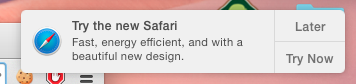
You know how much Google nags about Chrome? When I signed into Gmail on a different computer, I got an EMAIL telling me Gmail is better on Chrome AND a blue nag bar at the top of Gmail asking me to download Chrome. And any time I sign into a new computer, I will get both nags.
That's weird because Google constantly threaten me that google.com will no longer work with my browser very soon and that if I want to continue using google.com I have to install Chrome.
Edit: Got confused. It's Chrome no longer having updates because of Vista on an old laptop.
I also tested with Firefox, but it seems they stopped pestering us FF-users now. For a long time though every single page owned by Google on the entire internets told Firefox users to "Upgrade your browser" (and yes, those words).
Guess once if by "upgrade" they meant to a new version of Firefox.
And then guess which browser my non-technical parents are using now, after I instructed them specifically to use Firefox to avoid problems?
Can you guess which company is now harvesting all their browsing data?
Especially annoying when I use Firefox and they lie through their teeth about Chrome being better.
(Yes, I know I know I know, opinions. But still FF has TST while Chrome has not, as well as almost any other feature except sending every last keystroke to Google.)
And I say this as a heavy user of google (still), as someone who has defended Google+ here (ducks), -and I'd even go so far as to say I've been a fanboy until a couple of years ago.
If anyone from Google reads this: Please, please, please ask management to stop this. We don't need another browser monoculture where web designers think it is OK to design only for Chrome like they did during IEs reign.


After trying to revert to Windows 7, it wasn't fully recovered (the scheduled tasks, created by Windows, remained corrupted). So I had to restore Windows 7 from my backup. But it seems iTunes remain confused ("can't sync due to unknown error") as apparently some permissions in user directories remain different than initially even now?
So I've added some registry entries which were supposed to mean "I don't want Windows 10." And I've hidden the updates that install "Get Windows 10."
Yet not only the Update tries to install the "Get Windows 10" every month (un-hiding the updates without me!), the updates last for hours (the famous svchost looping in some unnecessary checking of something that doesn't have to be checked almost infinite number of times).
(Unfortunately Linux isn't working optimally on the notebook either, making the touchpad unusable and not handling the vendor Fn keys.)
Now I know that the nags came with the security patch of IE, which means that I can't even avoid it if I want to have security updates installed. Horrible. How is then that the nag doesn't happen for business users if it's a part of the security patch?