The thing about Ray Kurzweil is that he's basically entertainment, in the same way William Gibson or George Lucas are entertainment. He excites and inspires the lay population, but is ultimately pretty weak on the non-fiction part.
There aren't any scientists that are saying, "hey, no, that whole advancing technology thing sounds like a terrible idea!" Of course that would be awesome. The reason Kurzweil gets ragged on by the scientific community is because when it comes to specific claims and technical details, his batting average is terrible. His books are notorious for making technical statements that are just simply wrong. One of my favorite graphs from "The Singularity Is Near" is a plot of linear versus exponential growth with a point labeled on the exponential curve, "the knee of the curve". He was trying to make a point about how exponential growth looks slow until it hits some "knee" and then it takes off. Hey, anyone, what's the derivative of e^x? Exactly. The neuroscience background he brought to "How to Create a Mind" was first-year grad student at best.
Kurzweil is a director of engineering at Google, not the director of engineering as per the article, and Google has many of them. He is an entertainer who attracts attention and sometimes asks interesting questions. I wouldn't worry too much about specific technical statements he makes today. He's way out of his research area of OCR and text-to-speech.
Some say most of his singularity stuff has to do with his personal fear of death. He's good with hardware predictions, he doesn't understand software nearly that well. And his understanding of biology is trivial.
"When computers can achieve these things it's not for the purpose of displacing us it's really to make ourselves smarter," Kurzweil says. "And smarter in the sense of being more loving... Really enhancing the things that we value about humans."
Sounds an awful lot like wishful thinking on Kurzweil's part. Does he have any strong arguments for why superhuman intelligence will be chiefly interested in bettering the human condition, without displacing us in important ways? Certainly can't find historical evidence for this, in the way human beings have treated less intelligent species, or even less developed human civilizations.
I have nothing to back this up with (just like Kurzweil.) but I have a gut feeling that if superhuman intelligence were to emerge, it would quickly become preoccupied with things only it can think about, and largely indifferent to the needs and concerns of normal humans. It may also become frustrated by not being able to explain things in a way that we understand, and may just give up on trying.
Dr. Manhattan from Watchmen, or The Powers in Vernor Vinges "A fire upon the deep" are what I'm thinking of.
I lost a ton of respect for google when they hired Kurzweil, and more when I realized they put money into the singularity thing. Didn't they realize that Kurzweil will tell them what they want to hear for free, too?
Oh come on, you can slight Kurzweil for his whacky futurist theories, but allowing him to work with Knowledge graph seems like a tremendous use of his talents. His insights (and accomplishments) in machine learning aren't to be taken lightly.
Don't freak out. I'm personally dubious of most things he says. The ideas are often evocative, but I feel he has no grasp of the practical difficulties of his claims.
Except that he has been building leading-edge artificial intelligence systems since he was a teenager and studying those practical difficulties you mention for decades, and has now been hired as a Director of Engineering at the world's leading information technology company to lead the effort to build the most capable natural language understanding system ever created.
Would you like to be more specific about those technical difficulties that Mr. Kurzweil hasn't grasped? Or are you just saying that because you find it hard to believe his predictions?
Ray Kurzweil has been discussed several times on HN, I recommend diving in archives to read in-depth conversations about the topic with arguments from both sides.
But to summarize what a lot of smart people say about him– he hasn't produced any original research in the past decade or so, and his latest "revolutionary" book contains a lot of information that neurobiologists consider either plain out wrong or grossly over-simplified. Mitch Kapor called his ideas "intelligent design for the IQ 140 people".
It is also worth noting that the timeframe he lays out for most of his predictions about singularity-style technology ("computers that feel and love", "eternal life") seem to match the boundaries of his natural lifespan (i.e. in the next 30 years). Some have seen here the signs of a man who's getting older, terrified of death, and trying to convince himself and everyone else that he is not doomed to go through the human condition.
As you highlight, he has produced a lot of great things, but it is not unheard of for brilliant minds to become quite kooky in their old age.
>Except that he has been building leading-edge artificial intelligence systems since he was a teenager and studying those practical difficulties you mention for decades,
Except that you can do all these things and still be prone to wishful thinking.
Especially if there was a traumatic event involving, say, the loss of your father, an event that makes you obsessive about your mortality, eternal life through tech et al.
Linus Pauling even had two nobels, but he was saying BS about Vitamin C. And Wilhelm Reich was a smart guy too, until he got lost on his own make believe world. Ditto for Nash, ditto for Godel, Howard Hughes, the list goes on.
Genius and insanity are not that far. And merely-brilliant (which Kurzweill is) to obsessive wishful thinker, are even closer.
Especially if you have an audience of ex-hippy rich Californians that like to hear your transcendental techno-religious jive.
Maybe we should all be a little bit more obsessive about our mortality.
I think that if you can look at all of the amazing transformations technology has made in the last century and not have high expectations for even more incredibleness then you are not understanding reality correctly.
>Maybe we should all be a little bit more obsessive about our mortality.
This generally leads to an early grave, emotional paralysis in real life, and the "thousand small deaths" of the coward. Like Howard Hughes, Godel, Michael Jackson, and tons of other examples.
Nothing worse for living your life to the fullest than being obsessive about mortality.
>>"Like if I see a television commercial for baby diapers, I'm annoyed by it because I stopped buying baby diapers 30 years ago. But if I get an ad for something I really care about, some new supplement let's say, then I actually appreciate the ad."
He's already talking like a Google public relations robot. Google has been trying to substitute ads for content and trying to get people to go along with it. Of course Google can show you a multitude of sites about supplements and maybe 2-3 ads, not 30 ads and a few results (buried by ads.) Just because an ad is "relevant" doesn't mean it's anywhere near the same, financially speaking, for the user. Of course Google can do whatever they like, provided it's legal, but then we have the right to question their motives.
I don't care if this gets down-voted to oblivion by the ever-busy, MV worker bees
> Google has been trying to substitute ads for content and trying to get people to go along with it. Of course Google can show you a multitude of sites about supplements and maybe 2-3 ads, not 30 ads and a few results (buried by ads.) Just because an ad is "relevant" doesn't mean it's anywhere near the same, financially speaking, for the user.
Having money and having valuable information are not 100% correlated. Therefore, showing only information published by the people with the will and the means to promote it will always have some problems.
You want evidence that the most advertised product is not necessarily the "best" one? OK, but right after I prove that the sun rises, more or less, from the East.
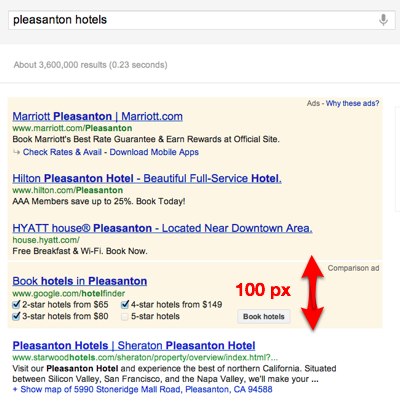
Placing adds at the top of the search results. It's basically saying hey just FYI you may be interested in this add vs the adverts to the right which are clearly adds and generally less related to your search.
Ah. Well, I can scroll down. But it does reminds me of complaints about the shades of yellow used. It is #FFF8E7 BTW. On some laptop computers, it does look more whitish the more you tilt the screen to the front. As for why, read Douglas Bowman's infamous post about why he quit Google for clues.


There aren't any scientists that are saying, "hey, no, that whole advancing technology thing sounds like a terrible idea!" Of course that would be awesome. The reason Kurzweil gets ragged on by the scientific community is because when it comes to specific claims and technical details, his batting average is terrible. His books are notorious for making technical statements that are just simply wrong. One of my favorite graphs from "The Singularity Is Near" is a plot of linear versus exponential growth with a point labeled on the exponential curve, "the knee of the curve". He was trying to make a point about how exponential growth looks slow until it hits some "knee" and then it takes off. Hey, anyone, what's the derivative of e^x? Exactly. The neuroscience background he brought to "How to Create a Mind" was first-year grad student at best.
Kurzweil is a director of engineering at Google, not the director of engineering as per the article, and Google has many of them. He is an entertainer who attracts attention and sometimes asks interesting questions. I wouldn't worry too much about specific technical statements he makes today. He's way out of his research area of OCR and text-to-speech.