There's one graph that basically predicts which countries are going to fail and which are going to prevail. It's the graph that shows how many people in the "doing things" age bracket a country has.
A key aggravating factor is most countries in the first group have stagnating productivity and the country in the second group has raising productivity on top. This creates a compound advantage for the country in the second group.
It seems likely to me that there is almost no degree of anti-national behavior the government of that country would need to exhibit or no amount of country-eroding policies that could forfeit this fundamental advantage. They'd need to get their country literally nuked or something similarly catastrophic.
Europe has largely converged on American growth, the East in particular continues to grow fast. But more important is that this is obviously an intentionally selective group of countries. Add Taiwan or South Korea to this story and it becomes a lot more complicated, because the latter is about to/has overtaken Japan on a per capita basis while having some of the worst demographics on the planet.
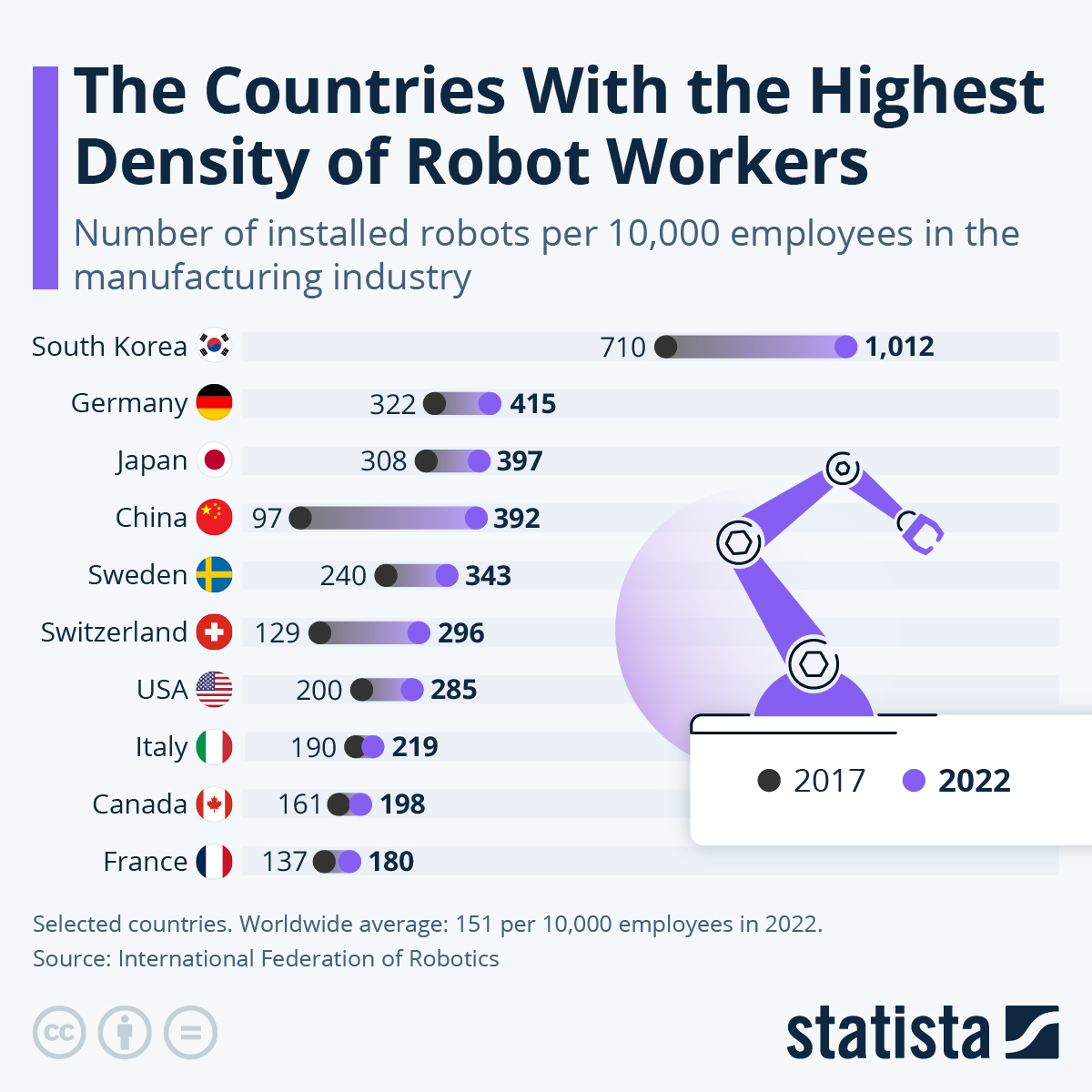
There's research by Keyu Jin that actually shows the opposite, globally growth after the year 2000 has been faster in aging countries for the simple reason that it increases returns on labor saving technology, i.e. automation (telling image:https://cdn.statcdn.com/Infographic/images/normal/13645.jpeg) and that is, even if you are conservative on technological developments in the next few decades, likely to accelerate quickly.
It is an important variable. But a more realistic picture needs to factor in:
  1. median IQ
  2. skills
  3. future unfunded liabilities (welfare, pensions, public health, etc)
China has demographics collapse like the West but they have high median IQ, high skills, and almost no unfunded liabilities. Meanwhile, Western IQ and skills are dropping like a stone and they have trillions in unfunded liabilities. And any attempt to fix it is either a drop in a bucket or going to trigger massive unrest. Just see what happened in France a year ago.
I hope China learns this lesson an makes some changes. At least they have a bit more runway to do so.
I think this really depends on how you define unfunded liabilities. China, for example, has mostly not established liabilities because the social systems for retiring are a joke. People instead save personally and shovel those savings into real estate, but the real estate market is collapsing/collapsed because it turns out all that retirement saving driving up the median-house to median-income ratio to 40+x was not sustainable.
To put in perspective how bad that is, cities the West considers expensive:
Paris is 17x
London is 12x
NYC is 9.7x
San Francisco is 9x
---
Shanghai is down from peak but still at 33x, and that's a correction. Either people still can't afford to buy homes, or a large class of homeowners will become destitute elderly people and all that entails for social stability, or the government will have to make up the difference somehow.
I’d also add that China actually does have future pension liabilities. China’s past one child policy is causing the pyramid to quickly go from 4-2-1 to 1-2-4 in terms of ratio of working to dependents; and young people are already not participating in pensions because they think its highly likely the systems will go bust and they won’t see a cent of their contributions.
Canada doesn't feel like it's winning despite what the graph says*. Bringing in tons of working-aged immigrants has caused housing (and other living) costs to explode, which in turn has lead to less people having children, which leads to more immigration to fill the gap and the whole thing has been spiraling. Not fun at all.
The problem with just "living by the graph" is that it ignores whether the country has the capacity to provide basics like food, clothing, shelter, and employment to the population. You need to have both to have the working-age population be able to engage productively in the economy.
The problem Canada created is that it tried to reset it's population graph without ensuring that there was an adequate supply of said basics, and in many instances (housing, food prices) had policies that actively undermined what needed to a happen to support a rapidly expanding population. JT and the other liberal leadership read the Century Initiative and all they took away as "we need 100m people!" (https://en.wikipedia.org/wiki/Century_Initiative)
It's not that a country couldn't theoretically be successful resetting their population graph through immigration, but that they would also have to do things that would cause housing prices to fall or more competition (ie less corporate profits) in the other sectors to absorb the extra demand generated -- 2 things Canada has been absolutely unwilling to do in any meaningful until late last year.
Yeah there has been a pretty definitive drop in overall productivity in Canada since the sudden increase in population.
I believe the economic term is population trap, where your society / economy can't expand fast enough to make efficient use of the addition in capital.
It is pretty clear based on the constantly decreasing GDP per capita.
Housing is very expensive, but inflation is largely tamed, unemployment is low, and the government is running surpluses - so things aren't terrible (despite what the Murdoch media say). Birth rates are falling, but I'm not sure how much that really matters given immigration.
Immigration is no excuse for the Canadian housing shortage. Canada is one of the world's largest land masses, and - even in its South - mainly uninhabited.
This seems to be a problem especially concentrated in the Anglosphere. Britain[0], Canada, Australia, and to a lesser degree in the US due to its libertarian streak. I wonder why that's the case?
I don’t know about the others but many in Canada believe they have the right to an unchanging environment. They just want to “get theirs”, kick out the ladder, and everything stops at that point.
Homeowners still make up the majority of the voter base so they will vote for municipal candidates which prioritize not changing things.
My prediction is that things will inevitably flip when the “have not” group becomes larger than the “have” group, but that might not be for a while as home ownership only became truly unbearable maybe 10-15 years ago.
Another factor is that generational wealth plays a big role in home ownership. The dirty secret is those mid 20s couples down the street did not purchase that house on their own, the either got cosigned by another family member with a hefty down payment gift or they inherited wealth from grandma. There is no estate or gift taxes here so families can perpetuate class transfers forever.
It's happening in almost every developed country. Everyone introduced similar planning/zoning regimes following the post-WWII rebuilding (possibly as an overcorrection to unpleasant prefab buildings), and 70 years down the line they're paying the price.
One problem is that many Canadians move away from those smaller cities because there aren’t jobs that pay well, yet that smaller city isn’t significantly cheaper to live in.
Nobody I meet is from the major Canadian city I live in now. Maybe it’s a fluke, I have only met so many people, or maybe us outsiders just managed to find each other.
This is where WFH could have changed the landscape in Canada but alas, even the federal government is getting on the back to office bandwagon. A whole bunch of your taxes are handled in Sudbury because they setup an office for the CRA there. When you call a company, if you're not talking to an agent in India/Philippines, you're probably talking to one in St John's. Unless you need to be physically present to do manual labour, there's a lot of work that can be done remotely outside of the 3 big cities. It could have been the solution to the death spiral many towns out east are facing.
I don't think its similar because this time those are not war thorn nations, it's just a period of population decline.
IMHO post communist countries after they got their shit together is closer analogy. They all had their infrastructure built, they had a well educated population and the problem was and its still is that there are not many young people to look after the aging population.
China still has a good chunk of population in rural area that will keep supporting urban population growth for a while. That being said, I'm not sure how any of those graphs translate to quality of life of an average person living in those countries.
When shit hits the fan, there will be drastic changes, just like how Japan is accepting more and more immigrants every year. That tap will be cut of in a decade or two, because every country will be fighting for them unless we have some magical economical overhaul. I have zero clues what predictions can be made for 2050 in terms of demographics.


Compare these:
(germany) https://population.un.org/wpp/graphs?loc=276&type=Probabilis...
(alternatively, Europe as a whole) https://population.un.org/wpp/graphs?loc=908&type=Probabilis...
(Japan) https://population.un.org/wpp/graphs?loc=392&type=Probabilis...
(China) https://population.un.org/wpp/graphs?loc=156&type=Probabilis...
to this one
(US) https://population.un.org/wpp/graphs?loc=840&type=Probabilis...
A key aggravating factor is most countries in the first group have stagnating productivity and the country in the second group has raising productivity on top. This creates a compound advantage for the country in the second group.
It seems likely to me that there is almost no degree of anti-national behavior the government of that country would need to exhibit or no amount of country-eroding policies that could forfeit this fundamental advantage. They'd need to get their country literally nuked or something similarly catastrophic.