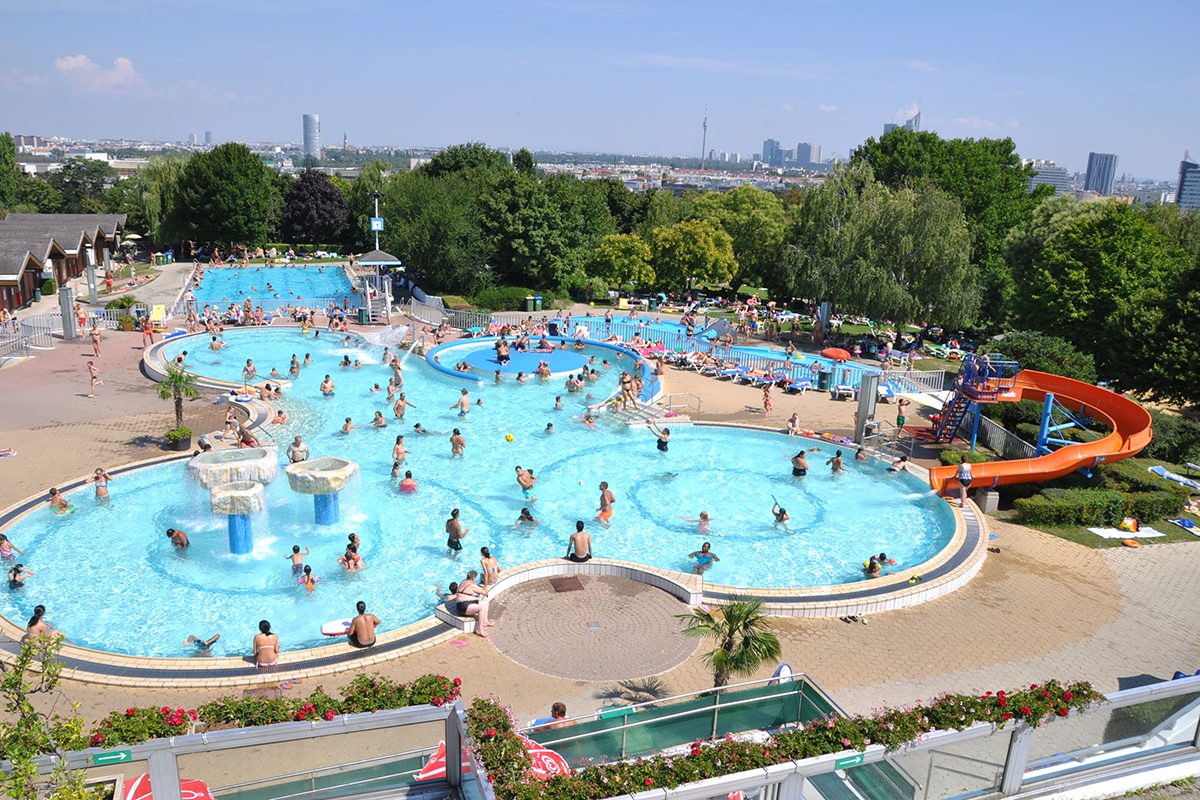
American living in Copenhagen here. We check all of these boxes. The entire channel that runs through town is swimmable thanks to decades of work cleaning it up. On a warm summer day, you could expect maybe 1000+ swimmers in the water in the city centre across all the locations. We also do Vinterbadere (Winter Bathing) throughout the year. The only time you can't swim is after a day or two of sustained rain and there is an app and red/green light system. My family lives on one of the new infill man-made "islands" and we have canals that run through our neighbourhood and you can swim laps around our apartment building.
It's just fun/sad reading about the concept of "swimmable cities" when you've taken it for granted all your life. Most cities with fjords or channels here, have "harbour baths" - essentially outdoor swimming facilities with springboards and tanning beds. Would have thought these existed elsewhere.
Is there specific agencies or services that will help look into relocating? My wife and I visited briefly a few years ago and have not stopped thinking about it since. It was everything we wanted that North American cities just don't offer due to our heavy vehicle-centric urban planning.
Someone at this company gave me some advice a while back: https://gatewaytodenmark.com/ - but I don't know if they mainly focus on corporate clients or what.
If too many Americans move there it'll just become the naval equivalent, everyone driving around in their massive twin outboard speedboats rolling coal to go grocery shopping and nobody will be able to swim anymore there either lol.
In Geneva, apart from being able to swim in the massive Geneva lake (100km long, crystal clear like most seas), one can swim portions of Rhone that flows out of the lake. The only exceptions are places where it can drown you or chop you up quickly due to some water constructs (for lack of better words).
Its also quite popular to hop on some inflatable boat or mattress once its safe, just before Jonction [1] which is amazing place on its own, and just take the slow flow for couple of kms in very nice forest environment. Basically till next dam.
Zurich has very similar situation, just way more restricted for free lake swimming.
It wasn’t always the case that the lake was clean and swimmable—as a kid in the 90s I remember it as kind of a “new thing” to be able to, since it had been polluted for decades and people came to prefer the public pools.
Not OP but my partner lived in Copenhagen for two years. As with all of Scandinavia fluency in English is very common, practically universal in cities so you can happily live there without speaking a word of the local language. Also unlike most of Europe it's a lot more acceptable to just assume English is spoken and lead with that rather than stumbling through in the native language to start with.
That said it's still polite to learn some basics, e.g. thank you to mix in. If you're planning on living there long term you will want to learn Danish for social purposes unless you're planning to mix exclusively with immigrant communities. It's a very international place so English can often be the default language that any given group will all speak.
Edit: oh and an interesting quirk English is often spoken with an American accent! I think because they watch a lot of American TV shows and movies.
> Edit: oh and an interesting quirk English is often spoken with an American accent! I think because they watch a lot of American TV shows and movies.
We (mostly) ditched received pronunciation / transatlantic accents in school in the late 20th century. IME, the (taught) accent is now primarily a construct of what Swedes perceive to be how English sounds. American culture has a strong influence here.
In the population aged over ~50, it's not uncommon to hear RP / Transatlantic mixed with a heavy and thick local accent, with/without Scandinavian words thrown in.
"I would gilla to order one glass tack" (I would like to order an ice cream please)
> you will want to learn Danish for social purposes
Are non-Danish speakers really going up to B2+ Danish, even if they live in Copenhagen for a decade? It seems like Danish people would still speak better English and non-Danish people would almost certainly speak better English.
I live next door in the Netherlands in a city in the south. You don't learn the language because it's required to survive but to be polite and assimilate and make local friends. All of the Dutch friends I currently have are other expats, but now that my language skills are better, I'm trying to make more friends that I only speak with in Dutch.
Also, once you get to B2, you will naturally get to C level if you interact with the language every day. It might take years, but you'll get there!
Yeah, exactly. I have said before that I think as an American it is easier to fit in culturally in Denmark than it would have been if we moved to the UK.
4 years. My kids are fluent now because we threw them directly into Danish public school cold-turkey as it were. My wife has studied a bit and knows some. For my part, I've just been too busy with work to learn much Danish and 99% of work is in English across a few organizations I've been with while being here. And 100% of the people you meet in Copenhagen will speak English near fluently so it is not necessary for daily life. In fact, you are more likely to find restaurants where nobody speaks Danish in the city. All of this is different if you travel to rural areas of course. It only becomes a problem if you are in a social situation with a bunch of Danes because they'll want to socialize in Danish. In small groups it is fine, they'll switch to English for me, but a big group makes it harder.
I moved to Copenhagen a couple of years ago. Still learning Danish but you can get by with knowing only English without any problem. Pretty much everyone can understand you.
For the record, I've only seen it red once or twice all year, so the odds are already in your favor. And at the more popular swim spots, there will be a physical sign with a little green or red light.
Arguably a lot of people consider it too cold most of the year.
But otherwise I would say that when the weather is good the water is filled quite up with people at a comfortable level!
During covid, my wife went every single day for months through the winter. There are lots of Danes that go for "streaks" of going every day as well. Oh, and speaking of streaking, especially in the winter they'll go in fully nude. As you don't really want a wet bathing suit to deal with when it is freezing out.
It's fascinating how some people make it a daily practice, not just for the physical benefits but also for the mental challenge and resilience it builds.
I just moved to a Dutch city with a large canal and I'm definitely jealous that you can't swim in it! Luckily we have a lot of small recreational lakes that are clean and have other accessories for swimming.
Yeah, in my city it's not that bad in the canals, but we have PFAS and GenX thanx to Chemours, down south we have 3M from Belgium dumping PFAS. Other rivers have crap from Germany.
They say: You can swim, it's not that bad, but eat 1-2 fish from said river and you're over the max your body could (theoretically) safely ingest for a year.
Since all other replies are a bit too concise, I'll try and dive deeper (ha ha).
1) Naturally, rains wash out street grime and small pieces of rubbish which may easily bypass the sewage system altogether and end up in the river.
2) Cities have systems in place to treat wastewaters before releasing them into the rivers. However, these systems need to store yet-untreated water in reservoirs, and heavy rain may fill these up. Then, the only solution (if you don't want sewage to blast out sewer holes) is to release the water without treating it. In fact, one of the main upgrades made by Paris for the recent Olympics was a massive, 30-meter-deep new basin [1] built exactly to mitigate that risk.
So naive question.. but how can they ensure all the water upstream is clean?
I guess in Copenhagen its water is coming from the Baltic so maybe it's less of a concern (short of container ships having issues near the city). But the Seine river flows through many communities before it reaches Paris. Many opportunities for actors to illegally dump things in the river and for all sorts of nasty runoff agricultural and otherwise to make it in periodically along the whole stretch.
Continuous water testing at the city limits also sounds impractical
> Continuous water testing at the city limits also sounds impractical
Why? Surely a small team of a few people could have that as their job, and it would be completely worth it, to help keep all the people that want to swim safe.
And like, aside from the manual testing of the water that this team would do once or twice per day probably, they could have a few different sensors to catch some of the most likely kinds of pollution.
On top of that add hefty fines and maybe even a year or two of jail time for anyone caught dumping pollutants into the river, and you have a good disincentive against polluting the water.
And have a strong sense of pride of nature in the country so that people will naturally want to be mindful of the environment we live in. Promote this kind of thinking in schools and in public service announcements (billboards, ads, etc) from the government.
It's not technically impossible to continuously monitor a river, but as the neighboring comments shows, it's kinda of cutting edge stuff and basically nobody is doing it. It's also very much not cheap. Pinpointing where upstream someone dumped stuff in the middle of the night is virtually impossible
Advances in remote sensing are making continuous water quality monitoring much easier. At our company we use a combination of satellite imagery and in situ optical sensors to monitor rivers and reservoirs. As well as a general water quality index, we can estimate concentrations of harmful nutrients, chlorophyll-a, phycocyanin, suspended matter, dissolved organic carbon to name a few.
A further advantage of satellite remote sensing for water quality is that it can be done by a neutral third party, without permission or access to the land, which can help bring a bit of objectivity to the politicized narrative around water quality we are seeing at the moment.
multiple daily satellite images of the whole length of a river... I know you can purchase these kinds of satellite products, but as I understand it - it's incredibly expensive. Doing that all year round seems cost prohibitive
It seems to be normal practice. Two weeks ago Russia poisoned a river flowing across the border into Ukraine. The standard monitoring tools and infrastructure seemed sufficient to monitor the situation.
Yeah, it is helped by the geography. The channel in Copenhagen isn't a river, it is directly open to the North+Baltic seas, so we don't have this runoff type challenge of other European cities.
Copenhagen’s sewage system was built in the 1850s and it was indeed considered to build a two-pronged solution. There was much resistance against this because it would eliminate a whole industry of “night men” (poop collectors), as well as people drying and trading it as fertilizer. So they build a single-pronged solution that was initially only allowed to be used for rain water.
Runoff water (which contains nutrients, metals and organic compounds) add to the volume/discharge of the water system while also increasing the amount of suspended material in the water (turbidity).
The increase in water discharge also causes sediment to lift from the bed where e coli bacteria live happily in the sediment (think of shaking a bottle with solids that have fallen to the bottom). The potentially harmful bacteria is now suspended in the water for a few days, also growing in number as a result of the runoff nutrients until the increase in the water volume drops and the water can no longer suspend the sediment.
This cycle is the largest reason why, it's not just the runoff (which can also contain animial feces with e coli, etc), it's the runoff with nutrients stirring up the water and lifting e coli which then feasts on the nutrients.
Pools are expensive to build and they almost always need chemicals and filters to be safe to swim in making them expensive to run. Where there are natural lakes/streams/ponds they are typically safe to swim in and much cheaper.
Which is to say anywhere pools are the primary place people swim, they will be few, small, and generally overcrowded (and also expensive). If you live where there are natural places to swim you will generally find it better, but many places don't give you those options.
Well, I meant it in contrast so some places that do Polar Bear dips or whatever just on New Years Day or whatever. Basically, people swim 365 days a year here. It doesn't get cold enough for the channel to freeze over, but we sometimes get some ice by the shore and the hard core ones will chop a hole.
Vienna is very swimmable. Not right now, because its cold and rainy, but on a hot summer day thousands of people gather and swim in the Danube every single day. It's amazing, the water is relatively clean, small fishes inside, its a joy for children and adults alike.
I usually went with the kids to Angelibad before, I really like the vibe and they love the ice cream, playground and kids pool. Now they're getting older, so we're either directly go somewhere to the Donau or hang out in one of the other baths like Strandbad Alte Donau or further down.
I normally don't like sweetwater for swimming and stayed away from the Danube for years. I was expecting the muddy smell and all, but this one's really great - I should've tried it earlier.
You can swim there if you want! there's a picture with ppl swimming in Viennas canal (Donaukanal) on the website and there's a whole association around it which claims 300+ members: https://schwimmvereindonaukanal.org/.
That being said, Donauinsel is still quite close to the center and I personally prefer the relative quietness and greenery around there to swimming in the canal.
Yea, Alte and Neu Donau are safe but Donau and Kanal... I see people do it with a balloon strapped to their waist for visibility to boats, but I wouldn't do it.
Those pontoon ferry boats travel over 30 km/h on the Kanal.
Yeah, but I see plenty of potential for improvement to make it more accessible. Start with the information, even many Viennese I've met don't know swimming in the canal is allowed. Putting up some signposts at places suitable for swimming would be great.
I was in Novi Sad for work a few years ago, they've got a walkable boulevard, artificial beaches and beach clubs set up along the Danube, it looked really nice.
This is a great initiative. It is weird if you think about it. Why are our waterways in many cities so polluted and dangerous that you can't use them safely as a human(or any animal)? We should take more care about making the environment we live in safe and accessible for everyone.
“In its evidence to the committee, the Environment Agency said that in 2021 the environmental performance of water companies was “at its lowest ever level” and the performance of most companies was declining.”” - https://lordslibrary.parliament.uk/cleaning-up-failures-in-w...
“Sewage spills in the UK hit a record high in 2023, amplifying public anger at the state of the country's dirty rivers and the private companies responsible for the pollution, such as the country's biggest supplier, Thames Water.”
- https://www.reuters.com/business/environment/uk-aims-curb-wa...
That tells us nothing useful about the state of things 15+yrs ago. Only that 2023 was the worst. Could have been bad for 100yrs, just the worst in 2023.
Everything gets spun, but the simplest way I can understand this is that water shouldn't be getting dirtier in England. It should be cleaner. Of course the regulate-everything crowd will jump on this as delicious confirmation bias, but there are also plenty of sensible people who also think this is worth investigating and enforcing.
It tells us enough to counter the low effort "even just cleaner 15 years ago? lol, they were not". If 2023 was the worst it had ever been, then they were cleaner at all points in the past. Q.E.D.
They're dangerous because waste management (sewage, drainage, etc) was dependent on the waterways for hundreds of years; only with modern infrastructure, laws and regulations and good water management can you change it. And even then a lot of places also depend on what's happening upstream, e.g. the Rhine passes through various German industrial areas, the Nile passes through half a continent, etc. Besides that, it'll be weather dependent; if there's a dry spell and not enough water flow, toxic algae or bacteria build up.
I don’t think that as a child in the Netherlands I ever contemplated that water might be dangerous for any reason other than drowning. It’s bizarre to hear that it’s true in any first world nation.
Yes, and we have blue algae alerts on ponds and lakes where I live. Kinda sucks when you go to a lake to swim for your family vacation and you can't because it's toxic.
I was in Basel last summer. The Rhine splits the city in two, and all along it's shore is a boulevard / terrace / stairs to the water, and it felt like the whole city was swimming in it along the entire length.
* Farmers having runaway water with lots of nutrition makes algae bloom
* Hotter summer also lead to more algae
* More unstable climate with flash rain makes sewage seep out into the fjord when the water handling stations can't handle the flow
* Fishing boats are destroying the sea bed
If this isn't turned around, our nice fjord will soon be dead, and possibly not safe to use.
Yeah there's this focus on cities where things are getting cleaned up but in rural areas the fertilizer and intensive agriculture makes the rivers (and fjords?) toxic. Check out the Des Moines river in Iowa. Seems absolutely insane that a rich and ostensibly well-run country like Norway isn't prioritizing health and environmental safety for its citizens.
While city folks like to blame farmers for the problems in Iowa, the soil in Iowa naturally makes nitrates which runs off into the streams after every rain. We have death reports from the early 1800s that on rereading with a modern eye make it clear that the problem was drinking water with high nitrates. This is both what makes Iowa such great farm country, and what makes streams harmful.
Not that fertilizer isn't making things worse (though sometimes it makes things better - farmers don't want their expensive fertilizer to wash away and so look for ways to keep it on the field), but it isn't the whole story.
Living on west coast of Sweden, our family went to Stockholm this summer and as the temperature rose, we asked were to go and swim and basically no one knew and we didn’t see people doing it either.
That's rather weird, it's one of the most popular summer activities in Stockholm. I personally swim almost everywhere around the city with friends during almost the whole summer, just need to check beforehand on Havs och Vattenmyndigheten daily updates if any bathing areas have been considered inappropriate that day [0].
Most areas are considered appropriate for most of the summer in the inner city, while lakes are everywhere outside the small centre, and quite many are private enough that you can find spots to go skinny dipping without a second thought.
Some popular in inner city: Tanto strandbad, Långholmsbadet, Smedsuddsbadet, Fredhällsbadet, Kristinebergsbadet, Brunnsviksbadet. Plenty of folks swim during hot periods in summer.
Yes, we went to Tanto but considering how much water that Stockholm is surrounded with, I can’t say it’s very accessible. That is also the view of some friends living there.
If it's a beach that's appropriate for smaller kids you're after with shallow water, yes you probably have to go to the more prepared beaches with sand that has shallow water a bit out.
Many places in central Stockholm have been built out from natural beaches by claiming water so the water will be deep at those points (probably held quays that was used for transports before trucks took over), but even in many places like that nobody would bat an eye if someone took a non-nudist swim.
Apart from the extremes most local teens and upwards will find cliffs by the water, as mentioned not appropriate for smaller kids and seniors as it's adjacent to deep water but perfect otherwise.
Well now I feel compelled to make a Gothenburg-centric remark, ha ha.
I literally swam not far from the archipelago pier last weekend, and there are many swimmable lakes around the city. Since we're talking about swimming in the city, the best option is likely the brand new public spot in Frihamnen [1].
Locals mostly don't swim in the swan/canning estuary because it's full of jellyfish[1]. The water quality is fine but ... ewww.
They're not particularly harmful ones but you don't want to get any part of them in your eye.
I have heard, though can't substantiate, that the mass jellyfish population (and there really are swarms of them) is down to the ecosystem having been basically plundered to extinction, and jellies having colonised. I guess in time things that eat jellies will become more prevalent and eventually a more normal ecosystem may return. The jellies appear to be introduced from the queensland area, and may have arrived in ships ballast.
Also yeah, poor woman, jumped in to swim with the dolphins and one of them wasn't a dolphin. Bull sharks have been seen fairly far upriver too. Rather take my chances in the sea.
I'm a West Australian local, lived in Perth-Fremnantle in the 1980s and was often in the river, swimming, kayaking, falling off the river cliffs and bridges when climbing, or occassionally doing what is now no longer possible; opening the door and jumping from the Fremantle train as it crossed the rail bridge over the harbour.
Oh wow. I can see the appeal when you're a kid, but that guy should probably have known better!
I'm a recent import so I guess I'm giving my impression of why I wouldn't swim in the river, and I haven't seen anyone swimming in the river much, not round South Perth or the city centre, or the wider bits of the Canning river in the waterford/rossmoyne area before it joins the Swan.
I was 18 or so at the time and it was pretty small beer next to, say, solo shooting the horizontal falls in a kayak or climbing the Centre Point Tower in Sydney *
> but that guy should probably have known better!
I have no way to judge, I wasn't there and I don't know the person involved. If it was a drunken spur decision he was likely an idiot to try, if he had the angles sussed and knew where the piers were then that makes it a calculated move rather than how the newspaper article paints it <shrug>.
Interesting to see Sydney Water put their sponsorship near the top of this. So much of Sydney including its larger rivers and waterholes are swimmable. Even our unique (but not very well known) ocean pools make many of our more dangerous surf beaches accessible.
"Ocean pools" in Australia are large pools, often square or rectangular regular swimming pool shaped, that are set next to the ocean at sea level and can be connected or pump filled (ie tidal or permanent level).
It's sea water, but without the sharks, wave action, rip currents, jelly fish, Bondi cigar's. etc
The N'West has Dampier's Shark Cage Beach - not a rock pool but a large steel fence enclosed swimming area to keep the sharks and the shark snacks seperated.
In Belgium, we don't even have swimmable pools. There are too few of them, their opening hours are worthless, going for a swim is stupidly expensive (~8eur), and many pools now require that you show them ID before you're allowed to enter. In all, it's become extremely unpleasant.
The results are as depressing as expected: more drownings (especially in the north sea) every year, and kids can barely stay afloat anymore.
There's a shortage of lifeguards, and (imo) some serious overregulation. No swimming allowed anywhere unless there are lifeguards on duty. It's a catch-22. People don't swim, so they suck at swimming, so they drown when they do swim, so we get more restrictions, etc.
I have the same frustration about Belgium's overregulation, especially because across the border in the Netherlands you're basically allowed to swim anywhere you want!
On a related overregulation note, I visited a playground in Leuven recently where they had to decouple the water toys because regulations requires playgrounds to use drinkable water for water toys, and the eco-warriors were against spilling drinkable water for the playground. Again in the Netherlands they just pump ground water for the water toys in playgrounds
In Belgium, I pay 4.5 eur as an adult to use any of the numerous swimming pools around me. Also, I never had to show my ID once in my lifetime to enter said pools. My kids are perfectly afloat and learned to swim with their school by going to the pool every week.
Not denying your personal experience, just sharing another point of view from another part of the country.
Same experience as the sibling, here in Antwerp. The swimming pool I sometimes go to is 4 euros (2 euros for people less than 25) and for 5 euros there's an open air heated swimming pool on Linkeroever.
Also this summer one could swim in the Bonaparte dock, in the old harbour in the city center.
I suck at swimming though, although I grew up on the Atlantic coast right next to the sea and bathed daily each summer. So I prefer shallow coasts rather than swimming pools.
I'm not sure which pool you're using, but Wezenberg is 5eur for adults, or 7.50 if you don't live in Antwerp. The cheaper pools (e.g. Plantin or Groenenhoek) are 4 or 6eur, and their opening hours are ridiculous (pretty much only open during office hours and a couple of hours during the weekend).
Many municipalities don't even have a pool anymore, which forces people to use the pool in the nearest city and pay the higher prices. Some schools have stopped swimming classes entirely because of a lack of pools.
Are you saying €8 is not too expensive for a swim? That's an insane price.
Yes, the ID thing is preventing me from entering. It's not about keeping "undocumented and migrants" out. It's allegedly about keeping troublemakers out, but it's yet another pointless deterrent. There's no need to force everyone to show an ID to enter a pool simply because of a few bad apples.
I don't care about your bizarre rhetoric about "how low Europe has sunk", please take your nonsense elsewhere. We certainly don't need razor wire or security guards in pools. Though, perversely, I'm sure it's easier to convince politicians to install those than it is to spend more money on lifeguards.
As someone who lives in Munich, the logo of "Isarlust EV" immediately jumped out at me. Unfortunately it's linked incorrectly - here's the correct URL: https://www.isarlust.org/ (German only).
Of course, the task is a bit easier for Munich than for other cities, as it doesn't have a lot of possible pollutants upstream of it. The other side of the medal is that the river is hair-raisingly cold, as it comes pretty directly from the mountains...
Paris is kind of partially swimmable in the Summer: a little portion of the Canal Saint-Martin is open to bathing under supervision during the months of July and August, only during weekends. This is because otherwise the canal is a dangerous place to bath because of the locks. The city plans to open the Seine to bathing by 2025, as well a small lake in the Bois de Vincennes. Things move slowly, but in a good direction.
I'm tickled by the African contact email address at the bottom of the page.
"Roomys" translates to "Ice Cream" - and with Nandos being a South African fast food chain, and well known for their razor sharp marketing department, I wonder what the story is there...
Lol, I searched it found it's somehow the email for the "Jukskei River Revival Collective". Also, I'm surprised to see Joburg but not the other cities; it's not really notable for rivers, at least in the city centre areas. At least it's a the biggest metro not built around a river or something like that.
My wife and I are going to summer vacation to Swiss towns that are on the river Aare for this exact reason. To me, floating in blue, transparent, super clean water on a hot day is heaven. Swiss are also individualist folk, so there is always many almost individual options to enter and leave the water or stay by it. It is depressing to come back to Berlin’s Spree and Havel that are both filled with cyanoalgae and Spree is also used for waste water when there is too much rain. It is lovely to see this initiative, perhaps there is hope for a clean swim in Berlin too.
Although for now, even switching the touring boats to electric engines, which should be easy enough (why do the private companies benefit from public space selling 25€/seat tours in the city center while spewing huge clouds of exhaust into the air and dumping oil and dirt into the river? – they should at least switch to clean engines and for a limited km range tours this would be sensible) is not done in Berlin. Even the ferries that the transport company operates are not all electric (cause they actually rent some of them from the private boat touring companies), although there they could even be tethered and not require a battery at all. Anyway, all of this is just optimistic hippie talk, I will rather just move to Switzerland than wait for Germany to clean up.
I’ve come across a video where Swiss people were commuting from work by diving into the river yesterday and it blew my mind! It looks so delightful. I’ve never thought about going to Switzerland for holiday but now it’s all I’m thinking about.
Thanks to the Clean Water Act, lots of the US is swimmable and clean. But we have a much bigger problem preventing it: lawyers. Lakes in State Parks will likely have swimming banned because people will not be self responsible.
Generally I think it is actually pretty much safe unless it has rained heavily recently. The last time I looked at the data, much of the harbor and Hudson have bacteria counts that are consistently within the safe-for-bathing parameters. The East River is the most polluted, however it also has strong and changing currents that make it less interesting for swimming.
Ultimately I think there’s just kind of a general inertia against it—a public perception that the water is gross (as it certainly was for generations), lack of facilities to easily enter the water, and a city government that’s not especially interested in promoting it, probably for liability reasons primarily.
Personally I’d love to see the Central Park reservoir made into a swimming place. As I understand it, it’s never actually used as a reservoir anymore and would be perfect for swimming if they built an entry point. Instead they arrest people who get in.
There's a large creek that feeds into lake Erie nearby that we used to hike and swim for several miles until we got to the lake. It was an all day affair, but it was a great time. Our dog at the time was a lab shepherd mix and I think those hikes were some of the best times of his life, getting to explore and swim and run like a goof. I don't ever want to live in a place without good access to large bodies of water, summers wouldn't be the same without it.
Seattle is swimmable. Lake Washington, Green Lake (both fresh water), and the Puget Sound (salt water) are swimmable in city limits. I swim in lake Washington 3 times a week May - October.
As in another comment here about Copenhagen, you cannot swim after hard rain because of how the sewer systems were designed. Seattle is famous for rain, but not the type of rain that will cause a spill over event often.
The county government also tests the water for bacteria and algae and reports the findings on their website and closures are signed at access points.
Also while there is a lot of private ownership of water access, there are 9 city beaches and something called street ends, which are public right of ways if a street ends at water, I swim from these all the time.
It takes less than a minute to walk calmly from my front door in an apartment complex to a public beach in Tampere, Finland. In my neighbourhood, you just see random people walking on the sidewalk in bathrobes on their way to the beach or back. It's 15 minutes walk from the city center.
In Toronto, we have a serious problem with out old combined sewage system and the lack of transparency from all levels of government on the reality of the water quality. I appreciate the work by Swim Drink Fish:
The name Swim Drink Fish comes from signs that are all too often found on shorelines around Canada: no swimming, no fishing, and no drinking. Our organisation’s goal is simple: restore the health of local waters so that every last one of those signs is removed. We strive for a world where every watershed can be enjoyed by the communities, doing what they love.
Can anyone tell me which city has the swimming pool right on the river that's on the home page?
In Michigan there are a lot of places in a downtown area that would be so cool in Michigan and it could double as an ice rink in the winter.
It would also be terrific to have a river pool or two integrated with Detroit's famed river walk but sadly Detroit's water just isn't quite there yet. Lots cleaner than in the sixties and seventies but cleanup efforts stalled a while back when the state stopped funding efforts and lost the federal matching funds.
All things being equal having clean waterways is better than hsn dirty ones but this doesn't really seem like a priority. Plenty of cities just don't have the climate or geography to make this possible and plenty of people can't or don't swim. Arguably NYC is very swimmable since it's mostly on islands but the waterways are fairly rough and very wide and result it at least a few drownings every year.
Being able to swim at a basic level seems like a fairly basic safety thing but I expect a fair number of people who grew up in places where swimming wasn't commonplace never learned. I went to school someplace that required passing a swim test or at least taking a class but don't know how rigidly that was enforced.
I was imagining something more like concept-city based around an extensive quasi-Venetian canal network, where "swimmable" (like "walkable") defined a possible mode of regular transport.
Me too. I like to think that, if humans survive to reach some kind of utopian, post-scarcity state, people will experiment with building places like this, just because they can.
I just spent some time in Basel, so I thought they'd mention about how the locals go for a dip after work with their wickelfisch and float downstream back home
This has to be a joke seeing how much of a fuckup "swimming in the Seine" for the Olympics has been, but I gather this writer hasn't kept up to date with people commenting on L'Equipe's related posts on social media. Maybe they just can't read French.
> This has to be a joke seeing how much of a fuckup "swimming in the Seine" for the Olympics has been, but I gather this writer hasn't kept up to date with people commenting on L'Equipe's related posts on social media. Maybe they just can't read French.
The Olympics and having the Seine swimmable for everybody are different things; the criteria for athletes and for the general population are not the same. The objective of having the Seine open to swimming again still stands and should be achieved by Summer 2025, as expected.
That being said the "swimming in the Seine" during the Olympics and Paralympics has been complicated but I wouldn’t call it a "fuckup"; triathlon athletes are used to these conditions (think about Rio, which had much higher contamination levels, or Sydney which had (risk of) sharks and bacterias), and nobody has been sick after the competitions.
Why would you think swimming isn’t a cultural thing in the US? Municipal pools are everywhere across the US - and practically a staple for southwest residences. The US produces some of the world’s greatest swimmers. It’s a part of school curriculum and while we don’t really have swimmable canal cities (like most of North America) there are plenty of opportunities to enjoy swimming.
From my experience, where I live (relatively affluent state, with Lake Michigan shoreline), it's highly regional who knows how to swim and who doesn't. People who grew up far south - not so much. Poorer folks - not so much.
I always find it weird when people don't know how to swim (being where I am from, born when I was born, etc.), so I've definitely noticed there's certain segments of society who tend not to know. What I do know is lots of people don't know how to swim.
Now - unrelated to my original post. I know a lot about the local river systems in our major cities. I wouldn't swim in even the bodies of water that look and smell nice (most don't). Actually, the rivers which don't look and smell nice are sometimes safer than the ones that do.
I think for some reason USA has quite big percentage of people who cant swim. Compared to some countries where its part of mandatory education and thus the % is much lower.
~80% of the US claims to be able to swim, though I've found some sources that say only ~60% have the "five basic swimming skills," but they don't seem to provide any details around how they determined that vs. the people self reporting the ability to swim.
I'm not even finding consistent details on what the 5 skills even are, though being able to get into the water, float, tread water, perform some sort of basic swimming stroke, and get out of the water were probably the most numerous.
I don't see how someone could claim they could swim and not be thinking of all of those things, though.
I don't remember the details of basic swimming tests but that sounds about right. The bottom line is that if you end up in the water within sight of shore under normal conditions you shouldn't panic or drown. I can easily believe 60-80% depending on the criteria. I haven't swum regularly for years and was never a real distance swimmer but I can swim by any reasonable measure.
It used to be pretty common for US schools to have a pool (often in the basement!) and teach swimming, but seems to have gotten less-so over time, I suppose because of the cost, and pressure from increasing costs in other areas.
I attended a couple schools that had pools in the basement that had been closed for a decade or more, and have heard of several others. The only one I know of that was still operational was in an old private school.
The US is a big place. If you live anywhere within a 2 hour drive to the beach, then its common to have weekend trips where you spend some time swimming in the ocean.
In the US, we've essentially banned swimming outside of a few lifeguard-monitored zones. There are no swimming signs everywhere and in places you wouldn't otherwise think should be banned, such as public lakes or beaches. People still do swim in these areas, but I remember a squad of cop cars showing up at Lake Artemesia near UMD because a woman was gasp swimming in the lake.
I used to regularly kayak in the River Thames (London, UK) - I didn't concentrate one day and forgot to keep the kayak always facing the current, and a small boat wake/wave knocked me over. I swallowed a little water while righting myself - as was burping a horrible metallic taste for days after - but I didn't get ill. Might have been helped that within an hour of falling in, I was at a friends 30th, and the alcohol consumed may have had some preventative effect? /s
I was kayaking on the Thames too (up in Richmond/Teddington), but on marathon/sprint kayaks which are very narrow and unstable, so most people in the kayaking club (hundreds of people!) flipped pretty regularly. We also went to swim from the pontoon in the summer every weekend for years. I can't recall anyone experiencing a persistent metallic taste, and I'm only aware of a single case of food poisoning in the club over the five years I was an active member, and that could be anything.
I do remember seeing seals, fishes, eels, kingfishers, herons, and cormorants though. The Thames is a lovely river with bad reputation because of the silt that tides are constantly churning up, and the only problem left (sewer overflows during heavy rain) will be finally gone next year when https://en.wikipedia.org/wiki/Thames_Tideway_Tunnel goes operational.
Yeah, I was down Putney Bridge - most people had fallen in at some point, but no one fell ill - but I would not have swim in there out of choice, you could see oil slicks on the water regularly - this was about 2008 I guess.
This is something I want to share but its platform includes nakedly racist framing:
Urban swimmers are stewards responsible for protecting the health of their local waterways, working alongside Mother Earth’s closest carers, such as Indigenous peoples...
Will you get ill from the water? (As you mentioned.)
Is it separated from watercraft traffic? (I've been to swimming areas with buoys to mark off where motorboats are not allowed.)
Is there enough safety infrastructure? (For faster rivers, people can get pulled downstream too far. Is there a rope at the end of the bathing area to help people catch themselves? If the river has steep banks or walls, are there ladders for people to get out? Are there life rings and poles so people on shore can help those who get into trouble?) While this could lead to drowning, other possibilities can include hypothermia, or if someone managed to get onto small island but is exhausted and can't get off.
Are there appropriate cautions posted or even closures for things like (this shows my beach background) unusually strong rip tides or jellyfish swarms?
Is the area physically appropriate for swimmers? (I'm old enough to live through the pull-tab era, where people would toss the sharp-edged tabs into the sand, then someone else would step on it and cut their foot, eg, https://pulltabarchaeology.com/archaeology/ . Or read about the "syringe tide" at https://en.wikipedia.org/wiki/Syringe_tide .)
Why do you guess that? The sentence includes both "safe" and "healthy"; the latter is redundant on your guess about the former. This is basic reading comprehension really.
A lake can be unsafe for people to swim in yet have a healthy ecosystem and vice versa. Or, if your reading is correct, redundancy might be an aesthetic choice.
Interpreting "healthy" as "healthy ecosystem" doesn't really make sense in the context of an initiative focused on people being able to swim.
This thread gives me the vibes of arguing for the sake of arguing. The first point mentions "safe" and "healthy", of course this initiative cares about both good water quality and safety from drowning, because those are quite important things for people wanting to swim.
I was very obviously only making a joke. But ironically your reply perfectly embodies the petty, joyless and argumentative side of HN commenting I was alluding to.
I’m not sure I quite understand why that’d be a red flag?
It’s great if there are lifelines, education, and good security equipment by the water, but if it’d be the city’s responsibility to keep me safe from drowning I’d worry they’d try to push me into swimming only where and when they have chosen.