Borlands tools were mostly used by business professionals. Sure they sold at discount to students/ hobbyists etc but professionals were the core of their market. It wasn't cheap software.
The Mac market (until very recently) was predominantly for home not business use.
>Borlands tools were mostly used by business professionals. Sure they sold at discount to students/ hobbyists etc but professionals were the core of their market. It wasn't cheap software.
No, the early Borland of 1980s was the opposite of what you describe.
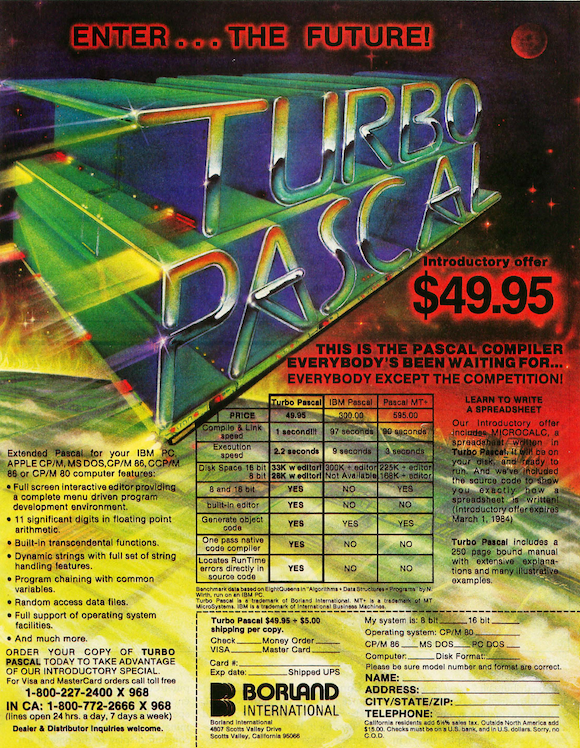
Borland Turbo C with the lower price of $99 was also advertised to hobbyists compared to competitors such as Microsoft Professional C Compiler costing $299. (E.g. https://archive.org/details/PC-Mag-1987-05-12/mode/2up) ; Microsoft responded to Turbo C's pricing with lower-end products such as "Microsoft Quick C".
It's the later years of Borland trying to go up-market with more expensive "enterprisey" products such as Interbase and subsequently Embarcadero, etc.
The main reason Borland didn't create much software for Macintosh was that they were a small company and didn't have the manpower to build tools for the tiny Apple customer base.
And qualifying the mac market as “for home use” is pretty wild, during Borland’s heydays design houses were pretty much mac only unless they needed SGI’s prowess. Borland had started tripping over its own feet before Photoshop was even ported to Microsoft.
Photoshop 1.0 was 75% pascal by LOC incidentally (the rest was 68k assembly).
Before 2005 I only ever saw Macs in offices, studios and universities. There was one guy I knew had a Mac at home, but he was a designer. For context, I'm in EU.
One of my first jobs was working with printing/scanning software and my company would install Macs in some large enterprises because of AppleTalk's printer sharing capabilities.
In late 2001 (in the US) I switched off of desktop Linux to a used iBook G3, and have never really went back.
We were a small company and I switched to using that iBook for some work (C++ development for *nix-based systems). I felt I was an early adopter there by a few years. I converted my workstation (which for reasons was way more powerful than the ones the rest of the development group had) into a build server and a local RedHat/Debian cache for the team. That poor iBook did not have the horsepower to build the software locally in a reasonable amount of time :-)
Apple basically created their own retail stores to accelerate their consumer sales channel, and the first one in the EU was in 2004.
Before 2000 that was also my experience (I was in the EU then too). Between 2000-2005 there was a steady increase of iBook/Powerbook owners thanks to being the only laptop with a reasonable battery that could run a Unix.
Design software for Wintel and DOS was actually pretty good around 1993-1994 time frame. Aldus PageMaker for PC was released in 1991 and QuarkXPress in 1992.
On the other hand, Mac hardware was super expensive. Today Mac hardware commands a little premium but pre OS 9 the difference in price was huge. So Mac owners could not have been very price sensitive in general.
It fluctuated. During the first few years of the Mac era they were stupid expensive. In the later Scully & Amelio years they dropped in price a lot as the component prices in the 68k Macs became way cheaper, and they became fairly affordable esp if you could get an education (teacher or student) discount, which they were aggressive about.
Still was not at all a common machine in people's homes.
A baseline Mac wasn’t any more expensive than the competition (IBM), it just wasn’t inexpensive like Commodore, Atari, and PC clones. Apple also had essentially the same price structure for decades, while PC clones raced to the bottom on both price and quality.
And the Mac II was actually priced better than most competitive systems—because those competitive systems were 16MHz 68020/68881-based workstations from Apollo, HP, Tektronix, Sun, et al. In early 1987, a name-brand 16MHz 80386 system with 80387 was comparably priced, which is why most people buying PC clones didn’t get a 386 until 1990-91 or so, around when the 80486 (and 68040) came out.
As jasode said. Borland's low pricing was a revolution and suddenly made it possible for hobbyists to get a real compiler without paying a fortune. This created an explosion of activity back then. We all jumped on Turbo Pascal for CP/M and DOS at the time.
It was much later that things changed, but then it was another world already.
My recollection is the Mac market was certainly not home use in the late-80s, 90s. They were relatively pricey and in fact not common in homes, but mostly in offices that did DTP, schools (we had 1 in my primary school office for staff to use, and then a handful in a "visual communications" lab at my high school), and, later, "multimedia" type shops. I worked in a shop that was full of them in 96, used by web developers doing photoshop stuff. There were a few in my university computer lab.
Late in the early-mid 90s this changed a bit as the Mac II series dropped in price a lot and became affordable at home. My mother (a teacher) bought one as her home machine because she got a good educational discount. This was on the tail end of the 68k era and just as the PowerPC transition was starting.
Borland sold by mail order for $99, at a time when "respectable, business-class software" was only sold in stores or direct, and for $299 or more. dBase sold for $699, as I recall.
I went to a talk by Philippe Kahn in the early 80's, and he was very much a rebel for going so much against conventional wisdom.


The Mac market (until very recently) was predominantly for home not business use.