Note, those pictures depict the towers as about 5x bigger than they actually were.
To get a true sense of scale, here's the same view on Google Earth: https://earth.google.com/web/@44.48152905,11.33820409,94.604... You can see the towers that are still standing. They visibly stick out from the shorter buildings, but they're nowhere near as big as in the picture.
I think Google Earth might be more wrong than the illustration. One of the two Towers of Bologna is 97m. On GE it looks less than that. 97m is more than 33 stories.
I think everything in the illustration is at least twice too high. The walled part of Bologna was ~1 km in diameter at that time, and the tallest towers were ~10% of that.
Why do people attempt to use "stories" as a measurement of height? There is no universal agreement for what a "story" is. 97 meters is in fact 97 meters.
which is also not normalized. A referee once told me that - in theory - football fields can be square. I think it was 80m x 80m since 80m is the minimum length and the maximum width. Correct me if I am wrong.
Field size for American football is definitely standardized: 100 yards between goal lines and 160 feet wide. Lots of Americans will have an intuitive sense for how long something like "three football fields" is.
But that intuitive size would in fact be wrong. The size we associate with an American football field is more commonly going to be the distance including the end zones.
Going to play the pedantic card and mention that there's also no universal agreement on how to measure a building's height. The Council on Tall Buildings and Urban Habitat on its own has three different methods and not everyone accepts those as being the correct and true way of measuring the building's height.
Really? I zoomed in on the Towers of Bologna and then used the "measurement" tool to draw a 97m line on the ground. The line seems about as long as the tower is high. If you try that, do you get the same result?
Thank you for the link, normally I just "upvote" a good comment, but here, I really recommend others to look at the Wikipedia page, especially the first "View of Shibam" in the gallery at the bottom. I would have never though it was possible to build that high with mud bricks.
I recommend checking out the ruins that litter Northern Arizona as well then.
The indigenous civilization there (before it collapsed in the 1200s and its survivors migrated south and became the Aztec) built multi-storied pueblos, a number of which were even built into the rock.
If you're ever out around Coconico and Flagstaff, you're in for an absolute treat.
Allow me to say that if you can, please, go visit Bologna.
It's still one of the few places where tourism won't affect much your own experience.
I had the tremendous luck of studying there 25 years ago when you could still bump into Umberto Eco having a coffee at the Students' Bar, when walking via Zamboni agglutinated most of the university life.
I just got back from a vacation to Como, Bologna and Milan. All amazing, but Bologna was the star. We stayed half a block from the Duomo and it was truly spectacular. The food, the people, the architecture…the place literally feels magical.
That particular illustration is an artistic interpretation of another older illustration. I wish I could place a link for reference right now but I’m using my phone and that’s no fun.
There’s a YouTube video somewhere that explains all of this and shows a more accurate physical model (or as accurate as can be reasonably expected) that is located somewhere in Bologna, which suggests that there were quite a few towers but not that many and not that tall as shown here. In any case it still had an impressive skyline for its day.
If I remember to do so, I’ll come back here and post a link.
>> I wish I could place a link for reference right now but I’m using my phone and that’s no fun.
Isn't that really weird? I realise that most people experience the internet only through their phone browser and social media apps, where it's hard to do many of the common and simple things one can do on a computer, like pasting a link. How is it that those extremely fiddly interfaces have come to be the norm?
Because they're with us everywhere and conveniently at hand most of the time. A traditional computer, even in laptop form, is comparatively bulky, unwieldy and inconvenient. Laptops don't fit into your pocket, they don't pull out for one handed use while you're waiting in line and they don't slip easily back in once the line starts moving again. To type in text, you need both hands free, and a relatively stable surface to place your laptop on.
Phones trade ease of use for ease of access. They allow people to be online and participating in an online discussion when and where a traditional computer would be prohibitive or inconvenient. And as a trade off those people aren't always able to do (or conveniently do) something they would do on those traditional computers. Most people most of the time seem to find that an acceptable tradeoff. And to be fair to those most people, I write far more than I copy and paste links so it's not unreasonable to find that tradeoff to be acceptable.
Most people never need to manually copypaste links on a mobile device because they can share links, via the browser’s share button, straight to all the apps relevant to them. Use cases like sharing URLs on a legacy non-mobile-oriented web platform such as HN are an extreme outlier. In any case, copying a URL via the browser’s "Share->Copy" or equivalent isn’t IMO too onerous a task even compared to C-l C-c.
Nowhere as much and as tall, but villages in Georgian mountainous region of Svaneti also used to have many tall towers for defensive purposes. There's still a bunch remaining.
Refuge from or assertion of banditry or other express or implied threat of physical assault is a powerful force underlying the development of much of technology, not only architecture.
In architecture, some of the more interesting I have seen are Guangdong's Diaolou (碉樓) - https://en.wikipedia.org/wiki/Diaolou - but of course we have castles, bridges, etc. IIRC John Young, architect and Cryptome maintainer, made some interesting studies in to public spaces as "the architecture of control". When you look at mass transit stations, for instance, there are so many control elements which we consider normal - lines, signage, threats of prosecution, physical barriers, choke points, hidden connections, video, etc. - but are actually explicit acknowledgement of risk, danger, threat and control.
But something as simple as staple foods (deriving from settled agriculture and thus central control), or the entire field of logistics, operations research and indeed computing can also be linked directly to force projection.
Truly, we are base creatures.
The product of the human brain has escaped the control of human hands. This is the comedy of science. - Karel Čapek (1921), inventor of the term 'robot'
There are also towers in the Mani peninsular in Greece. They were built to defend against not only invaders and bandits but also neighbors due to vendettas. A local told me that blood feuds between families could often last for many generations.
Yes, in that era it was somewhat lawless interfeudal warfare, arguably as big as a threat as those from other kingdoms/empires. The Italian city states would also fight against each other.
I think part of the motivation for the Crusades, was redirect those feuds elsewhere. And it worked somewhat.
I've heard many places, although I haven't independently verified it, that it wasn't until the invention of the elevator that towers were really valued for what we use them for today and the high floors were often cheaper.
Towers were mainly defensive structures. A tower would provide a commanding view of the surrounding area, and give archers and missile weapons substantial advantage. They were also somewhat intimidating and a display of wealth/power/prestige.
Like walls they were vulnerable to sapping - digging under the structure and causing it to collapse. More so than walls due to their height. And later, cannon fire. Which is why along with castles they started going out of favour about the 16th century, except as cheap observation posts, such as on borders, and non-military structures such as lighthouses.
As living quarters, much like castles they were not as practical as simpler manor homes. But in a very violent, somewhat lawless era, they were often used by the wealthy/powerful.
Funny that with the rise of "hidden history" "mud floods" channels like MyLunchBreak which show a lot of this historical uncanny or not well known paintings/pictures, more accurate history sources are also coming out to explain them
But seeing ideas and opportunities of 500 years ago, that took dozens of years to take off, might help us better understand the opportunities we have now
A bit off topic. But lately i see in my social cocaine feeds a lot of ai generated content with a few days ago exactly this example with an image of zillion towers. Obviously AI generated. But the point is. I dont even know anymore what is real or not. Is this site real or also a fake AI story?
When we stayed in Bologna for a month, we were told that it was used defensively. You can see a very long ways from the top of the central tower (I think it’s closed at the moment). It would have been nearly impossible for an army to approach Bologna without several days for Bologna to prepare
If you just need it to view far, then why build more than the primary tower, a backup, and perhaps a secondary backup (in a pinch, you don’t want to be caught without a secondary backup).
Same reason people build those prepper bunkers. The towers were presumably not there for the general public. Consider as well other castles and sieges. There is a limit of how many people would be allowed in, and everyone in a siege needed to pull their weight. Really, once a town is under siege, the castle is closed, when the town walls are breached, the pillaging happens and the castle does not open its gates. My point is that medieval town defense was not really a communal endeavor per se.
It's a combination of that and status. Wealthy families would build tall towers as a way to protect themselves: if you think you're at risk of getting wacked by a disgruntled competitor, you take to live in your tower for a few months, where nobody can sneak in. From that, it became a competition to show off the biggest pen1$-- sorry, tower; and then someone probably figured that the benefit of height could be used for the common good as well, installing city guards on the tallest towers.
To add to this, height advantage is enormous in combat. Arguably even more so then than today. A mob trying to storm up a narrow staircase under fire.. there is a strong force multiplier effect.
There's even a HN post about the closure! Indeed, the two most famous towers Garisenda and Asinelli are closed for renovations for the forseeable future. IIRC, they used to be the same height and had a wooden bridge connecting them at the top. From there, guards could oversee the marketplace and look out for riots.
I expect it comes from reactions to earlier attempts to pass US-made sausages for actual mortadella (aka ”bologna"), as in "that's not Bologna, that's <anglicized distortion of the name>!", which was then shortened to "that's baloney".
To show off the wealth and prestige of the family mostly. Usually their houses were right by the towers. The higher the tower, the richer the family obviously.
They were pretty common in every big enough city in Italy at that time.
Another good example would be Perugia. At a certain point it was even called “turrita”, literally “of towers”. As of now there’s only one left, Sciri Tower[0].
Defense and prestige I imagine. Also the article reports that the towers were mostly "panic rooms", they were not lived in, only used in case of emergency.
The article asserts (plausibly, but does not justify it) that there is a correlation between land value and structure height, since a higher structure has more floor area to be used in that high value area, while in a low land-value area you can do the same thing by spreading out.
The article is actually quite disappointing as it’s really just clickbait content for a video that I have no interest in watching.
They mostly were not used as living quarters, except cases of emergency.
Its not like they rented out office space like in downtown Manhattan. Also no factories that required thousands of workers. So I'm not sure the modern analogy of square footage
applies.
They fell out of favor by the 16th century. Coincidentally about the same time as cannon starting being very effective.
There’s a museum here in Bologna that says this was one of the main reasons, along with keeping a lookout for invaders. People built up because there wasn’t enough space to build out.
What Americans call baloney, is properly spelled Bologna ( https://en.m.wikipedia.org/wiki/Bologna_sausage ) and named after the city of Bologna. I came here cautiously hoping to find a good meat-based pun, but disappointment is rather the whole experience.


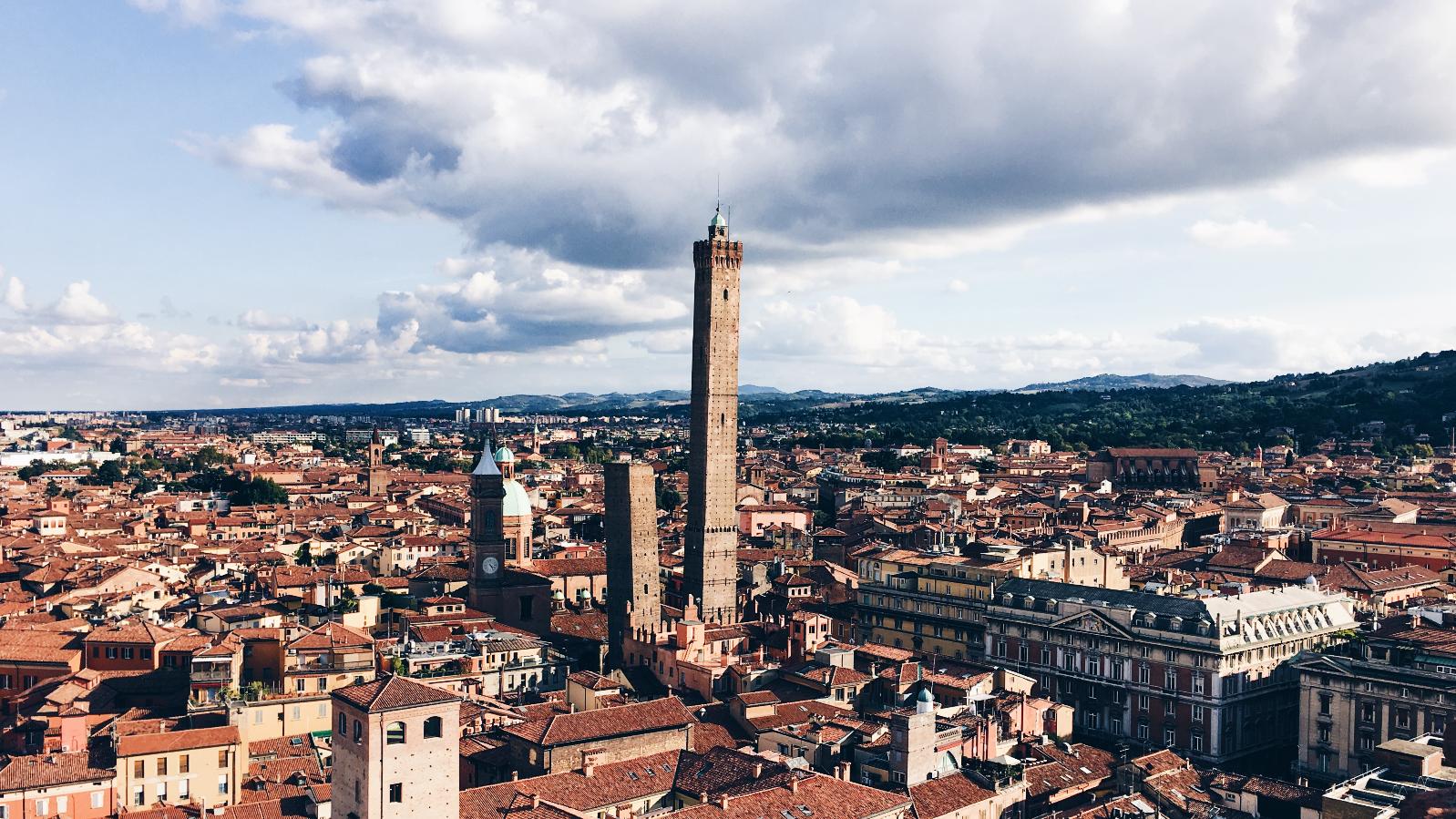
To get a true sense of scale, here's the same view on Google Earth: https://earth.google.com/web/@44.48152905,11.33820409,94.604... You can see the towers that are still standing. They visibly stick out from the shorter buildings, but they're nowhere near as big as in the picture.