Almost all of this articles are based in wild extrapolation from the same unique source. This is bad science and time will prove that is a false solution (In my arrogant opinion). Models in biology are not always linear.
There won't be any ingenious, miracle carbon removal solution and various proposals may even be flirting with ecological disasters of planetary proportions. Anything that expands our footprint in order to mitigate our footprint is a dubious direction. Reminds of an apprentice wizard that panics and invokes a sequence of spells, each one worse than the other.
Discussions and thinking around sustainability underestimate the complexity of the problem we are facing. Climate change is but one symptom of the anthropocene (defined as the extremely intensive utilization of planetary resources).
In the fullness of time it might prove that climate change isn't even the most dangerous of the anthropocene side-effects. We already have several other channels and signals besides GHG emissions and induced climate change: ozone layer depletion, microplastics, invasive species, biodiversity loss etc. and there is a "smell" about them that's worse than rotting seaweed on a beach.
Don't get me wrong, various (bio)technological adaptations may play a role to expand our options, but fundamentally they need to fit together in a package that is conservative and will not lead to more harm and further degradation.
The principal component of our collective survival strategy is hard to substitute: Where possible, we need to do more with less. Where that is not possible, we simply need to do less.
Technically there might be. There is plenty of brains around to explore all possibilities and there are far worse ways to waste talent. Just don't bet the planet on it, don't create a sense that a painless fix is just around the corner and then we can simply go on.
There's no other possibility except a technical solution. Expecting humans to change their behavior collectively, across the globe, is magical thinking.
Here’s the thing: actually, we need the behavior of a _very small_ number of humans to change: the rich. Not only is their personal CO2 consumption the majority of personal CO2 consumption, but the capital they control drives the behavior and policy of everything else. This is a far easier problem to solve. I’ll leave the solution to your imagination.
That's actually completely and entirely untrue. The largest delta of CO2 in the coming years will be coming from developing countries as they rise up to modern standards.
But when you say:
> This is a far easier problem to solve. I’ll leave the solution to your imagination.
It pretty clear you're not really arguing in good faith. Dog whistle is pretty loud.
In the context of the post you're replying to, that's like believing there will be a miracle pill so you can eat whatever you want, however much you want, drink as much alcohol as you want, and the magic pill will prevent obesity, cancer, heart disease, and liver failure.
And even if such a miracle drug did exist, if seems like the better solution is to simply lead a healthier lifestyle to begin with.
What if fusion is impossible though, from an engineering perspective? Why not continue to pursue fission using safer, modern reactor designs? It works. The timelines for fusion, if it ever works, are too long.
Most polluting regions are also the least politically stable. Today at any moment disaster could happen on largest nuclear power plant in Europe because madman decide to play a conqueror.
People can hardly be trusted with a dangerous nuclear power.
Latent heat can be radiated into space, and offset with a relatively small, invisible shade at the earth-sun Lagrange point. 10,000 1km aluminum foil and Mylar sails surfing that point would make earths temperatures completely controllable and would be measurable only as a dimming of the sun imperceptible without sophisticated measuring apparatus.
Starship can carry 2 per trip. Inflatable, polymer hardening, weigh-shift controlled kites gliding just beyond L1 on the solar wind. We would have to launch 3 a day indefinitely, so we would still be encouraged to sort out our CO2 situation.
Eventually yes, but that's not the immediate problem.
400 years to boil the oceans, but that kind of timescale means we can have 300 years of business as usual followed by using a von Neumann probe to rearrange Mercury into a Dyson swarm, at which point the Earth's temperature is under total external control because we can switch the sun off when we don't like the heat.
OK, so more like "hiding" the sun — switching it off is still possible with a Dyson swarm but I don't know how long that takes — but from the point of view of Earth it might as well be switching it off.
There is a LOOoong... distance between "I think there will be" and "there is and it works"
Plus, climate change is not the most existential threat.
That would be the biodiversity apocalypse in every part of the bio-web being caused by a myriad of pollutants, pesticides, monocultrue farming, habitat destruction, light pollution, and hundreds of other scaled-up human activities, all leading to the breaking of the food web.
When the food web fails, it'll be nonlinear, and humans will not do well.
The problem lies with carbon's essential role as part of the energy cycle that powers the majority of this planet.
H2O + (Solar) Energy + CO2 => Useful hydrocarbons (everything form sugar to gasoline)
O2 + Hydrocarbons => Useful Energy + CO2
When you burn a log you're really using a solar battery that took potentially decades to charge and roughly 25x the energy you feel from the fire (photosynthesis is only 4% efficient).
The same process that feeds us powers the global economy, but at the cost of emitting CO2 in direct proportion to the energy we're using and benefiting from.
This is why "miracle" solutions are so unlikely. Because they require a major disruption of this process in a way that it's not clear is fundamentally possible. Anyway to massively remove CO2 from the atmosphere is fundamentally going to require energy. And because of the nature of inefficiency, will always be a poor use of any energy you used to create the problem.
This is obviously where things like nuclear fusion do provide the possibility of breaking this process because they create a lot of energy outside of solar powered carbon cycle.
How? Unless you get a breakthrough with fusion, I just don’t see us finding the energy to make carbon removal feasible. You either need huge tracts of land to power forests, or massive amounts of energy from another source to do it with tech, and neither of those is going to be the easy fix people believe is coming.
It's hard to imagine how someone can look at the track record and then think "impossible! we will never figure it out!" when human history is basically a detailed record of us constantly "figuring things out" that previously seemed impossible. When something has yet to be figured out you are supposed to be baffled because the part where it all make sense doesn't come until after we figure it out. It doesn't guarantee we will figure out this or that specific challenge, but the well-established pattern gives ample reason to be optimistic.
Survivorship bias. You're missing the big graveyard of civilizations that thought they could persist in the face of changing external circumstances but miscalculated. Many of those are buried in what are now deserts, created by their misguided land management.
I appreciate the case for optimism, and I agree that as a species we can be quite clever. We can also fail to address important issues with simple and obvious fixes in ways that boggle the mind (e.g. getting vaccinated or wearing masks during COVID). Whereas I might have once thought that our ingenuity would rule the day, it seems like a functional society requires more than just technology.
Getting vaccinated wasn’t an option during the halcyon days of Covid and like 95%+ of people I saw at public businesses in my red state were wearing masks (or at least attempting to) during that time period. But unfortunately people still needed to eat, work, purchase necessities, learn, get treated, etc.
This all to say that I don’t really think your analogy really holds up in this context.
There's a nice handy fusion ball in the sky; but that isn't sufficient for CO2 removal, and if we do have a genuine incentive to remove it, I wouldn't want to bet that the incentives stop at any particular level and thus would give equal a priori credence to us ending up with too much or too little atmospheric CO2 with such technology.
We currently have financial incentives for producing CO2, which are proving almost impossible to reverse.
But let’s say we reverse them and create incentives for CO2 removal.
How are we going to change the incentive yet again, when it’s time to stop? By the time this happens, the CO2 removal lobby will be strong. Think about the jobs! The taxes! The communities!
The core of the issue is that we are polluting and not managing externalities as we should right now. It means we need to fix what we are doing not that we have to go back to the pre-modern world.
The projection of multiple agenda only tangentially related to the the actual issue we are facing is not helping.
The Planetary Boundaries framework, extended from the original article in Nature [2] in 2009 is a good way to look at multiple of the Anthropocene symptoms.
In the modern era (and for Western cultures) there was a cognitive revolution that started around the time of Carl Sagan's Pale Blue Dot moment.
The Planetary Boundaries concept is in a sense the evolution of that initial internalization, the beginning of a more analytical approach towards long-term sustainability (a first UML diagram of our predicament if you wish).
yes, and the scale of that social problem is unprecedented and fractal in nature (repeating in all scales within and across regions and peoples).
the shape of humanity on the other side of this challenge (assuming it exists and we will somehow reach it) will be remarkably different from our current narratives and infatuations
Do you have any evidence whatsoever that your claims are true? It looks like you have an agenda to push but no sources to support it. Is there any scientific backing to these ideas? (not to climate change, but ideas like "Climate change is but one symptom of the anthropocene")
...not to mention the extremely emotional language meant to manipulate instead of argue with evidence.
> At least several of the departures were due, in part, to concerns that the company’s executives weren’t paying sufficient attention to the potential ecological effects of its plans. Some employees were also disturbed that Running Tide was discussing more controversial practices, including adding nutrients to the ocean to stimulate macroalgae growth.
What does success look like in the climate change fight? Is there a point where victory can ever be declared? Is that a "correct" temperature (what is it) or a CO2 PPM number (what's ideal)? When industry and scientists stop lobbying for money to fight it?
I assume 350 is simply considered more achievable. It's not easy to remove carbon from the atmosphere, especially when you consider that a lot of it was not even in the biosphere before we pulled it out of rocks.
Ideally, pre-industrial levels of CO2 ppm and stabilization of planetary scale changes (ocean dilatation, melting of glaciers etc). Because of inertia at this scale, for the second part we are already in trouble, even if we were able to magically stop emitting CO2 today
I think it's interesting that Homo sapiens evolved during the last ice age where the climate was significantly different than today's climate. We already "won" a major climate change once despite having a level of technology barely better than sharp sticks and pelt cloaks.
Instead of defining success based on climate stability itself, I think it makes more sense to define success in terms of what we care about: a thriving environment for humans and diverse other forms of life.
I think we'll be "winning" climate change, regardless of average temperature or CO2 level, as long as we're able to avoid catastrophic loss of human population and the rate of extinction is within some acceptable limit.
At the same time, the population has been booming to the point that close to half of the humans who ever existed are alive on Earth right now. This is a significant part of the current crisis actually.
An even larger fraction of developed countries would be losing population already if it wasn't for immigration. This suggests that as the developing world becomes more like the developed world, human population will be less of a concern for the global environment.
My perhaps radical position is that two best solutions for surviving climate change are birth control and education for women. The fewer people we need to keep alive, the more easily we'll be able to adapt to the changing climate.
Yep and there is broad disagreement regarding when the peak will be. I remember at least one analyst for a large found implying it would be much sooner that what the UN model predicts. It’s apparently surprisingly hard to give good long term prediction for population growth.
I think it’s a bit late for what you are proposing however. Most of the world population is quite young.
I mean, the entire shape of that graph changed radically with the invention of the Pill, so it's probably very hard to predict going forward when we have no idea what upcoming technological innovation or cultural change will affect birthrates.
I remember reading, admittedly in a couple of science-fiction books, that the estimated number of humans that have ever existed is about 100 billion. Was that estimate wildly exaggerated? Or has it been dramatically reduced in recent decades?
It depends on what we want to do collectively, which seems largely undecided. If we want to look at addressing climate change as a way to stabilize the environment in a way that we see fit, then there may be more ways than just CO2 in which we could do so. Unfortunately, a lot of more environmentally-minded individuals, including politicians, speak as if their beliefs are that humans should have no impact on the environment whatsoever and that the environment of the mid-to-late Holocene epoch is the correct one. Neither of the latter is accurate or possible, but superficially it would seem compatible with the view that we should tweak the variables so that the environment suits our needs.
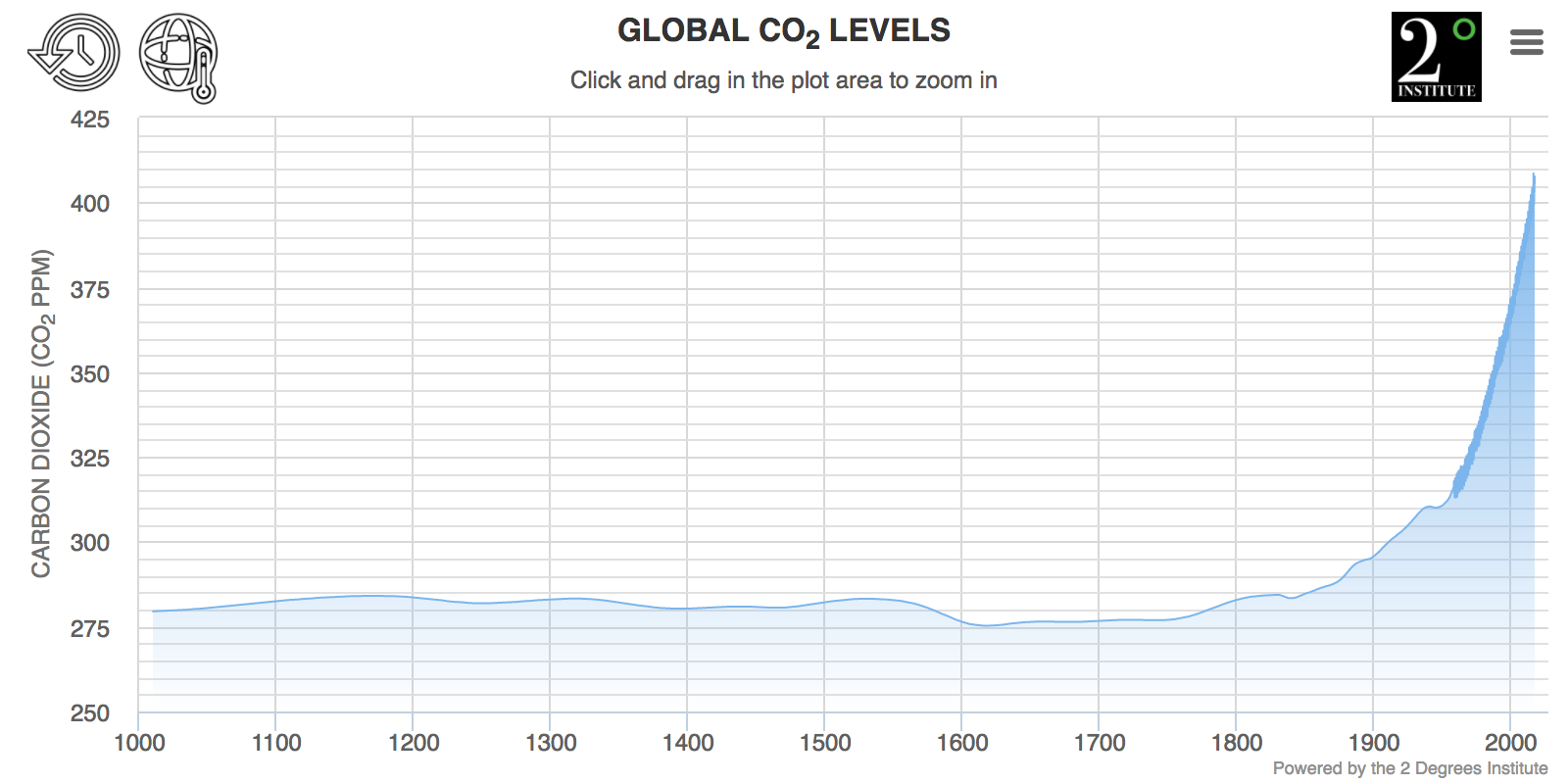
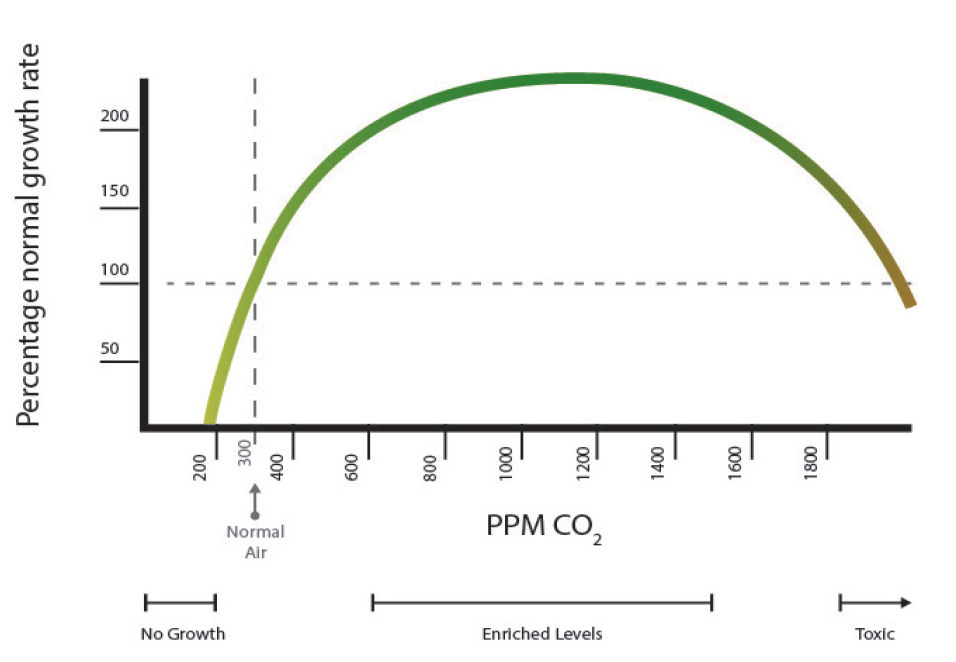
If we bring global CO2 back down to 280 ppm (like it was in the year 1700[1]), then a lot of today's farming methods will have substantially lower yields. Our modern crops need those higher CO2 levels to grow fast[2]. Without other ways to grow more food, people will starve.
Hi there. Over the last 2 years, I've interviewed over 200 seaweed innovators, academics and investors to get to the bottom of this question.
In answer to your question, YES. It probably is one of the fastest and least expensive tools to fight climate change. It requires next to no inputs, can be cultivated alongside other extractive species which foster biodiversity and clean waterways, and can sequester carbon. The products we can make from it can further reduce emissions.
However, we have to be super careful with overselling the solution. To have measurable impact, we need to grow a lot of seaweed OUTSIDE of Asia. Scaling up supply will be a challenge - because market demand for this seaweed as a food/feed/bioproduct alternative has not been completely validated. This will take time, but it will happen. Watch this space.
Overall, it's became very clear to me how hard it is to distinguish signal from noise in this sector. That's why the Paxtier Report newsletter is so good. If you're keen to better understand the space, check it out here: https://paxtier.substack.com/ . The Phyconomy newsletter is also superb: https://phyconomy.net/
Hope this helps. And shoot me a message if you have more questions.
Most of the ocean is desert lacking the limiting nutrients of nitrogen, phosphorous and iron. If we can cheaply fertilize large swathes of the ocean with these limiting nutrients in a controlled manner, then this could trigger massive algae blooms that on sinking sequester massive amounts of carbon.
Would we have to continually fertilize the ocean? And at whose expense? It'd be great if such an operation could be profitable, but it there's only so much seaweed people can eat.
Many crop fertilisers have that issue, but fertiliser is not only one thing.
One hypothesis is that algae are limited by some single resource which could be gradually dropped out the back of cargo ships as they cross oceans, seeding carbon-absorbing algal blooms as they go.
(I heard about this nearly 20 years ago, so I assume that has either been tested or banned since then…)
Indeed, that's one of the main possibilities I guessed you were thinking of; for triggering algal blooms, one of the things suggested was iron. (And given it was immediately going into salt water, ore would presumably have been fine… if the hypothesis was correct).
Terrestrial ag fertilizers don't have to be produced by fossil fuels.
The Haber–Bosch process used to make ammonium nitrate can be solar powered instead of using methane.
Phosphate rock processing could greenified for a green "green" phosphoric acid wet process.
Potassium from potash is mostly a passive solar evap process.
For seaweed aquaculture, iron sulfate is used because iron availability is the most frequent limiting factor. It's frequently a byproduct of steel production, in much need of greening itself, and produced in large quantities. Volcanic ash is another abundant source.
it depends on the final balance. As mentioned above the ratio for iron is 13k Carbon atoms sequestered for atom of iron.
Keep in mind the vast majority of agricultural yield growth the last century is giving these limiting nutrients as fertilizer for plants, so it is successful and worthwhile for land based farming atleast.
Could recycle plastic into floating kelp forests that consist of a weighted substrate that the kelp holdfasts can lock onto supported at the appropriate depth using lines up to floats. Each deployment could be of sufficient area to be self-sustaining in the open ocean and populated with appropriate fauna. If the floats degrade the entire forest would sink to the seafloor to sequestrate the carbon. Gradually these would congregate in the gyres in the oceans where all the loose plastic ends up and eventually take it all to the bottom.
800,000 years is pretty slow, though. Maybe we could speed it up with the right conditions?
I think what we'd need to replicate the azolla event is a large fresh-water lake that's very still and stagnant, so that O2 levels in the deep parts are low enough that when the plant dies and sinks to the bottom it doesn't decompose.
Or alternatively would could have azolla-harvesting ships that skim the surface, and then we could turn the resulting plant mass into biochar and bury it, or something like that.
Azolla doesn't do well in salt water, but maybe we could engineer a salt-tolerant variant. The Black Sea, for instance, has about half the salinity of the rest of the ocean.
For some salt-tolerant azolla variant to get loose and cover the whole ocean sounds like it could be a major ecological disaster though, even if it does draw down CO2 really fast.
Azolla is sometimes used to feed livestock and as a fertilizer, so it could displace other, potentially more CO2 producing ways of accomplishing the same thing.
I think there have been some efforts to use it as a food for humans.
I am skeptical of any remedy to climate change that’s not reducing emissions. Whatever you do, be it seaweed, carbon capture or other stuff, would have to be done on an insane scale to make a difference. Who knows what the side effects of growing that much seaweed would be ?
While I agree, how do you recommend we reduce emissions immediately, which is basically when it needs to happen. It seems like largely people just don't care about the environment on a "general global" scale. There are pockets are people/groups/countries that do. But on average people don't.
So that leaves really one solution, which is attempting to reduce the amount of existing emissions to stop the rise to some degree, basically prolonging the enviable.
I personally think we probably need to just let it happen so we as a species can grow, or at least grow for a few hundred years till we forget.
As a possible alternative to teducing emmisions, I remember reading that the eruption of Mt. Pinatubo lowered the earths temperature by about half a degree for three years [1]. So maybe there is a way to trigger another volcano. Or a nuclear explosion?
I know... These are horrible, horrible ideas. And they really reinforce the "people don't care about the environment" thing, too. Maybe someone has better ideas?
> It seems like largely people just don't care about the environment on a "general global" scale.
The issue is not really people. The worst emitters are out of reach from us.
It’s good to make people more conscious of their environmental impact but what good does it really make when what is saved is a minute of energy production by the average Chinese coal power plant.
That’s a sector breakdown of emission. That doesn’t address my point at all. Everything human is people related at some point or we wouldn’t be doing it.
As you can see the most emitting sector is energy production. That’s mostly driven by countries using coal as energy source and countries with significant oil and gas reserves. It is a lever at the strategical and political level. Same with industry where gains are mostly achieved through regulation.
Construction is direly in need of innovation regarding its emission but unless you want people to sleep in the street remains somewhat unavoidable.
That leaves agricultures where people have a huge role to play by consuming less meat and somewhat transportation (even if that’s actually extremely linked to the offer of effective public transport).
For the rest and as much as I would like to believe in it, most actions I see people doing are actually fairly inconsequential in the grand scheme of things. I’m a bit annoyed by it because it somehow lulls people into thinking they are doing something for the problem while the actual issues stay unaddressed.
Per-capita is not an interesting number here. We need to curb absolute emission and China doesn't get a pass because they pushed their population to 1.4 billions for hegemonist reasons.
Not that the US shouldn't also stop burning coal, mind you. Same with Germany.
At the same time, we don’t get to talk down to or look down upon other countries who are doing less damage per-capita even as they (quite reasonably and entirely expectedly) seek to improve the living conditions of their people, even while making products (and the associated emissions) for our people to buy and outsource emissions counting to another country.
We’ve been burning coal for hundreds of years and around 150 to make electricity. To suggest that others should do much less than we did and continue to do is, IMO, unreasonable to the point of being absurd.
> We’ve been burning coal for hundreds of years and around 150 to make electricity. To suggest that others should do much less than we did and continue to do is, IMO, unreasonable to the point of being absurd.
Well then I’m being absurd because we are sharing the same planet and the fact remains that they are stupidly burning coal. The fact that they are late to the party doesn’t magically make it stop affecting all of us.
There is no place for virtue signalling here. At some point, some serious pressure will have to be put on countries which are not sorting their shit out or we will all pay the price.
The average chinese power plant powers a factory that produces products demanded by western populations.
A carbon tax could be imposed on companies selling products made using manufacturing processes that result in emitting CO2, regardless of where it's manufactured
e.g. American company C developed Phone P, sent it to china for cheap manufacturing costs, and sells ot to US people. C should pay a carbon tax to be allowed to sell that device.
Whether the company will pass that tax on the consumer or not or irrelevant.
Your body, like a furnace, would break the seaweed down and re-release the CO2.
Better sequestration, would be to grow the seaweed and then bury it. Then in a million years future Earth inhabitants could dig up that broken down seaweed and have a new oil rush.
You just attacked NG in the same breath where you confessed you don't even read it. I'll take my chances that the NG reporters put in more effort, at the very least.
No, it means it's safe to utterly disregard clickbait articles whose titles ask stupid questions designed to entice you to read it so they can earn ad money.
Ok, tactical vs total solution. That really could work. Folks would quickly find a new solution that replaces the problem that your solution causes. I could see this working.
gregschlom's law of headlines on HN: "Any headline on Hacker News that ends in a question mark will have a comment mentioning Betteridge's law of headlines"
I'm not joking. It's been done so often that it doesn't add much to the conversation at this point.
I do not understand this logic. Only because something has a certain probability of happening makes you glad to be mortal? If you could choose now between being mortal and immortal, would you choose mortality because there is a certain probability that SO2 and H2S will be blown into the stratosphere?
BTW, I am not advocating this approach. I just wanted to answer the question in the headline which can only be a clear "No".
The increasing probability that humanity will become desperate enough to stave off climate change by pumping sulfur into the atmosphere follows from our ongoing failure to stop pumping carbon dioxide into the atmosphere. It's going to be a hell of a mess, and I do not envy the people who will have to deal with it.
I don't know of any such plans, but it seems unlikely that global industrial civilization will reduce its CO2 emissions anytime soon, which means that very hard times are coming for billions of people's children. Someone will be desperate enough to try it.
I'm certainly glad that I won't ever have to say, "Yeah, global acid rain seems like a good answer to the problem of global warming." But only because I'll be dead, and it will be other people having to say it.
So many different cheap, easy options to at least partly remedy the problem and possibly reverse it, but the only possibility seriously discussed is a civilization-destroying and politically unrealistic austerity.
It's a cool idea but I don't see how this is a viable long term solution, even if done at a large scale. Global oil production is on the order of 90M barrels/year, each barrel contains about 300 lbs of oil, so we're currently producing something like 27B lbs (~12B kg) of oil per year. I'm not sure how much of this ends up as CO2 in the atmosphere versus e.g. plastics, but I think it's safe to say we're probably emitting at least 1B lbs/kg carbon into the atmosphere per year just based on these numbers.
Seaweed grows quickly, but it's almost entirely water by mass, and this strategy will really only work in coastal regions. If this strategy was adopted at a wide scale globally how much time does this really buy us? And this isn't even considering things like the unknown ecological effects of the plan.
It is one of many viable solutions and humanity is working on many or most of them. We need them all. Seaweed would be great as cattle feed is one of the pathways this highlights.
It doesn't do as much as you think for cattle feed as most the high % numbers you see touted are only looking at feedlot emissions - which are only 11% of overall cattle emissions. Actual reductions are pretty small
>What’s more, feeding cattle algae is really only practical where it’s least needed: on feedlots. This is where most cattle are crowded in the final months of their 1.5- to 2-year lives to rapidly put on weight before slaughter. There, algae feed additives can be churned into the cows’ grain and soy feed. But on feedlots, cattle already belch less methane—only 11 percent of their lifetime output
[...]
>Unfortunately, adding the algae to diets on the pasture, where it’s most needed, isn’t a feasible option either. Out on grazing lands, it’s difficult to get cows to eat additives because they don’t like the taste of red algae unless it’s diluted into feed. And even if we did find ways to sneak algae in somehow, there’s a good chance their gut microbes would adapt and adjust, bringing their belches’ methane right back to high levels.
[...]
> All told, if we accept the most promising claims of the algae boosters, we’re talking about an 80 percent reduction of methane among only 11 percent of all burps—roughly an 8.8 percent reduction total
The authors' argument about the 8.8% reduction hinges on both their assumption that it wouldn't be feasible to add to cows' diets on pastures and the uncertain possibility their guts would adapt and mitigate the effectiveness.
Yet the articles they cite (which both quote the same study) describe that on a diet of 0.75% seaweed (0.25% more than the research I saw years prior) only some cattle didn't like the taste and there was an unspecified reduction in feed intake, which hardly seems the foregone conclusion the Wired authors make it out to be. While the aspect about cows' gut reactions long term is also unknown, though one of their links mentions both a 72 and 90 day trial which showed no gut adaption or reduction in effectiveness which is said to be hopeful since 'most adaptations happen within a few weeks'.
Ironically the On Pasture link Wired cites for their argument against is more neutral/optimistic and also mentions that two other more common types of seaweed reduce methane output by 20% and encouraged experimenting with for cattle diets.
> Global oil production is on the order of 90M barrels/year
It's much worse, this is off by a factor of ~365: that production of ~90M barrels is per day[1]. Global carbon emissions are up to 36 billion tons annually as of 2022[2].
Looking at the technology trajectories of PV and wind it is pretty clear that within the next 5 to 15 years many countries will start seeing substantial extra electricity being generated by the build out of renewables. Because countries will aim to cover most electricity by renewables and thus overprovision them for dark windless winters, it is likely that there will be massive amounts of energy available during the summer and windy times in spring/autumn.
At this point the technology which is best in converting surplus electricity in something which counteracts climate change is most likely to become relevant.
Yeah last time it happened (on a scale which is hard to imagine we could achieve) it took a 800k years to reduce CO2 ppm by ~2850, this is a leisurely rate of 3.56ppm/1k years.
I like this back-of-the-envelope estimate, but it's even worse than that.
The carbon in oil is lightweight relative to the two oxygens it combines with (atomic weights 12 and 16 respectively) from the air, so 1kg of oil emits about 3kg of CO2!
Punchline: we emit around 34 gigatons of CO2 per year.
My argument is that we're probably going to kill the Gulf of Mexico, anyways, with global warming; so, let's go ahead and dump 34 gigatons/year of serpentine in it. That'll 0-out the CO2 we're releasing, at the cost of dramatically changing the Gulf's ecosystem. At this point, I really do think we (humanity) are going to have to make some pretty hard trade-offs.
But wouldn't it be a carbon chain again in the seaweed without oxygen? So, we can ignore the weight of the oxygen? Still, the numbers are huge. But I think at this point we have try everything at once.
The cow burp effect is a myth. With five minutes thinking about it, is easy to see why is a no solution. I have explained here before why will not work.
Most of the seaweeds are water. And the dry matter is salty.
Coastal areas are extremely busy. You can't remove Honk Kong city to culture seaweeds. You can't block maritime traffic routes to culture seaweeds, or stop all commercial fishing near the shore, or ban tourism. In most areas is a no-way.
And there are other problems and obstacles that could be spotted easily by biologists, for example that water temperature is rising.
If you think that you can obtain a permit to put such eyesore as a seaweed farm in front of Copacabana, well... good luck with it.
But we could of course build it in the middle of nowhere, and then spend lots of fuel to move the product to the far-far-away markets, and even feel good about our ecological trace for a couple seconds.
This is not about being clean or not, is about being previously occupied by another activity that is economically much stronger so you just can't compete or displace them. All the good places near the coast are heavily occupied yet so, where do they want to culture all this volume?. The other companies have enough money to buy you off of the road and build an hotel, or are the only remaining place suitable for the local authorities to place the new airport
And not all places are suitable to grow brown algae. (Not they aren't. Algae are not so easy to grow as National Geographic seem to suggest. They have predators also). Chinese grow a lot of Palmaria since thousands years and the trend is to replace it for its relatively low value by Hectare, either transform it into crab farms to increase the benefits, or turn it into a developed urban area.
Dry areas are required for logistics and as a safety vault. You need space for storage. Space for wintering. Space for each machine that you need to process the production. And drying algae smell. And if you have a big storm alert, you will need to rush to move a huge volume of stuff, cords and algae safely ASAP to the coast and keep there for several hours. You can't just put this in the closest hotel terrace.
There is a lot of things that a sea farm needs to survive. And there is a huge load of legal issues, because the sea is not a "free for all" space. Is a high skill / high luck and deep pockets activity.
Why could be a big company be interested in this? Well, If you have the money you could culture much higher value products in the same space, right?. I would speculate that is a combination of being able to obtain government aids + real state grab. I can be totally wrong about it, of course.
If you don't care about harvesting it you might want to bioengineer something that will grow on the coast of Namibia and seed it there. This coast pretty much can't be used for anything.
>We model a nationwide transition [in the US] from grain- to grass-finishing systems using demographics of present-day beef cattle. In order to produce the same quantity of beef as the present-day system, we find that a nationwide shift to exclusively grass-fed beef would require increasing the national cattle herd from 77 to 100 million cattle, an increase of 30%. We also find that the current pastureland grass resource can support only 27% of the current beef supply (27 million cattle), an amount 30% smaller than prior estimates
[…]
>If beef consumption is not reduced and is instead satisfied by greater imports of grass-fed beef, a switch to purely grass-fed systems would likely result in higher environmental costs, including higher overall
methane emissions. Thus, only reductions in beef consumption can guarantee reductions in the environmental impact of US food systems.
No (to the question in the title), this is someone trying to sell a magic solution. You do not need to fight climate change, we need to stop it. And the first thing that needs to stop is the greed of the superrich. Unless the seaweed gives a conscience to the superrich then no, seaweed cannot help.
> You do not need to fight climate change, we need to stop it.
The correct answer is neither; we need advanced technologies and material wealth that will allow us to master the environment more robustly. Consider that in the past 50 years of climate change, the human population more than doubled yet the number of deaths from climate-related causes dropped to one-third[0], mainly due to the growing wealth of developing countries that allowed them to better shield themselves against extreme weather conditions.
The state of man in nature is "solitary, poor, nasty, brutish, and short". Anyone who has spent any time outdoors in remote places or tried to build even a rudimentary shelter knows how true that is. There has never been a time when the climate was conducive to human flourishing except when humans made it that way by ever-increasing per capita energy expenditures; hence today, despite everything, we are the most insulated from the effects of climate on ourselves.
To "stop" climate change is like telling Glurg the caveman no, you cannot light that stick on fire to keep yourself warm, because think of the CO2 emissions!
My sincere hope is that the poor non-Westerners will also be well air-conditioned. And yes, you are quite right that there is no free lunch. In my analysis, the opportunity cost of going all-in on degrowth and solar/wind is precisely that the global poor will remain poor.
I'm by no means advocating that we destroy nature for the fun of it! But if the alternative is between us destroying nature or nature destroying us, I know which side I'm going to pick.
That is all of human history, from the moment we wrapped animal hide around us and picked up a sharp rock. Humanity didn't get to be the dominant life-form on the planet by asking nature nicely to please not bother us.
Okay cool, so what is your timeline for how long will it take to stop humans from being greedy? You realize any solution that is "rich people stop being greedy" is no solution at all?
Each of those words may be carrying more load than you intended.
Food on the table — Rice, lentils, peas: not greedy; Beef burgers, caviar, civet coffee: kinda is.
Roof over your head — traditional hut, not greedy; penthouse suite in Dubai, greedy.
A few nice things? So many options. Once was, aluminium and purple(!) both cost more than gold. Is it "a nice thing" or "greedy" for me to fly to some paradise island for a week vacation? Or to own a fursuit? Or a normal suit? Or to get an electric bike instead of a manual one?
(I'm in favour of raising everyone to the level of current royalty; I think this can be done without wrecking everything, but we have to solve some problems first).
Being greedy is declaring the food and the house is yours, and kick everybody accordingly. Then you offer as little food as possible in exchange for 18 hour shifts of housekeeping
We need to make it profitable to do the good things and not profitable to do the bad things. This way people will do the good things and not the bad things.
The most straight forward way to do this would be to make doing the bad things more expensive, which means taxing carbon emissions.
Alongside this would be to create alternatives that are cheaper and easier to use.
Unfortunately this would mean actually spending money, making investments in public works, and changing things away from the status quo, and apparently this is impossible.
So we're going to sleep walk into our doom rather than do basic things like making gas more expensive and building public transit.
> The most straight forward way to do this would be to make doing the bad things more expensive, which means taxing carbon emissions.
Yes. This is the solution starting in 1990. It is too late now, for this to be the solution. It is a good idea, but.
We are going to have to shut down hole industries, and the owners will loose their investment. We are going to have to make a lot of very rich people, ordinarily rich.
Yes. A revenue-neutral carbon tax (often called "Carbon Fee & Dividend") is a politically feasible, fast, efficient way to reduce carbon emissions.
To drive emissions down to zero, without massive economic disruption, start small and increase the tax gradually every year.
Coupled with a "border adjustment" (a tariff on goods coming from countries to compensate if they have less aggressive climate policies) you can solve the problem of industries being outsourced to countries where GHG pollution is cheaper, and simultaneously put pressure on those countries to implement similar policies.


1. Banking on the Seaweed Rush - https://news.ycombinator.com/item?id=35322725
2. Ocean Farming: Seaweed is having its moment in the sun - https://news.ycombinator.com/item?id=35176560