Greek here, the weather is snowy over here as it is in Turkey last few days.
I can't even fathom the idea of staying out in the cold. My thoughts are to the people affected.
This is really bad. The timing couldn't be worse, pretty much everybody was at home. The videos that came out so far are devastating, whole apartment buildings leveled with everybody in them, people trapped under the rubble and calling out for help.
Given the timing and the magnitude the first estimates of casualties seem surprisingly low, I really hope that they are right but there are some major cities right in the middle of this. Ugh.
In my experience initial reports being low doesn’t necessarily translate into final casualty accounts. When the entire infrastructure is destroyed (see Haiti, the 2004 Christmas tsunami) counting the number of dead is much harder and isn’t the top priority.
On the flip side, I’ve often found that ‘missing person’ reports can overcount the number of casualties. Again, when infrastructure is destroyed or when there’s a locally-devastating disaster it’s hard to get an actual account of who was actually in the area when disaster struck.
I have never seen an earthquake covering such a wide area. I confirm collapsing buildings in at least 5 cities. There is a big chaos on social media as well - many people asking for help since they are stuck under debris. What a disaster!
I accidentally saw one of these videos on Twitter. As a human, seeing a young person suffering, frightened and calling for help in real time when I can do nothing felt disgustingly voyeuristic. Perhaps humans who have never met and will likely never meet were never meant to connect in this way?
The situation is apparently quite grim with the broad scale of devastation. I hope technology can help guide and focus resources and rescuers as quickly as possible.
I vividly remember watching videos of the 2011 Japanese tsunami rolling inland. Seeing cars and bicyclists that looked like small toys that were completely oblivious to the torrent of water that was about to be upon them gave me such a sickening, helpless feeling.
I saw this too, trapped under debris with only their cellphone flashlight and dwindling supply of oxygen. So gut wrenching and horrifying to see, still can’t stop thinking if it was me in that situation. I hope they make it out alive.
Are you saying that people are asking for help in general or that the actual people stuck inside collapse buildings are using their socials in search of help?
What kind of infrastructure is in place that would survive to allow network connectivity for people to access socials to ask for help?
> actual people stuck inside collapse buildings are using their socials in search of help?
This one. On the previous large quake in the country, the networks collapsed and there was a huge public uproar because the network operators were claiming disaster readiness in their ads, even showing drone swarms flying to the disaster area to provide network services.
Maybe they actually hardened their networks but in general, the internet connectivity seems more resilient as the regular phone calling was restored much later than the internet connectivity last time.
This time there are many tweets and instagram stories of people posting text, selfies and videos from under the rubble, together with their address, their condition and the number of people in the house.
Apparently mobile connectivity is intact in some places, but data is generally down. People are calling/texting their friends who in turn post it on social media:
This one really came as a surprise, and since people often only act when there's a precedent, sadly the building collapsed. They will learn from this, like the Japanese did.
No, they won't, unfortunately. Turkey is in the fault lines and there was a 7.6 earthquake in 1999. A lot has been said but not much have been done.
Just a couple of years ago, there was "amnesty" for buildings. My father in-law was bragging how his building, which did not have any inspection or permits during the construction, has gotten amnesty for a small fee and he could sell flats to others now..
The location of the earthquake is pretty much on top of a plate fault so earthquakes are to be expected, especially big ones
But the problem is not that you can't build for big earthquakes, more that the whole area is a low income one with everything that along
It is possible to build for a 7.8, at least so that the structure doesn't collapse (severe interior damage is inevitable). But many older high-rises in San Francisco were built to weaker standards or on soil subject to liquefaction and would be at serious risk.
That's not a prediction that can be evaluated. For example, I could say "there will be a 7+ magnitude quake somewhere in the Pacific Rim tomorrow" and if I publish the same prediction every day it won't be long until my prediction is true. I might even be right the very first time.
A real prediction should include exact time period, magnitude, and geographic area. And every prediction made must be documented. This lets you do two things: first it lets you clearly decide which predictions came true. Second, we can look at historic probabilities for the predicted quake and evaluate the chances of blind guessing being correct for that exact set of predictions.
In this particular instance, if you look at the predictions made on his twitter stream you'll find that he's clearly a quack who predicts stuff constantly. Not super surprising he got one right. EDIT: Also... surprise! There was a foreshock a couple of hours before he made the prediction.
Look at his youtube and Twitter for 5 minutes, he draws "bands" all over the world predicting nonsense everyday, and probably has a positive prediction rate of 0.5% and he bases everything on some nonsense call "Atmospheric Fluctuations"?
> He is probably more knowledgeable than the average person and has access to latest data on earthquakes.
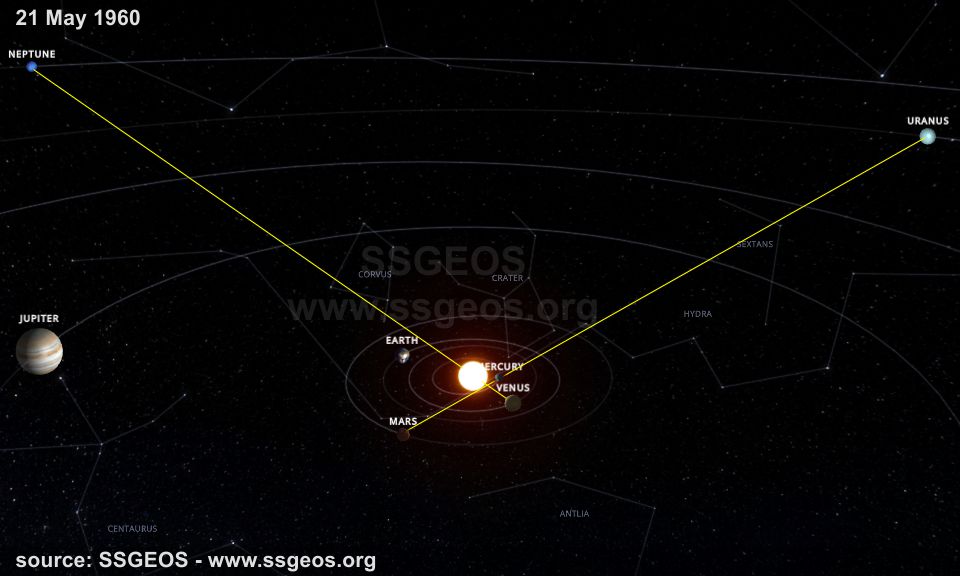
The person in question's area of "expertise" is claiming that when planets line up to form geometric shapes (e.g. when earth, uranus, and neptune form approximately an equilateral triangle) that this somehow affects seismic activity on our planet. The claim isn't that it's closeness of celestial objects causing this effect, mind you, it's the fact that the planets, however distant, happen to be in a configuration that resembles a geometric primitive.
It sets off a lot of my woo detectors. Here's their website: https://ssgeos.org/
- Enough data that the correlation becomes strong enough.
- The physics community chimes in? I mean the effect could only be due to gravity unless there is another mechanism we don't understand. But given how small the earth is, and how big other planets are, I'd suspect the physics people to see this effect somewhere else?
No, absolutely not - gravity is an inverse distance squared force.
The sun dominates our gravity environment and planets at those distances have negligible effects (really effectively zero) certainly not seismic size perturbations!
The gravitational force from the other planets does slightly affect the Earth's orbit, but the gravitational pull from the other planets and the Moon is still very small. The gravitational pull of the Moon on the Earth is only 0.55% of the gravitational force between the Sun and the Earth, other planets even less than that. Unlikely, very unlikely to trigger earthquakes!
> The gravitational pull of the Moon on the Earth is only 0.55% of the gravitational force between the Sun and the Earth, other planets even less than that. Unlikely, very unlikely to trigger earthquakes!
Playing the devil's advocate, but doesn't Moon affect the movement of water on Earth (i.e. low-high tide) and these are massive movements of mass which could potentially trigger an earthquake?
One would also expect this effect to be a function of distance, not of how prettily lined-up the planets are or the shapes they make when viewed from above.
My claim isn't that it's unlikely that any celestial body can affect earthquake likelihood. It's that it's unlikely that earthquake likelihood is affected by pretty geometry of planet arrangements that do not include our own.
For example, on the "About" page of their website, they show this image:
They go on to make the claim that earthquakes were more likely on Earth, because if you draw a line from Venus to Neptune, and another line from Mars to Uranus, those lines cross at right angles.
But isn’t this earthquake microscopic in the scale of the earth?
But I get your point. The sun should be responsible for most of these earthquakes (if gravity was to play a role) unless its gravitational field is prefectly uniform.
I better give up on this because my understanding of gravity and general relativity is based on youtube videos.
> - The physics community chimes in? I mean the effect could only be due to gravity unless there is another mechanism we don't understand. But given how small the earth is, and how big other planets are, I'd suspect the physics people to see this effect somewhere else?
To be totally honest, we don't actually know what specifically causes earthquakes. That is to say, we understand that earthquakes are essentially the sudden, violent release of stress due to crustal deformation, but we don't have great ideas for understanding what causes the stress to be released so violently. As a result, even basic tasks like earthquake forecasting or merely distinguishing a mainshock from a foreshock (before the mainshock occurs) have turned out to be miserable failures.
But as for planetary orientations having an effect via gravity... well, let me put it in perspective. To exert the same gravitational pull on an object on Earth as Jupiter does, the average human being would have to stand does math 15cm away.
> if you look at the predictions made on his twitter stream
The way to do this is to make the same prediction every day, and then delete the tweet when the prediction ends up not coming true. That way, when someone goes and looks at your profile, you'll have a 100% track record. (Or probably better, just a prediction mixed in with random pictures from your dog walks.)
You're missing one important thing: confidence level. You can probably make a 7+ magnitude prediction every day as long as your confidence in it is -- I guess, not knowing much about the Pacific Rim -- less than 1 %.
It's the 10 %, 20 %, 50 % confidence level predictions you have to be a bit more sparing with!
Are some of you scientists? I was searching for how trustable this person is. This man claimed to be a scientist have catched attention of many Turkish twitter user and they've started to fallowing him. And some news sites shared this man as a Dutch scientist who predicted earthquake 2 days ago. Like there isn't enough misinformation about earthquakes.
Also if you click through to to the organization he works for (not linking; no google juice for them), they're clearly quacks: they seem to believe that geometric shapes made by various planets in the solar system can be used to predict earthquakes. Note that they aren't even talking about gravitational effects (which are near zero, anyway), just the specific shapes. Complete nonsense.
Not debating whether this guy is a quack, but it's worth noting that there have been studies showing a strong correlation between accidents and the lunar cycle:
There are also studies suggesting that lunar cycles causes behaviour changes in humans, which could explain that. This doesn't seem that unreasonable given that the lunar cycle has been shown to affect the behaviour of animals and insects:
You're on to something here. I followed some information from the SSGeos website and found that they appear to use work done by a guy who is revered among astrologers, John H Nelson. I had never heard of the guy but it looks like he is a big cheese of early 20th century astrology believers who liked his studies on the effects on short-wave radio propagation under the influence of planetary alignments.
I think this is another case of a blind squirrel finding a nut. It's bound to happen once in a while.
Indeed. He'd have had more respect (and less suspicion) if he's tweet was something like: foreshake detected at xx,yy location, given the nature of the location, high probability of an earthquake of 7.5M.
He's fishing for attention from the general public.
Even if he said that, it'd be nonsense. Foreshocks usually do not precede larger earthquakes (https://www.usgs.gov/faqs/can-you-predict-earthquakes). Yes, sometimes they do, but it's uncommon. If every time you see foreshocks you predict a larger earthquake, sure, you'll very very occasionally be right. But you haven't done anything useful with your predictions.
(Note that I wouldn't be surprised if this is the kind of person who makes tons of predictions on Twitter, and then deletes the tweets when they turn out to be incorrect, leaving only the correct ones.)
Agreed, but it is specific enough to at least see if he can do it again, once = random, twice = coincidence but the chances of doing this twice are pretty remote.
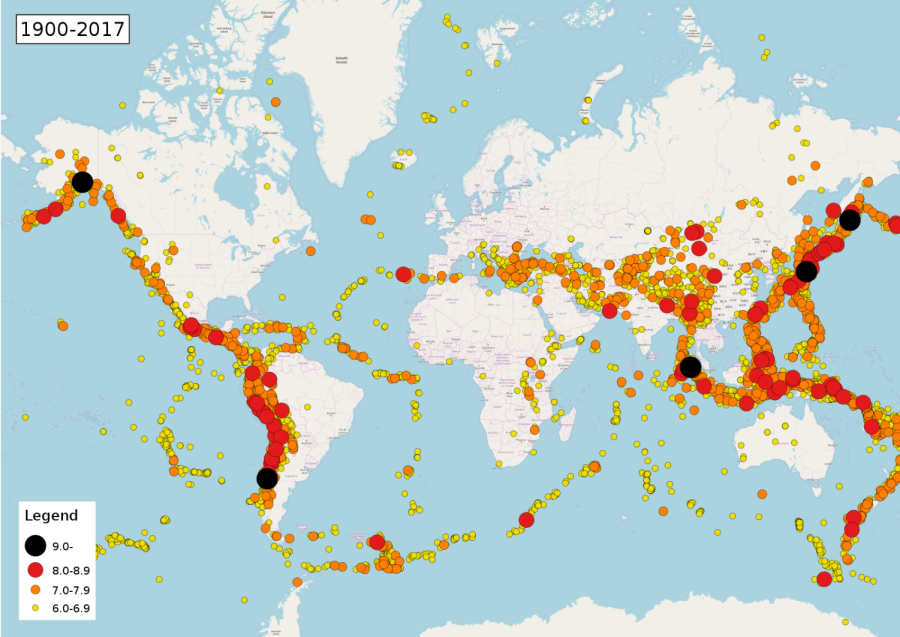
What's exactly specific? I'm not an expert in Geology but my understanding is that these hot spots are largely known. The outlier prediction will be for a location of an earthquake outside these hot spots. Here is a random map I found on the internet but I think matches a few ones I've seen before: https://broadview.sacredsf.org/wp-content/uploads/2022/10/Ma...
Heh, that map shows the west coast of the US as completely covered. I assure you that we don't have daily earthquakes that are even noticeable, let alone destructive. I live in an area covered by orange circles, and have for nearly 20 years, and I've never felt a M7+ earthquake. The ones I usually do feel are no more than M4.5 or so, and happen at most a few times a year.
My point is that it doesn't really matter if you "predict" an earthquake inside or outside these hot spots: you will nearly always be wrong. And when you are right, it will be due to luck.
Years ago I made an observation that an earthquake would happen based on a near earth object. It ended up being the one in Chile. I do wonder if there's some kind of correlation considering that green comet is flying by
The sun completely dominates all other bodies in the solar system when it comes to gravitational effects on Earth (even the moon has less of an effect than the sun, despite its proximity). The Earth doesn't even notice this comet's existence, gravitationally speaking.
The Gradient between the gravitational forces on different parts of the earth is larger for the moon though, as you can see by the tides. I would assume this would have a bigger effect than the total force. But you are right, a comet or asteroid isn’t going to do anything.
The one doesn't rule out the other. If they can do this again it would be great news in a way because any kind of reliable indicator of an imminent earthquake would save many lives.
This was felt across the region (Isreal, Lebanon, Syria, Iraq, some places in Egypt). Anywhere one can get news of what's happening in Turkey? The epicenter of the quake seems close to a large city. (I know it's like 4-5 AM there now)
Having lived through the Christchurch quake, this was the thing I hadn't properly appreciated. It's a sequence, so, you can expect literally thousands of quakes after a big one like this.
It's completely and utterly headwrecking! Every time one happens you don't know whether it's going to build into a big one.
This is an unnecessarily vague comment. Either way, if it wasn't about differences then we'd either just share access to the resources we need, and if it wasn't for differences, there would be no way to justify the war?
Why would Russian invade Ukraine for gas and oil, when all the gas and oil is already in Ukraine.
And Turkiye is trading with Russia and blocking accession of new NATO members. Harsh winter in Russia (while Europe is downright toasty) and now this. I'm glad I'm an atheist because those events would reinforce my faith if I had one.
Some people in the government renamed the english spelling of my city into an unreadable alphabet soup. Not only they strongly insist the whole world to spell it this way, they also deem everyone who doesn't like it a traitor.
I'm not sure how this is related to this case? Isn't there still a cyrillic spelling of your city? Did they change that one as well? I wouldn't be surprised if they changed the English spelling to match the cyrillic one. Is it the same?
Ah I see. I think that's fine given the current conditions. However at some point, long after this war, it'd be nice to see Ukraine endorse a policy of multilingualism, as many other European countries seem to manage just fine.
> Wikipedia is a better source for common usage than the US state department, and they've explicitly resisted changing the spelling.
Why would common usage matter for something that recently changed? Of course the former name is more commonly used. The State Department is the better source since they’re the ones dictating how the US government as a whole interacts with Türkiye.
It doesn’t matter what the people in the US call countries if we’re not the ones making deals and talking to their leaders. I can convince everyone that Russia would be call Assuria but that doesn’t make it’s name. The only ones that have authority of the name of a country is the country itself.
More recently yes, but historically it was from the British Empire. US's influence has helped expand it to many countries that never had former extensive use of English creating many new second language speakers, but in terms of first language speakers, the British Empire is still the cause of almost all of them.
Umlaut modifies how a letter is pronounced; diaeresis tells you where a new syllable starts. I'm not sure how to pronounce "u" or "ü" in Turkish.
The problem with naive is that it's not very clear how to pronounce it: it's "na-ive", which isn't very clear. With naïve there's a clear indication that the "i" starts a new syllable.
While I agree that diaeresis in English are more archaic than not, I don't agree it's better style to leave them out. Right now there is, in my opinion, no good way to spell some words: "cooperation" is ambiguous (coo-peration, coop-eration, or co-operation?), "co-operation" looks ugly and is an abuse of the hyphen, and "coöperation" is nice but rather archaic.
A bit of effort to reduce ambiguity and match spelling and pronunciation (as far as the language allows) doesn't strike me as a bad thing.
I wonder if this is the impact of technology. When written by hand, there's not much practical difference between naive and naïve. With English typewriters and English keyboards, writing naïve is tricky so people, presumably, just didn't bother. Now, however, a lot of written text goes through spelling correction so, if the spell checker wants naïve then it may automatically change it or suggest you do.
In my completely rigorous and scientifically valid testing of this assumption: Word corrects to naïve, Chrome text box flags naïve, Edge text box is happy with both and imessage suggests naive. So bit of a mixed bag.
The façade of your rôle in the naïve crusade against Türkiye's self-determination will not last for an æternity, my friend. You'd better update your résumé!
Lol. Yes they do. There are dozens of instances of names of places being changed due to what the local population wants it to be called. Putting politics aside, disambiguating from the bird turkey is smart from a marketing and tourism sense.
Names of places do certainly change, but that does not dictate how those names are spelled/represented in other languages.
Now, you or anyone else can certainly spell it "Türkiye" instead of "Turkey", but a) you risk confusing people (which you may or may not care about), and b) typing "ü" is awkward on many (most? all?) English-layout keyboards. I suppose you could also spell it "Turkiye", which I suppose is closer to what the Turkish government wants, but is still "incorrect".
At any rate, I personally see little reason to change unless popular usage overwhelmingly changes. At least in the US, popular usage (which influences dictionaries) dictates English spelling, not governments.
I don't think this is about umlauts. Like you said, it is a name. I'm from Turkey and my name is spelled Doğuhan, but as I was immigrating to the US (before Unicode was commonly used) it became Doguhan. A lot of native English speakers struggle with it, almost no one pronounces it right, they misspell even after seeing it written in front of their faces.
I did play around with the idea of going by Doug during college, but then I decided that I wanted to retain my unique identity. It took years for some of my friends to stop calling me Doug, but they did change.
It'll be okay, people will adapt, umlauts or none. Otherwise, people will do what they'll do. Some idiots still refer to Istanbul (correct spelling İstanbul btw) as Constantinople. C'est la vie
Clearly there are limits to what is reasonable though; Vietnam is the common spelling in English, and I think it would be unreasonable to demand everyone spells it as Việt Nam. I can type most diacritics without too much effort, but no idea how to do that ệ double diacritic.
The title on HN actually gets it "wrong" by the way, as it's supposed to be Türkiye, not Turkiye.
Things can have more than one spelling or name, and the "best" one depends on context and personal preference. You can argue from Constantinople to Istanbul about this; but it all seems rather pointless. I wish people would just accept that other people have different preferences. This fits in the "color vs. colour" or "courgette vs. zucchini" category.
Whether Türkiye or Turkiye catches on and becomes the more common spelling? We'll see. I guess it will eventually, but it may take a while.
At least "Vietnam" is somewhat close to the native spelling. I live in Japan, and the English name is nothing at all like the native name (日本, romanized as "nihon"). But you don't see the Japanese government throwing a fit over this. Furthermore, the name in many other languages is the same or much like "Japan": in German, it's spelled the same, but pronounced "yapan" since there's no (English) J sound. What does the Turkish government have to say about the Japanese name for Turkey ("トルコ", romanized as "toruko")? If the Turkish government insisted they spell it "Türkiye", no one here is going to pay attention because none of those characters are part of the Japanese language, nor is that name even pronounceable using the sounds available.
It did make it confusing though. For a long time as a kid, I always wondered why I never heard native Japanese speakers say "Japan" unless they were speaking English. While I couldn't understand it, I could somewhere reasonably sometimes hear words where I've seen it's romanization, but not ever hearing "Japan" was quite baffling for a long time.
You don't have to feel so strongly about other countries pronunciation. It doesn't matter much. You can still use Turkey and people will understand what you talk about. The problem will only arise in official communications between governments. I believe you aren't part of them anyway.
It's not uncommon to have various diacritics in loanwords; e.g. über, führer, señor, façade, crème brûlée, or proper names such as Schrödinger, Gödel. All of these can be spelled without the diacritic too, but also with it.
Native English speaker have literally no idea what umlauts means. And the connection between how a word is spoken vs how it's spelled is tenuous indeed. So really there isn't any point.
This is the important part. Sure, go ahead and add whatever decorations to the characters you want. 99%+ of us will have no idea what they mean and treat them like they don't exist. Pronouncing those isn't taught to the vast majority because they are not even remotely commonly used. What use is any extra indication when nobody knows what it means?
It's not smart when they're demanding the use of a Turkish word that doesn't fit into English characters or pronunciation rules.
And why aren't they making the same demands of other languages anyway? How about Chinese? How exactly would their new name fit into Chinese, a language that doesn't use Latin characters at all? Not to mention all the other European languages that do?
Türkiye is not representable in English so it will never be used for in any article written in English that's not being written for some diplomatic purpose.
>There are dozens of instances of names of places being changed due to what the local population wants it to be called.
Sorry, no, not outside a country, when dealing with foreign languages. Every language has different names for other countries, and they're frequently quite different from each other. Countries have no way of forcing foreign languages to adopt any particular name in those languages.
> Sorry, no, not outside a country, when dealing with foreign languages.
Are you saying there's no instances where a country has "rebranded" (for want of a better term) its own name and people outside that country have gone along with it?
Don't get me started on the silliness of people inventing completely unique "pronouns" and demanding everyone use them: it completely defeats the linguistic purpose of pronouns. If you want to be referred to a certain way, we already have something for that: it's called a "name". You can name yourself whatever you want.
Anyway, back to your comment: this is a different issue. The pronoun thing is dealing with how people want themselves referred to in their own language, by people they know usually. The Turkey thing is about a government that wants its country called by a different name in a foreign language that it doesn't use.
It's because it is spelt Türkiye, not Turkiye. It is the official name used by organs like the UN, the United States Department of State etc but that doesn't mean you can't be using Turkey. It's like Taiwan, which few people refers to as "Republic of China".
The good thing is that Türkiye is pronounced almost like Turkey, so you're saying it almost right ;)
Or we can respect the name they prefer, since it’s important enough that they requested international recognition. I’m pretty loosey goosey with my own name and don’t mind if other people are, but I respect when other people don’t feel the same way. I don’t see any reason to insist on disregarding it for a whole country.
Nobody will care about it after Erdoğan is gone. We've been called that for a long time and it never really bothered anybody. We call India "Hindistan" (land of turkeys) ourselves and nobody seems to see the irony there.
You have the cause and effect reversed. Hindustan doesn't mean land of turkeys, it is that the bird is named after the country (Hindustan is a semi official name for India, ultimately both names come from the Indus river) in some languages. In my understanding it is because the bird is actually from the new world, so the existing cultures made up / didn't know where the bird was supposed to be from, and called it "bird from India" in some cases.
I didn't mean it that way but if you look at the name and all the other -stans that's how it translates. It's quite fascinating how various countries name the bird. Another similar example in Turkish is the one for Egypt. I believe it's Misr in Arabic. In Turkish it's Mısır, which is the word for 'corn'. I am not aware of them complaining about Turks calling their country corn. :)
Czechia (formerly Czech Republic) is also trying to change their English-language name; in both cases seems like a reasonable request and worth respecting, at least when it comes at low cost (I wouldn't rush to reprint maps or anything just for this, but am happy to use the terms in new materials including typing it in comments.)
Language is too complicated to wrangle. I don’t care if they add their new names to urban dictionary, but surely it just causes confusion to change definitions under the feet of billions of speakers.
Sure it is. When you take a French course they have you learn the name "Etats-Unis" (or "Angleterre" or "Australie" or wherever you're from) as a French word along with all the others.
Yes. The name “Beijing” is for people writing in pinyin, which is not a transliteration designed for English speakers. English speakers should use Yale romanization or the traditional postal romanization for well known places.
It’s not. Beijing is pretty accurate as most English speakers say it (except for the tones), although I often hear people do really weird things with the j. The b and j sounds in Mandarin are not the same as in English, but they are closer than p or k to my ear.
Yes! People in other countries can have their own ideas about their country’s name should be in English, but if they don’t have a large English speaking population (eg India), they don’t get a vote on what we say in English.
I realize that these passions exist for profound and longstanding reasons, but please do not post nationalistic flamebait to HN. It's not what this site is for, and destroys what it is for.
Where's the request? I wonder what if any change in spelling they requested for other languages besides english. In Spanish it's Turquía. That's probably acceptable.
Nope, the official name uses "ü" instead of "u," which really emphasizes that it's not actually a real English toponym and is out of place in English usage. Erdoğan is just being silly pushing this.
It is a silly move indeed, but an official name doesn't have to use English only characters. The official name of the Ivory Coast has always been "Republic of Côte d'Ivoire".
I don't know, I can relate to people not pronouncing your name or spelling it correctly. I had an argument with my freshman history teacher about how I was either pronouncing or spelling my name wrong.
So, speaking from experience, it is absolutely exhausting having to argue about the spelling and/or pronunciation of one's name. I was just totally unawares that I could petition the UN to have an official decree for people to refer to as the ultimate say. I will have to look into this.
Here [1] is a youtuber that does a decent job covering these and predicting where the next wave will hit. Apparently yesterday he predicted this one would be a 6.0 and just to the west.
How so? I understand the dangers of being in a place that experiences earthquakes, but I don't understand the significance of the nuclear plant being Russian or the earthquake zone specifically being in Turkiye.