It's amazing that humanity can produce this sort of hardware under $1. This has implications that are more profound than previous industrial revolutions.
In centuries from now, our time will be studied as a remarkably revolutionary one.
I would argue that this kind of price is only doable because people and resources are being exploited for it. Not specifically only for these microcontrollers, but most our consumer products in general.
In a worst case scenario, the resources for this $1 microcontroller were mined by an african child, barely earning anything. These resources are then shipped to China(probably), where people along the way don't earn much either. Except the white collar workers managing it all, of course.
These controllers are then built in a factory, either by robots, or low-earning workers. Then shipped to a warehouse.
For me, the fact that such things can be bought so cheaply is not really an achievement if we look at how broken the supply chains are if we consider the humans who are affected by them. And also the environment which gets destroyed quite a bit.
I am of course talking from a moralist and empathical perspective. What I am trying to say is, that this is only an achievement because we accept or ignore the drastic consequences.
>I am of course talking from a moralist and empathical perspective.
Speaking from a business and engineering perspective, I'd be surprised if (even in an ideal world with no environmental externalities or exploited third-world labourers) the cost of the raw resources, shipping and e-waste processing were a significant part of that $1.
We're literally talking about something 1/16 the size of a postage stamp that gets stamped into a similarly tiny plastic shell.
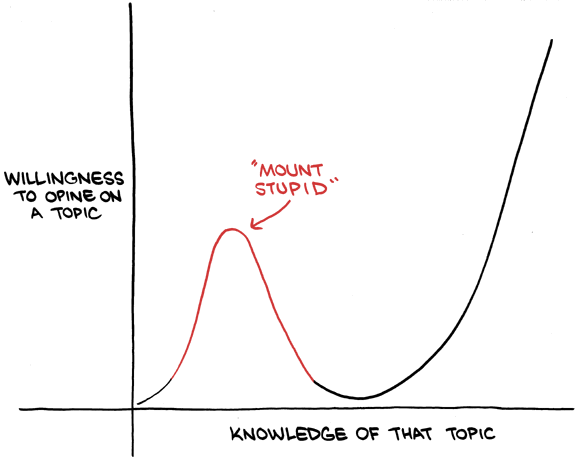
From my admittedly "peak mount stupid"[1] position as an engineer that uses these things, I'd suspect that the biggest contributors to that $1 figure come from the expert labour required to both R&D the chips as well as run the machines that manufacture them.
I'm sure there's truth to that. But I also think a large proportion of the price (and in general the plummeting price, and apogee-ing performance of many high tech components, such as batteries) is due not to exploitation, but to increases in efficiency. The bequeathed legacy of the thousand accreted technologies and improvements that have layered to produce contemporary supply chains.
Of course...everything we do today is based on exploitation: 1000s of years of exploitation of humans, frequently the worker and poorer classes' labor, 100s of years, and billions dead in war...all our achievements today literally stand atop this ginormous pile of blood and death...but, that ever-present historical reality aside...I think a large proportion of the skyrocketing perf and ocean-depth-plumbing prices of components is due to the compounding and intersecting effects of all our technological efficiencies.
The first step in solving these problems is getting the accounting in place, so we know exactly who is paying what. It is beyond me why we are not even doing that.
Anyway, we could solve these problems if we doubled the price. And then it would still be an amazing achievement.
Given our love for destruction, and ongoing events, it will be talked about the same way as we talk about Babylon, Egypt, Sumerian, ancient Roman and Greece, Aztecs and Mayas.


In centuries from now, our time will be studied as a remarkably revolutionary one.