Being able to download and upload files at the same time really helped make things more time efficient. From downloading files from BBS door games (e.g., Trade Wars 2002):
HS-Link was the best. You could upload and download at the same time which with zmodem you could not. Also, if you were using hs-link, you were definitely not downloading "tradewars 2002" tradew4rez maybe
By 1990 I was in university with 10BaseT available.
So my peak modem experience was probably 9600 baud modems with Zmodem for transfer protocols. I think there were 14.4 modems available then but I don't recall that I owned one.
I got to experience so many different remote access methods in my life - modems to bbs, direct dial to Unix system, slirp on said Unix system, dedicated 56k modem to home network, upgraded to dsl, finally college and Ethernet. So many discarded technologies…
If your modem was US Robotics, your parents had money. If it was 3Com, your dad was an executive. If you had a WinModem, you bought it at the computer show along with some Microsoft Office OEM CDs with no license key.
Firmware upgradeable 33.6k "Sportster" with the promise of a rebate on the front of the box.... no actual rebate coupon IN the box... and it's not like any of my friends actually received their rebates anyway.
Trying to get that thing to run on Linux via LinModem was fun.
If I recall correctly, wasn't that because WinModem was a software modem whereas USR modems were hardware modems? The WinModems were a glorified single chip on a board (analog <-> digital converter), with all the actual work being in the Windows Drivers.
Which on modern computers wouldn't be a big deal (see modern onboard sound) but back then a slower computer actually could mean slower data rates.
I recall the big transition from 2400 to 9600, and as a teenager I couldn’t afford any of the modems. But then IIRC CompuCom came along with a much more affordable 9600 modem, with the catch that it could only talk to other CompuComs, which my local BBS offered special numbers for. I can tell you going from 2400 to 9600 was massively beneficial, much like my first “broadband” experience. Every bump since then has been marginal improvement, really.
I had a Zoom external 56k. My internal 14.4 went kaputski and to replace it I went external because by that time, all the internal modems were WinModems and I had Linux.
The images on this site load very slowly... I very much hope this is because someone at USR deliberately throttled each connection to 56k. Retail performance art is an underexplored niche.
There is a twitch streamer (kitboga) who role-plays as an elderly lady. He baits scammers into calling him and messes with them for a few hours.
His setup is quite elaborate. Fake bank accounts, google play store, etc. One of the more subtle parts is a chrome extension he wrote that adds a random delay to the load time for web elements to better simulate an ancient home desktop and poor internet connection.
I worked in Medicare claims EDI years ago, but still in the modern era. 2008ish? Anyhow, back then at least, ALL claims were required to be submitted via dial up modems. These doctors offices with fiber optics were befuddled, and rightly so. The biggest complaint was that they couldn't even find modems to buy anymore, and USR is where we pointed them to.
Between that and the magic of modem commands, it really felt like everything you learned at that job was useless. Turns out, it was.
No idea if it's still the same way today, but it wouldn't surprise me.
I used to work for the company that did tech support for McDonald’s. They were still using USR modems to transmit data from restaurants to corp way into the 2010s, like 2015 or 2016!? They sucked to troubleshoot because nobody knew what a modem was anymore, but on the other hand, they were kinda indestructible.
I remember how excited I was when I bought my usr 56k modem. I imaged how awesome it would be to download faster than 3.2k/s!! I plugged that bad boy in, and discovered that due to the phone lines in my area, I could now download at about 3.3k/s.
I worked for a local ISP in the 90’s and can tell you you were not the only one. In my memory 56k modems were rarely reliably better than 33.6ks. Myself I seem to recall feeling luck to get around 40k connections.
I definitely remember redialing multiple times to try to get both a modem from the 56k bank (my ISP had a mix while switching over), and a connection going as fast as possible. I don't remember whether the max speeds I got were, but when downloading a "big" multi-MB file it was worth it to get a faster connection.
same experience, France had decent phone lines for audio, but the bandwidth 56k provided over those lines were rarely stable, falling even below 1kB wasn't uncommon.
I still have a bunch of proper modems in a box (including some USRs). What I've been planning, is to put up a real live dial-up BBS on a spare land-line I have, so that retro-people can actually play with the built-in modems in old machines.
I've done a cursory Google search, and I don't think there are any UK based dial-up-only BBSs still running, so I think it would be a good thing to do.
In a few years time, the whole of the UK will be fully switched over to VoIP on the back-end (invisible to the end-user) for all land-lines, which as I understand it will limit modem speeds to about 2,400 baud due to the VoIP compression. So this might be the last chance for [UK] people to experience dial-up at full speeds.
Which also means they won't get to hear the full connection "song" as their modem explores all the different coding and error correction options to negotiate the best connection. A full rack of modems connected to a server made our server room into discordant cathedral, sporadic modem sopranos overloaded on the thrum of the big tape drives bursting writes.
It would depend on the codec they choose. You're definitely getting more delay and jitter regardless, but g.711 is commonly available for voip and is essentially the same encoding as on a t-1/e-1, but with packetization delay (a t-1 multiplexes with one sample per line per sample period, in voip you generally send 20 or 40 or something samples per packet)
Weren't USR modems famous for being some of the better Linux compatible modems back in the day? (As opposed to cheap crappy "WinModems" that overtook everything)
All modems were compatible with Linux until very late in the piece, when so-called WinModems appeared commercially IIRC ~1998.[0] In these, processing done in hardware on other modems was offloaded to the CPU via closed source systems. This was probably only possible as CPUs had become faster, and was likely done to save cash and PCB space in Y2K-era laptops. I think they were eventually largely supported under Linux, but basically by this time nobody needed them anymore. The reason modems were all so well supported was that a stable serial interface was largely supported across the board by all vendors. After serial line configuration, only vendor-specific extensions and a slow evolution of additional features such as caller ID differed. Some Aussie examples (ignore the two at right): https://upload.wikimedia.org/wikipedia/commons/5/50/Australi...
> but basically by this time nobody needed them anymore.
Not quite. Broadband was getting significant adoption, but it was more expensive and not available everywhere, so most people stayed on dial-up for years to come. Visitors to this site old enough to recall that era would very likely have been early adopters, so it's easy to have the perspective that dial-up went away circa 2000, when it really didn't, it merely peaked... It wasn't until the 2010s when dial-up disappeared.
But that also discounts travel... Even if you had broadband at home, the world wasn't blanketed with Wi-Fi like it is now. Only the best hotels had ethernet jacks, and cellular data was still very slow and with very high per-minute usage fees. So laptops continued to come with rj11 jacks for years to come.
~1960s-1980s: critically important for HIGH SPEED LEASED LINE[0] MAINFRAME[1] MINICOMPUTERS[2] IMPs[3] and PADs[4] (~100-300-1200bps).
1980s-early 1990s: Hayes serial modem AT command set released.[H] Modems critically important for BBSs, UUCP, Amiga/PC warez scenes, early open source distribution. (2400bps/9600bps/14.4/28.8/56k)
~early 1990s: critically important for early internet growth which largely supplants BBSs (56k) and coincides with the initial popularity surge for Linux
~1995-2000: broadband grows rapidly in developed countries. It really kicks the llama's ass. Early P2P warez via Gnutella, MP3 and DivX. CD burning is rife. ISO images are a thing. Against this background, Sony's minidisc fails but accidentally enshrines funny Finns rapping as history.[5]
~1998 winmodem! KK System releases Fax U and popularizes negotiation sounds as art.[6]
~1999: Somebody picks up the phone[7] and the modem connection drops.
~2000-2005: potentially viable but declining option vs broadband (Mbps). Even China had >Mbps HFC broadband at this time. DVDs are mainstream. Steam, Valve's revolutionary harbinger of online software distribution for desktops, is released.
~2004: Artists use modems as current subjects.[8]
~2005-2010: poor countries and extreme desperation only. Physical distribution of software wanes.
~2010: 56k becomes slower than mobile data in most places. Many countries cease hauling copper pair due to mobile plus copper thievery. The developing world comes online without legacy copper infrastructure.
~2013: Artists use modems as retro subjects.[9]
~now = Amusing historical tidbit. Slower than mobile data that's 3 generations old.
The external serial ones will work with anything, and they say "OS Compatibility: Windows, Linux" but really any OS would see these as just serial devices.
Would the PCI-E one work under Linux? I've got an old 98/XP/Linux machine that would be fun to stick a modem into for the novelty. Unfortunately the PCI slots are all taken up
Just as an aside, even if it turns out to be a Winmodem, many of them can still be used under Linux. Towards the end of the modem era there were a couple of open source efforts to create Linux drivers for popular Winmodem chipsets. LTMODEM was one of them. For reasons I don't understand, most were unable to do 56k/v92bis though.
The other interesting thing about Winmodems/softmodems, is that they could also be used for stuff besides serial data transmission. In particular, you could use them to send/receive faxes and handle voice calls. This latter ability was particularly neat.
No idea if they're still supported, but the Asterisk telephony package could even use inexpensive PCI modems as part of a PBX, to connect to analog devices on either the internal (wired phones) or external (POTS phone line) sides. This is a bit less impressive today, when you can buy a cheap SIP ATA for $20, than it was in the late 90s / early 00s when I first heard about it.
I still have a Psion 5mx with a USR modem connected via a null cable. This thread intrigues me to try connecting via dial-up again and see what/if something works with Psion browser
It makes a person of my age feel right at home that they are still using the same case molds for these. I wonder if they still have regular production runs, or they are selling off a monumental back inventory from the 90s.
I worked Mac tech support for a regional ISP in Northern California when the 56k modems were announced. It was a time of rapid development in modem technology. When my boss told me of the new modem it sounded impossibly fast - most of our customers at the time were still on 14.4 or 28.8. He then told me that 56k would probably never catch on while pointing at the large point to point radio antennas he wanted to mount on everyone’s homes…
Years ago, I used a Linux script from the vendor to upgrade my us robotics "56k message modem" from V90 to V92.
The result was a brick. Lifetime warranty or not, the vendor did not honor warranty. Thus I do recommend getting your modem elsewhere. By now, I'd expect OSHW solutions to be available.
Should anybody know how to possibly get past the brick, please let me know. A cursory glance inside years ago didn't yield anything that looked like a PROM.
I did some firmware hack to make a 28.8 or 33.6 Sportster a 56k one. I think there was a window where they used the same hardware, but throttled it down in firmware so they could charge more.
I do remember seeing the K56flex AND the x2 firmware upgrades available on Geocities warez sites of the late 90s... I was too scared to brick my modem.
Good news, it’s the year 2021 and computers are so fast that you could probably bit bang a 56k modem connection using a python script on a raspberry pi
I can't find any scans of the external modem PCBs, but the internal ISA ones have a 28f or 29f series EEPROM from what I've seen. Often there's a sticker on them with firmware info, which suggests they're programmed before being soldered on the board (ie: no JTAG).
The internal ones shouldn't be much different than externals, they just implement another serial interface.
Would be a pain to desolder and resolder if it's a TSOP chip, but PLCC isn't too bad. You might have some better luck if you high-jack a compatible motherboard's floppy-disk BIOS update process to write a new binary.
What an animal! I logged onto our BBS with a 300 baud, and could watch the characters appear on the green CRT one at a time. Such speed, such exhilaration.
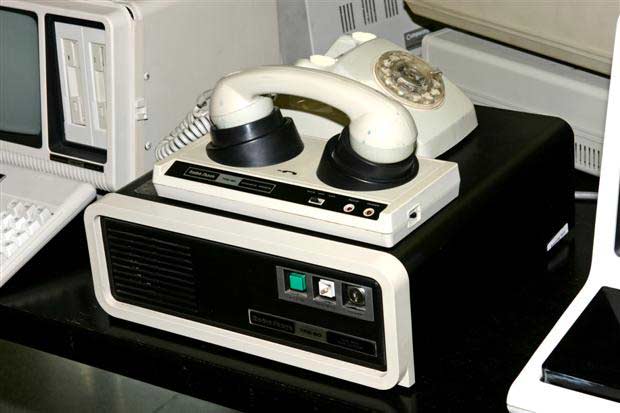
My dad's modem was 75 baud, on the TRS80. You didn't plug a phone line directly into it. This was still in the era of rotary phones before push button blue tone ones. You put the handset of the phone (which had the microphone and speaker) into a cradle. It looked like this[1].
Coincidentally, in the picture, that big box that is as big as an early desktop PC that the modem is sitting on, is a whopping 5 megabyte hard drive. State of the art for consumer hard drives at the time. I still have my dads in the garage. I vividly remember having to type "park" to park the hard drive heads before you turned it off, or it could corrupt everything on the drive when you turned it back on and the heads went back to the MBR.
I still have the Apple USB modem, they made it until 2009 or so. Doesn't work on modern Macs anymore but tried last year on Windows 10 and Debian and worked like a charm
The price reflected that they could also talk to mainframes, which didn't use an async bit stream. Couriers could support synchronous communications, and programs like CLEO could use that to support bisync and SNA protocols using the EBCDIC character set.
Instead of start bit, stop bit, and parity, it would use a few SYN bytes (00110010) to get the other side's clock in sync, and then send bytes back-to-back with no start or stop bits, then a checksum at the end of the block.
Back in the day, you had to talk bisync to sell goods at Walmart, for example. They just had a mainframe with Sterling Software's SUPERTRACS mailbox program, and a bank of 9600 baud synchronous modems. Basically in the 90s you had to learn some really arcane shit just to sell your whats-its there.
> Please be advised that USR does not, and has not sold any personal information in the last 12 (twelve) months. Similarly, USR does not have any future plans to sell personal information. Please refer to our Privacy Notice for details on how your information is used.
> USR respects and understands that you may still want to ensure your personal information is not sold. Therefore, if you would still like to proceed with your “do not sell my information” request, we ask that you kindly provide the following information:
This is just how the CCPA works. If you want to tell them to avoid selling your personal information in the future, you have to identify yourself so they know whose information to not sell.
Right. I vaguely remember when that happened. I think USR was trying to rush a 56k modem out before Hayes, so they invented their own protocol instead of waiting for ANSI to standardize V.90.
I almost want to buy one and get a landline just for the nostalgia of it. I’m sure there are still some dial-up BBSes out there.
A couple years ago I came across a post about someone who runs a packet radio BBS in San Francisco: https://www.reddit.com/r/amateurradio/comments/cuxso3/packet... I connected to it over VHF a few times and chatted with the operator once. That was fun.
I wonder if the phone lines are still compatible with data modems nowadays, or if they're all Voice over IP.
If they're Voice (and other noises) over IP, then the modem would be encoding IP packets to tones, and as soon as it reaches the phone provider's hardware the tones will be digitized to be transmitted over IP packets again...
There are some other standards, but they have to be supported on both sides of the line, which is not a given, especially not between different TELCOs/ISPs.
Which makes trying to use FAX over it really 'interesting'.
When we moved into a newer subdivision just before 2000 we discovered our modems couldn’t get over about 19.2 (IIRC). We did a lot of troubleshooting but in the end found the culprit was how the phone lines were setup in the complex.
I think the lines were basically like VOIP from the box at the street (or somewhere nearby). They did it to pack more lines in, but it limited the bandwidth available.
You had to pony up for an ISDN line if you wanted to go faster until cable internet was available a few years later.
Vice recently made a series called "The Dark Side of the 90's." The title theme has a 90's rap sound, but at one point, a dialup modem cuts in. It's even pitch and tempo matched.
I didn't watch this but your description gives me hope that someone, somewhere has noted how dot matrix printers made for great audio samples. Public Enemy comes to mind.
PCIe 1.0 was 2003-ish [1] (I don't recall when the first motherboards actually shipped with them). Even in 2006, AOL had millions of dial up customers, particularly in rural areas without serious broadband options. Eventually they raised the prices on dial up to push anyone that they could to switch to their mediocre DSL service [2].
I recall a lot of even casual internet users finally accepting around that time that they should just transfer their email from AOL (to GMail if they knew someone to get an invite!) and get faster, cheaper "real internet".
But for a time, new PCs from folks like Gateway and so on had an option for PCIe modems, IIRC!
A lot of modern desktop computing (64-bit x86, SATA, PCIe, Wifi, death of Windows 9x, multicore CPUs) landed around the same time, and yes, dialup wasn't quite dead yet.
In a lot of ways, desktop computing hasn't changed much in the last 15 years. It changed way more between 1991 and 2006 than 2006 and 2021. Phones and tablets, now those are completely different.
The coveted king modem for me was the external version with an on/off switch (having started on an internal card). When I finally got one was super happy. Now it’s funny that you can still see these awesome USR 56kx2s kicking around for out of band management in IDFs, gathering dust, sometimes hanging by a cat3 but how totally awesome they were to me all those years ago. Now I don’t even have a phone line to use one if I wanted to.
I'm curious what year their statistics came from for "In North America alone there are 28 billion dialup transactions, which make up over 60% of all the transactions". The oldest Wayback snapshot of that page is from 2014, and while it's surely gone down since then I still run into them from time to time especially in rural areas or those little standalone ATMs in places that don't otherwise have POS.
They might still be installed in lots of those places even if a faster connection is usually used. I've experienced that even within the last year at a gas station when their satellite connection went down and there was a big line due to every card transaction taking 40+ seconds.
I used to work in a store with a credit card terminal that normally used the internet but was hooked up to a phone line as a backup. When the internet went out the line would back up because the dialing process was so slow, but at least we were still in business. Seems like this is probably still a reasonable backup measure for retailers to have in place, if you already have a phone line it doesn't cost you much.
These are still used in mission critical environments where someone with a Wyse Terminal sits on one end (or at least a terminal emulator) and calls systems in places like a cable company's head end. It's definitely antiquated but, in many cases, old school tech works fine, so penny-pinching folks choose not to upgrade.
x2 and KFlex were both pre-standard single like 56k modulations; v.90 was the resulting standard and most x2 or KFlex modems could be upgraded to that.
Bonding two modems (or a modem with internal bonding) should have a different name to avoid confusion. But maybe didn't.


* https://en.wikipedia.org/wiki/ZMODEM
Later BiModem and especially HS/Link built on top of that:
* https://en.wikipedia.org/wiki/BiModem
* https://en.wikipedia.org/wiki/HS/Link
Being able to download and upload files at the same time really helped make things more time efficient. From downloading files from BBS door games (e.g., Trade Wars 2002):
* https://en.wikipedia.org/wiki/BBS_door
To one's mail and forum postings via QWK (and SOUP for offline Usenet reading):
* https://en.wikipedia.org/wiki/QWK_(file_format)