This USA tax thing has always baffled me... it is the exact definition of why we pay taxes: for the government to provide services that are common to the country´s citizens.
There´s nothing more common than tax collection: rich, middle class or poor. Why wouldn't citizens demand a public tax filing process? Even in Mexico we have an automagical tax filing process that makes:
a) The great majority of the population who perceives a salary not needing to file taxes.
b) For the rest of the people, those who don't do anything fancy, just click one button in a portal to do the filing, and everything is calculated by the tax authority.
c) For the small percentage that do more complex things (I'll say it is between 5% and 10% of the population) still can do it in the portal for free, or hire an accountant.
Most countries have this "automagical tax filing process". And what kills me the most is that America actually secretly has this same system too. Yet every year we have to go through the charade of filing taxes ourselves, when the governemnt already knows what we owe without us needing to round up paperwork, W2 forms, 1099 forms, and so forth. Yet they make us do it anyway.
Don't believe me? Simply don't file your taxes next year. You will get a letter from the IRS sent to you that literally tells you what you owe. They know all of your income down to the cent, they know what you owe. This automagical system exists. Yet the only way to "use" it is to either not pay your taxes, or to pay them wrong.
Yet every year, the IRS makes us go through the charade of putting our taxes together and all the work (and money) that it entails, when the whole time they know what we owe already and expects us to pay that unless we can prove them otherwise.
If it was automatic, income would be missed. The government would be revealing what it doesn't know about, and people would not supply the missing information.
Under the current system, people aren't sure what the government is aware of. Because we get in trouble for leaving things off, we are more likely to report everything.
Make people file a tax return, but auto-populate it with the data the government already knows. And at the end include a tick box clause that essentially says "I have included everything and reviewed the autofill info, and if I have omitted anything later discovered I will be prosecuted".
20 seconds to file your taxes if there's nothing unknown. Very easy to add extra info. Covers the tax departments back of you intentionally mislead them.
Same here in Europe, my tax form is auto-filled I only have to check the numbers and confirm, with same warning and laws to back it up in case you decide to hide income.
We know what the IRS knows because the majority of people get the same forms as the IRS as far as income goes: W2, 1099, 1098, ... Unless you’re self-employed, the IRS only misses some deductions or foreign income.
Ever performed a lot of stock trades in a single year and had the IRS believe that you owe them $5 million in income taxes because they assume every sale you made was all profit? That's always fun, especially when they think they're right and they're entirely wrong.
The IRS information is at times comically incorrect in fact.
If you're trading more than $20 million a year in stocks, you are in the vast minority that everyone here acknowledges would need to adjust and file your taxes manually.
99.999% of the US population is not trading $20 million a year in stocks, and everyone else here is merely talking about the 95% of the population that has straightforward tax returns.
Which is why most countries have a system that shows you what they think, and you can accept or not. It’s not like the majority of people are in such a situation, and likely over time that will become less common as its often a byproduct of legacy systems / mergers that lose the original transaction.
If you have a W-2 job and all your investments are in a bank or brokerage, but they still don't know your filing situation, dependents, other income, or deductions.
Not that I'm justifying the current system. It's just that the IRS only knows the big picture for most people. The rest is complicated.
Or if you work overseas and send regular payments to your bank account in the States, you need to make sure you file your Foreign Exclusion Tax form. Which is even more complicated. -.-
I'm not sure if it does or not, but you can have one W-4 per paycheck, so I thought it was just used to figure out your withholding. The amount withheld shows up on your W-2.
There's no reason why they couldn't go to the IRS though. They could quite easily maintain this information and make it easy for you to update it come tax time if it's changed.
Completely agree. Tax preparation is actually work the government should pre-fill. Australia does this. You can do your taxes online free and/or get an accountant or an army of accountants if your affairs are that complex. Frankly, the government should do the initial assessment for you generated automatically from the many, many existing surveillance systems already in place. They are watching all financial transactions and you might as well assume they are.
To even imply otherwise, and I've seen other comments say they shouldn't / don't have this already in place... even when social media companies are slurping data every way they can... seems absurd.
All that said, you should go through each item and correct their mistakes. Those matching systems aren't perfect.
Everyone who replied to this with "But what if...?": we are not talking to you. To a first approximation, literally everybody else does not have your problem -- they have W2 income and their filing status is very probably the same as it was last year. If you got married you filed a marriage license; if you had a kid your name was likely on the birth certificate. The IRS could guess everybody's taxes and be right at least 80% of the time, quite probably more like 95%. It really would be an existential threat to H&R Block, and good riddance.
The IRS will intentionally not give you any deductions and the cost basis for any capital gains will be $0 regardless of what you paid. The intent of the "return" they file for you is to get you to file a real once since their version will say you owe a lot of money.
This is all explained in the letter they send you should you fail to file.
What they don't know is my charitable deductions. My charitable deductions greatly reduce my taxes. If I went with their automagical tax filing process I'd lose out on those deductions.
That could be automated too largely. In Austria charities submit this information to the government and it automatically gets added to your prefilled tax filings.
Things don’t really work that way in the USA. I can take a bunch of stuff to a place like Goodwill. They will give me a little slip of paper that is “proof” that I donated, but they don’t keep records of my donation. The only way the government could know about it is if I tell them at tax time.
Americans on the whole don't trust their government quite a lot. If the government just said "you owe X in tax this year", nearly everyone's knee jerk reaction would be that the government is overestimating and cheating them.
On the other hand, you can pay a flat fee to let a third party fight the government on your behalf. That's something that many Americans like the sound of.
I think the real problem is that the tax system is complicated, and turbo tax does a good job of making it feel even more complicated than it is. You can fill out your own 1040EZ, if you even know what that is, but people have this sense that the tax system is full of loopholes and they want to exploit that.
> Americans on the whole don't trust their government quite a lot. If the government just said "you owe X in tax this year", nearly everyone's knee jerk reaction would be that the government is overestimating and cheating them.
That's why most governments that do self-declaration services make it so you can review what tax rules they based amounts off of. It's not like tax law is super easy elsewhere and without complications. I should never have to pay a fee just to declare taxes to reconcile things for the IRS. That is a basic governmental responsibility to give me that service for free.
> That's why most governments that do self-declaration services make it so you can review what tax rules they based amounts off of.
Right, but since no regular person understands the rules, they can't really double-check. Especially since sometimes you can file stuff under different rules that produce different results, despite both being valid (I say this based on experience from another country, but I suspect the same is true in the US).
> "sometimes you can file stuff under different rules that produce different results, despite both being valid (I say this based on experience from another country, but I suspect the same is true in the US)."
Yes, such circumstances exist in the US too. For instance married couples usually file jointly, but they could chose to file separately which results in a different effect.
It's the same problem as with auto repair and medicine. It's nice that we have competing providers, except we don't have the expertise to judge their performance.
> except we don't have the expertise to judge their performance.
Well, this is a bit different in that regard. Last time I tried it, it was free to put all my info into turbo tax and see what my amount owed would be, and then it would be a fee to actually file. I assume most tax software works that way.
So it's actually very easy and objective to see the performance of these systems. It would obviously be a big hassle though to spend a whole afternoon playing with all the different tax softwares.
I can assure you the secret sauce in "exploiting" tax law is almost never in choosing one thing or another during filing (there should only be one optimal answer once the facts are already created), but in tax planning. The tax software even hints at that. Paying for tax filing itself is basically a low-level scam.
I think you buried the lead here. American public schools, part of the American government charged with teaching children and funded by taxes, don't teach kids how to pay taxes to the American government (maybe it sometimes happens, but it's certainly not standard.) It's ludicrous.
I'm not disagreeing with you, but how are schools supposed to teach kids how to pay taxes when it's such a convoluted specialty that requires college level education to learn?
Eh, I think you could teach 90% of how taxes on wages, investments, and property work in a simple class for teenagers. It's the other 10% that takes years of study and legal expertise--but the vast majority of people don't need that 10% more than a few times in their lives (e.g. if they get very rich, retire, have to handle a complex family financial situation, or are otherwise massive outliers), and hiring a tax attorney at those times is probably a good idea regardless of whether or not you learned the basics in school.
For most people it isn't that complicated, but public schools don't teach kids even the bare basics like "you can get the paperwork at public libraries and post offices."
An actual argument I've heard from TurboTax shills is that tons of people underpay taxes now with the self report system, and having the government pre-fill forms for you to rubber stamp would effectively increase taxes on the working class.
That's such a nonsense argument, though. Having the IRS pre-fill basic forms for you would not obligate you to accept them. People could still compute their taxes themselves (or pay someone else to do it).
Ok, I disagree with the TurboTax reasoning, but I think your argument doesn't make sense... if most people have their pre-filled tax forms making them pay more than they should, then everyone is going to compute their taxes themselves anyway to avoid paying too much... at that point, why is it better than the current system?
About 20% of people (particularly low income people) have simple tax returns and file using 1040EZ. If the IRS computed that form, then what they send out would be ideal for the majority of taxpayers. So it would benefit those by eliminating the expense of tax preparation without actually costing them more in taxes.
Then there are those like myself who fall into an in-between area. I have more complex taxes, although not as complex as a lot of people, but would gladly pay more than is strictly necessary in order to not have to bother with figuring them out. In fact, I already do, in the form of paying a tax preparer (I fully consider the expense of tax preparation as a tax itself.)
Those whose taxes are more complex are very likely aware of that fact, and would continue to do their own tax preparation.
Also, if the IRS provided a prefilled 1040EZ, that would make computing your own taxes easier because you could use the figures supplied as a reference.
To nuance this - they've been refactoring/shuffling the forms around.
  2017 Form 1040EZ goes up to box no. 14
  2017 Form 1040 goes up to box no. 79

  2018 Form 1040 has no boxes for $ amounts!
  2018 Form 1040 Schedules 1-3 is where they all went, if you needed them.

  2019 Form 1040 added boxes back up to 11b
  2019 Form 1040 Schedules 1-3 also exist
Basically, Form 1040 is now "EZ" by default. For those with more complicated tax filings, you've had your work scattered to the four winds - I mean, three schedules.
Great, sounds like TurboTax will still be able to compete if the IRS gives people tax filings precalculated, as TurboTax can say "We can save you $XXX!"
I’m sure for a large percentage of Americans like myself the “$XXX” that they saved you is just the standard deduction. Maybe at some point in my life an itemized deduction will actually save me more money, but every time I have filed taxes TurboTax looks at my info and decides that the standard deduction is the best I’m going to get. So for some percentage of Americans TurboTax won’t be able to compete because they can’t save you more than the IRS already did with its deductions.
I would expect that to be common for the first couple years but after a couple years of realizing that they aren’t saving any additional money or are saving less than they are paying for TurboTax I’d expect that to drop off.
Unless using TurboTax actually saves people money. I wouldn't expect the IRS to have enough information to be able to predict in advance the deductions people might be able to take -- stuff like business expenses, mortgage interest, charitable donations, state taxes, etc.
Tax evasion and overstating deductions are common partly because the IRS doesn't have access to the information necessary to verify everything -- that's the same information the IRS would need in order to pre-fill tax forms accurately for the 1/3 of taxpayers who itemize their deductions. 1/3 of American taxpayers a pretty big market for TurboTax and similar services to thrive in.
It's by design. The GOP wants you to rub your face in the fact that the government runs on tax revenue, in the hope that you'll develop an allergy to taxes.
The US hasn't had a real balanced budget in much longer than that. During the Clinton era the balance was achieved in part by stealing from Social Security by keeping the surplus inflows and pretending there's a magic locked Social Security box with trillions of dollars in it (which are really IOUs backed by the Fed's ability to debase the future for past over-spending). We similarly treated as 'surplus' tax revenue that should have been set aside for future higher Medicare costs (which back then we knew full well were coming) and is now burning a massive hole in the present budget.
The Clinton years were the twilight of the fantasy of abusing inbound entitlement tax flows for spending in the present and ignoring the future. That government spending party trick - kicking the can down the road - is now exhausted on a normalized basis, so we're rapidly heading toward perma QE as the only solution remaining other than very high taxation across all major income groups.
Can someone explain to me the negative consequences of running a deficit? Countries aren’t people. They don’t die. As long as countries are willing to lend us money and the US can service the debt, what does it really matter if the national debt is multiples of the GDP?
There are no real negative consequences. Fiscally conservative people want people to think there are because it's a way to counter government spending with an argument that makes sense on the surface, despite the fact that the argument is completely wrong if you spend a few minutes thinking about it.
We will spend $479 Billion in interest on the national debt in 2020.
That's >22 NASAs-worth of money, if you care about space exploration. It could be roads or high speed trains or education or healthcare or whatever you care most about.
Instead it's going towards paying interest on debt incurred for cheap political wins in the past...
a) The great majority of the population who perceives a salary not needing to file taxes.
In the United States, and many other nations, the vast majority of taxes aren't collected from payroll. If that was the case, things would be easy. But there are hundreds of other ways that taxes are collected, and they vary from person to person.
More importantly, taxes aren't exclusively about revenue generation. They're used to encourage people to do or not do things: Save money, invest money, buy houses, have babies, buy cars, add solar panels, and thousands of other things.
There are plenty of people who shout "flat tax!" whenever this topic comes up. But they're mostly people who have only led simple lives where the IRS only touches them on their paycheck, or who don't understand the full range of how taxes are used.
Or people do understand how taxes are used and fundementaly disagree that taxes should be used for those purposes
Taxes sole purpose should be to collect money to provide services, Nothing else
they should not be used to socially engineer the society the way the government sees fit, that is not a free society or a functioning democracy/republic at that point
But this argument can be trivially extended to all other "social engineering" taxes. Vice taxes make you drink or smoke less? You're reducing state's expenses on healthcare, law enforcement and social services. Tax benefits for installing photovoltaics or buying electric cars? You're helping to improve the quality of life, again saving state on healthcare, and in the future, on various forms of crisis management once the climate issues start taking their toll in full.
(FWIW, I'm generally in favor of this kind of "social engineering" when done by democracies.)
A democracy doesn't stop being democratic because you don't like the outcome. If a democratic government performs social engineering, the people socially engineers itself.
Corporations are people, money is free speech, and our politicians are bought and paid for. They have every incentive not to make things work better if corporations are profiting from the broken status quo.
Even a lot of the more complex things could be automated.
For example, the only slightly complex thing about my taxes are capital gains and interest. It would not be hard to have my brokerages/banks coordinate with the IRS to autopay my taxes on that as well, just like my income taxes are auto paid.
Does the government automatically know what you spent in business expenses? Or what charitable donations you made? Or what property you may have lost during the year?
I’m not saying those are easy to automate, or that everything can be automated, I’m saying a lot of things are able to be automated. Not only capital gains and interests, I suppose mortgage interest deduction would also be easy.
"it is the exact definition of why we pay taxes: for the government to provide services that are common to the country´s citizens"
I disagree with that definition. In a limited government, taxes are only for specific purposes, not any service that might be commonly (or even universally) needed/wanted.
You can agree or disagree about whether a limited government is good, or whether tax filing services should fall within those limits. But it's certainly not the definition of taxes to be for any and all "common services".
It's mostly because so many special interests have gotten loopholes put in for their particular pet project, simplicity be damned. That's just the way politics works in America.
> Why wouldn't citizens demand a public tax filing process?
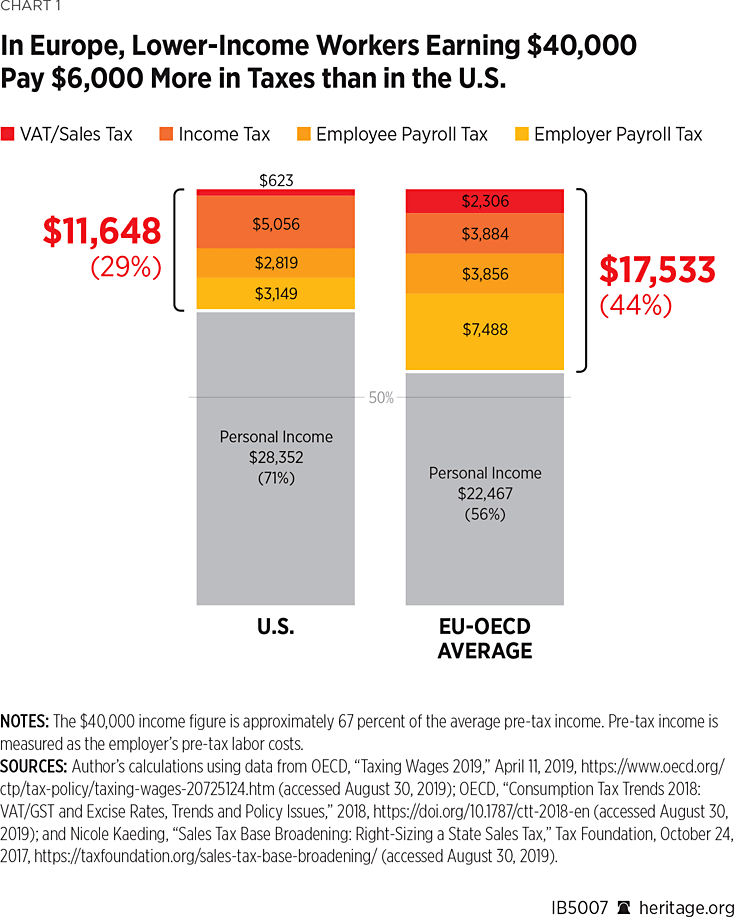
Because they don’t want to make it easy for the government to impose lots of taxes. Americans have the lowest taxes in the developed world. Not especially for rich people, but for everyone else: https://www.heritage.org/sites/default/files/inline-images/I....
This isn’t the work of some secretive cabal of billionaires. Rich people hire accountants to do their taxes anyway. The absence or existence of free tax filing doesn’t affect them at all. But a platform of “we’re going to make taxes painful so the government is afraid to raise taxes” gets a lot of votes. (In my view, is nothing bad about people being confronted once a year with the cost of the government to themselves. I just looked at my taxes for 2018 and concluded I’m taxed too little and would rather pay more for a government that offers more services. But people should be making that decision with eyes wide open.)
1. This doesn't make any sense. The easiest way for the government to impose more taxes is to raise the percentages on the taxes they already collect. Private filing has nothing to do with it.
2. Americans don't have the lowest tax rates in the developed world. Mexico, Ireland, Chile, Turkey, and South Korea all have lower tax rates[1]. And in some cases the governments provide more services with less money because they're not spending half their budget on occupying other countries.
"And in some cases the governments provide more services with less money because they're not spending half their budget on occupying other countries."
This. The American military is perhaps the largest and most wasteful social program on the planet. Americans spend way too much time trying to find their way around this elephant in the room.
> 1. This doesn't make any sense. The easiest way for the government to impose more taxes is to raise the percentages on the taxes they already collect. Private filing has nothing to do with it.
To raise the percentage rates, politicians have to vote to raise those rates. Private filing means that everyone is very aware of how much they’re paying in taxes. It’s not just an invoice they receive listing how much was withheld. They have to recalculate it. That makes them much more sensitive about voting for politicians who vote for higher taxes.
> 2. Americans don't have the lowest tax rates in the developed world. Mexico, Ireland, Chile, Turkey, and South Korea all have lower tax rates[1].
I don’t think people would consider Chile and Mexico to be developed countries. You’re right that Ireland and South Korea are lower (depending on the year, Ireland cut taxes significantly recently). But they’re together with the US in the bottom band.
> And in some cases the governments provide more services with less money because they're not spending half their budget on occupying other countries.
I think it’s true that other countries do more with less. But it has little to do with the military budget. US government spending as a percentage of GDP is 38%, meaning all levels of US government spend $7.3 trillion annually. The military budget is just 10% of that, or 3.2% of GDP. That’s high compared to Europe, but not a big difference compared to overall government spending. The US military budget is proportionally where the U.K. and France’s was in the late 1980s, back when those countries had robust welfare states: https://worthwhile.typepad.com/.a/6a00d83451688169e2022ad3a0...
If the United States cut its military budget to the same proportional level as France, we’d have an extra $175 billion for other things. That’s not nothing, but to put that into perspective, we spend $970 billion a year on education (5% of GDP). We spend $1.1 trillion on healthcare and welfare for poor people. Cutting our military budget to European levels wouldn’t revolutionize our budget.
> To raise the percentage rates, politicians have to vote to raise those rates. Private filing means that everyone is very aware of how much they’re paying in taxes. It’s not just an invoice they receive listing how much was withheld. They have to recalculate it. That makes them much more sensitive about voting for politicians who vote for higher taxes.
I'm not sure how you think private filing is related to manually filing your taxes. Yes, if taxes were just paying an invoice at the end of the year, that would make them less noticeable, but that's not a necessary component of private taxation. Adding up all your income and just calculating a simple percentage would create just as much awareness--probably more, because there's some clarity/transparency that is easier to understand.
In fact, I'd argue that a complex filing process puts a focus on where money is coming from, rather than where it is going, which is arguably much more important to make transparent to people.
> I don’t think people would consider Chile and Mexico to be developed countries.
Any basis you could have for not considering Chile and Mexico to be developed countries applies to large sections of the US (incidentally, they tend to be the parts of the US with the lowest taxes). There's more poverty in the parts of Alabama and West Virginia that I've visited than the parts of Ecuador I've visited.
> You’re right that Ireland and South Korea are lower (depending on the year, Ireland cut taxes significantly recently). But they’re together with the US in the bottom band.
So the rest of your argument doesn't work, since it was based on your claim that we have the lowest taxes.
how would that affect ease of tax generation? You would still need to have the proper congressional authorities vote on the matter, no? And sure, when I am in sweden I get taxed more because of VAT and such, but having a national standard where I can just declare my taxes for the year by pushing a single button for free through the government tax app is a benefit to outweigh any worry that you will get shafted by new taxes. In the US it just seems backwards and no excuse can justify this. Horrible system.
> how would that affect ease of tax generation? You would still need to have the proper congressional authorities vote on the matter, no?
People aren’t paying attention to tax bills that are getting voted on. But when they do their taxes, they’re forced to actually work out how much they’re paying the government. A bill or invoice they get in the mail wouldn’t have the same effect.
As to the US system being unjustifiable, I think Europeans don’t really understand America. In an ideal world, I’d prefer a Swedish system with high taxes, lots of social services, etc. But Americans aren’t Swedes. They don’t trust their government, and they don’t really trust each other. A quarter of Americans polled favor their state seceding from the country (ranging from 20-34% depending on region). By comparison, only 15% of people in the Basque region of Spain want independence.
I live in Maryland, which is about the same population as Denmark and only moderately smaller than Sweden. It’s a “blue state.” Our capital is Baltimore. Schools in Baltimore spend 40% more per student than schools in Sweden, in a city where you can get a beautiful townhouse for maybe 1/4 of what it would cost in Stockholm. The schools should be amazing, right? No. They’re awful, with terrible test score and enormous gang violence. The city government is corrupt. Not in the way you probably think the US as a whole is corrupt (controlled by wealthy elite), but the sort of reciprocity that typifies developing countries. The former mayor has been convinced of felonies, and in February will probably receive a sentence of 5-10 years in prison.
So despite being a strongly blue state, we elected a Republican Governor by an overwhelming majority that promised to control spending, cancel public projects like transit lines, etc. Because we don’t trust (can’t trust) our government to use our tax dollars effectively.
So yes, there is support in America for things that make people think hard about how much they pay the government: https://www.youtube.com/watch?v=BcEhl5HfGMM. And it’s not irrational or crazy. Our situation is very different than what you face in Sweden.
> People aren’t paying attention to tax bills that are getting voted on. But when they do their taxes, they’re forced to actually work out how much they’re paying the government. A bill or invoice they get in the mail wouldn’t have the same effect.
Except they’re not working it out. They just have TurboTax do it then see they get a few thousand dollars for $35+ and a few minutes of work. Most people don’t understand that a tax return is money that was already theirs; They just see it as an extra paycheck.
> But a platform of “we’re going to make taxes painful so the government is afraid to raise taxes” gets a lot of votes.
I've never heard anyone promoting the idea of keeping taxes complicated to avoid higher taxes.
There's nothing inherent in complicated taxes that stops the government from raising rates.
Conservatives have long wanted the flat tax (file taxes on the back of a postcard) and lower taxes, so simpler lower taxes.
I think the reason it became so complicated was because businesses lobbied for special rules and tax breaks that made things complicated in the first place. Businesses are now setup to take advantage of these loopholes (Amazon passing $0 in taxes, etc.).
TurboTax was built as a result of complicated taxes and they lobby heavily against a simplified tax code.
It's not some cabal of citizens wanting to keep taxes complicated, it's the industries that benefit from the current tax code that wants to keep it this way.


There´s nothing more common than tax collection: rich, middle class or poor. Why wouldn't citizens demand a public tax filing process? Even in Mexico we have an automagical tax filing process that makes:
a) The great majority of the population who perceives a salary not needing to file taxes.
b) For the rest of the people, those who don't do anything fancy, just click one button in a portal to do the filing, and everything is calculated by the tax authority.
c) For the small percentage that do more complex things (I'll say it is between 5% and 10% of the population) still can do it in the portal for free, or hire an accountant.