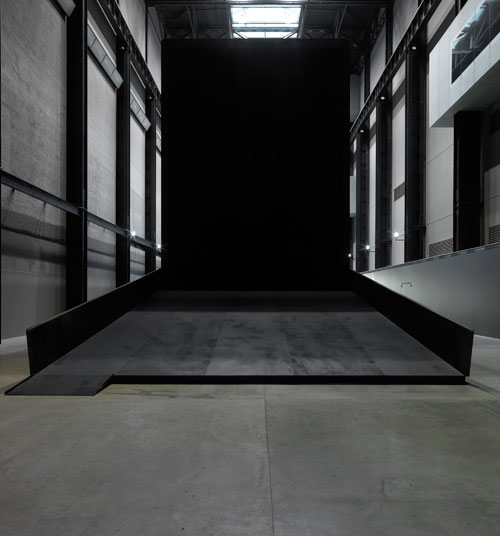
I think it would be cool to walk into a room painted entirely with this material. I bet it would be so disorienting that people would fall down and get vertigo. So weird.
It would just be....completely dark? I had this experience when working at a mine at one point, and if you went down one of the tunnels and switched off your headlamp.....it was absolute darkness. Like, we think that our bedroom at night is "completely dark" - but that's usually not true, that's always some source of light, after some adjustment you can see at least faintly. In an underground corridor without any lights at all it was very uncomfortable, it was like completely losing one sense of perception entirely.
Pilots flying in "hard" instrument conditions also experience this. You can see the interior of the airplane, but everywhere you look outside is exactly the same shade of grey/black/white, and there's no usable data from your sense about the position of the airplane relative to the earth. Passengers who think about this might intellectually get it, but it's quite a different experience when you're looking out the front window and responsible for choosing the correct control inputs. I believe scuba divers diving at night also can experience this.
I think they meant an illuminated room, but with absolutely no light being reflected by the wallls/floor/ceiling etc.
So all the visual spatial cues would be missing, despite being illuminated, like being in an infinite space. I could see how that might be disorienting and strange feeling.
Even well-lit caves (or similar environments) can be disorienting. A few years ago I was walking in a sandy-floored lava tube with a flashlight, and the floor was sufficiently uniform and featureless that I didn't have a clear sense of depth perception.
Another time I was flying a radio-controlled glider at the beach on a foggy day. There was a big rock sticking up in the middle of the beach. I thought the glider was closer than the rock, but then suddenly it vanished from sight because it was actually farther away and went behind it. Another flight I thought I was about 20 feet off the ground and then it suddenly struck the sand and slid to a stop.
I've actually worked on blocking all light in one bedroom. This is a great thing when one must sleep during the day.
The one window is thoroughly covered using well fit light blocking material. During daylight there is a very small amount of light the gets in under a door. At night it is utterly black. You may wait as long as you wish for your eyes to adjust; you cannot see your hand in front of your face. Nothing. Activating a smart phone becomes painful.
It is far easier to block light than absorb it. You can experience that type of absolute darkness with a $10 eye-mask (The new ones that look like tiny bras) from your airport. Your ears will orient you if you let them.
I was thinking about car/plane applications. At first thought, it's "that reflects no light that's a terrible idea". Thinking further, the absolute absence of anything itself stands out from a normal background, day or night. Would be a bit interesting to see.
These things have applications for stealth aircraft as they often absorb radar as well as visible light. But even for visible light, if you're looking at something painted vantablack in broad daylight, you only see a silhouette--much like WWI "Dazzle" camouflage, it's very difficult for the brain to process what you're looking at.
"if you're looking at something painted vantablack in broad daylight, you only see a silhouette"
If you scroll down the linked page, there is a photo of a vantablack BMW taken with a flashlight and a cell phone, and it simply looks like a dull gray when some light is pointed at it:
It seems like common sense to me that if you're looking at a picture on the internet that is staged just so, it is trivial to get all the "black" pixels to be exactly zero, but that doesn't tell you much about the quality of the material or how it would look to a person.
That's very interesting, I was thinking about stealth bombers. Do you think it would have applications in say, military uniforms? I wonder how it compares to digital camo, mirror based camo, etc in regards to detection.
> Do you think it would have applications in say, military uniforms?
During the first gulf war they gave us some jackets that absorbed the wavelengths the night-vision goggles could see so you'd just see a human shaped void which kind of stands out a lot more than a regular person -- not the best of plans.
I asked this exact question last time we were talking about vanta - and several people more knowledgable on stealth than me, said that they would not...
London's tate modern did a similar thing. At open ended black chamber. You blindly inched forwards to the back wall feeling as if you were about to trip over something. Then you turned around and realised with the light coming in the open end it actually wasn't that dark on the way out, its just there was nothing to pick up the light. https://www.studiointernational.com/images/articles/b/balka0...
Wouldn’t a pitch black room achieve the same effect with much less cost/effort? As far as I know the idea of these compounds is to absorb light, but if you get rid of light to begin with then you don’t need them?
You don’t experience black in absolute darkness, more of a very dark static-like fizzling grey. In order to experience the deepest black, you need to contrast it with something lighter.
There's a single bare lightbulb suspended out of reach in the void. The walls feel like ScotchBrite though you can't see them. You aren't wearing any clothes. The room begins to rotate slowly as if it were a large tumble drier, rolling you off your feet. The walls gradually turn red.
It's really not that bad. Some people find it unsettling, but many find it kind of relaxing. Derek from Veritasium has a good video on it for the interested.
It's a piece of art - you could reduce the cost in many ways but it's subjective whether you'd be achieving the same thing as it doesn't have any intrinsic value except for how people appreciate it.
Banksy did something similar where he sold art in New York for $60 without indicating they were his work. [1] After this was revealed, some of those works that were sold that day went for six figures at auctions.
There's a great youtube video called "Darker Than Vantablack" that has a cool demo of light reflecting off of different paints, etc; and at the end he revels how he got such a pure black without vantablack or a darker substance. It's neat! https://www.youtube.com/watch?v=JoLEIiza9Bc
The Action Lab! The first time I saw his channel I honestly didn't take the guy too seriously...but he is super creative and has some really cool ideas that most people could do at home if they wanted to.
If you want to see something very black, look at the side of a stack of razor blades or x-acto knife blades. The individual blades are shiny, but the geometry of the stack makes it absorb almost all the light hitting it.
I just watched that and at the end they state that you can't buy it because it's subject to UK export controls. The Vantablack website confirms this:
> In order to comply with UK export control regulations we are required to verify the identity and credentials of potential clients and the nature of their proposed use of Vantablack. Only verified companies, research facilities and educational establishments can order a sample of Vantablack. The coating is not available to private individuals at this time and we can’t accept orders from private email addresses.
Assuming it isn't because of it's chemical compositions, why would this be controlled?
An interesting usage example for very black materials (which are required to be effective also at grazing incidence angles) is flocking the insides of amateur telescopes. Not that it's always necessary, but can help in some poor designs where the light beam might reflect off some optical tube elements etc. (which results in a decreased overall contrast).
One of the popular choices these days are adhesive sheets of black velour. Another option is thick dark paint mixed with sawdust.
Does anyone know how stable these coatings are in real life? How easy is it to dust off or wet clean one of those super black coatings? How well would it take daily touching?
Would these coatings be useful in solar panels? Does the energy trapped/absorbed by these CNTs turn into heat and does it transfer easily to the material its applied to?
Going from 99% black to 99.999% black turns out not to represent that much more efficiency. It's the difference between absorbing 99 of 100 joules of energy vs 99.999 of 100 joules of energy; unless the rest of your system is effectively 100% efficient, it may not even be a noticeable change. It is very likely that other engineering concerns, not least of which is price, is going to dominate this question.
The article does mention that it's more durable than vantablack, so perhaps more suitable for a space-based project (if it turns out a really black material is useful for a solar panel of sorts).
Would the human eye see the difference between this and Vantablack? Even though it's ten times darker I feel like the returns would get smaller and smaller.