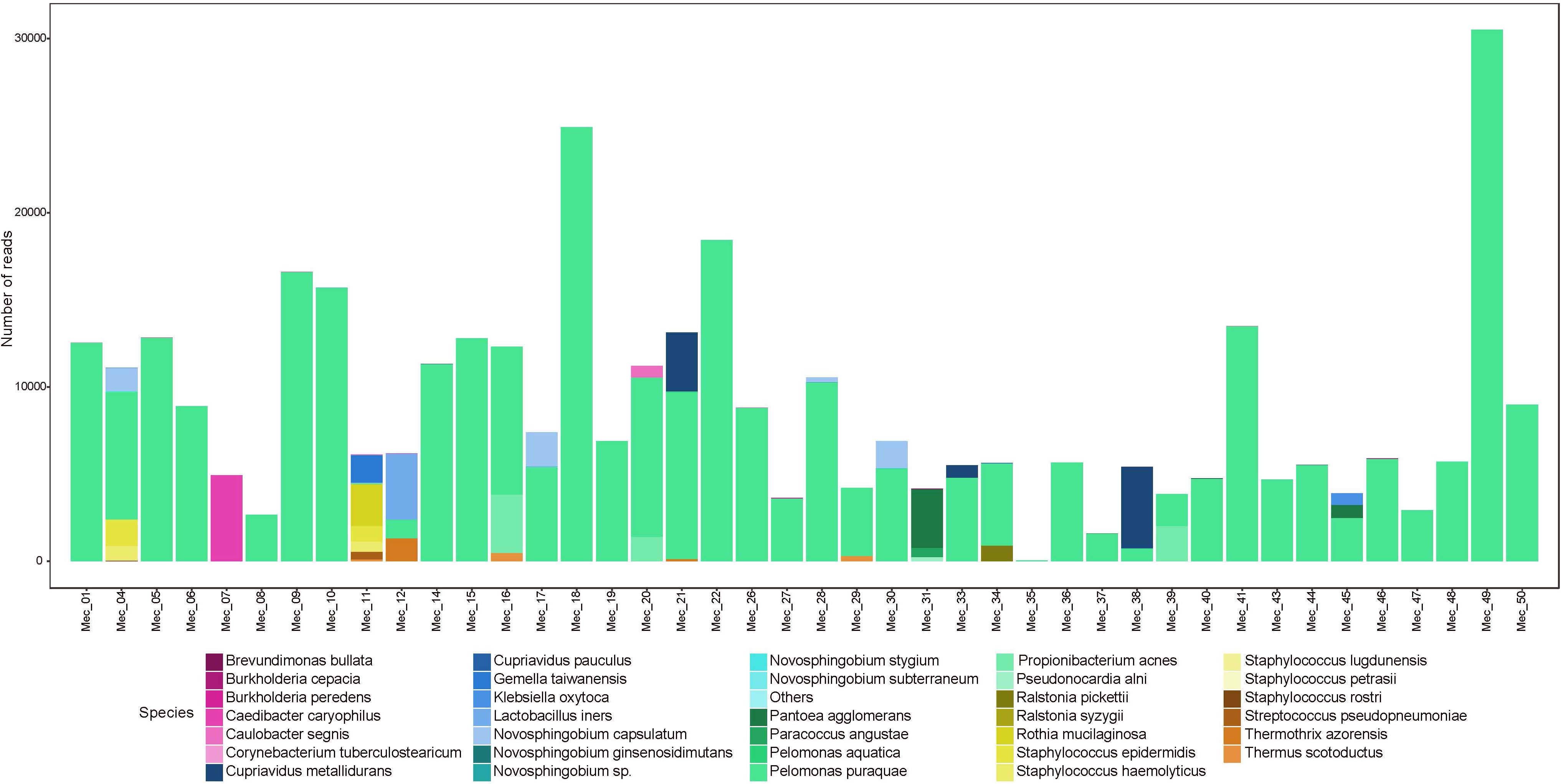
This has been known for quite a while, basically passing through the non sterile vaginal canal vs the sterile (or close to it) abdominal wall yields differences. This has lead to some questionable practices such as "vaginal seeding" whereby new moms will swab their vagina and then seed their babies shortly after birth (usually through placing the gauze in babies mouth or around their face). This comes up not infrequently at the hospital I work at. I think much of it stems from Facebook rather than actual discussions with their OB.
The article addresses this practice and states that the bacteria found in babies born vaginally differs from the bacteria found in the vaginal canal this further calling into question this practice. The bacteria instead seems to come from the mother's gut.
This article is about new research that says the source of useful gut flora is not the vaginal canal, but is in fact from faecal matter from the mother.
"Crunchy Karen" is a stock character who advocates dubious medical practices and preaches moralizingly, patronizingly to others to do the same.
Where I got the term from is a friend of mine is part of a Facebook support group for women who have particularly unproductive breasts and are tired of being told to risk starving their babies by adopting a breastfeeding-only policy or face moral recriminations.
Yeah, I don't get this. My kids are breast-fed and obviously there's a lot of evidence it's a good idea, but why would I need to shame / bother people who can't do this? It's their loss, if anything.
idk man, I feel kinda ok with dismissing antivax/essential oils/healing crystals theories. Especially considering how many children got harmed (some to the point of death) by "crunchy karens" who decided that they know better than modern medicine and doctors.
While every topic deserves to be questioned and not dismissed, some have been argued to death already, and I would feel ok with not getting into an argument about the merit of vaccines for a while.
Conflating microbiome interests with antivax mania doesn't make any sense to me, and I agree that "crunchy Karen" is a dismissive sexist tropE, especially in this context. Do any of you have even a passing familiarity with modern microbiome research? It's super fascinating and I wouldn't be so quick to dismiss it.
Most of us have heard of it. You can't log into this site and not hear of it. "Gut bacteria" is a square (alongside the likes of "Rust" and "Bitcoin") on my Hackernews bingo card.
But there are scientifically validated treatments and then there's folk medicine of unknown safety and effectiveness, and putting gauze swabbed with vagina juice in your baby's mouth sounds a lot like the latter.
I dunno, after having had a front row seat to more than one vaginal birth I'd say that it's implausible to suggest that microbes aren't being transferred (via "vagina juice" and the proverbial "microbial organ", i.e. poop) from mother to baby. Also, having dabbled in microbial ecology in my professional life, I'd say that it's unlikely that said microbial transfer is inconsequential for the gut health of the baby. Doctors don't know everything, and I'd venture that effectively no research on the effects of a cesarian on the baby's gut health was done before the procedure became widespread.
> Doctors don't know everything, and I'd venture that effectively no research on the effects of a cesarian on the baby's gut health was done before the procedure became widespread.
You’d venture wrong. The initial studies demonstrating flora differences date well over 20 years. It was in fact probably a pop science article in some mass media outlet poorly citing one of those papers that got the ball rolling for this seeding practice in the first place.
And did you bother to read the TfA? As mentioned there is no evidence that the biome is influenced by vaginal flora. So there is absolutely no new support for the value of vaginal seeding.
Doctors may not know everything, but many of us know what we don’t know which is why we don’t recommend seeding. There is no evidence that it works nor that it does any good. This new study only further supports this hypothesis.
Oh, I am not dismissing the microbiome research. As evidenced by the comments in this thread, it seems that it is even taught in nursing/med schools. I think the parent just described the type of person who brings it up to doctors, not that this specific technique should be dismissed.
But I would dismiss any non-conventional medical theory from non-educated (in medical field) people, even if it proves to be correct in the future. When the research and appropriate studies are done (and they prove the initial hypothesis), I will gladly switch my opinion.
Last I've read from someone who knew what they are talking about, he said it's still very early and we don't yet know enough to apply treatment level stuff with biomes.
A lot of people are optimistic for the future and there's some useful research available currently such as helping identify certain issues, but it's not yet a serious clinical option being pushed anywhere as far as changing or influencing the biome.
> agree that "crunchy Karen" is a dismissive sexist tropE
So we're not allowed to use labels to draw attention to the fact that the majority of people who believe in [1] and spread information about things like spirituality, crystals, anti-vax, anti-gmo, etc are women?
Often times x-ist tropes are rooted in reality. Dancing around these associations doesn't do anyone any actual good beyond cheap virtue signaling.
The only issue I have had with vaccines, I have three daughters, all vaccinated; but I just don’t like how they cram like six vaccines into a single doctor visit.
My middle daughter got the chicken pox vaccine right before we went on vacation to Chicago.
When we got to Chicago, she got the chicken pox actually from the vaccine. I was there for work and wife and daughter were supposed to be fiddling about the city while I worked during the day building the salesforce office.
Instead, they were holed up in the hotel room with calamine lotion and bath stuff to make Madeline comfortable. Since she had the chicken pox, they were only supposed to stay a week in Chicago with me, but had to stay the whole two weeks I was there as she couldn’t fly with the pox....
So when my youngest was due for all her vaccines, they wanted to give all 6 to her at one time.
And as the kids feel really lethargic and crappy for several days after, I made the doctor split the vaccines into only two at a time and made three different visits over two weeks instead of six vaccines in one visit and it was a much better experience for Coraline.
Same here. Our son has gotten all the required vaceenes but we also opted for two at a time max. Aside from being less convenient (2-3x as many visits) he still had all his shots by the time they were needed. Maybe it makes no difference but it certainly seems less taxing overall to the immune system.
This is apparently one of the better-studied questions about immunization, and the verdict is that multiple simultaneous vaccinations does not increase the risk of side effects.
Tossing three coins doesn't increase the odds of any one of them being heads, surely enough. But tossing them at the same time as a single combined trial, instead of just one coin, does increase the odds of at least one heads showing up from 50 to 87.5%.
Of course, you're going to have all those vaccines anyway and so the odds are the same overall for those administrations. Just like it doesn't matter whether we toss three coins at the same time, or weeks apart; the odds are 87.5% we will see a head.
But grandparent has a point about a situation like getting multiple vaccines before travel, where you're making it more likely that side effect will occur during that specific inconvenient time.
Once again, the question of whether multiple simultaneous vaccinations increases adverse effects is well studied, and the verdict is that they do not. It doesn't seem to me like trying to reason to the contrary axiomatically is going to get you anywhere.
I do not sense that you've read my comment critically. Because, for one thing, it says nothing about adverse effects increasing. Rather, the idea proposed is that effects can cluster together in time, without increasing in absolute quantity.
When a vaccine is administered, the probability of some reaction follows some kind of curve that initially rises, and then drops off. If two weeks have passed and no reaction has occurred, then the probability has already fallen off to a long tail that is next to zero.
With me so far?
So now if several vaccines are started at the same time, the "payload" parts of respective curves are superimposed now. If any effects occur, they will almost certainly occur within the next few days or couple of weeks of the administration. And that is the same period for all vaccines in the bunch.
It's almost unimaginable that synchronized start does not create a clustering effect of the probability of adverse effects.
However, in most cases that clustering probably desirable. If the adverse effects are boxed to within the same week for all vaccines, then people will experience less overall "down time" like fewer days off work or school.
Thus, don't have three vaccines just before going on a dream vacation booked months in advance. In fact, maybe don't have any vaccines at all (other than something related to the vacation destination!)
Aside from my daughter getting the chicken pox from the vaccine which is extremely rare, as a parent you observe your child’s reaction to every dr visit and vaccine (ideally) and if you know and can see that these have such put your child into an uncomfortable state or lethargy, then mellow the fuck out.
The doctors don’t give a crap abt how your child feels after they leave their office.... but you as a parent must.
Also, source: my brother is one of the top doctors in the nation. Head of the entire VA for Alaska, commander of the 10th medical wing for the USAF, for personal flight doctor to the joint chiefs of staff at the pentagon. He agrees with me, so armchair all you want.... but I know what the fuck I am talking about.
You are making a different claim than the parent. Their point is that simply from a scheduling perspective, and stipulating some adverse reaction from some vaccine, simultaneous vaccination maximizes the likelihood that you're going to experience that reaction at that specific time.
Your argument is that your kids feel crappy after they're vaccinated... so you get them vaccinated in 3 different stages. No matter what your brother says, the research appears to demonstrate that you're not improving your kid's experience; in fact, it seems like, if the parent comment is right, what you're really doing is maximizing the number of days they'll be uncomfortable, if they happen to have adverse reactions to more than one of the vaccines.
The thing we seem to know from the research is that simultaneous vaccination doesn't tax the immune system in such a way that a reaction to any one vaccine is more likely. Vaccinate all at once, or in 6 separate appointments: the number of reactions will be the same.
Also, the adverse effects won't all simply be additive when superimposed. Using a made up example, suppose Vaccine C by itself would give me a 0.9 degree fever the next day, and Vaccine D a 1.1 degree fever. If I get them together, maybe I will have only a 1.3 degree fever, not a 2.0.
So, the one daughter whom had all of her vaccines at once was the only one of the three who had an adverse was one of three...
The other two daughters who had shit split up were not adversely affected
So literally A/B testing my kids.
And to top it off, did you see my comment abt my brother being one of the top doctors in the nation,here is him (and yes I’m going to call you Patrick again just for fun)
So that’s a test with a sample size of 3. You can not conclude anything meaningful from this. Med creeds aside, if you have any research creeds you’d know this isn’t particularly powerful.
I have a 2nd cousin that is a fantastic doctor. I also happen to be a doctor, like a bunch of others around here. Not to insult your brother in any way, but I’ve never heard of him until now.
Also looking on Scopus, while he may be doing great things in the service of the VA, he does not seem to be a researcher.
Edit: also why do you think making a generalization shitting on “the doctors” that “don’t give a crap” to just follow up with an appeal to your brother “the doctor” strengthens what you’re saying in any way? I can assure you most pediatricians do give a crap (appealing to my own years of working with many), and if yours doesn’t I encourage you to find a new one.
I’ll concede to your points, except you saying that my sample size of three is insignificant because they are the only three I need to worry about personally, and so observing them personally individually react to the size of amount injected, with the additional outcome of getting the actual chicken pox due to the vaccine biases me.
Spread across millions, sure, an outlier family, but truth.
How many kids do you literally have? Have you taken three different toddlers to get vaccines and observed how miserable they feel over the next week?
No?
Well I have and I don’t give a shut abt those fucking “studies” because I have three humans I have raised and watched how their persons react to many inoculations at one time,
Fuck those “studies”
And recall my brother is one of the top doctors in the nation, and he agrees with me.
I don't understand the "Patrick" thing. My confirmation name is Peter? That's the closest any of my names come to that. The 'P' in my last name is silent.
I have 2 kids.
I really don't care what your brother thinks? Sorry.
Then we need to start studying how to help parents have a better experience when vaccinating their children. The fact is that, as a parent, it's unsettling to watch a doctor pump vial after vial into your kid. Even immediately after birth, I remember there was a big vial they injected into my son. If the patient had been an adult it would have been like injecting an entire tumbler full of serum. There's a bit of a gut punch there, especially if you're like me and generally believe that you were born with pretty much everything you needed to live well and that seeking medical treatment is something you do because you can't otherwise live well.
I'm good with vaccines, but we shouldn't be dismissing the parental perspective. Also, studied side effects probably don't include things like increased agitation, crankiness, lethargy, as side-effects. These things make life miserable for parents for a few days so yeah, parents are going to notice. Of course some parents are going to blame the vaccine when the kid just happened to get a cold at the same time too, but people get the message of "trust your instincts" and then see their kid get sick, and it is the parent that is ultimately responsible for the child's well being and also the one that will be blamed if the child is having a bad day or year.
So yeah, some amount of working with parents would be a good thing.
Splitting the vaccines across additional visits sounds terrible for everyone. It’s a much larger time commitment and your kid feels worse for an extended period of time. Your kid also gets more negative doctor experiences.
> I made the doctor split the vaccines into only two at a time and made three different visits over two weeks instead of six vaccines in one visit and it was a much better experience for Coraline.
Of course it was a better experience. Your second didn’t contract chicken pox.
My younger brothers are identical twins, one born vaginally and the other 20 min later via C-section. I've always said they'd be good data for these type of studies.
Anecdotally, they don't really have big differences regarding allergies or autoimmune disorders. Although growing up I always complained one stunk up the bathroom worse than the other.
Increasingly in developed countries twin births are caesars; the risk profile of twin births often necessitates this for patient safety.
When a normal vaginal delivery is possible (ie first twin cephalic) generally the second will follow.
My partner (obgyn Resident ) says she has had 2 twin births where the first was vaginal and the second Caesar, out of roughly a couple hundred
This has been hypothesised for a while and is listed in many pregnancy books. There are also hypothesis linking the difference in gut flora to other long term outcomes (obesity, autism etc) in adults.
Reference:
J. Neu and J. Rushing, “Cesarean Versus Vaginal Delivery: Long-Term Infant Outcomes and the Hygiene Hypothesis,” Clinics in Perinatology 38, no. 2 (2011): 321–331.
My twin brother was born by caesarean. He gets asthma attacks from allergies that I don’t have. I’ve wondered for a while what effect a faecal transplant could have...
I thought allergies are built up over time and so vary greatly with individuals, a perfect sample of the "nurture" side of the coin. (Though I'm sure you can have genetic predispositions.)
The idea that there is some doctor who will employ the latest and greatest of medical research to take care of me is at odds, to say the least, with my experience in the healthcare system.
If you decide to do this, please document heavily and report back on results.
Anecdotally, I am Norwegian genetically, and it has been said that the scandanavians are the group that developed the gut biome to be able to eat cheese/dairy - and I eat a TON of cheese each year (and I suffer no ill affects (I’m super lean and tall and skinny))
Whereas one of my exes was Asian and would get IBS whenever she ate cheese.
> group that developed the gut biome to be able to eat cheese/dairy
Why would one need to "develop" a gut biome to eat cheese/dairy? Have you ever heard of breast-feeding? Yes, you may be surprised to hear that even Asians can breast feed.
What you seem to be thinking about is lactose intolerance, which is not due to a gut biome issue but due to genetic or environmental factor causing a deficiency of lactase, a protein, after infancy. Lactase persistence is not common in many ethnic groups.
There is evidence that a biome habituated to certain strains of lactobacillus can allow those that would otherwise be intolerant to become tolerant, but that has nothing to do with the cause of lactose intolerance.
> Whereas one of my exes was Asian and would get IBS whenever she ate cheese.
IBS is a functional digestive pain syndrome. It has nothing to do with lactose intolerance. For someone epeening about their medical knowledge, you seem to know very little to back it up.
Children create lactase to process milk (lactose) until around puberty, then they stop creating it. I learned in college that studies have shown that a lot of people of Northern European descent continue to create lactase into adulthood, and thus can continue to break down milk and cheeses without issue.
There is still a percentage of non-European population that can consume lactose into adulthood, and not break it down without any external symptoms.
There are plenty of non-Europeans that can digest lactose. Think middle-easterners and Mediterraneans and their consumption of sheep and goat milk. Central and East africans too. The trait has incomplete (variable) penetrance.
Lactose tolerance is estimated at 30-45 percent.. So it's a substantial non-European population. The intolerance is heavily skewed toward East and South Asia -- though a lot of South Asians consume milk and paneer.
Wow, what's your damage, man? When did I ever claim to be "smart"?
Let's say this is my area of expertise. I am informing you that lactose intolerance is due to a deficiency in the enzyme lactase, a typically endogenously (by your bodies' cells) produced enzyme. It is therefore not a component of the gut biome. The proteins in your body can affect the gut microbiome, just as the micro and macro structure of your organs can, but they are not part of the biome.
Lactase is present in all normal human infants, since all healthy human babies are capable of digesting breast milk. Lactase expression starts trailing off in toddler-hood. Some populations apparently developed a mutation that causes lactase to persist. One group are northern European/Scandinavians. But there are also other groups such as certain Africans and Meds/Middle Easterners that have lactase persistence (Mediterranean and Middle Eastern people have a long history of consuming sheep and goat milk). The interesting thing is that there are multiple, independent mutations.
The cause for lactase persistence has a number of hypothesis, such as the consumption hypothesis. But these are speculation.
There is no cure for lactase deficiency. The most common "treatment" is oral enzyme replacement. This is known as Lactaid and Lactrase. Lactrase seems to work better for symptoms in most people, but response is variable.
I thought the same. Our OB/GYN, doula, hospital staff and birthing classes all covered this as if it were factual and provided some ways to overcome it should you go through a c-section.
Still good to see studies around this get passed around. You never know if you'll have to go through an emergency caesarean and being prepared is best.
> “In many cases, a caesarean is a life-saving procedure and can be the right choice for a woman and her baby,”
And in other cases it is a way to make life easier for medical staff?
Here in Panama, babies are disproportionately born through C-section in privately run hospitals.
Update: While I can't cite any stats for Panama, there is an article [0] that says
"The rates can be even higher in private clinics. For example, in Brazil, 80-90 percent of births in private clinics are now C-sections, compared with about 30-40 percent of births in public hospitals."
Joshua Gans (my old economics Prof) did a study of births by day of week, and showed that the fall in weekend births was explainable by the rise in inducement and cesarean section procedures.
Having a c-section might not be the underlying cause of the problem. Doctors carry out c-sections when a vaginal birth would create complications for the mother or the child. I.E. the mother or child was already "sicker" prior to the c-section.
I'd love to see a randomized control trial for this. To do it ethically, the trial could be designed like the CRASH trials. In those trials, doctors received patients with head injury and administered a placebo or corticosteroids. Since it was unclear whether corticosteroids helped or hurt, it was ethical for doctors to randomize patients. For births, only situations where it's 50/50 between a c-section and vaginal birth would qualify. Perhaps it's too small a subset to be workable or perhaps it's never 50/50, but that type of trial would provide much stronger evidence for this intriguing idea.
On a personal note, I was a c-section baby and seem OK!
TL DR: C-section babies pick up more hospital bacteria than those born vaginally, research shows. The findings could explain the higher prevalence of asthma, allergies and other immune conditions in babies born by caesarean. By six to nine months, the differences between the two groups had levelled out.
But scientists think that the initial exposure to bacteria at the moment of birth could be a “thermostat” moment for the immune system, defining its sensitivity and which strains of bacteria trigger a response.
Please don't tldr if you're going to do it this poorly.
The new bit of this story is that the vaginal canal isn't adding anything to the microflora of the baby, and that the source is in fact fecal matter from the mother during birth.
My understanding is that yes environment makes a huge difference in your biome, however there may be strains of bacteria, for example, that you would only get from your mother. Maybe something she picked up playing in the dirt in a different country, or maybe something from her mother.
Whether it makes a difference really depends on the individual. Personally I think it's better to get the gut bacteria that you can from your mother near the time of birth, but that's me.
If you were to test the microbiome of a family, you’d find they are very similar. Humans living in close quarters exchange biomes readily (oral - fecal transmission).
I’m certainly not arguing there is no impact of the microbiome on disease, but right now the data is far to early to say anything conclusively.
...scientists think that the initial exposure to bacteria at the moment of birth could be a “thermostat” moment for the immune system, defining its sensitivity and which strains of bacteria trigger a response.
I was depressed for half my life, I read on gut microbiome about 5 years ago(swapping the gut microbiome of mices changes their character) but didn't put it together until I switched my diet to meat only. Any kind of sugar seems to trigger depression for me, that sadly means that I can't eat plants. And current push for plant based diets worries me a lot.
I was a C-Section baby.
the mother probably gets antibiotics before caesarean. Does that antibiotic make it into the baby? That would mean that beside not getting the good vaginal mix of bacteria (that mix among other benefits seems to be able to control candida yeast growth which is a big deal on its own), the bacteria set that the baby already possesses gets hit by the antibiotic, a double whammy of sort.
A Caesar mother does get a stat of antibiotics before opening.
In crash caesars this would barely have time to distribute; normal operating procedure calls for the dose to occur 30 min to 1 hr before skin incision though.
You have a bit of a misunderstanding here - a baby does not have a microbiome in the womb - it is a sterile environment
"The first, and most important, contribution to the genesis of the microbiome is vertical transmission of maternal microbiota. Colonization of mucosa in the digestive, respiratory, urogenital tracts, as well as the skin begins at, or perhaps even before, the time of birth when a newborn is exposed to a mother’s microbiota. It was previously thought that the in utero environment was largely sterile and that a fetus was not colonized with bacteria until the time of birth. Recent studies suggest the presence of a microbiome within the placenta as well as fetal meconium, suggesting that the colonization process begins well before delivery. "
And my point is that the "most important, contribution to the genesis of the microbiome" probably gets hit with the antibiotics given for C-section.
Most samples had only a single species isolated from meconium; Controlling for sources of contamination it looks like out of the sample of 43 there were several that would meet the classification of a sterile environment.
I'm not insisting on specific source of bacteria. I mentioned it only as illustrative detail/example, and it only distracted (who knew that here would be a medical professional for whom getting such details right is naturally important - the same way like it is very distracting for coders when movies get computers related details wrong :) from the main point that baby coming out of C-section may have antibiotics in him/her which would screw with whatever gut microbiome "priming" scenario pre-/post- delivery he/she would be going through.
I take your point but it’s not binary - in the sense that I have strong doubts that the MIC (Minimum inhibitory concentration) of antibiotics would touch much of a colonisation in a neonate should it be present.
Having a single dose of abx in an adult doesn’t kill everything; the intent of a pre-surgical dose of abx is because evidence shows it significantly reduces post op infections; and the antibiotic used is active primarily against gram positives (cephazolin 1-2g) whereas Pelomonas puraquae is a gram negative anerobic rod and more than likely not going to be touched, even if the MIC is reached (and my experience of obstetric theatres is the antibiotic usually (80% of the time) goes in only minutes before skin incision.
So; a couple of things:
- presuming no contamination in the study, the primary coloniser of neonates appears to be a gm -ve rod
- antibiotics given for caesars are active against gm +ves /aerobes
So while there may be a mechanism, it’s not highly plausible in light of the other known mechanisms affecting Caesar births vs natural (ie bacterial microbiome pickup during traversal of the birth canal) about which there is significant evidence regarding immune priming
I thought the same, but No, as the original hypothesis was the bacteria came from the vaginia, but this study shows it comes from gut. It maybe because during delivery women often have anal fissures.
I am not an obstetrician but I am pretty sure that fecal transfer is far more likely because of acccidental pooping while 'pushing' instead of anal tearing/fissures.
It certainly affects gut biome, personal observation and what I've read. Michael Douglas also believes this caused his cancer.
It's a cliche that the kids from the rich side of town, who didn't put dirt in their mouths growing up, are the ones who get mono in college. Farm kids are healthiest; our immune systems need regular work they can manage.
It's a cliche that the kids from the rich side of town, who didn't put dirt in their mouths growing up, are the ones who get mono in college.
This is true but not necessarily for the reasons you think. Epstein-Barr is largely harmless in younger children, showing up largely as a common cold. It's not that the "farm kids" didn't get infected; it's just that they were infected long before they got to college.
(And to preempt a common question: No, we shouldn't proactively expose kids to Epstein-Barr when they're young. While they wouldn't get mono, Epstein-Barr has other long term effects; for example, it has been implicated as a trigger for autoimmune disorders.)
Michael Douglas had hpv+ SCC throat cancer. Hpv is a virus, has nothing to do with the gut microbiome as it is commonly discussed and is the cause of cancers of the cervix and head and neck. The oncogenic varieties are sexually transmitted. So he’s right.
Perhaps. HPV was also linked to throat cancer. It requires contact with HPV, and is one of the only ways HPV directly affects men, because they put an HPV infected part of the body in their mouth.
Not here to debate probabilities, but it is interesting how the possibility is controversial to some
My sister works as a physician at Phoenix Children’s Hospital and they are literally studying whether giving “dirt pills” to children helps prevent asthma. Wish I could find the link for more info.
Coronado Biosciences tried to treat Crohn's disease using hookworm eggs. Basically give the patient a bunch of eggs, the hook worms hatch, cause an immune response, then die (as they can’t live in humans).
Clinical trial showed no impact at all on the disease.
So that would be HPV causing cancer. Not cunnilingus. If you are insinuating that the transmission of HPV is through cunnilingus then fine. But stating a direct causation is careless.
So that would be the impact causing injury. Not stepping in front of a car. If you are insinuating that the impact was caused by stepping in front of a car then fine. But stating a direct causation is careless.
everyone here is insinuating that the transmission of HPV is through cunnilingus in this context
Ask yourself, why are you missing this context or being intentionally obtuse? you aren’t smarter or deemed as smarter for pointing out the obvious that other transmission methods are possible, everyone already knows that and is still enjoying these euphemisms because of their relatable conscious decision to give head. Curious what the thought process was here
Another thing you might never have thought about, but might be real (subject of recent and ongoing research): women incorporating DNA from men's sperm into their bodies. Search "microchimerism" with "sperm", e.g. [1]. (There's probably more instances of "sharing DNA from close encounters", but this one is particularly easy to research simply by checking for Y chromosome in women's bodies.)
That's interesting. This is totally off the wall, but I've noticed that many long time couples start to look like each other. I've assumed it was from environmental factors, but what if there was some biological basis as well? Crazy to think about.
not ridiculous — it leads to higher chances of throat cancer, tragically, thanks to certain viruses being picked up in this manner. (I know, viruses and bacteria are not the same, but they share transmission vectors)