Is there a service that provides summaries of long-form articles like this? I get that some people enjoy reading prose, but I'd like to know what the article is actually about. So far, I'm 5 pages in and still not sure what the insight is.
I really don't care about the decoration of this guy's office, which drugs he prefers, how his voice sounds, the atmosphere in a horse racing venue, the outcome of a specific horse race, not even this guy's entire life story.
What was his key invention?
Edit: Skimmed the rest, and it sounds like he was simply good at statistical analysis.
Other key parts of the article seem to be (remember, I skimmed): It was a betting system where effectively people bet against each other, not a bookmaker with fixed odds, so he basically became a bookmaker.
The rest reads like many other "smart gambling" stories:
- others invested in his operation
- he first was treated as a good customer, getting an "API" to place the bets programmatically, then got that revoked as the organizers realized that other gamblers might not like that he was winning so much (from them, effectively)
Overall, I learned nothing new, and wasted my time reading ten pages of drivel. This is why I hate long-form journalism: You don't know whether the article contains any useful information until you've spent half an hour trying to find it in the description of people's looks, landscapes, weather, and similar chaff.
Computer aided statistical analysis to give a small but profitable edge. Place a huge number of "smart" bets where the statistically likely winnings exceed the cost of all the bets.
Hear, hear. Paragraphs like this to me have barely any more relevance to the real story as your grandmother's oatmeal cookie recipe:
>As the pack thundered around the final bend, two horses muscled ahead. “It’s Mascot Treasure a length in front, but Bobo Duck is gunning him down,” said the announcer, voice rising. “Bobo Duck in front. Mascot fighting back!” The crowd roared as the riders raced across the finish line. Bobo Duck edged Mascot Treasure, and Frat Rat came in third.
I already know what horse-racing is like. I don't need this cruft, the headline promised an explanation of a novel betting scheme and that's the only thing I'm interested in. If I'm feeling particularly crotchety I'm insulted that the author thinks I can't tell the difference between this fluff and actual content.
I too loathe long-form journalism. It seems like self-indulgence on the part of people who wanted to write creative fiction but aren't good enough to be successful at that.
This is like saying Moneyball is 200 pages too long because it talks about how baseball works when everyone already knows how baseball works.
It's not a research paper. The whole point is for it to take the reader to another place so they can imagine being there, not expounding on the square root of the hypotenuse which led to three commas of winnings.
I guess you hate novels as well? I enjoy long indepth character centered articles and I think many other people do as well. The point of reading doesn’t necessarily have to be about acquiring the most information in the densest representation.
Also if reading the article was a total waste of your valuable time, why are you commenting about it?
This is a poor comparison. I can understand the OP since a title like this generates interest as in "how did they do it", and I expect to learn something by reading the article. I won't be reading a novel with this same expectation; I read it for its entertainment value.
I just like separating information acquisition from entertainment, because things that try to fill both roles tend to be bad at both.
I'm also not proposing to make it illegal to write long-form articles, just asking whether there is a service that transforms them into a form that I personally prefer.
There are other ways of parsing text that are worthy of practice. Skimming or speed reading can be applied to all sorts of visual stimuli, including prose and code. Also reading bottom up is very handy, especially when reading say the economist.
I've noticed a little uptick in stories about gambling here, I suspect there is a strain of us at HN interested in sports analytics for financial gain. Interesting. :-)
I think HN is just generally interested in financial gain and doesn't mind bending ethical guidelines for that cause. I mean, they do have a high incidence of people working for tech companies.
If you win a bet, someone else loses one. Losers lose money to bookies, bookies very rarely lose it on to winners. Many people can enjoy responsible gambling. Many people cannot. Therefore, any time you win a bet, you're winning money from someone who can't stop. In my view it's similar ethically to owning tobacco or alcohol stock.
Is this insinuating that winning victimizes gambling addicts? If so, I don’t understand that connection.
Gamblers are making a personal choice to bet their money, other gamblers should not be made to bear responsibility if that gambler’s choice turns out to be a poor one. Gambling addicts obviously exist, but they are playing the same game everyone else is. If you want to protect addicts from harming their finances, change the rules to accommodate that goal (betting limits, credit/finance checks, outright banning of gambling) rather than expect other gamblers to follow undefined rules that may or may not protect other gamblers from themselves.
The problem is that gambling is a zero-sum game. By your logic, the crypto market being played in 2017-2018 was perfectly ethical even though people's life savings were being drained to fill the pockets of other people who were capitalizing on the ignorance of the layperson.
There are good arguments that gambling isn't exactly a zero-sum game. (Non-addictive enjoyment, hobby, relaxation, etc.)
But you're right in that the vast majority of players in gambling (including the house) are either (a) being fleeced, or (b) fleecing others. When the majority of users/members of a particular system are either victims (in some sense), or profiting off victims, I question the amorality of that system. So traditional morality called gambling "immoral" for good reason, I think -- if only because of this emergent, victimizational behavior it encourages.
It seems to me that economic regulation exists primarily to--and functions ideally when it successfully does--protect the vulnerable and prevent victimization. So it seems right and good to me that gambling is outlawed in most of the US.
Are you referring to the sudden boom of the general public dumping their money into cryptocurrency hoping to get rich?
Hell, I’ll bite here and assert the same as my parent comment: the folks who dumped their life savings into crypto made a personal choice. I fail to see how the rest of the market bears responsibility to those who lost their “investment”. So long as everyone is playing by the same rules, there’s no way you should be ethically responsible from benefiting from other’s losses.
You signed up for the risk when you chose to play. Do you believe that if I dump my money in a stock and it tanks, investors who benefit from that are now responsible for the money I’ve lost?
Gambling is not zero sum, there's the enjoyment (which is the most important factor for an addict, unfortunately), the percentage the bookie makes, the investment in facilities (shops, communications, race courses etc) that all occur because of an exchange of money.
Crypto is not a zero sum game, because money is being printed in the Forex markets all the time, which bleeds into the crypto markets. There is a lag time, called the Cantillon effect, between when money enters circulation, and the arrival of downstream purchasing power inflation.
This is a flawed argument. If you were to never make your bet in the first place, the "person who can't stop gambling" would still be losing their money to the bookie. You're not enabling the bookie taking their money.
In fact, if you're winning more than you're losing, you're decreasing the profit of the bookie. You are therefore making it a less worthy venture for them to hold these ethically-negative gambling events. If you were to win enough, the bookie would lose money from the venture, eventually resulting in them no longer hosting gambling events.
So actually, winning money off of bookies is an ethically good behavior, since it's negative feedback for them enabling other gamblers with "uncontrollable behavior" to lose their money.
In fact, if you're winning more than you're losing, you're decreasing the profit of the bookie
Not if it's a parimutuel betting [1] system, as described in the story. The Hong Kong Jockey Club takes a flat 17% cut. The rest is exchanged between winners and losers. This is no different from playing poker at a casino, where the house collects a rake but otherwise the players only win money off one another.
Note how in the story, the Jockey Club contacts Benter and offers assistance rather than blacklisting him. If he were decreasing the profit margin of the bookie, as you call it, they would have ample reason to cut him off. In actuality, he was increasing their profits (but not their margin, which remained a flat 17%) simply by increasing betting activity. This is something poker sites have also hit upon, and as a result they've developed sophisticated rewards programs for their top players.
> Many people can enjoy responsible gambling. Many people cannot. Therefore, any time you win a bet, you're winning money from someone who can't stop.
Or, to put it another way: any time you win a bet, you (and the bookie) are helping gambling addicts to take one step closer to "hitting bottom" and thus getting on to the first phase of recovery—acknowledging that you have a problem.
(This is the complement to the argument that charity for drug addicts is a bad thing, insofar as it delays the addict longer in the self-harming, not-prioritizing-getting-well phase of addiction. In the gambling addict case, charity would be, in effect, "giving them another pile of chips"—obviously a bad idea, no?)
Gambling and drug addicts share another unfortunate tendency: they often end up dead. This is the nastiest but most compelling argument in favour of intervention before people hit rock bottom.
Probably not, though tech industry employees do tend to wave around their "total compensation" numbers in a chest-thumping competition. I see that less as "greedy" though, and more as a mistaken proxy for personal value/competence/etc. The same thing seems to happen in the finance/banking industry. I suppose anywhere you gather very well compensated people in high concentrations it's going to happen. The actual money is only part of the phenomenon.
It’s sort of amazing that given the fast-moving legalization of sports betting, there hasn’t been a lot of VC action in the space, either on the platform side or on the content/services side.
I can count on one hand the number of funded companies over the past six or seven years, and I can think of only one that has exited. Might have something to do with vice provisions dictated by LPs, but it certainly seems like a ripe growth area.
There are an absolute ton of companies working in this area (mostly in the UK). But the reason they don't need VC capital is simple...they make a ton of money already (VC funds are naturally interested in capital-intensive businesses that are kind of junky...companies in this sector aren't capital-intensive and are usually obscenely profitable).
I won’t say that’s exactly true. I know Founder’s fund have invested in a couple. I think the need for scale limits VC funded options to companies that are building things like a gambling exchange, but at that point, the funding sources might be better from quant traders/hedge funds as its closer to a capital markets type business. For instance:
The US market is not representative at all. It is basically nothing (and Susequehana's operation isn't large). Exchanges are cumulatively worth tens of billions and they are a tiny part of the market. Again, most of the people involved have no interest in VCs (I know a few people starting exchanges). They know nothing, and they usually have less money than them anyway.
>there hasn’t been a lot of VC action in the space, either on the platform side or on the content/services side
Do "social" casinos count? Zynga is all over that and went public in 2011, Big Fish was acquired by Aristocrat in 2017, and I'm sure there are others.
If you throw ethics to the wind, there's no reason to make a real gambling app/service when you can give gamblers the same dopamine feedback loop without ever needing to pay them real money.
Personally I think there's only so much time left for gambling (in lootboxes, social casinos, or even sports betting) before it gets shutdown by regulation. There's very little pragmatic argument for allowing it to exist in the first place, other than classic prohibition arguments like "personal freedom" and "black markets still exist." Valid, but I think the harm of industrialized gambling through digital platforms outweighs the benefit of taxing it and allowing a black market to exist, but that's just me.
I’d say it’s a simple argument. Letting adults make bad decisions is preferable to sending guys with guns to stop them and throw people in jail for doing something they voluntarily want to do. Perhaps the people who would have wasted their money gambling instead invest in the stock market, but more likely they’ll piss it away on something although maybe something you find less offensive.
I'm not saying a drug-war like approach is the best method here, just that some degree of prohibition that prevents industrialized gambling is better than none.
For example, even in a fair game the house will eventually take a gambler's bankroll provided the house's bankroll is practically infinite [1]. That's a thought experiment, but it works in practice when you are dealing with gambling addicts that won't walk away from the table.
Secondly, those gambling addicts, or "whales" as they call them represent something like 0.15% of players bring in 50% of the revenue [2].
And lastly, I would have agreed with you a few months ago, before I heard this story [3] on NPR about how Big Fish was targeting people and using predatory practices to keep them on the game. It reminded me of a twisted version of AOL's customer retention practices that they were sued for a decade ago.
There's also the whole notion of casinos/gambling disproportionately impacting low income communities and how you can't start a gambling business without tons of capital, so it serves as an efficient funnel of money from the poor to the rich. And it's really naive to think that someone going broke affects that person alone. God help them if they have a family.
I'm with you except I'm not so sure those .15% of players wouldn't blow their money on something different. In my state, casinos are the sole purview of Native tribes, and those whales pay for a lot of tribal services for people in need.
Which just struck me as a perfect point for your argument. So I guess I'm smelling what you're cooking.
the answer is pretty obvious: low multiples. A gaming company trades at low multiples whereas a tech company with little revenue can be worth billions. You cannot turn a $1 million investment into a billion with gaming like you can with tech.
ROI is insane. If you made 20% a year on Wall Street, you are crushing it. You can make 20% a month in sports gambling with a fairly pedestrian strategy.
The only issue is that you can't scale well but this only becomes an issue when you need to put down tens of million a week (i.e. when you have $50m+).
The barriers to entry are also getting higher as competition is increasing in the space (although limits are probably going up too). One big issue right now is data. If you bet on soccer (the sport with the highest limits), you need to spend at least $100-200k/year (before hiring programmers) on data to become competitive.
Yes, most of the people at the top are billionaires. Tony Bloom owns Brighton FC, Benter is a billionaire (probably, he made several hundred million in HK), Billy Walters is likely close, Ranogajec, Alan Woods is close, Benham is likely close (or was before he decided to buy several football clubs).
The issue, as I said initially, is that you aren't scalable past $100m or so (without connections to the Asian books, which some people above have...apparently, some of the guys are able to put down multiple millions on most European soccer leagues...which isn't available to most). But yes, most of the funds run by the above people have been making 100%+ for years.
It's solid. The problem is scaling: if you're betting fixed odds, a lot of bookmakers will limit the amount you can bet, or ban you outright if you're winning too much. If you're into horses and bet into the totes, you run the risk of wildly affecting the pool (and therefore the final payout) if you're throwing huge amounts into it. The only way to really scale it is to bet into pools that are already huge (like Hong Kong - hence why it's such a popular target for the big syndicates).
Sports betting is huge. this is not 30 years ago. you can easily scale millions into bets/ and most ppl would be very happy to make $30 million out of $5k or so over a decade.
Wall Street has a higher barrier to entry, AFAICT. Hedge funds need capital and subscriptions to proprietary signals, HFT needs colocation. But there are enough one-offs of people making money on Wall Street that I suspect it is (relatively) common, just not reported on in the news.
if you suspect you aren't the most sophisticated gambler, then maybe it doesn't pay? Honestly, sports betting is orders of magnitude less sophisticated than Wall Street, so you have a better chance of finding an edge that others haven't also found.
Also, it's easy to imagine that there are a lot of "unskilled" betters, i.e. old folks betting for the thrill of it, people betting a few bucks just for kicks, ... With wall street, there might be a few unskilled people, but they are probably a small minority.
They're both the exact same thing when it comes to exchanges. I was working for a betting exchange and a market maker for a while, taking 500 orders a second and arbitraging between different competitors, before moving back to finance. It's quite interesting actually.
A lot of the market is not tradable though. On one end of the market, gambling is often a state monopoly with high spread and high margins (if not prohibited entirely), while on the other end there are large trades going on in private or closed circles.
My brother in law is a physical therapist. He was recently flown first class to treat a starting NFL quarterback. Do you think what transpired during that appointment is public?
Is reading a quarterly earnings report the same as being in the boardroom? Of course not. If perfect knowledge were attainable this whole money-making business would be a lot easier. In sports, you can get information on how a player has performed historically as well as recently in order to make educated guesses on how they will perform in the future. In business, you have no access to R&D information. You have no idea if a company's past success will bring future success. You have no way of knowing if they have hit a snag or a breakthrough in R&D until after it's hit the market and if you do, you are likely breaking insider trading laws.
In sports, you can study your opponent to predict what they might do. In business, you can really only study what your opponent did during the actual game so to speak. For example, Microsoft can't wait for Sony to release the PS4 in order to develop a game plan for the Xbox. Both have to put forward their best effort regardless of what the competition may or may not do. In sport, you are training to beat 1 opponent, in business you are trying to appeal to the whims of the multifaceted consumer which aren't nearly as concrete.
I'm not sure what your point is. The original post I responded to was saying that all information in sport is public, unlike boardroom meetings, and then ask if reading a quarterly report is the same as being in the boardroom, which it's not, which is my point.
My point is that you picked an uncommon occurrence as evidence that sports are just as covert as wall street. I then rebutted your argument by pointing out that injury reports are public. Do people violate the rules? Yes, just like people inside trade. The point is that you can’t factor in cheating if you are starting with the assumption of a fair system. If it was utterly corrupt it would fail. If everyone is playing by the rules of the SEC/NFL then predicting future performance is much easier in the latter for all the reasons I previously stated.
I don't think that occurrence is all that uncommon, there are plenty of variables in the NFL that are not regulated to be transparent, there are loads and loads of variables in sport, not just NFL, that are only known to insiders. Not every sport or league strives to be as transparent as the NFL.
>I suspect there is a strain of us at HN interested in sports analytics for financial gain
I would assume that people who post to Hacker News, as a rule, are less risk averse than the general populace due to Hacker News being more focused, in my mind, in the entrepreneurial side of technology.
"[...] casino security, who were constantly on the lookout for card counting". Why this is something "forbidden", this isn't cheating, am I missing something? Anyway, how security can detect that someone counts cards? I assume gamblers are not doing that aloud.
Casinos are private properties, they can kick you out for any reason without having to justify themselves. Playing too well is one of these reasons.
Of course, kicking you out is the only thing they can do. They can't take your earnings, prosecute you, detain you, or use force unless you resist. Usually the player will be kindly asked to cash-in and leave.
Security can track your play patterns, your gains and losses. Card counting result in very characteristic patterns, and if your gains are too consistent to be explained by chance alone, they are going to watch closely. If you are just lucky, they will offer you free drinks, if you are an advantage player, you will be asked to leave, if you are a cheater, you are going to have problems.
Edit: I think there are some places where casinos can't just kick people out for no reasons. But anyways, there are ways of making card counting impractical. The use of continuous shuffling machines is one of them.
> Casinos are private properties, they can kick you out for any reason without having to justify themselves.
I find this surprising. Aren't there any rules about having to serve everyone equally? Like non-discriminatory rules? A Casino could unilaterally bar entry to all people from a certain ethnicity and they wouldn't have to justify themselves? Is this true for all businesses?
It's really fishy that Casinos can say you can come play here unless you win.
Counting cards isn't considered cheating because you're manipulating numbers in your head and in NJ, where the case happened, you can't be asked to leave a casino just for counting cards. Edge sorting is considered cheating as it's basically a form of marking cards. (This is an oversimplification of the rulings in the US
If you can count perfectly, you can beat the odds. An obvious solution would be for casino to reshuffle cards at ever game but I suspect they don't do it because they bank on a lot of people who underestimate how hard it is to count cards or overestimate their mental skills.
Blackjack is an incredibly boring game, remove the ability to count and beat the odds and no one would play it.
You don't really need to count absolutely perfectly. The more you count the better, of course, but it's a probabilistic system with a thin edge to begin with.
They don't reshuffle every time because your last statement is very wrong. The money card counters can take before being caught is a rounding error in the face of the masses of people who are happy to play with no edge.
I haven't personally done the math but one of the articles I read (Scientific American?) mentioned that 1 error an hour makes you basically at the break even level. Higher error rates brought the house advantage _higher_ than non-counting methods. Is this incorrect?
It probably depends on the technique. Some counts are pretty easy to manage, like simply keeping a tally of the number of 10+ cards vs. total cards. It does take practice, but it's way easier than trying to keep a tally of every card you've seen in your head.
But yeah, it's really easy for casinos to keep a track of your betting pattern and kick you out if you're playing the game too well. That's why the really successful card counters play as groups with personas. They'll station a bunch of low key guys around the casino and have them maintain a steady stream of cheap wagers while they count. When a table gets hot they'll signal a flamboyant high stakes looking guy to sit down and play a few rounds.
The Casinos will eventually catch those guys too, simply by correlating who is sitting at what tables when the high stakes guy comes to play, but it takes a lot more work and they make out with a bunch more cash. Worse, because what they're doing isn't illegal the casio can't even deny them the winnings, only kick them out and plaster their faces all over the blacklists the casinos use.
Your middle paragraph was true, but is now outdated as of the last 15 years or so. This is indeed how the MIT Blackjack Team worked, as documented in books like Bringing Down The House.
However, casinos now know of and how to foil this strategy. The countermove is to prohibit entering a table while a shoe is in progress. Either the new player must wait until the deck reaches its established end point at the cut card, or the deck gets reshuffled immmediately upon the new player entering. Either way, an incoming player can't take advantage of any count.
Well there are casinos that use shuffling machines to shuffle every blackjack hand. People still play it though, just like they play slot machines and the dozens of other boring things to do in Casinos.
If you want to know how boring casinos are, but don't live near one, go to any game arcade where the games give out tickets that can be traded in for prizes. Compare with home video game consoles.
They sucked most of the fun out of video games to turn them into gambling machines for kids. Now imagine if they sucked the remainder of the fun out, and the only thing left was the gambling. Now you can only have fun if you think playing a game where you are statistically guaranteed to lose everything in the long run is fun.
They may have more glamour in the gambling-centric cities, but the few casinos I have been in have all been sad, dingy, smoky places filled mainly with old women staring at their slot machine with dead eyes and cups full of their pension funds.
Even if you temporarily win at gambling, you're still part of a machine that sucks life out of people and leaves them drained husks.
If you don't have an expert system mathematically guaranteed to give you an advantage over the house, you're better off gambling on the stock markets, because at least if you lose there, it might have at least paid for someone else to have a decent non-bullshit job for a little while, and there's also a possibility that everybody wins, even those who didn't play.
> you're better off gambling on the stock markets, because at least if you lose there, it might have at least paid for someone else to have a decent non-bullshit job for a little while, and there's also a possibility that everybody wins, even those who didn't play.
In Quebec all the lottery games and the casinos are owned by the government, thus every gain there goes to the public sector. Everyone win (except the one with gambling addiction, which are sadly the vast majority of the customers).
Yeah, actually I forgot how boring you can make the experience once you have people addicted to it. I should know, there are tons of pachinkos where I live. The dullest experience of all...
The purpose of a casino isn't to provide a venue for betting on cards. The purpose of a casino is to take your money. Cards are just the mechanism. Some wins are allowed to maintain the fiction and keep gamblers coming in, but they won't allow anything that jeopardizes the overall direction of flow from gamblers' pockets to the casino's. They don't differentiate between being "too good" at the game and simply cheating.
There's an interesting article on how security detect card counting[0]. My take is that it's not a science, instead the security/ pit boss' who spend significant time watching players would develop a 'feeling'.
It is actually quite easy to spot counters depending on how greedy they are. In order to successfully count you have to bet proportional to how positive or negative the count is in your favor. It is not uncommon for someone that knows nothing about counting to vary their bet a bit based on how much they are winning or how "lucky" they feel, but if you see someone varying their bet widely (Say min bet -> 32x min bet) then all one has to do is keep a count as well and that person is easily detected. Many dealers and security personnel keep counts anyway.
Casinos will use continuous shufflers which kill counting 100% or will cut off multiple decks at the end of the shoe so one cannot get a very positive count and more certainty that the deck is in their favor. In addition, as stated earlier, the type of counting these people did in the early days which was most lucrative is easily spotted. So now modern counters have to apply "camouflage" which includes placing higher bets when the deck is not in their favor to make it appear they are betting randomly, and also reducing their bet spreads. All of these eat into the theoretical return, and make it much less lucrative if not entirely not worth it. So modern advantage players look for casinos that don't watch as carefully or dealers that are not cutting off enough cards.
They likely do some kind of cop tricks to get the player to admit to counting cards. I wonder how many people have been banned from casinos for bragging on social media about their skills.
They don't need to get the player to admit it. It isn't illegal, and is easily spotted in many cases. Casinos are private establishments and can either toss the player out, or if they are nice, allow them to only make the same bet every time (flat betting) which makes it impossible to make money counting. Egregious counting which makes decent returns will be spotted almost immediately anywhere that isn't asleep. More subtle camouflaged counting is harder to spot, but the return is also much less. So whenever that player starts varying their bet more, or moving to high roller tables they will get more scrutiny.
I think you misunderstand me. If they get the player to admit he can count cards they can just ban them and justify why they did it. The casinos even share info with each other. There are talented people who probably brag after winning a lot and get banned forever.
To make it even weirder you can self-ban yourself statewide from casinos in most states that allow gambling. It is actually a crime for you to go back in[1]. Not sure what the punishment is.
Oh, you want to know the punishments for willingly breaking responsible gambling rules?
Huge fines, potentially followed by loss of license.
You do not want to go there. With the elevated scrutiny on gambling operators (triggered in part by the US opening up, in part by the increased competition, and in part by the receding margins) all the regulators are itching to make examples out of suitable villains.
Disclosure: I work for a [UK] gambling company and deal with compliance matters on an almost daily basis.
An interesting question to be honest. I'd somehow expect any prosecution to be far too complex for the parties to enjoy court.
Sure, you excluded yourself but then went to the casino after all. Did you do that because addiction caused you to misjudge the risks? Did you go there with the intention of defrauding the casino when you lost money? (Gambling establishments that fail to prevent self-excluded customers will have to refund their losses. And if they do that only after regulators get involved, there will be fines on top.)
Proving the nature of intent for that kind of violation could be very messy indeed.
Worse; they're subject to the public's opinion. A player says "They're throwing me out because I won too much! Go someplace else! These guys are bad sports!" and they may lose business. They have to have something obvious and convincing on a person, especially if that person is well-known.
Casinos have way better information on large players' win/loss figures from in-casino surveillance (eye in the sky and pit bosses) than they could ever get from social media.
I count cards and it is not hard at all to spot the patterns that counters use. The most common counting system follows a very specific pattern that, if used, would leave anyone following along with an identical count. In response to that count people will change their betting patterns and this is what is generally being watched for (and guarded against, to your earnings detriment, by people that don't want to get caught). More serious counters will work in teams and the casinos can try to look for the signaling that such teams traditionally employ (in addition to betting patterns).
Even with counting (at the individual level) you are really only giving yourself a very slight edge and this assumes that all other advantages are being taken (playing a perfect game, playing favorable rules... unfavorable rules are everywhere these days... managing your bets to take advantage of the count without getting caught, having a properly sized bank roll, etc.). Sadly, after all of that you can still get your butt handed to you on a bad night. On the aggregate you can beat the house with counting and all of the above but only just.
Anyway, how security can detect that someone counts cards?
It’s pretty simple. Surveillance and the pit bosses also know how to count cards. All mathematically correct counting systems will tell you to raise or lower your bet at almost exactly the same, because a counting system is simply a way of quantifying your positive or negative edge at a given time. So if you modify your bet in correlation with the count even 4 or 5 times, the odds that you did that on a hunch become very small. Do it 10 times in a row, and the odds are nearly 100% that you are counting.
It isn’t counting that casinos hate, per se. They hate anyone that can consistently beat their games - “advantage players”. Counting just happens to be the most easily detectable form of advantage play, so the people that still do it are cannon fodder for surveillance. Most professional advantage players today don’t count cards. They use a variety of other techniques, such as hole carding and taking advantage of promotions created by mathematically challenged casino marketing departments, that are both more profitable and far harder to detect than counting.
It is forbidden by casinos because it is in their best interest to keep winning players away. Even if the house still gets their cut, it can create a bad image for players that are losing.
If we are talking about live dealer, they use bigger shoes (6+ decks) and they switch decks randomly around midway, making the counting techniques almost useless.
Online casinos can shuffle cards without having to use automated shuffling machines and set the cut card earlier[0], which makes it less profitable/ harder/ worthwhile to Card Count.
IIRC card counting relies on tracking which cards have been drawn and thus inferring which cards are remaining in the deck. Shuffling by hand is a tedious process, hence it is done only so often and this makes counting possible. With electric shuffling machines, shuffling becomes easier and is done more often. This, in turn, makes counting cards harder because the remaining deck never gets small enough for you to draw any useful conclusions about the remaining number of cards. In an online casino, you would have the same problem I guess ...
I often think, why don't online games deal from an 'infinite deck'? That is, every card is simply random from among 52 choices, regardless of the previous cards dealt. Then card-counting would be pointless.
I know - it would change the games entirely. So? The games are arbitrary. They would be new games, and it would defeat many modes of cheating.
I think the idea of games like Blackjack/Poker is that intuitively it feels like it's a skill game, rather than just a game of chance. It feels like if you played enough you'd get better - after all, with only 52 cards, how hard can it be to get an edge on the house?
This is different to a slot machine, where clearly it's just a game of chance.
In reality casino card games are 99.9% chance, but I think the infinite deck idea would remove the skill feeling and hence the attraction for many players.
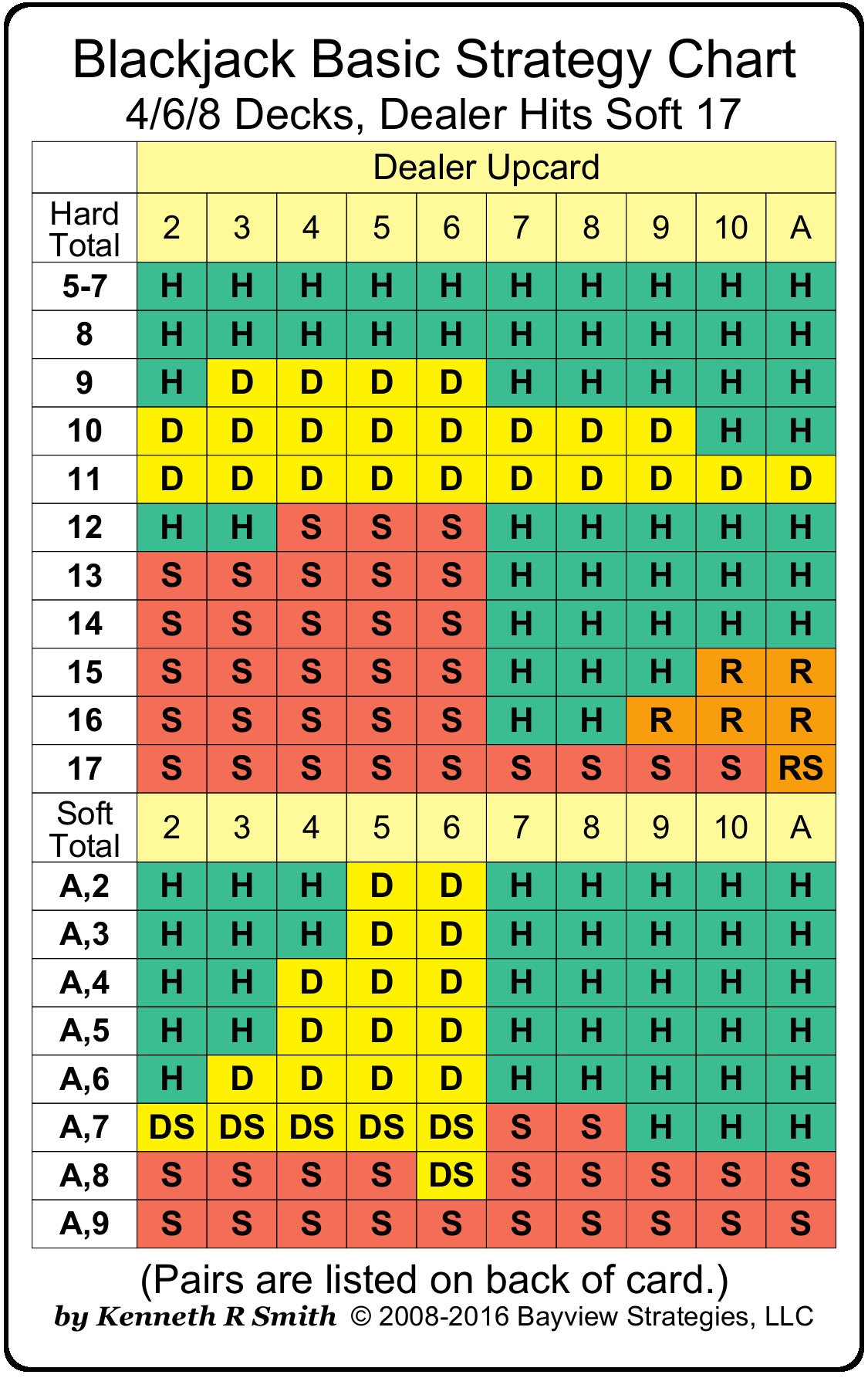
Small nitpick: I'd argue that Blackjack is closer to 80% skill, and 20% chance, just based on the fact that if you don't play every Blackjack hand with the same statistically "correct" strategy [1], you will end up bleeding money well in excess of the house advantage.
I'd venture a guess that casinos make 80%+ of their profits from players that aren't playing with perfect Blackjack strategy (for example, not double down on an 11, or not splitting aces, or not remembering whether to hit or stand a 16, etc). When players aren't playing with perfect Blackjack strategy, the house edge isn't all that relevant.
The amount of money a player loses can be attributed to the "mistakes" an average player will make (that can be avoided by memorizing perfect blackjack strategy), rather than being attributed as much to chance. Someone playing perfect blackjack strategy will on average break pretty close to even, since the house edge for Blackjack is incredibly small.
> It feels like if you played enough you'd get better
From the perspective of a player learning perfect blackjack strategy, the truth is you do get better with practice :)
Poker is somewhat a game of probabilities related to the 52-card deck. But any professional poker player would tell you, the big pots come from reading the other players. That wouldn't change.
It's so much harder to read a hand (and player) value when there are an infinite number of possible outcomes. If I have AA in a game of hold 'em with an A on the flop, I know there's no possibly way anyone else has AAA.
If there's an infinite deck, there's now no way of knowing if I'm tied for the best hand or not. How the hell can you read a player if you have no way to possibly peg him to a hand? The game would be unplayable with an infinite deck
That's also the reason that you can't play poker with multiple decks shuffled together, despite this being common in blackjack. The rules of hold 'em don't allow for the possibility of two players both having the nut flush, nor is there any concept of "five of a kind," which would of course at some point happen with multiple decks in play concurrently.
Two players having the same hand is no issue - just split the pot. This already happens when neither player can improve on the five community cards.
Adding five of a kind also seems like a pretty easy adjustment.
The most obvious difference is the possibility of cards matching both suit and rank. So if you have HA HK and the flop is HA HJ S2 you have both top pair and also a very strong flush draw (although HA HA would be better), a combo which is impossible on that board with a single deck.
Yes, the game can deal with these things. There's been wild card games forever and people like them just fine.
The issue is that this is a completely different game. It might be a fine game. People might like it (maybe even more than Texas Hold 'em). But this isn't the same game anymore. They're both played with the same 52 data points, but the frequency of those 52 data points makes these games and the skills needed to be good at them very different.
My previous comment of the game being "unplayable" might have been hyperbolic. The point I was trying to make is that it's not the same game when you change one of the rules so dramatically.
They shuffle a lot. I've seen some online blackjack where it is possible to count cards, but they know this and the stakes are low enough and game speed slow enough it's just not worth the effort.
A casino makes its money on the house edge which is for example for European Roulette 1/37. If you win on a single bet you get 36 times in winning. But you do have the number 0..36 on the wheel so 37 numbers. If you are good at counting cards the casino will have a negative edge and if all customers would be doing that it would lose money over time.
Interesting story about a group of UC Santa Cruz students using slight tilts in roulette wheels which increased the probability of the ball falling in specific sectors the wheel.
The most obvious way they are caught is changing their bets.
If you bet 10$ every hand, then suddenly 100$ when you think the count is good, and are winning, then back to 10$, you're done.
Good card counter will level their perceived variance by dumping money back, just like a poker player will sometimes call with a wider hand range than they consider their play style to be profitable in.
One of the ways casinos combat card counters is to lock their betting. So, they'll see someone with variant betting, between 1 and 100, and tell them they can keep playing, but only if they bet 20$ per hand.
That's an easier thing to kill card counting than outright banning players, as they still may be losing players at slots or some other table game.
That's not enough variance to win in the long term. Counters actually work in teams and will bet closer to the table maximum when the count favors them. They also stop playing as soon as the count is not in their favor. Someone sitting down to play 5 hands at the table maximum is a pretty big red flag.
This is explicitly legal in Atlantic city as a result of a lawsuit, Uston v. Resorts International Hotel. In all other areas the casinos can kick you out except for a few legally prohibited reasons like race.
Fun fact about Ed Thrope is that it's pretty likely he derived the correct formula for pricing options a decade before Black/Scholes/Merton. Unlike them though, he kept it to himself so it wouldn't dilute his edge in the market.
The latter would of course publish their work and go on to win the Nobel Prize in economics. So, Ed Thorpe basically gave up the Nobel Prize to make a shitton of money instead.
Seconded: this is a truly great book, as is William Poundstone's "Fortune's Forumla" which describes Kelly Criterion: perhaps the most influential equation in trading and gambling in the history of either.
Amusing in a grim way - he had a trading firm, two offices.
His own in Orange County California.
East Coast office went rogue, was raided by Feds. Thorpe shut down his side right afterward.
He published some of his trading methods in "Beat The Market", about trading warrants, which were more or less options issued by the companies themselves, instead of written by third parties.
It says he's still winning to this day. Makes me wonder if his current model is using Machine Learning (ML) techniques? Which leads me to wonder how successful ML techniques are with data rich sources of gambling and whether there are any syndicates I can join to invest in and let them do all the heavy lifting... I'm sure there's a whole world out there I am yet to discover.
The cutting edge for a lot of people right now is using Bayesian approaches over frequentist approaches.
Interestingly, a frequentist approach (i.e. just looking at what happened in the past, producing a rough regression, and then assembling ensembles of such models), is likely to get you +EV in markets that don't get frequented by big hitters. It'll help you in your high school football league, for example, but it won't help you make money in the NFL markets.
Benter has written about his approaches, and has hinted at various ways of working he used.
The frequentist approach he took most likely still stands up in Hong Kong because there are only two tracks, variance is limited, the horse population is limited etc.
That doesn't apply anywhere else in the World, or for almost any other sport.
There is a whole World out there that you are yet to discover, but it's unlikely the syndicates will welcome you. More money in the market on the other side of the table is always welcome (that's liquidity, always helpful for the market to be bigger), but more money on your/their side makes the job harder.
Always remember to only bet what you can afford to lose, and good luck!
The frequentist approach states (in simple terms), the observations I have made will help me predict future outcomes, because they are a good measure of the inherent probabilities inherent in what I'm observing.
The bayesian approach says the data is fixed, and the probabilities might change.
Imagine I am watching a game and I am betting in play. I am offered odds of 1.9 (decimal odds) that they will convert the third down they are about to try and convert into a first down.
The frequentist approach says given the implied odds of past behaviour is 1.88 (we can convert percentages into decimal odds by dividing 100 by the percentage, so 100/53 = 1.88), and I am being offered 1.9, I should bet! Kelly says I should bet 0.78% of my bankroll, as I have an edge here.
Now, does that make sense to you? 30/56 is what happened in the past, and we're using that as an indicator as to what to do next. Would you take that bet?
The problem with this approach, I think, is that frequentist approaches whilst practical assume there is an underlying probability we can uncover by measuring it.
The Bayesian approach (in simple terms), says we can't be that precise, and the probabilities change over time based on the context. This makes more intuitive sense: the probabilities in poker are fixed and calculable, it seems to me they are much less so in NFL games.
In the Bayesian approach, we broadly need to think of a probability distribution and understand our confidence interval, and we use priors and observations to help us calculate both.
Doing some maths we might say the chance of the Patriots getting the third down conversion is with 95% confidence the chance of between 51.5% and 54.5%.
Well, now the 1.9 on offer isn't quite so sweet - it's within the confidence interval, albeit off to the edge.
Getting to that distribution and narrowing your confidence interval (it would be great if we could say it was 52.8% to 52.9%, for example), and then figuring out how to use Kelly accordingly, is relatively state of the art.
Doing this in the NFL might be tricky because the data sizes are relatively small - the confidence intervals might be too broad. Also, the frequentist approach is provenly useful in some situations: Bill Benter is richer than either of us, and I don't believe he ever used bayesian statistics.
People often think of gamblers as slightly grimy/shady characters with a gold chain and a wad of bills in their hand. That might happen, but all the ones I speak to spend their weekends reading PhD theses from maths and finance departments where people have been trying to figure out this stuff. I hope this answer gives you a flavour.
Yeah this is interesting, thanks. I might be mis-reading your answer, but would it be fair to (over?) simplify it to "bayesian estimates are frequentist estimates + confidence intervals around them?"
I think that data availability is the problem, rather than the statistical technique (ML vs. "traditional" statistics). How would you - as an "outsider" - even get hold of the countless variables which determine outcome? If the horse has performed well in a training session? If the jockey had been on vacation prior to a race? Etc. ...
The Hong Kong Jockey Club, in particular is excellent with regards to the free data they provide. They really do try to publish everything, from track work times to horse weights.[1]
Other jurisdictions not so much. There are various scrapers available to obtain generic race card information[2] and APIs from some bookmakers/exchanges.[3]
A couple of years ago I read an article lamenting the lack of open data in horse racing, which still largely holds true today. Unfortunately, I can't find the article now (it was either on the Paulick Report or Bloodhorse website), but here's a more recent one from May this year calling for more open data.[4]
In fact, a question was asked on HN a couple of years ago about an open horse racing database and as far as I know the answers there are still valid.[5]
In general, there is data available for US, UK, IRE, Australian racing (the main jurisdictions) but they have to be paid for.[6][7][8][9]
I work in the industry, can confirm, the tactics used to dissuade people for aggregating horse racing data so we can sell $2 PDFs are extremely counter-productive and reflect the age of the industry.
Several orgs, including Equibase (US-based, the gate keeper of a good portion of handicapping data) will regularly send cease and desist orders to people who attempt to automate aggregation of data even with free, publicly available content. That's at least half the reason PDFs are used when customers purchase data access, to make aggregation harder (you should see some of the white space, character encoding fuckery they use to throw off aggregators).
I suppose some of this often depends the quality of the data as well. Most data entry happens at the track during the race by a human, none of the data collection about races or the horse stats are collected by a computer, it's 95% hand entered. That also goes for pedigree information and other statistics including medications, weights, etc. And 100% of that is usually self-reported.
Much of the current handicapping in the industry is everyone trying to protect their personal mountains of data. Tech-minded people would love to provide open, controlled, API services so that people can do what they will with our mountains of data. But "giving it away for free" is a non-starter for the good ole boys at the top..
You've hit the nail on the head. It's all about vested interests.
I was involved for a number of years with a UK based horse racing ratings service (handicapping if in the US). This service used to license their base data from the Press Association[1] and then run algorithms on top to produce the ratings.
There's certain things I can't say due to NDAs which are probably still in effect, but the cost of licensing this basic data was in excess of £10k per annum. So, unless you were a serious bettor or were looking to operate a service of some kind, it's beyond the pocket of most individuals.
Timeform in the UK also license some of their own proprietory data, via an API[2]. They've published some pricing on their website and you're looking at between £6k - £12k per year. This is just to access data which is available via their website for a subscription fee of £75 per month, but via their API.
There's even a specific UK organisation which apparently has the permission from the British Horse Racing Authority to officially licence key racing data. This is who sells the data to bookmakers, form guides, racing newspapers etc. They have a rate card published on their website.[3] Private, pro-punter? £8.5k per year please.
It's a bit of a rort really. Most of the data is "freely" available online or in the racing press, but if you want to access it any useable format, either build a scraper (good luck with staying on top of the website changes) or pay a stack to access things programmatically.
As you stated, the vast majority of racing data is collected, measured and entered by hand, by people who are paid to perform this job. It costs enormous amounts of money to employ all these people to watch every race in meticulous detail and gather all the data required to publish the Daily Racing Form. Why would you expect them NOT to protect this proprietary, valuable information?
Almost all tracks publish result charts online for free along with race videos. If you want free, why not compile the data yourself? How long would DRF or Equibase exist if people could access their data for free?
The DRF relies on Equibase data for program and scratch data for all US and most International tracks. Even Churchill Downs relies on data agreements from Equibase to provide up-to-date information to feed to Totes. Result chart information is also almost exclusively Equibase data at least in the US. They make closed door deals with tracks, ADWs and Totes to provide data feeds.
Also, it's important to make the distinction between editorial content (analysis, predictions, subjective descriptions of a horse or jockey performance) and empirical information (horse weights, medication, surface conditions, weather, placements, jockey-horse combo win-rates, etc).
The DRF sells its speed ratings as well as analysis of pedigree and past performances. There's value in that and it definitely justifies the cost of their publication and the other publications that perform similar work.
The critical issue with your stance is that users have no options to aggregate their own data easily. The free PPs Equibase offers have been scrapped before and I know of several specific instances where the creators of those scrappers were sent cease and desist for collecting the information Equibase otherwise provides for free. Even to Github to remove the repository that contains the code.
I'm not advocating scrapping (please don't scrape sites like that) but there isn't any industry interest in providing modern consumable data. Wouldn't it be in Equibases best interest to put that information behind an API and sell access to the public? The industry actively discourages using publicly available data.
Charging a lot for the data is self defeating. In order for the sport to grow, more people need to be interested in the sport. One measure of interest is betting turnover. And a proportion of betting turnover is usually used to fund the industry. In order to increase betting turnover, one strategy could be to make the data free and easily accessible in an automated, machine readable form.
I really do not care about the likes of DRF or Equibase and how long they will or won't exist. I think it is upon the industry itself to ensure this data is available free and easily accessible. Look at Hong Kong as the alpha example. Loads of free data, huge betting turnover, well funded industry.
You may not care about DRF, but it is the sole source for a typical horseplayer to get reliable information about the horses, without which, these players would have zero guidance and likely abandon the sport.
DRF makes racing data easily accessible. If it was left to the tracks, which are independent entities (unlike NFL/NBA/MLB), an horseplayer would have to compile past performances from dozens of sources. The fields of a single day's race card may have run at 30 or more individual venues, in aggregate. Even if that data were free (well, the result charts and replay videos are already free, so technically this is already possible) if would take a ton of work to assemble it all in a digestible format -- which the DRF does for 6 bucks.
I don't believe HK offers free data that is not available from American tracks. There is no API, the result charts are less detailed than American tracks. If info was so freely available to everyone, how would someone like Bill Benter gain such a huge advantage? Why wouldn't he replicate his methods in the US? Probably because the US makes MORE data available.
One of the ways to improve a betting strategy is to incorporate into your model the available odds for a race (especially near to the off), as the odds will to some extent reflect the hidden knowledge of other participants...
But where would you even start discovery? I guess no one with a remotely useful idea wants to share it ...I did a bit of Googling after the article came out last year and apart from a few research papers and that Wired article about Joan Ginther, not much comes up.
I'm surprised he is openly talking about everything, but I suppose many others have caught up and there's not much to lose ...
If you know the business you can focus on one area. I had a friend who was a fanatic that specialized in workout performance. He was in his late 70s and would use twitter, forums and other sources to identify about a dozen horses that he would track tightly in the spring.
Then he'd go to Belmont in the Spring and basically live at Saratoga in the Summer. He'd watch workouts, assess the horses, watch the trainers and jockeys and gather various datapoints. I was skeptical at first, but he at a minimum made enough to live in Saratoga for the meet, which is not cheap, and funded alot of his toy purchases from his winnings. He'd call out of the blue give me picks that were good winners about 50% of the time.
Basically, there were two ways he made money -- he followed his dozen horses for the high quality stakes races, and was able to eliminate shitty horses for the lower quality races based on trainer or workout performance. For the low quality races, he would hit a few wins/exactas a week (exacta = bet on 1st and 2nd place), and for the higher quality races he would do more exotic bets (Pick 6, trifecta, exacta)
This guy loved horses, the track, and the people around it. He was a widower and had lots of time on his hands. Definitely a labor of love that kept him sharp for a long time.
There are a ton of papers on sports analytics. The public stuff isn't cutting-edge, most of the results about profitability are totally bogus but you will quickly understand what people at the cutting edge are likely doing. The great thing is though: you can start with a few thousand and bet in small markets, you don't need to do anything sophisticated there.
The big syndicates also aren't that secretive anymore. The founders and employees have got too rich (some are billionaires), and they have had to build a profile to hire (if you attended an elite uni in the UK, they recruit there...the largest syndicate in the UK has hundreds of programmers now).
And Bill has been talking about this for years. I don't understand why but he was publishing papers and giving talks in the 1990s. The impression I get is that he wants other people to know he is smart, and already has more money than he needs (this was true even in the 1990s).
Something that most people here won't get though: the models don't matter. The largest syndicates hire clever people but the real money is made in finding liquidity and people to take the other side. The big UK syndicates got large because they worked with bookies in Asia (the largest syndicate is run by someone who ran an Asian book) who needed people to take risk.
Yeah, that's the conclusion I am coming to as well. The people with good models aren't going to talk about them. Even if they need investment they'll seek it privately. I guess I was thinking of a market where you can 'invest' your money in someone's model and they take a percentage of your winnings (that's their incentive for adding your money to the pool). Then it's a democratised race for whoever has the best model.
In horse racing where the bets are done via parimutuel[1], the challenge is that there's an upper bound on how much you can "invest" in a given wager without changing the odds. This makes it less likely that an expert will seek outside investment unless their model has them betting "wide" (lots of small bets vs. a few large ones).
Lol. The people who have the best models are often billionaires, have funds that manage hundreds of millions, and will employ hundreds of people on their own dime...they don't need to make a percentage on your $1000 investment.
Btw, these websites already exist but no-one on there makes any money. You don't need a lot of capital to make money in sports betting (because you turn your capital over so many times a year), there is no reason for a good sports bettor to use those sites to publicise themselves.
Here's an idea from an Australian website where you can build a very basic model, using past results (which are of course no guarantee of future performance) and then sell it. Or alternatively, you can buy "qualifiers" for these systems for a small fee.[1]
I'm from Georgetown, KY / Lexington area (the horse capital of the world) and I have a program where I can input data from upcoming races, including weather predictions, that can simulate a potential race over and over, resulting in some meaningful numbers. It's a bit like a brute force training/ML approach. Data resulting from this approach is FAR more valuable than an actual bet.
I want to make it clear I'm not advocating for any action with this post, but it did make me curious. Given the parenthetical of this article
>After costs, the Jockey Club’s take goes to charity and the state, providing as much as a tenth of Hong Kong’s tax revenue.
and previously,
>Hong Kong’s population was then only about 5.5 million, but it bet more on horses than the entire U.S., reaching about $10 billion annually by the 1990s.
Isn't horse racing gambling a ripe area for the Hong Kong protesters to disrupt?
> Isn't horse racing gambling a ripe area for the Hong Kong protesters to disrupt?
That is a very bad idea. The protestors are already against one powerful actor. If they are against a second powerful actor, and something sinister happens to protestors, it will be easy to cast doubts on who did the sinister act.
Sinister things are already happening to the protestors. The piece of shit governmaent is dropping UV powder on protestors from fucking helicopters so that they can be identified as participating in the protests, and then arrested.
So, fuck you china.
I personally boycott anything from china for the rest of my life. Period.
> Sinister things are already happening to the protestors
I'm not the above poster, but I think that was their point. Right now, when sinister things happen to the protestors, there is little confusion as to the source. But if the protestors were offending TWO powerful vested groups, then each can hint that the other is the source of the problems and observers will have a hard time knowing who to blame. Protest groups NEED observers to have clarity - the only way non-violent protests win is with the eyes of the world seeing the sinister acts and knowing who is responsible.
Good heavens, it's a difficult path to walk avoiding Chinese goods. Everything seems made in China - clothing, electronics, etc. Moreover, when shopping online it's rarely specified where the product was made. How do you manage these practical problems?
> (the) governmaent is dropping UV powder on protestors from fucking helicopters so that they can be identified as participating in the protests, and then arrested.
If you don't think police forces around the world won't learn and copy this tactic, you're sorely mistaken.
Also, I applaud your vindictiveness, but good luck abstaining from any consumer electronic that doesn't include China in its supply chain.
The problem is i still need a small amount of things (which i already have, which were made in china (crock pot, etc), but ill have to work even harder to stick to my statement)
I love that this is being downvoted you Chinese piece of shit shills. Keep going! The more it’s downvoted the more i win!! Yay communist robot shill pieces of shit!
I don't why this point is not emphasized more often. What this torrent of protests has done is destroying the very home of the protesters. Sure, some chinese interests are hurt. A lot of underground money is parked in HK real estates. But when all is said and done, the citizens of Hong Kong will bear majority of the cost.
Those companies that could tolerate the conditions of operating directly in the mainland already have moved there, and they won’t be eager to move now given all of Xi’s backsliding. China is actually approaching a point in world relations that hasn’t been lower since 1989.
Since there's a lot of machine learning folks reading this, let me mention not too long ago, there was a kaggle competition on horse racing. The dataset is from Hong Kong Jockey Club, which is still available here
Yes these systems work. How they describe it is basically correct, although a lot more sophisticated. They are big operations, I've been employed by one. I've met names in that article. And that's all I'm saying. :-)
Large org, existed for 10-20 years, 100-1000 employees, worldwide offices. Either worked, or had someone chucking some serious money at it for years down the drain.
Other big names from around that time include Alan Woods[1](mentioned in the article), Australian Paul Makin[2], Rod Dufficy (also Australian)[3], the Manuel brothers from Adelaide[4] and the Eddington brothers from the UK.
More on Bill Benter. From what I heard, his model had worked well for a while, then faltered. It suffered large drawdowns, which is typical of machine learning models on behavioral data with feedbacks. The betting patterns could/have changed in response to the model predictions.
> A breakthrough came when Benter hit on the idea of incorporating a data set hiding in plain sight: the Jockey Club’s publicly available betting odds. Building his own set of odds from scratch had been profitable, but he found that using the public odds as a starting point and refining them with his proprietary algorithm was dramatically more profitable. He considered the move his single most important innovation, and in the 1990-91 season, he said, he won about $3 million.
The article suggests he came up with arbitrage vs. other bettors in 1990, a kind hedge fund for horse racing “without precedent”.
On the contrary, my college roommate and I had Dr. Z’s Beat the Racetrack from 1987:
> Benter had achieved something without known precedent: a kind of horse-racing hedge fund, and a quantitative one at that, using probabilistic modeling to beat the market and deliver returns to investors.
In fact the 1987 edition was even preceded by Beat the Racetrack by William Ziemba from 1983, a decade earlier than the innovation described in detail here:
William Ziemba and Donald Hausch explain the fundamentals of track racing and show how patterns of public inefficiency in betting pools can lead to you reaping big payoffs. Rather than focusing on the complicated details of thoroughbred handicapping, the groundbreaking “Dr. Z” system offers mathematical models based on stock-market analysis.
William T. Ziemba is professor of management science at the University of British Columbia, Vancouver, Canada. He is an expert in operations research and portfolio management and has served as consultant to the Canadian government on lotteries and pari-mutuel betting systems. Donald B. Hausch has a doctorate in managerial economics and decision sciences from Northwestern University, and is currently teaching in the School of Business at the University of Wisconsin, Madison.
Met a professional football (soccer) better in a gambling convention here in the UK a few years back. He had a small team of AI computer scientists.
Told me his average bet size was £100,000, and his edge was in the region of ~1% (EV of £1,000 per bet). Interesting guy but you have to have a huge amount of cash and real belief in your model to ride out the variance!
Pretty sure he wanted to bet bigger but there was an issue with available volume.
The only place he's going to be able to get that size of bet on is on the exchanges, and even then it's going to be a struggle for many games. I'm guessing he's sticking to EPL games or Champions League, which means he has to be super, super sharp.
He'd actually make more money by betting less and looking to the smaller markets, I expect because the edge is likely multiples of 1% there. Strange that he hasn't.
No. You can bet multiples of £100k on the Asian books. There are people putting down millions on CL games with no issue (you can put down £100k+ on the Championship ffs). Exchanges represent a tiny fraction of the market (and only mugs bet on the main ones, you need to go through a white-label to get decent commission rates..again these are usually run by Asian bet brokers).
1% is also a fairly decent ROI. What you are missing is that you compound at 1% weekly. And if you are putting down bets on other leagues with a higher ROI, you are likely making well over 50%/year.
On that level of throughput, even on the main exchanges, they'll be paying 2% max, and perhaps less. Betfair's Premium Charge might be an issue, but a discussion could be had I'm sure, for that level of liquidity.
Going through the Asian books has problems. You're basically dealing with money launderers. Would you be happy to trust that process and team on £100k+ sized bets?
And I did not "miss" the 1% compounding. I get it. I do it myself. At 1% per game, if they're doing EPL, Championship, 2-3 other European leagues and CL, they should be getting 300% or more per year return, which means the £4m-£5m capital they have today to work be able to make those bets (minimum), will make them £10m profit in the next year.
If they are actually hitting those numbers, the Asian books will shut them down. If they are not hitting those numbers, well, they're not getting 1% per game.
I would strongly advise you don't take the stories people tell you in this area as direct, god's honest truth.
You don't seem to understand how or why Asian books exist (which does explain your odd views). You aren't dealing with money launderers (the only reason they have that reputation is because the Chinese govt calls people who buy foreign currency "money launderers" because buying foreign currency is, mostly, illegal), you are dealing with the biggest bookies in the world (they are far bigger than any in the UK).
And they are happy to do business with winning players because they aren't like UK books. UK books make markets on ML, that means they don't have a balanced book, and therefore need to take risk. Your only edge as a UK bookie is, therefore, marketing and finding enough mugs.
Asian books mainly make AH markets, this means a balanced book, and their only aim is to make the overlay as a commission. This means that they need sharp bettors to come in and move the line. They lose money on bets with sharps but their lines are now efficient so they make it all back and then some. All the biggest books (Pinny, SBOBet, etc.) do this. And some of them actually open lines privately for sharps to bet on before they go public (this is how StarLizard gets so much down, Tony Bloom used to work at an Asian book).
Btw, most of the large UK books trade in Asia too. It is the epicentre of betting in the world. They don't shut down accounts. It isn't money laundering.
Also, you appear to know nothing about Betfair too. Betfair white-labels through bet brokers to offer lower commissions to big bettors (I don't use Betfair but I know these deals START at 2%, no premium charge). No professional goes through Betfair directly.
Your maths for the ROI is also wildly inaccurate. Basic. I'll leave it to you to work out why.
Edge is always after fees (and, as said twice in the post, you are not betting on an exchange or with a bookie if you are putting down £100k/game...you will be dealing with a broker, your trading cost won't be as high as 1%).
They kind of did explain it. If they cashed it in then there would be coverage about who won it and the fact that they were American and were placing bets with a system would have surfaced. So basically they could make more money by continuing to slowly siphon money off then they could with a big win like that.
Another untapped market is political betting. I go with a low-risk low-profit strategy that involves a rolling strategy of buying 98 and 99 cent markets (the status quo) on PredictIt. Not very hard to make a 50% annualized return with this kind of stuff. You gotta use multiple accounts though, since you can only put $500 on a single market.
Not untapped at all. There are guys who run their own polls to get an edge on political bets. One guy actually runs his own polling company now (Survation).
There is a big edge...if you have info about what polls will say before they come out, etc.
I had a look at it and there appear some good opportunities to make a quick buck ... How high is your bank roll altogether? Mind sharing a few details?
I run around $7000, habing started from $500 a couple years ago. My annualized returns have gotten a lot worse with more money, the markets are too thin to sink tens of thousands into it. I manage to make around 0.5%-1% not annualized per month with this capitsl. The thinly traded markets limit investment above 10k, imo. With like $500 though you can double up every couple months, as long as those returns don’t compound.
There's a whole bunch of other bookmakers listing political bets, mainly UK based ones where you should be able to get more liquidity: https://www.oddschecker.com/politics
Are you betting on US politics? You can apparently get x1.06-x1.12 your stake on Trump being the Repulbican nominee for example.
I’ve looked at UK sites, but their odds are unprofitable (at least with what I’m doing). That 6% - 12% stake does sound super nice however, these are exactly the kind od trades I make! If fact they are the only political trades I make. I’m not smart (or stupid) enough to start betting on twitter markets.


I really don't care about the decoration of this guy's office, which drugs he prefers, how his voice sounds, the atmosphere in a horse racing venue, the outcome of a specific horse race, not even this guy's entire life story.
What was his key invention?
Edit: Skimmed the rest, and it sounds like he was simply good at statistical analysis.
Other key parts of the article seem to be (remember, I skimmed): It was a betting system where effectively people bet against each other, not a bookmaker with fixed odds, so he basically became a bookmaker.
The rest reads like many other "smart gambling" stories:
- others invested in his operation
- he first was treated as a good customer, getting an "API" to place the bets programmatically, then got that revoked as the organizers realized that other gamblers might not like that he was winning so much (from them, effectively)
Overall, I learned nothing new, and wasted my time reading ten pages of drivel. This is why I hate long-form journalism: You don't know whether the article contains any useful information until you've spent half an hour trying to find it in the description of people's looks, landscapes, weather, and similar chaff.