Nonsense. The airport has no need of additional procedures because it is gatewayed by Norway (it's not an international airport).
If you arrive there by boat, things look well different:
> Visiting yachts must obtain a cruising permit before arrival and make arrangements for special insurance to cover the possible cost of a search and rescue operation. Also compulsory is having a gun to protect the crew from possible attacks by polar bears, of which there have been several in recent years. Those who do not possess a gun can hire one locally. SAR insurance cover is also available locally but is probably much cheaper if it is arranged through one’s own insurance company or bank.
Your quote really doesn't relate to TFA at all. "Open borders" is about immigration, whereas you're discussing insurance and self-protection requirements. Incidentally, a gun is virtually essential if you're going anywhere on Svalbard outside of built-up areas, whether you arrive by boat or not.
It is an international airport, when you fly from Oslo, you go through immigration and exit the Schengen area.
While the visa requirement of transiting through Norway probably limits most visitors, the article does mention there are charter flights from Moscow every other month that avoids this restriction.
It looks like it's about 4500 km from Longyearbyen to Istanbul, which seems like a charter flight could then really open up international access without regard to visas -- since Turkish Airlines flies to around 120 countries from Istanbul Atatürk Airport, which allows visa-free international transit¹.
I don't think this will happen since that charter would be insanely expensive, and it would be hard for large numbers of people who all can't easily get a Schengen visa to coordinate regularly to pay for it to happen at the same moment.
I think it would be a fun premise for a movie, at least.
¹ It might be challenging to convince the Turkish Airlines gate agents in all of the origin countries that the passengers, some of whom are not legally eligible to enter Turkey visa-free (https://en.wikipedia.org/wiki/Visa_policy_of_Turkey#/media/F...), are all planning to make an inter-airline transfer in Istanbul, although maybe they could all show some kind of boarding document for the charter.
I think the degree to which open borders are a reality within the U.S. is under-appreciated. As a reminder, U.S. states are sovereign entities with their own criminal laws, tax regimes, educational systems, property and contract rights, civil rights, economic growth, industries, natural resources, etc. In some cases their laws are pre-empted by U.S. federal law, but there remains quite a bit of diversity.
Despite this, U.S. residents can travel or move anywhere they want within the 50 states, with no prior approval and relatively inconsequential paperwork that largely amounts to notifying local authorities after the fact.
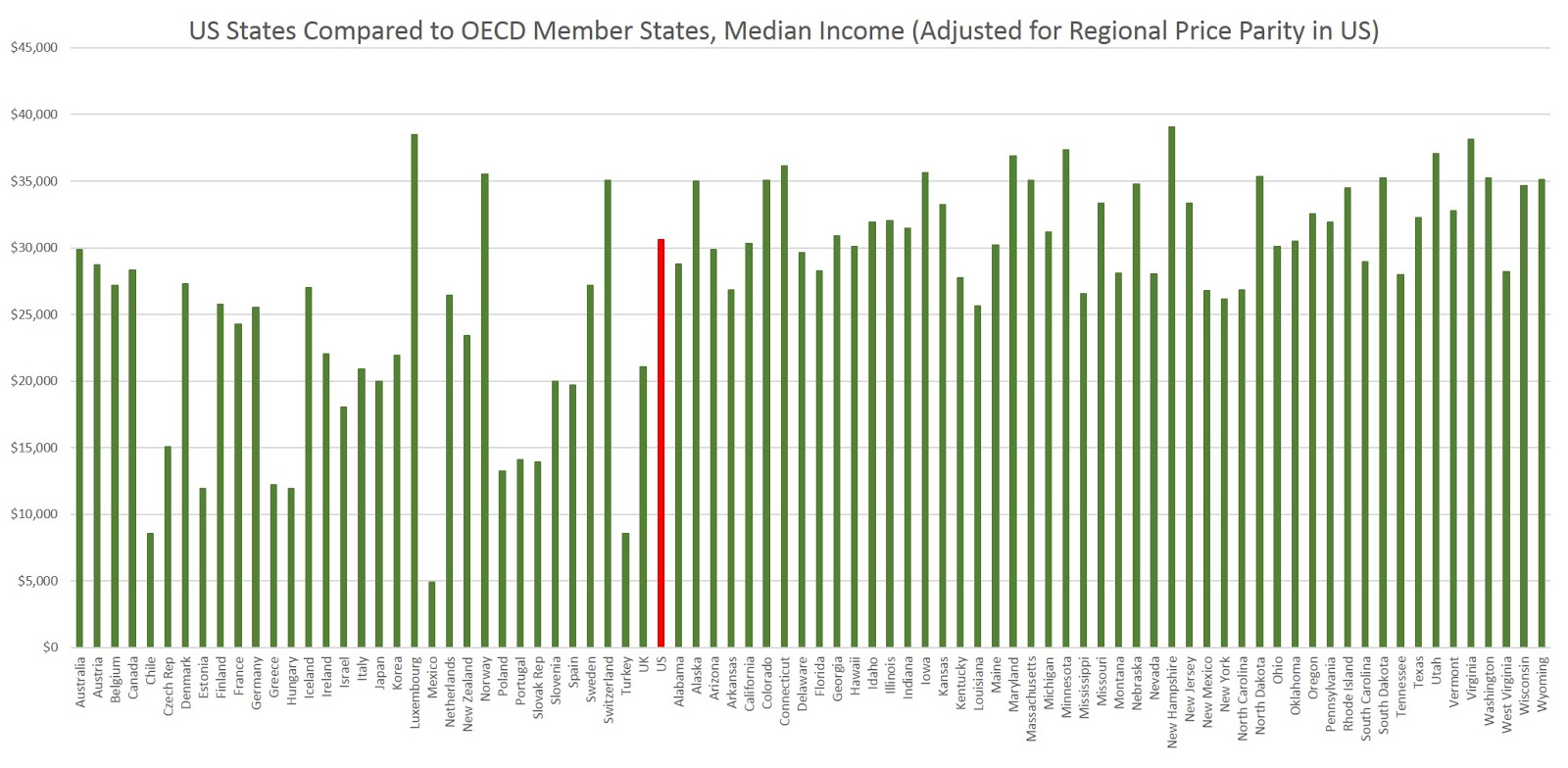
Given this, I think it's surprising, and somewhat illuminating, the degree to which population, cultural, and economic differences persist across generations. The states with the highest (MD) and lowest (WV) median household incomes are directly adjacent to one another, but WV has not been emptied by mass migration into MD. Plenty of Oregon residents complain about income taxes, but don't move next door to Washington, which does not have an income tax. Etc.
I know it's not the same as international borders, but it's also more significant than a single national government with purely administrative regions. Thinking about this has led me to question some of the fears about open international borders.
You dramatically overestimate how much of an economic difference there is between MD and WV: https://1.bp.blogspot.com/-vwpy8_glsgc/Vi5llZ9ZILI/AAAAAAAAI.... Adjusting for purchasing power, the difference in median income is just 10%. It’s like the difference between Belgium and Australia.
On the flip side, there is actually quite a difference between states like New York (second poorest in the US) and Virginia. And there is a very large internal migration from states like New York to states like virginia.
Having driven all over both MD and WV, both in cities and country. they are _very_ different. I also think that Belgium and Australia are very different in many ways, but they're also on opposite sides of the earth, whereas, as was pointed out, MD and WV share a border. I've also been all over NY and VA and would say they are more similar compared to the WV vs MD comparison. I'm not sure where you saw that NY is the second poorest in the US... would be interested to see a source on that.
Median doesn't tell me much because it doesn't describe the skewness of the distribution of incomes. Without looking, I bet that both:
1) max income is higher in MD than in WV
2) there are more people at higher incomes in MD than in WV
So I looked it up for MD [0] and WV [1] and while they don't really help with my conjectures, MD has a higher per capita income ($24,774 in WV vs $39,070 in MD) and lower poverty rate (19.1% in WV vs 9.3% in MD).
Also interesting to note from those sources that they have basically the same retail sales per capita and rate of persons without health insurance (although MD has about half the disability rate).
I recently visited WV and I found it an interesting contradiction. A lot of the major infrastructure I saw was in perfectly fine condition, even quite good in many places. But in a lot of the little towns the poverty was palpable. Houses in such an amazing state of disrepair with patches cobbled on top of patches. Then you drive into the hills around the town and sooooo beautiful, big houses on big plots of land, etc. It was gorgeous to drive through and see ... from the inside of our air conditioned van ;-).
I wonder how long until someone builds a high speed commuter line into the heart of WV from DC. There is probably an obvious reason not to, but from my west coast perspective it seems like a good idea.
West Virginia benefited for a long time from being represented by Robert Byrd, a powerful and savvy U.S. senator who was adept at directing federal dollars into his state to pay for nice infrastructure and federal jobs (the FBI, among other agencies, has a major center in WV).
At the same time, much of WV's private economy was centered around extraction and manufacturing, both of which have declined over the decades.
There's a big highway under construction into the center of WV, currently called "Corridor H", that is intended to link up with 66, a major artery in and out of the DC metro area.
I think it's unlikely that high speed rail gets built in that corridor any time soon, simply because high speed rail in general seems unlikely in the U.S. right now.
The puzzle piece you are missing is topography. Load up a topo map of the state sometime. Nearly all of it is a twisted, practically fractal landscape of hills/mountains.
And unlike some other regions known for mountains (like New England) there are no (relatively) wide valleys between them.
It's wild, beautiful, and absolutely awful for building even a decent sized town in. It's why the few cities in the states are at the far edges, and even they are hilly. It's also obviously terrible for building transport infrastructure to get anywhere quickly.
> I wonder how long until someone builds a high speed commuter line into the heart of WV from DC. There is probably an obvious reason not to, but from my west coast perspective it seems like a good idea.
I grew up in MD and spent a lot of time in WV. It's a beautiful state with a lot of wonderful people. It has a modest crime rate and a murder rate typically 1/3 lower than the US rate. And of course as noted it's quite poor relatively speaking. Sub par economic outcomes is one of the long-term constants of WV. You will often notice the difference in the quality of the roads immediately when you cross into WV from MD or VA.
Here's one big reason why that high-speed line will never happen from DC to eg Morgantown or Charleston WV: the population of West Virginia hasn't increased since the 1930s. 1.8m people in 1935, 1.8m today (and falling). The demand just is never going to be there, given the extreme cost to build infrastructure in the US.
The "second poorest" is likely a misquote. The Hasidic community of Kiryas Joel has a notably high official poverty rate due to the lifestyle of the people living there. This is one village in one county. The entire state in aggregate is not anywhere near the poorest even with NYC removed.
New York has the second lowest purchasing-power adjusted median income. On the Census Bureau’s supplemental poverty measure (which accounts for cost of living), New York is the third poorest, with 17.9% of people living in poverty (versus 14.8% for West Virginia): https://www.census.gov/content/dam/Census/library/publicatio....
CA does very poorly by that measure. Both of these states have large rural populations (which bring down the median income), as well as large urban centers (which bring up the cost of living).
I've also often driven through both quite a bit when I lived up north.
I'm not sure I could tell you if I was in (non-coastal) rural MD or rural WV (same as I'm not sure I could tell you if I was in Fairmont, Cumberland or Winchester).
I don't think I estimated the size of difference at all. Are you suggesting that there is a cutoff below which differences in income don't affect where people decide to live? Is the difference between NY to VA above or below that cutoff?
I guess my main point is that we take this freedom for granted in the U.S. and generally folks don't examine it, or consider it to be good, or consider it not bad enough to be worth changing. I can tell you that there is zero public concern in VA about economic migrants from NY state.
An oversight in your observation is failing to account for the fact that equilibriation processes are slower and less dramatic when there are smaller differences between two things. E.g. dropping ice onto a hot pan is quite dramatic. Dropping 60 degree water into 70 degree water not so much.
> Are you suggesting that there is a cutoff below which differences in income don't affect where people decide to live?
Of course there is, for plenty of reasons:
- Moving away from friends and family is not free, is risky financially (what if your new job does not pan out), and is often simply not something people want
- Population-wide differences do not guarantee that you personally will gain anything by moving (correlation vs causation)
- Small differences in average incomes are imperceptible to most people, and the quality of average person's financial analysis is lacking. For example, looking at just median income ignores differences in cost of living, quality of government services, lifestyle, and anything occupation-specific.
- There is often more variation in median income within a state (e.g. urban vs rural areas) than across states. Migration from rural to urban areas is a thing.
> And there is a very large internal migration from states like New York to states like Virginia
I don't feel particularly qualified in this area, it's an interesting question though; but, this really needs a citation. I think you're making a very strong claim here, that there is a "very large" migration from New York to Virginia -- although I have a problem with the qualifier "states like" -- what does that mean? Blue/red states? Northeast/South? Does "states like Virginia" include Florida, because that feels like a pretty strong outlier for the rest of the South.
In any case, here's a little information I've found, which I don't have the time right now to seriously analyze to support or refute your statement
Then there's the issue of comparing median income, without including average or standard deviation in the analysis. And while I can see the value of adjusting for Regional Price Parity, I would be curious to see a county-by-county breakdown of New York state -- I would guess the burough of Manhattan ("New York County" apparently) would also be a dramatic outlier, statistically, compared to the rest of the state.
Lies, damn lies, and statistics, I need to see a lot more to feel convinced of either argument.
See: http://thecontextofthings.com/2014/04/23/people-are-leaving-.... Domestic migration is flowing from New York, LA, etc., to southern cities like Charlotte, Houston, etc., where purchasing power is higher. New York lost 1.5 million net residents to domestic migration from 2001 to 2008. (I.e. 1.5 million more people left New York for another state than left another state for New York.)
The people in rural, red areas are usually concerned about urban, blue immigrants- they drive up prices, have an outsized effect in politics, then bitch about how things aren't as great as where they came from. I've seen this with New Yorkers in Virginia, Californians in Colorado, and Washingtonians in Montana.
Probably the same basis by which California is the poorest: statewide cost-of-living adjusted poverty line.
There's a number of ways this measure is potebtially misleading; for instance, both New York and California are diverse states where the local cost of living varies considerably, and the numbers for any CoL adjusted measure would look very different if instead of a statewide CoL you used, say, county CoL based on residence and then aggregated the statewide numbers.
But using this or other statewide CoL-based metrics does get at something that mean or median income or measuring against the even less relevant national poverty line does not.
Yeah, when it comes to New York, CoL, income, etc. vary widely; Albany, Buffalo, Binghamton, and NYC are all incredibly different. And as far as I know county level CoL isn't so great either, depending on how big your county is; even in New York, Huntington and Riverhead have vastly different local economies (to the point where there are occasionally calls to split Suffolk County in two), to say nothing of massive counties like King County, WA.
I would not characterize it as the "usual" way of comparing incomes. It's useful in some contexts but the adjustment can mask differences in local quality of life that matter to people.
West Virginia is being emptied, however, with a net loss of population over time. People do leave bad economic areas for good ones over time.
People don’t move to Washington from Oregon because their jobs are in Oregon and they would be subject to income taxes anyways. Really not smart if you work in Vancouver WA to live in Portland, however (income taxes are an or proposition).
However, I totally agree. Contrast this to China’s hukou system, where you can be a foreigner in your own country because you live in a city without hukou, even if you were born there.
The hukou system is fascinating- I literally turned to a Chinese coworker to ask about it. He is dealing with visa issues in the US, and explained if he wanted to go live in the Chinese city of his family, he'd have essentially a new set of "visa" issues there!
Never having heard of the hukou system before (wikipedia[1] for anyone in the same boat) I have a hard time understanding the rationale behind it. The only "benefit" I can see is the government having more control over citizen movement and reduced class mobility. I was surprised that people with rural hukou status who had migrated to urban areas were reluctant to change status. I'm curious how it's perceived by the people?
They aren’t reluctant to change their status, they simply can’t. Hukou upgrades only come with marriage or divine central government intervention. Even if your ancestors moved to that city a few generations ago, it won’t change your (or your descendants) hukou; ie no jus soli.
Reading about the program that was my initial guess as to how it would work as well so I was surprised when I got to this section[1] of the wikipedia article that seems to say people are deliberately choosing not to convert from rural to urban. The entire section is sourced to an article[2] titled "China's Hukou Puzzle: Why Don't Rural Migrants Want Urban Hukou*"
Interestingly, the asterisk in the title indicates the research was funded in part by the Chinese government and the user who included the paragraph/source in the article has been banned by Wikipedia[3].
Farmers do lose the rights to their land when they are given urban hukou, but that is part of the divine central government intervention I was referring to. It isn’t usually the case that they are migrants, but their land is being “liberated” by a nearby city and their hukou is being changed to urban so that they no longer have rights to that land anyways (they’ll also be given a small apartment, good luck with your new career as a non-farmer!).
This is a bit different from people moving from one place to another, and involves another nuance between urban and rural hukou within the same area.
I did the equivalent for almost 10 years. (Lived in Massachusetts; worked in New Hampshire.) But I owned a house I liked and it didn't make sense to move.
The problem with this argument is that going from most of south America to any part of central America would be a large economic jump. And we know that people who come into the USA illegally tend to go towards major hubs with more economic activity and opportunity. The amount of economic migration would increase for sure. And in a situation where we already turn around over 100,000 a month for attempting to cross illegally, not to mention the number we never catch, it's definitely not going to advantage American citizens to have open borders along the Mexico-USA border.
Where there's economic activity and opportunity that immigrants are drawn to, like you said, then that means there's an unmet demand for labor in the host country. A business that could expand, but isn't able to because it can't find workers.
Immigrants then spend the money they've earned which further stimulates the local economy and increases tax revenue for governments.
This basic reasoning is why economists are pretty united in the idea that immigration is good for citizens of host countries experiencing immigration, and real-world data has shown this over and over again.
The idea that immigration to the United States disadvantages citizens just isn't supported by evidence.
>then that means there's an unmet demand for labor in the host country
Where did you come up with that idea? Maybe you meant there is unmet demand for labor at a lower cost, or lower than minimum cost (under the table, etc). This can come at the expense of people earning moderate wages who are not going to be happy about this. A race to the bottom does have issues.
Same with EU, people seems to take it for granted but every time I think about it I find it amazing that it works as well as it does and how good it is.
Which was dumb then and still is - UK was never part of the Schengen agreement and has full control of its borders, it can stop anyone from entering as it pleases.
Schengen is about being able to check at your borders. Indeed the UK can still do that, despite being in Europe.
However, the UK still has to allow free movement of people. Meaning that it can not stop Europeans from living in the UK. This does not cover working though, and I believe that some European nationalities still have to apply for a work permit.
UK can stop anyone who is deemed national security from entering(if the worry is criminals coming here) and free movement applies only if you're employed, a student or can demonstrate that you have enough funds to live here without assistance - without it you can be denied entry. So that should solve the issue of "immigrants coming here for benefits". Really, UK has full power over its borders, it just chose not to exercise if.
You get it backwards, free movement of people is for workers, you don't have the right to stay if you aren't working (or alternatively studying, or living with someone who works) — though this isn't heavily enforced
You're right. I just looked it up to be sure. When I lived in the UK in 2007, Bulgaria and Romania entered the EU. There was some fuss about that, and initially those nationalities did not automatically obtain a work permit.
Not really, no. One of the basic tenets of the EU single market is free movement of goods and people. Schengen agreement just removes border controls. UK has the freedom to stop any non-EU citizen from entering as it pleases but so does every other EU country, including the Schengen ones.
See my reply above - even with free movement, there's plenty of cases where you can deny someone entry. Right to free movement is not absolute, and UK is in a fantastic position because it can inspect every single person coming here, unlike for example Germany.
To clarify the united states system, states have rights to regulate commerce within their territories. So movement of goods is not in fact free. For example, California has border gates where they will sporadically check for and confiscate certain agricultural products.
Yes, the state that wants to be a sanctuary state has border gates and enforcement.
The United States has "open borders" arround the states, because it is the _United_ States. For th emost part, most of the EU has "open borders" arround their member countries. (Sometime that flexes since it's not united)
As far as the diversity in culture, I would not agree with that amongst states. Not in a way of comparing say Costa Rica to Panama or the UK to France.
Having just finished re-watching Ken Burns' Civil War for the first time in 20 years or so, like a freshman psychology student who now understands the motivations of the entire world, there is a line in the documentary, stated I believe by Shelby Foote, that stuck with me
> Before the war, it was said, "The United States are." Grammatically, it was spoken that way and thought of as a collection of independent states. After the war, it was always "the United States is," as we say today without being self-conscious. That sums up what the war accomplished. It made us an "is." *
I certainly, today, think of the U.S. as a whole, not as a collection of independent states, and consider the issue of states' rights to be a generally pointless debate.
* Ignore the issues for a moment with the documentary itself and with Shelby Foote, who has stated Nathan Bedford Forrest is "one of the most attractive men who ever walked through the pages of history" -- seriously, I don't even know what to do with that. And I don't know if they did their footwork -- a textual analysis of, say, newspapers prior and subsequent to the Civil War saying "the United States are" compared to "the United States is." From what I've seen regarding issues with the documentary, I would question it, but I don't know for certain. Some things they seem to have done good scholarly work on; others, not as much.
It's not quite so clear cut. In WA, I feel far more cultural similarity to British Columbia than I do to California or Colorado. And Central Americans easily feel more cultural similarity to other Central Americans (they were even a united federal country, sans Panama, at one point), whereas Mexico might as well be Norway to them.
Canada has free movement between provinces, including Quebec, which has a different language and a different legal system. Not arguing the larger point one way or the other, but wanted to add this data point.
There's a huge amount of cross border inter-state migration in the US. Maybe 30% of the population over a lifetime. I would guess less than half of citizens die in the state their parents were born.
I echo your amazement with the sheer size of the open border area. It's possibly the largest in the world.
US states are very culturally homogenous. Likely the highest similarity in the world among large countries. Possibly a result of such a mixed heritage and extremely pervasive cultural influences. Who really knows though.
I've been to many states and the difference between even coasts is the same as maybe 300 miles of travel in Europe or Asia.
Most people don't like migrating (whether that's intercity, interstate, or to a different country). Culture, identity and familiarity have a lot more staying power than HN readers (who tend to be a very transitory demographic) give credit.
Oregon and Washington are an interesting case. Washington has the most regressive tax system in the US. Oregon is one of the least regressive (yeah, all states are regressive). You would think that wealthy folks would really want to move across the river to escape Oregon's income tax. The problem, though, is that there are just two bridges across the river and they are frequently very busy, and 99% of everything is on the Oregon side. The only way I would move from Portland to the other side is if I am moving all the way to the Seattle area. And that is unlikely, I enjoy Portland too much.
I think it comes down to the fact that people don't care as much about taxes as is commonly thought. They care about how much they like a city, or the general culture, or how close they are to mountains or the ocean.
Tax is belabored because it's so ideological, like when the Kansas governor claimed cutting taxes would bring a rush of new industries into Kansas (it didn't).
I know though when I chose to move from Texas to Hawaii to Washington State I never thought too much about taxes at any point.
That may be somewhat true, but I know a lot of retirees in Portland that could easily relocate. Also I'm not positive in the case of Oregon how much the income tax really applies to retirees.
The issue is washingtonians working in oregon would pay oregon tax. Tax applies if you work in the state not if you live there. Living in portland and working in Washington is the best bet if you can pull it off
Unless something has changed very recently, you pay Oregon income tax if you live here or work here. To avoid it altogether you would have to both live and work in Vancouver.
(until 5 years ago I lived in Portland and worked in Vancouver)
Seems like im wrong. However this puts oregon in a minority of states i believe. Most states do not tax residents on income earned in another state though they certainly could
> U.S. states are sovereign entities with their own criminal laws, tax regimes, educational systems, property and contract rights, civil rights, economic growth, industries, natural resources, etc.
States can hardly be considered sovereign entities anymore. They are subservient to federal laws, educational standards, international trade restrictions, environmental protections, etc. States aren't even allowed to leave the federation.
True but public sentiment on this is not a matter of degree; it's not like Americans go around saying "open borders between U.S. states is only a little bit bad, in proportion to relative economic differences."
In my experience it's most often taken for granted, or seen as contributing to American cultural and economic strength--a good thing.
Or compare Los Angeles to Beverly Hills. These two cities share a border. Median incomes are way, way higher in Beverly Hills. And LA's poor millions are free to crowd right into to Beverly Hills and just start grabbing up some of that wealth. But it barely happens at all. The two populations are not merging nearly as much as the shared border would predict.
>And LA's poor millions are free to crowd right into to Beverly Hills and just start grabbing up some of that wealth.
Yeah, not really free. They can't pay rent in Beverly Hills, they can't afford to shop at Beverly Hills shops, they can't even be walking around looking poor without harassment (especially if also black/latino), they don't have access to closed communities, and so on...
> they can't even be walking around looking poor without harassment (especially if also black/latino)
I don't quite know where you're getting that. I mean, it's not like the city has enacted some kind of Jim Crow regime. Beverly Hills residents were among Barack Obama's most generous donors. You think they would stand for that kind of evil in their own city?
Beverly Hills is represented by Democrats at the state and national levels. It sits in the middle of one of California's bluest counties. Are you saying LA County is tolerating that kind of blatant discrimination in one of its cities? This isn't Louisiana or Alabama for goodness sake.
>Beverly Hills residents were among Barack Obama's most generous donors.
That's not really relevant. They can virtue signal how non-racist they are (as long as it doesn't cost them anything real -- donations help buy favors) and still only live in 99% white areas, with closed gates, and local pops/private police ready to harass black/latino people for your protection.
>You think they would stand for that kind of evil in their own city?
You're not presenting evidence specific to Beverly Hills here. Saying that "such places have done exactly that" is not evidence of what's happening today specifically in Beverly Hills. And redlining is not a scheme for harassing people who are walking around on the street. Why is that your response in this context?
> They can virtue signal how non-racist they are (as long as it doesn't cost them anything real -- donations help buy favors) and still only live in 99% white areas
You're assuming the very point you should be proving. You haven't offered any evidence about why some BH residents supported Obama. Instead, you assigned them a motive without providing any objective evidence. How are you going to persuade anyone of your viewpoints that way? And Beverly Hills is not 99% white.
Bev Hills has fought tooth and claw to ensure a subway would not go through their city, and it was generally reported that the fear was that poorer people would be more easily able to go there. They (shamefully) got their Democratic congressman, Henry Waxman, to pass a bill forbidding Federal funding for any subway to the area: https://la.curbed.com/2012/4/13/10379720/eighties-subwaystal...
Anecdote: my friend from Trinidad who has an affinity for Caucasian women told me a story of harassment in Beverly Hills. He and a lady friend were in the woman's Mercedes and the police pulled them over and kept asking the woman if she was "under duress".
I feel like you're both supporting the parent's point: fears about open international borders are overblown because things like cost of living, culture or private property naturally limit massive migration.
Cost of living prevents a poor guy from some lesser LA area to rent in Beverly Hills.
While the same "but how I would afford the same lifestyle in US" might be a concern for middle class immigrants from poorer countries considering getting there, it's not really relevant to mass immigration from poverty stricken areas, as people from there can (and do) enter the US and live in dirt poor areas, working whatever minimum wage job they find (in fact they're welcomed from employers for being able to get paid so much less), and taking it up from there if/when they can...
> ... mass immigration from poverty stricken areas, as people from there can (and do) enter the US and live in dirt poor areas
it's also true that many people from poverty stricken areas in other countries live in moderate to expensive areas in LA County, like LA's West Side, Downtown, and Koreatown, as well as neighboring cities including Santa Monica, Burbank, West Hollywood, Torrance, etc. again, to do this, multiple inviduals or families simply pool resources and rent an apartment or house and share that space.
given that about 9% of Beverly Hills's population falls below the poverty line, it's a safe bet that this high density renting strategy is also employed within that city.
i think you're right. and i don't even need to look at the open border situation in West Virginia. i mean, i can look much closer to where i live (LA).
just from examining the nearby BH/LA border, we see that there may be other "invisible borders" (e.g. "Our prices discriminate so we don't have to") that prevent two populations from really fully merging.
it seems likely that any "open border" is actually accompanied by a unique set of additional, invisible borders, and cultural, financial and linguistic "force fields," sometimes powerful, sometimes weak.
Only to outsiders because individual states do not make treaties with foreign countries. However states do sometimes send their own commercial ambassadors and meet with world leaders.
States also retain full sovereignty of their territory except for limited cases and maintain their own armies navies and air forces
The National Guard are the individual armies of each state. Typically, they aide the army and obey national orders. However their commander in chief is the governor of their state not the president.
As an example, California has pretty strict border controls on its state bordera. Bringing certain agricultural goods into california is illegal and they will fine or jail you depending on the severity.
It is entirely possible and legal, but unlikely, that the governor of California sends it national guard troops to the border if Oregonians for example were attempting to storm the border with ferrets or something.
It's difficult to express how profoundly misapprehended your comparisons are.
Moving into a higher-income area is the last thing poor rural Americans want - and the last thing that would help them. They are already living in high assistance areas - the area assisted by the United State federal government.
People invading the US are not looking to be in a high-income area, because that implies a higher cost of living. They are looking to be in a high-assistance area. They are not looking to make money, and have little prospect of that. They are looking to be given money.
Antarctica too: if you can get there, you can step onto the ice.
There's a pattern here: the only places with open borders are places where you wouldn't really want to live anyway, while the places with the strictest border controls are often those that are quite desirable.
Svalbard is an amazing, humbling place in terms of nature. The fact that once you leave town, for hundreds of kilometers in any direction there are zero humans, zero cellular reception, just nothing but you, the ice, and maybe the bears. I went there one winter and spent a week without sunlight. It was the first time in my life I went a few days without seeing the sun. A few photos:
True, I wouldn't want to live there long term -- the limitations of a small town and no road access to other towns could get depressing after a while. But it was definitely an experience being there for a week.
Yeah so the trick I used is to find a cheap deal to Oslo, and then use Star Alliance miles to get the Oslo-Longyearbyen segment as a reward flight on SAS. It counts as a domestic EU flight as far as mileage goes.
FYI unlike mainland Norway's national parks, you cannot "randomly" go to the national parks in Svalbard. Svalbard is almost completely devoid of infrastructure (no roads outside the couple of towns) so you'd have to make a completely self-sufficient expedition across arctic terrain to get there. You also need someone with rifle skills in case of a polar bear attack, and it's required to carry a rifle and register all plans with the Governor of Svalbard to leave the town. It's possible, but definitely needs a properly-equipped team -- not a casual trip.
Germany, Ireland, Sweden, Denmark, Finland, Austria, and Netherlands are some of the most prosperous countries in the world, and they have an open border with 28 other countries — some of which can be easily classified as very poor and undesirable places.
it’s not an “open border”. on the contrary.
there are actual physical borders between schengen countries and the rest of the eu. whenever you enter/exit schengen you have to pass border control.
that’s not how schengen borders work. it’s not an open border. it’s an actual border. and yes, you can be banned from travelling into schengen even if you have an eu passport.
I presume it's also to keep out subversive foreign agents. And reporters. And people whose mere presence is suggestive of Western capitalism and therefore subversive. Something like that.
Pay a bit of money in China and you'll have a visa in no time. That's doesn't work with, say, Switzerland, at least not with a similar amount of money.
My aunt was forced to leave China as her husband's work there (for some multinational) was done. Instead, she started her own business (not for the money, but to have a presence which 'stimulates the local economy'). Now she's allowed to stay in China.
Argentina strikes me as a strong combination of "desirable" and "open". Virtually anyone can become a citizen, and it's a prosperous enough country, currency decline notwithstanding.
For those in the US, it might be 1-2 affordable flights and in the same timezone? Someone elsewhere in these comments suggested Svalbard would be 40 hours and $1200+.
A century ago it was the world's 10th wealthiest state per capita. Right now it tops the list of the upper middle-income group, so is almost a high-income country, and per capita is richer than, for example, Russia.
Exactly. It went from a rich nation to a poor nation, to default, back to poor and free markets, then to progress then again back to the IMF. It’s a classical basket case country.
When reading the article, I wondered whether global warming might change that. It won’t (fully) flood (highest mountains are over 1 km high), and has ”has an Arctic climate, although with significantly higher temperatures than other places at the same latitude.” (https://en.wikipedia.org/wiki/Spitsbergen)
It probably will stay on the ‘too cold for most’ side, though, and the long winter night won’t go away.
"The key to Svalbard’s status as probably Europe’s closest thing to a crime-free society, according to the governor, is that unemployment is in effect illegal. “If you don’t have a job, you can’t live here,” Mr. Ingero said, noting that the jobless are swiftly deported. Retirees are sent away, too, unless they can prove they have sufficient means to support themselves."
Basically Svalbard can have relatively open borders because it's unappealing and they are very very aggressive about deportations.
Having deportation along with open borders is the best example of how doublethink has taken over any sane discussion of nordic economies and government
"Amid scaremongering about unrestricted migration, I went to Svalbard because I wanted to see whether there were lessons we could learn from this 2,300-person community a few hundred miles south of the North Pole."
Translation: "I made up this bullshit and wrote this article so I can have the magazine pay for my adventure vacation".
"As climate change renders the rest of the planet as hostile to human life as the far north, we too must make the choice between throwing up walls and letting them down"
Is this really the general conclusion about the cause why people want to emigrate to "developped" countries (the "we" in the citation) ? climat change ?
> Svalbard’s geopolitics provide an imperfect but alternative vision of how places can be governed, whom they can accommodate, and how communities can form.
Hardly. It's a rugged community of 2300 people. That's not a model for alternative government.
> "This is not a cradle to grave society,” one of Askholt’s colleagues told me.
Specifically: if you are pregnant approaching 7-8 months, if you become seriously ill, or if you are old enough to need care, you are flown off to the mainland. You're literally not allowed to be born or die there.
You could get there with a tourist visa and stay? After the visa has expired, I guess they'd let you back into Norway mainland before potentially kicking you out again, perhaps with a large medical bill.
Edit: The article mentions for example "significant Thai and Filipino population"; I assume not all would have a right of residence in Norway.
Not only that but it provides no social services, so there’s no government cost or burden to immigration. Similar to how the US was in its early history but contrast to how the US and Europe is now.
It is a myth that immigration creates a burden on the US government.
I'm so sick of "two side"ism taking over every conversation.
There is an opinion on this based in the weighing of all relevant facts, and there is an opinion about this based on the creative selection of only some facts. Decide for yourself, but what I've seen is that the full body of facts is much more supportive of the idea that immigrants are a net positive to the US than it is the opposite.
Of course it has a cost. Everything has a cost. Maybe you meant the net benefit of immigration is greater than the initial cost burden in the long term? I agree with that.
Or do you really believe that tripling the amount of software engineers in the Bay Area wouldn’t have any negative consequences?
That’s the fallacy of an open border. At the very least we moderate and control immigration to mitigate short term costs and maximize long term benefit. And also for basic precautions, such as criminal history checks and vaccinations.
It's not relevant to talk about the cost of something without also talking about over what period of time, and the myth that immigrants are a net negative to the US is completely ungrounded.
Further, the notion that something must not have any negative consequences to be a net positive is an insane one, and not how any rational thinker applies themselves to a problem.
There is no fallacy of an open border, and the short term costs are lower with immigrants than they are with native born Americans (see the myriad of articles I linked if you don't believe me). Lower short term costs, similar-to-better long term benefits (again, a well supported idea), it is a no brainer; immigrants are a better investment for Americans to make than on themselves!
Now obviously it's silly to say, "Kick out Americans, let immigrants take their place" but pretending like there's a cost to be considered for letting immigrants in is hilariously selective in its application of fiscal responsibility, when we spend so much money trying to keep immigrants out.
> but pretending like there's a cost to be considered for letting immigrants in is hilariously selective in its application of fiscal responsibility, when we spend so much money trying to keep immigrants out.
The reason immigrants are of benefit is because of the very borders you seek to remove. We apply a high barrier to entry which means we get more wheat and less chaff.
Even if it was true that both legal and illegal immigrants are of advantage to "the economy," that argument acts as if the economy is the end-all-be-all of the nation-state. If allowing in cheaper immigrant labor allows for someone to get cheaper services at the expense of our lower runs of society through higher competition and lower wages, that's not a trade-off I'm willing to make.
That isn't true, because of how many undocumented immigrants come in and these numbers remain positive.
Nobody is filtering out the undocumented, and yet here we are, still net gaining from their existence in the US.
Further, no one is asking you to make that tradeoff, it is not at the expense of lower runs of our society, because immigrants are the lower runs of our society, at least they are right now, due to how we treat them.
Also, why are native people better or more deserving than the immigrants to a better life? You say it's not a tradeoff you're willing to make, but why not? People are people, regardless of where their birth town is.
Why do you value natives higher than non-natives, despite the clear indications that the non-natives are of a net benefit to you over the natives?
You want to keep America small, its economy small, and its people worse off, all because you believe there's a false tradeoff. That's a problem.
To put this another way, if there "magically" were no tradeoff at all, if the "lower runs of American native society" weren't "negatively impacted", would you change your position?
> That isn't true, because of how many undocumented immigrants come in and these numbers remain positive.
The articles you cite are specific to legal immigrants.
> Finally, why are native people better or more deserving than the immigrants to a better life?
The nation-state exists in service of its citizens, not the wider world.
> despite the clear indications that the non-natives are of a net benefit to you over the natives
I come from a family of legal immigrants. Not the long-winded "trace my family to the Mayflower" way, but in the "my family speaks another language" way. I have no argument against legal immigration that selects for what our society most needs. Open borders are a free for all that throws our lower rungs to fend for themselves.
...I don't think you understand what an open border means, and if you're getting hung up on the "legality" of it, an open border would literally make immigration legal. If you have no argument against legal immigration, then you have no argument against an open border, as it changes the policy, making immigration generally legal in its various forms.
Further, a nation-state's service to its people is a geographic and societal one. Once more people enter into the geographic area and participate in the society governed by the state, those people become its citizens, in every relevant sense. Additionally, you are admitting to agreeing with the idea that "Americans are more deserving humans to non-Americans" and that is xenophobic, literally the textbook definition.
It's funny to me that you think the Wikipedia article titled, "The Economic Impact of Illegal Immigration" is about legal immigrants.
Open borders is not a "free for all", and I hate to break this to you, but our lower rungs already do fend for themselves. Allowing more immigrants into this country would in no way further their dire straits, and in many ways it'd likely help them, as a larger poor population would increase votes for programs and infrastructure to support poor people.
> I don't think you understand what an open border means, and if you're getting hung up on the "legality" of it, an open border would literally make immigration legal.
You're conflating the societal value of legal immigrants, which is itself questionable at times (H1-B abuse) with those of illegal immigrants which further depress wages.
> "Americans are more deserving humans to non-Americans" and that is xenophobic
I never made a statement of who is deserving of anything. I've pointed out that nation-state exists to serve its present-day citizens, not hypothetical future citizens as you are saying.
> It's funny to me that you think the Wikipedia article titled, "The Economic Impact of Illegal Immigration" is about legal immigrants.
How could I forget the one article in your deluge.
It's a great article:
>> Immigrants, legal and illegal, are more likely to pay taxes than they are to use public services. Illegal immigrants are not eligible for most public services and live in fear of revealing themselves to government authorities. Households headed by illegal immigrants use less than half the amount of federal services that households headed by documented immigrants or citizens make use of.
Illegal immigrants are a benefit because they cannot access services that they pay for. They're a net benefit because we allow their exploitation.
> but our lower rungs already do fend for themselves.
Exactly, so let's make it worse for them by further depressing wages! They're already suffering, what's a little more?
Poor Americans are not suffering because of immigration, undocumented or otherwise.
Undocumented immigration does not suppress wages.
Undocumented immigrants would be able to climb out of poverty if they weren't being persecuted by the federal government, so the fact that they can't use services they pay for is a problem, not a solution, as these services are intended to push people up and out of poverty (to the extent that they work, admittedly).
And yes, you did actually say you prefer American people over not Americans, and yes, the viewpoint you are expressing is not only xenophobic, but also not grounded in the many many facts I've provided.
What is it really? Do you fear things different from you? Do you think of "your team" as the one that hates immigration, so you feel the need to support that view? Do you think you and your kind are superior than the people who want to live here? What is the actual reason? Trying to cherry pick statistics won't get that true reason out there so maybe just say it.
Dang doesn't like it when these conversations get combative and protracted, so I'm going to stop replying. I do wish we could continue, and I think you should summarize your position in your final reply, because it's important to get this stuff out there, and honestly I think at this point the only really "wrong" thing you've done is not fully consider the consequences of your position.
Singapore's government is widely acknowledged to have one of the best track records in the world, when it comes to considering and then successfully implementing unpopular policies that nevertheless economically benefit the group. And immigration policy is one area they considered with fresh eyes; even the most radical open borders advocates were permitted to, and did, try to make their case in Singapore.
What did they conclude the facts actually were? What is their immigration policy today?
If one of you two is ignoring the facts, there's practically no question that it's you.
That research you're talking about (with fresh eyes) concluded they needed more immigrants, not fewer.
I just don't understand what point you're trying to make. Singapore's immigration laws are in what way relevant to the US? It's an "island city state" according to Wikipedia, not really at all comparable, but if one wanted to make a comparison, the government of Singapore suggested opening its own borders further, which supports what I was saying.
Did you think I was advocating for a more closed border?
Singapore treats high-skill and low-skill immigrants quite differently. That's the centerpiece of their policy, and entirely relevant to the West. Compare Canada/Australia/NZ's race-blind (and high-volume, especially relative to their population sizes!) but points-based immigration systems, and much lower severity of populist revolt in those countries, with the problems in the US and European countries that had been executing less selective policies against the wishes of their citizens.
Also, how is any of that relevant to a country that has so much more space and resources for people? The US is geographically and economically gigantic compared to Singapore, proportionally we can take on orders of magnitude more people than Singapore, so why would we try to apply the same policy?
At 35 people per km^2 vs 8,100 per km^2, how on Earth could you possibly try to compare?
To make the country as nice a place to live as possible.
Here is a concrete example. Look at the outmigration of California -- if there had been way less immigration, more people (that aren't descended from recent immigrants) would get to enjoy living in California, but instead it's too expensive and polluted, houses are really packed in together. Imagine how much nicer a place to live California would be if we had only admitted immigrants that can solve basic math problems.
California is not too expensive and polluted due to immigration, it's too expensive and polluted due to Americans. It's also neither polluted nor expensive, when you consider the entire state. Some of the most barren places in the US are in California, as are some very poor areas. It's a big state, which is my whole point, the US is huge.
But I get it, you want nice things and you don't want others to have them. Too bad.
The US has a far better track record than any other leading power in history when it comes to facilitating the development of other countries into nice places. See e.g. http://davidbrin.blogspot.com/2009/11/how-americans-spent-th... , or consider the motivation behind the Optional Practical Training student visa provision. As a US citizen, I personally spent three years working in China for a Chinese company, on salaries in line with those of local PhD staff, and nobody lifted a finger to stop me from developing cutting-edge technology for them; this may be slightly more restricted today in the specific case of China, but a younger analogue of me interested in applying what they learned from US grad school to problems in India/Indonesia/etc. faces few barriers from the US side, beyond unusual income tax and other financial considerations that only really kick in if you're already making enough to live like a king.
Yes, I want nice things. And I want as many other people as possible to have them as well, which is why I'll remain opposed to US-weakening policies until we have a #2 power that's even better at helping foreigners than the US.
You can be opposed, but that doesn't make your position correct. In fact, based on your steadfast commitment to your position despite the glaring evidence I've put directly in front of you, that... kind of makes you stubbornly closed minded.
The fact that you're not even talking about the things I mentioned in my earlier comments should be a red flag for you; why won't you talk about the facts related to immigration into the US? I wonder, maybe it's because the facts won't support your position?
1. How relevant is open space when a majority of prospective low-skilled immigrants want to live in already-heavily-populated areas, not North Dakota?
2. I already mentioned that the other countries most comparable to the US (Canada and Australia), including on the open space dimension, make the same hard distinction between high-skill and low-skill immigrants... and they are doing conspicuously better than other Western democracies at simultaneously maintaining high immigration volume and avoiding populist revolt. It is not my problem that you failed to parse this. New Zealand did see a political turn in favor of more restriction recently, but it was from the left. If anything, it's Singapore's lack of space that makes it practical for the Singaporean government to enforce the conditions under which they can keep so many guest workers around to mutual benefit, such as no pregnancies.
> Undocumented immigration does not suppress wages.
They can and do.
> And yes, you did actually say you prefer American people over not Americans
I would appreciate it if you did not place words in my mouth which I have not said.
> Trying to cherry pick statistics won't get that true reason out there so maybe just say it.
Because I've witnessed first hand the problems of illegal immigration. I grew up in a community filled with them. Went to school with them. Befriended them, and watched many of them achieve citizenship. Witnessed illegal workers being paid below-legal wages, living three to a room so they could save every penny to send as remittance. I've seen them out compete the local blue collar laborers.
Sorry I'm not willing to throw aside the working class so you can acquire cheaper goods and services.
> Dang doesn't like it when these conversations get combative and protracted, so I'm going to stop replying.
Ah yes, take the moral high-road after you've attempted to assassinate my character by calling me a xenophobe.
I'm seriously not trying to take any high ground, this is an entirely practical problem, he will literally ban me if I go too far, he's said as much a dozen times in my 10 years on this site.
Totally not a high ground thing, I just don't want to get banned is all!
> he will literally ban me if I go too far, he's said as much a dozen times in my 10 years on this site.
Regrettably, it would appear you haven't learned the lesson dang is trying to impart. I hope for the sake of your tenure that you one day find your inner peace.
I wouldn't characterize it like this. Longyearbyen has schools, churches, a post office, a local elected government. Kids play hockey near the streets over summer. Adults open museums, galleries and cafes for tourists. They've incredibly high speed broadband, amazing plumbing infrastructure too. It's an emotionally tough place to live over winter for some people, with the darkness, but it's not some Arctic campsite where only the rugged and tough can survive. And if you get ill you can easily go to the local hospital, with the possibility of a transfer to Tromso if it's bad.
>>> Svalbard’s geopolitics provide an imperfect but alternative vision of how places can be governed, whom they can accommodate, and how communities can form.
Yeah, how you can govern an "open border" society made up of rich, educated people with abundant resources who intend to go back to their home country after a little while. You wouldn't need borders if it was as hard to get to NYC as it is to Svalbard.
Slightly off topic. I've often wondered why so much effort is put into "sea-steading" when you can simply get enough money to buy island territories away from countries that may not want them and setup something akin to a prototype country. Sure the islands of the far north may pose some technological challenges, but probably less so then setting up something floating on the ocean.
"
Svalbard: The Svalbard archipelago consists of nine main islands located midway between mainland Norway and the North Pole. You need a passport to enter Svalbard.
    Unlike Norway’s mainland, Svalbard is not party to the Schengen Agreement and air travelers to Svalbard from Norway will depart the Schengen Zone prior to boarding.
    Travelers to Svalbard face unique hazards given the extreme weather conditions and limited transport infrastructure.
This assumes you get to Svalbard the traditional way--by flight from the Norwegian mainland, in which case you need a passport to transit or depart the Schengen on the mainland side. If you arrive by some other means you do not.
In the US at least, I would imagine that if your cruise ship stops at a port in the USA and you come onto the mainland, you would still have to go through customs if you're coming from another country.
I took the ferry from Dublin to Wales while on vacation. We collected all our passports once the ferry docked and we went to our car preparing for the immigration officers, police etc. There was no one. Literally. We only saw sheep for the first 10 miles or so after driving off the boat.
People who want to live on Mars could start by showing self-sufficient in Svalbard or Antarctica first. I assume it would be far easier because of the ideal gravity, protection from radiation, atmosphere and water. Manufacturing everything required would still be challenging.
The norwegian diplomat baron Fritz Wedel Jarlsberg, managed to make Svalbard Norwegian territory during the ongoing peace negotiations in Paris after world war 1. It is rumoured that the french diplomat leading the negotitations was Fritz’ secret lover.
For me: I grew up in Europe in times where the wall came down in Germany, a shared currency was established (Euro) and all European borders within Europe where suddenly passable without passport, visa checks, money exchange, someone judging you, etc.. Of course this caused other problems to solve, but the general feeling of freedom and being able to go some other country and even being able to live and work there was very liberating for me and motivated me to travel a lot (easy and relatively cheap in Europe by railroad). I don't want to argue whether or not this is possible for the whole world and what it would take, but it surely is a dream for me to live in a (global) society that makes this possible.
Have you been to other European countries before Schengen? I keep hearing how much easier it is now that you don't need your passport for travelling in Europe. I've traveled quite a bit before Schengen and the Euro went into effect, and I've never spent more than five minutes at a European border, and rarely more than five minutes exchanging currency. Granted, it's easier to know that they are robbing you at some tourist trap if you don't need to convert amounts in your head, but I'm not so sure that's a good thing if you want to enjoy your trip...
That's for traveling, and the same currency is quite nice, especially when visiting multiple places in one trip.
But the possibility of moving permanently (or to study at the university) to another country without needing a visa, well, that's a game changer. Not to mention the agreements between European countries (e.g. If you move, there's no need to change your driving license)
> But the possibility of moving permanently (or to study at the university) to another country without needing a visa, well, that's a game changer.
Is it though? I mean it's sure helpful if that's what you want to do, but it's not like that was impossible before. Given that relatively few people make use of it (relative to the population) it seems to be a small win, easing the bureaucratic process for a small number of citizens (that, I suppose, in Western Europe are generally wealthier than the average, and wouldn't exactly have to jump through hoops before).
No, not wealthier than average, at least looking at all the expats I've met. It is not about the money, at least for me. I refer to the feeling of insecurity you get when your studies or contract are over, you don't yet have a new one, and you might have to take all your belongings and move out of a country where you lived for years, just because you can't renew your visa. As an EU citizen outside my home country but still in the EU, I don't have that. Many PhDs from Turkey I have met ended up like that. You don't want to even risk that kind of situation.
Also in the past people moved abroad for work. Now it's easier, from a bureaucratic and economic perspective. Doesn't mean everyone WANTS to move: most people are perfectly happy living in their hometown, or at least same country, as long as you can make a living there[1]. But this should not surprise anyone, it's not that most refugees would leave their countries if they could find a job and security in their homeland .
[1] btw, I have no stats but the feeling is that most internal migration in Europe is from the poorest countries and/or social classes to the richest countries. Which, again, makes a lot of sense...
> Given that relatively few people make use of it (relative to the population)
[citation needed]
There are vast numbers of cross-border workers and internal (to the EU) migrants. I don't have numbers, but I really think that statement is misleading.
Most (I'm going out on a limb here and would say: the super majority) lives and works in their home country. It's different for tourism where most have traveled to different countries, but it's not like 30% of the population in the EU is living outside the country they were born in.
I'm half German, half Croat. Granted, I was just a kid, but I can remember hour long waiting times at the borders. Even today, with only the border Croatia-Slovenia remaining (and, back to Germany, our beloved Interior Minister's Grenzpolizei checking tourists for not carrying refugees), the waiting times can be hours. The earlier we can get rid of this crap, the better.
What is also a benefit of ever more unification across Europe: communication. Family vacations in Croatia meant next to no communication with friends back in Germany as phone calls and SMSes were ludicruously expensive, and mobile internet roaming all but unaffordable. Now? No roaming charges any more.
Multi-hour delays at European borders were not unusual before, and persist at the external land borders of the Schengen area.
The common currency is valuable for more than just tourism purposes. A business in one country can much more easily trade with businesses in other countries if it doesn't have to deal with currency risk and the resultant necessary hedging, and if the business is selling services to consumers the single currency allows them to compete with businesses across the whole Eurozone on a level playing field. That's just considering currency; the single market is of course a much broader concept.
I think you're mixing up travel without a hassle which everybody likes to exist, with open borders which is a way more complex idea. EU is not an open-border place, I, for example, has to obtain visa to enter it.
It is you who are mixing up inner and outer. The EU is an open border place (or at least, the Schengen area is) for those who reside there. For some other countries' nationals to enter a visum is required. The EU was never about 'open borders' at the boundaries, in fact there are a lot of requirements on the boundary states and they get compensation for that.
The EU was never about 'open borders' at the boundaries
That's exactly what I wrote. Open borders as an idea is about global free movement. Schengen on the other hand is just a bigger kind of fenced area, international agreement simplifying travel and trade for citizens of participating countries. When @cojxd asked "For whom is open borders a dream?" I'm pretty sure it was meant as an idea/ideology. Because, if someone agrees to lift this border, but not that - there's simply nothing to discuss. It's a kind of position acceptable for almost everyone.
> Because, if someone agrees to lift this border, but not that - there's simply nothing to discuss.
You're pretty wrong about that. Borders are a nuisance, and lifting all of them is a good long term goal to have. But in the intermediary we can only move so fast. Saying that you don't want to discuss lifting individual borders as long as we are not lifting all borders is like saying you don't want to make a first step as long as we're not agreeing to walk all the way to the destination. That's not how societal change is achieved, it is achieved one step at the time, usually without lofty long term goals and every border that falls is one more step along the way towards open borders and should be applauded.
don’t all countries in the EU have a 3 month stay period after which you have to register as a resident?
i’m a european that has lived in multiple EU countries and the hassle of moving between them is more or less the same as moving across the globe.
For me. I'd love to see open borders, where everyone has the freedom to move to where they can achieve their goals and dreams, rather than being restricted to the country where they happened to be born. How many Einsteins have been born in Africa, but denied the chance to make the contribution to humanity that they could have?
(And before the cynics note that open borders are incompatible with welfare states, that's not necessarily true, and the path to open borders is a long one, not a sudden change we can make without massive upheaval right now.)
And before the cynics note that open borders are incompatible with welfare states, that's not necessarily true
Ok, why is that not true?
And I'd argue that any Einsteins born in Africa are going to find moving to another country and near impossible task regardless of how open the borders are.
Take universal basic income, if combined with open borders, you are attracting people who would like to also get (say) $1000/m, who will now use that welfare to induce demand on people who may like to trade this freshly minted coin for some service they can render, so the economy grows through immigration instead of debt.
MMT would suggest that the government prints money and then adjusts taxes to control inflation.
So you have a bunch of new people move, they start collecting UBI, the government prints money to fund the new liabilities, the newly-immigrated spend their UBI, incomes/revenues go up for businesses, the overall size of the pie grows, and if inflation starts to get out of control you raise taxes such that everyone is still better off than before.
Unfortunately this wouldn't work because of politics. You need a relatively reactive monetary & tax policy which just is not realistic.
But what happens when you can't raise taxes any further? Or the high taxes shrink the motivation of the people running businesses to expand their businesses.
The money has to come from somewhere or you _will_ have runaway inflation.
They spend what they get - few people surviving on $12k/year are saving much. So do the people who sell them stuff, as do their providers, and so on and so forth. At every step, some taxes make their way into the state's coffers.
Eh, this doesn't really work well with too much immigration running in to land and water use issues, along with uncontrolled need for infrastructure expansion.
Let's not forget that this does cause some negative externalities. I like the idea of it overall, but I think we need fewer people on the planet (1bb max probably) and a more overall educated and wealthy population for it to be successful. You would probably also want to start with non "western" countries (including Japan etc.) because if you start with, say, the US and the EU, it would almost immediately become uncontrollable. It also doesn't factor in disruption in local communities, changing how others live their lives or how they afford to live their lives now. Some of the tensions we see now are directly linked to mixing of cultures (and subsequent local divisions). At least that's how I see it.
How many non-Einsteins from Africa and Asia would want to move to Western countries if given a chance? a few hundred million? A billion? How does a say Germany or France support a couple hundred more million people all at once?
I think open borders is inherently a call for decreasing standards of living for the populations of those countries where most of the migration would be directed to. I just can't picture a scenario where hundreds of millions of people move to my country within a short span of time and not completely destroy the infrastructure under the weight of sheer numbers.
Sounds fair. Also the Scandinavians should pay reparations to Britain and France for everything the Vikings looted. And Mali should repay Ghana for the actions of the Manden Kurufaba. And so on.
Me. I hate how the planet is arbitrarily sliced up. I hate the bureaucratic nonsense involved in going to various parts of it. I hate how my wife is forced to choose between citizenship in her country of birth and citizenship in her country of residence. I hate how our children have to get government approval just to visit their grandparents. And I hate how my welcome home to my own country after a brutally long plane ride is a long line, an agent who treats me like a suspected criminal, and the threat of upending my life.
Cool, but we're not going to do much about changing that anytime in the near future. The vast inequality between different places along with massively overpopulated locations in others sees sure to that.
For me. To be precise: it is mostly a reality, a very highly appreciated one. I am also a German who grew up in western Germany before the wall came down. Since then, two things have changed. First and most obvious, the division of Germany has ended. The inner German border was the cruel evidence of what is needed to forcefully split people apart. As there was not just the Berlin Wall, but the whole border over several hundred kilometeres became a heavily fortified border. Basically just from one side as most of the guarding was in keeping east Germans from entering the west. It was walled, fenced, fully controlled by guard towers and even had robot guns which would automatically fire ony anything moving in the zone. This was certainly an example of all the suffering a closed border brings.
And with the EU shortly after came the complete freedom of movement inside the EU. While the EU is made out of many often quite different countries, any EU citizen has the freedom of movement. That not only means I am allowed to travel to any of those countries but I have the same rights as any other citizen of that country. I could tomorrow decided to move do Edinburgh, I could do so without having to apply for anything. Just go there and look for a job. Even if any German citizen usually has little restrictions on international travel - which is great on its own - having the full rights to move is a great achievement.
The example of Edinburgh also shows how disastrous the looming Brexit is. All economic reasons aside, the pure fact that there is a new border raised in Europe is so heartbreaking and of severe consequences for all involved people. And this is the reason, the EU won't accept any treaty which does not grant the fundamental rights, like the freedom of movement.
For pretty much anyone reading this, open borders is the reality. Any of us can show up unannounced almost anywhere on earth and be welcomed in with no more than a cursory interaction with customs, at least to visit. And if you can find a job or have some savings, you could move to quite a lot of them.
I think people here would be a lot more in favor of them, if we were treated the same going to other countries as people in the developing world are treated coming here.
It's a dream. There is something about our luck of being born in a good and wealthy place; then close it off, hence punishing people because they happen to be born in shitty place.
I believe your parent is referring to the place where you’re born being a matter of luck: no decision or choice on one’s own part determines where one’s born.
I did nothing but be born and follow the path expected off me -- handed reliable and cheap electricity, water, free schooling, internet connection; and lastly great jobs giving my primadonna arse more $$$ than I need. Idk dude, I wouldn't mind taking credit but I'm not being honest.
I've formed a firm opinion that nation states with borders restricting people's movements and economical freedom based geographical citizenship is a leftover 20th century concept that we need to move overcome.
Grew up in Europe and I see no reason why others shouldn't have the freedom of movement that I have, practical consequences aside. In my book it is (or should be) a fundamental right. It's more than just travel and tourism, it's also the right to settle as long as you comply with local law.
I've been saddened and disillusioned to see the rise of support for restricted border control in my home country during the past decade.
Which do you want, a cradle to grave welfare system or open borders for all comers? You can't have both. Huge numbers of people are, for financial reasons, utterly dependent on welfare - they don't have the privilege of choosing not using it. Someone has to pay for it and for example, in the UK 50% of the population won't be paying for that in terms of income tax at all.
...why wouldn't it be? Why is a world with effectively arbitrary borders (and a huge amount of money and human effort wasted defending them) preferable to a world without borders?
If you believe in America's founders, you should believe in open borders.
America's foundational documents are based on the the social contract theory of Hobbes & Locke - they differ on some aspects, but largely agree that governments are formed to elevate people from the State of Nature - we enter into a social contract to elevate ourselves.
But people nowadays don't form governments - and very few have much influence over the government in which they live. If you are born into a country, you are subject to the governance of that country.
By restricting the right of people to relocate to new governments, we deny them the ability to meaningfully assent to the social contract in which they live. If I'm born in a "shithole country" and I don't like it, tough luck. I gotta roll the dice to see if I get accepted for immigration in countries whose social contracts and mores I do agree with. I've never agreed to the social contract under which I am forced to live.
The conservative view on borders is based on fear - the desire to protect the in-group from the out-group. Despite their objections, it is in direct opposition to the foundational ideals of this country.
I want open borders in every country which provides free government health care so that millions of retired Americans would be able to afford to move away from America. Most of America's health care dollars pay for late in life care so this would save American insurance providers and hospitals significant amounts of money. And a lot of American retirees would be able to realize their dreams of living out their retirements abroad. It would be a win-win.
Well, not only that. I also want American retirees to benefit from enjoying their golden years in a fascinating new location full of scenic wonders, interesting people, excellent cuisine, music, language, art, architecture and other culture. I mean, imagine what these people would have to face otherwise: the dismal, frozen landscape of a city like Fargo or Cleveland, or the blazing hellscape of a city like Mojave, California. That would just suck for them.
Exploiting the known demographic bias of tech (and thus hackernews) to post a story that has nothing to do with tech and everything to do with the political dogfighting in the US knowing that it will go to the top is kind of pathetic.


If you arrive there by boat, things look well different:
> Visiting yachts must obtain a cruising permit before arrival and make arrangements for special insurance to cover the possible cost of a search and rescue operation. Also compulsory is having a gun to protect the crew from possible attacks by polar bears, of which there have been several in recent years. Those who do not possess a gun can hire one locally. SAR insurance cover is also available locally but is probably much cheaper if it is arranged through one’s own insurance company or bank.
Source: https://www.noonsite.com/place/norway/svalbard-spitsbergen/l...