So a helicopter with that could lift 1.13 kg/kW (1.86 lb/hp).
A plane with a 10:1 lift to drag ratio would fly with 0.0886 kW/Kg (0.0539 hp/lb). It could lift 11.3 kg/kW (18.6 lb/hp).
A 200 kg (440 lb) helicopter, including human passenger, would take 177 kW (237 hp).
The same mass airplane would take 17.7 kW (23.7 hp).
Of course the pulsing would add a buzz which may not be desirable. It looks like the pulsed DC uses 17.72 RMS W vs 69.58 DC W, so is about 3.927 times more efficient than DC. Maybe a plane could have both silent and high efficiency modes for takeoff and cruising.
I have no idea how these numbers compare to the ones in the article, but they should be within the same magnitude. Please someone double check my math :-)
While the lifter clearly represents a manifestation of some reall effect, they do themselves no favours by linking to a book called "Secrets of Antigravity Propulsion" that claims to expose the secrets covered-up by NASA with respect to the B2's "highly secret electrogravitic field propulsion system" and Rocketdyne's secret antigravity propulsion project.
I hate the fact that phenomena worthy of proper scientific examination are often also massive nut-job magnets.
When I was young and foolish, I remember running into that same website through UFO conspiracy theory sites. Theory was/is, the ion wind 'lifter' tech was figured out many decades ago and that's how those pesky flying saucers get around.
Well, kinda, yea. About 25 years ago we had confidential demos from a company I worked for where we made substantially heavier (compared to now) solar cells literally float in the air using self-generated ionic thrust.
Problem was, that was all the power you could get, and even then it wasn't enough to keep the cell afloat. Back then, we were using 10%-ish efficiency cells. Where I work now, we just toss 21+% monocrystalline cells which are 1/8th the mass of the originals around and don't care if they break, because as long as you can still put a bus ribbon on them all the way, they will produce full rated power, even if it looks like they were nailed with a sawed-off shotgun on the EL image.
“You want to play with 40,000 volts on an aircraft? That technology didn’t exist. Steve [Barrett] found a clever way to get that efficient conversion.”
So, the technology existed (when you do PWM with DC it mostly acts like AC so you can run it through a basic transformer) but they figured out the circuitry to make it efficient (nevermind solar efficiency now is enough to do what we want today without the basic transformer tech from almost 20 years ago.)
Still neat, but this really hints of amateurs that never checked some basic math which hinted at this possibility, and existed back in the 70s, which was before I was even born.
EDIT: added the second half after re-reading, edited again to make the PWM DC statement more clear.
Likely because at some point 'lightedman was banned. If you feel the comment is worthy, you can vouch for it by clicking the timestamp of the comment and clicking "vouch".
Naudin has flown lifters as well as ion wind propelled flying wings for a long time. Not maybe 100% sure if all had either wires to ground or other propulsors as well. But the "world first" seems like a great exaggeration.
In your link he mentions not being able to test higher frequencies but Says “Ithink that the Lifter efficiency can be greatly increased and even overcome the efficiency of a conventional helicopter with better flight characteristics.”
Something doesn't quite add up. Cessna 172 and Robinson R44 use similarly powered engines for similar payload, same on the the heavy end of transport planes vs transport choppers.
In general, the lift to drag ratio (L/D) of an airfoil is proportional to the square root of the aspect ratio (AR). For airplane wings, this hits a limit of about 60 simply due to the difficulty of reinforcing a long wing while keeping weight down.
A helicopter rotor spins, so has different requirements (like greater strength near the hub) so can have a higher aspect ratio. Unfortunately the inner third of the rotor turns too slowly to contribute much lift, and the tips shed large toroidal vortices that diminish efficiency. The tips also encounter turbulence near the speed of sound which diminishes efficiency. So rotors (even on wind turbines) can't really get higher than 60% efficiency:
There has probably been more research in helicopter rotors over the years than increasing the L/D ratio of light aircraft, which explains how they reduced some of the discrepancy between the two.
When I was doing research for the Sikorsky human powered helicopter competition (unfortunately someone already won it haha), I did a lot of napkin calculations for this sort of thing:
There are many ways of increasing lift using winglets, vortex generators, EHD devices, etc (a few other keywords to look for are boundary layer and Reynolds number):
Personally I don't think we've even scratched the surface of what's possible in L/D ratios. With modern materials science and computer simulation at our disposal, I'd like to see someone break 100. Probably by using an array of airfoils and some EHD effects. I don't think anyone is seriously looking at it though other than maybe Bigelow Aerospace (JP Aerospace) and their defunct airships-to-orbit project:
I think this idea has merit and is one of the only ones that can compete on price with a space elevator. But it's not sexy enough, and people are still stuck on the idea of using helium instead of hydrogen, which sabotages it from ever succeeding (due to the limited supply of helium).
I would love to work on revolutionary ideas like this, but like most of you, I'm building SPA CRUD apps on the web to pay the mortgage. Sorry there's a lot of info here, but hey it's black friday on HN. What else are we gonna do.
Would be great to have some comparisons for energy requirements to other common appliances or surface area/weight percentage required to propel each configuration.
As planes use most of their energy to not crash into the ground, I could see the most practical use of this technology for propulsion where crashing isn't a major concern.
Airships (dirigibles/blimps), and to a lesser extent, sea and land vehicles.
>planes use most of their energy to not crash into the ground
Surprisingly, not by much!
To the first approximation an optimized plane will use 50% of its power during cruise generating lift ("not crashing into the ground"), and 50% of its power overcoming drag.[1] The tie is broken because planes expend extra more energy climbing than they save descending, and that's also part of "not crashing into the ground." :)
I wouldn't expect to see this on passenger aircraft anytime soon. They even had to build light weight high voltage converters. There's also a lot of safety things involved when you're dealing with tens of kV (which in a big craft we're talking at lease MV). BUT these things could be used for silent drones. Think more spy type drones, not predator type drones.
There is a lot of safety stuff with the current design of the airplanes. If this is just simpler or had fewer parts that can break, it may still be a win.
I'm pretty sure the voltage wouldn't need to increase for a bigger aircraft. The current would increase as you ionize more nitrogen molecules, but the voltage required to tear away the electrons doesn't change.
> As planes use most of their energy to not crash into the ground
Not disputing you, but do you have a quick argument for this? My understanding is that passenger planes fly at high altitudes because at lower altitudes (higher pressures) they would expend most of their energy pushing air out of the way.
>My understanding is that passenger planes fly at high altitudes because at lower altitudes (higher pressures) they would expend most of their energy pushing air out of the way.
The way I think about it is that commercial flights spend the vast majority of the time at "cruising speed", where the engines are most efficient on a power/fuel basis. The flight already dissipates 100% of engine power output into pushing air out of the way, so what altitude does is determine what airspeed that happens at. At lower altitudes, there's more air molecules displaced per foot of travel, so the airspeed is lower.
So airplanes fly up at 30k feet because it's faster at the same power output, which also happens to be more fuel efficient, but it's not like the plane runs the engines any harder if they cruise at a lower altitude.
> These ion thrusters have worse thrust/watt than an electric propellor drive, and far worse than the jet engines they use.
From the Ars article (for others who were curious about this):
> Measurements showed the thrusters collectively generated five newtons for each kilowatt of power, which is actually similar to the output of jet engines. But because of many inefficiencies in the system, the overall efficiency was only about 2.5 percent—well below that of conventional aircraft.
> So there's not really any reason to use ion thrusters at cruising altitude, unless the relative silence is worth paying a lot more per-ticket.
Even then, I'd imagine that a significant portion of the noise in an airliner is wind noise rather than engine noise. Your plane is only going to get "less noisy", not "silent". Good noise canceling earphones are a far better solution (I have some specifically for plane flights, they're awesome!)
so why not use jets to reach cruise altitude, then switch to ion thrusters ( for which you don't need fuel
Because you would need to restart the engines to land, and that is when they are at a higher risk of failure. You could maybe throttle them right back but keep them ticking over.
The sooner we get back to the age of dirigibles the better.
Personally, I'm a little surprised we don't have them in the Bay Area. With our traffic and (mostly) year round nice weather, and great solar energy potential it seems like it could be a win.
But then again I don't know much about the technology or it's limitations.
It's limited by the fact that you need a very large volume of lighter-than-air gas to lift a human. The theoretical maximum lift capability of 1 m^3 of hydrogen is just about 1.1 kg so you will need a really big airship to carry a passenger.
Maybe. At high altitudes, the ions can be accelerated to much higher velocities before losing energy due to molecular collisions. Higher acceleration of the working fluid, more thrust and higher efficiencies. Much like a rocket. There is also a lot less drag on the rest of the vehicle.
Missiles, just like planes, still use most of their energy to not crash into the ground.
The point was that this current design won’t be enough energy to keep a heavy vehicle aloft, but it could be enough to propel something that can passively stay airborne.
I was thinking how Musk could do that. Launch some tungstan rods into a highly eliptical orbit, small thruster + control pack on them to adjust their orbit when required. When it's out at say 300,000k+ fire the engine for a few seconds, adjusting the orbit so it will crash into the chosen target a few days from now. The high apogee means not a lot of power to change orbit to collision, and almost impossible to detect. It would likely appear to be an asteroid hit.
I’ve looked at this idea myself. At current cost per kg to LEO launch and kW/kg solar, even if you could totally ignore reaction mass (I dunno, invent a ramscoop for van Allen belts or something), it only becomes cost competitive with dynamite after a few years.
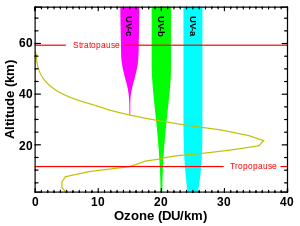
"Air ionisation can cause the following: forming of ozone molecules
Ozone is produced naturally in the stratosphere when highly energetic solar radiation strikes molecules of oxygen (O2), and cause the two oxygen atoms to split apart in a process called photolysis. If a freed atom collides with another O2, it joins up, forming ozone(O3). Most of the ozone in the stratosphere is formed over the equatorial belt, where the level of solar radiation is greatest. The circulation in the atmosphere then transports it towards the pole . So, the amount of stratospheric ozone above a location on the Earth varies naturally with latitude, season, and from day-to-day."
Can we send a bunch of these ion-powered planes to fly on solar power in the stratosphere, more efficiently and rapidly generating ozone than the natural process?
As someone else suggested before this comment was posted, use a balloon for lift?
Maybe combine the whole thing with project loon like internet relays. With a source of thrust like this it would be much easier to keep them where you want them.
At the very least, it seems like there might be some prospect of combining the battery and voltage upticking tech here with the likes of the solar-powered Zephyr [1] which can fly at about 20km, which is apparently about the denser part of the ozone layer [2]
I suppose it would make more sense to pair the battery and voltage conversion tech with a high altitude balloon covered in thin film PV, so there's less competition between 'ozone generation' and the 'lift generation'.
Incidentally this made me wonder if producing more ozone could be used to counter global warming. Unfortunately it looks like the opposite, Ozone is (counter intuitively to me) a greenhouse gas just like the rest of them that warms the earth.
Ah, darn. I was wondering if this might be a new way to have better indoor air circulation with no moving parts. But filling my home with ozone doesn't sound like a good idea.
There were a whole bunch of them maybe 10 years ago. Usually advertised as "ionic air purifiers" or something similar. I found quite a few links / articles from "fanless air purifiers": https://www.google.com/search?q=fanless+air+purifier
The market dried up because they were borderline bullshit, and produced ozone, sometimes far in excess of their claims. They did make air move quietly tho.
Worse yet ion propulsion uses positive ions. Negative ions clean the air and have beneficial effects to humans and plants. Positive ions do the opposite.
From the article:
the front row conducts some 40,000 volts of electricity—166 times the voltage delivered to the average house, and enough energy to strip the electrons off ample nitrogen atoms hanging in the atmosphere.
So doesn't seem like it.
You don't want any holes in the ozone layer because it absorbs UV light, but you also don't want a thick ozone layer anywhere because of its greenhouse properties. It's a balancing act, and mass commercial adoption of this technology would likely mess with that.
It’s not as easy to get ahold of >20kV power supplies these days! Before, you could find them on the street corners and in your neighbors trash. There was always a CRT to
sacrifice.
My lifter, probably like most, eventually caught fire.
Efficiency seems fairly poor [1], and from my experience, ozone is absolutely a problem.
Is there a good resource for learning the design principles/best practices. When I look at the design I’m immediately wondering why the thrusters aren’t longer, but I’m sure others have thought a lot about this and I’d like to read up. Or is most of this still primarily located in scientific journals?
Ideally, for safety reasons, you'd use something like a neon transformer. They supply a very high voltage, but at the same time the output is current-limited, which decreases the chance you'll electrocute yourself.
I've zapped myself on one of those. It contracted my muscles enough to send me across the room and almost knocked me out. I'm happy it wasn't across the chest. And yes, I was doing something incredibly dumb. My teen-age years had some regrettable moments.
Absolutely not. Microwave transformers are much too dangerous.
The flyback transformers from a TV (or neon sign) are fairly low power because they don't need all that much. The goal is high voltage for both. A microwave transformer is meant to pump a thousand of Watts into your high specific heat food and will very easily kill you. They should not be used for any sort of hobby work.
Oh man, I remember that site! Used to be way different, though. I built a lot of those things, though not the lifter.
Back in high school I spent a lot of time on sites like scitoys.com, rimstar.org, Bill Beaty's site, etc. I really miss those days. Now similar content is all on YouTube with clickbaity thumbnails that start with "WHATS UP YOU GUYS".
I subscribed to a couple different channels that did some pretty neat experiments with ion generation, they both just went away, I can only imagine what happened to them.
I don’t think you can move a lot of air silently, the turbulent layer between the flow and the still air produces noise. This is only silent because of size. Maybe less noisy than a fan or prop, but not silent.
I gather this thing ionizes air to create a positively charged "working fluid" which accelerates away from the anode in a cone shaped pattern. The working fluid doesn't generate [much(?)] thrust directly, as it collides with the craft again at the cathode. But along the way some of the ions near the edge of the cone bump into and accelerate neutral air molecules, generating the [bulk of the(?)] thrust that propels the craft.
With a modified design, is it possible to accelerate the ionized air so fast that all of it vents out the exhaust (e.g. using magnets)? Would that result in higher efficiency / higher thrust? Are there already atmosphere-breathing engines that do this and what are they called?
>Are there already atmosphere-breathing engines that do this and what are they called?
Generally this kind of engine is called Magnetohydrodynamic drive. I'm not sure about atmospheric engines, but according to wiki[1] there are prototypes that uses water as working fluid.
Others have pointed this out I think, but this kind of craft concept has been around for a while. Here is a 1964 Popular Mechanics article about the idea...
Mars's atmosphere is probably much too thin - not many atoms to ionise and not much lift to be had. Might work at some altitudes on Venus or a gas giant, though.
Titan. 3 times the atmospheric density of earth. Would be awesome to fly something like this there though i suppose a balloon would probably be much more practical.
Neither is a human powered ultra light weight, huge aircraft like the gossamer albatross. If you have a very weak engine it needs to be made out of incredibly light materials, and even so light it must be flown indoors with zero wind.
They noted that the first successful test was at 50% and effectively a power glide. Further in the video you can see they do achieve a sustained flight that reaches the end of the gym and is more than just a glide.
I would be more inclined to believe it if it didn't fly out of frame before it had even been in the air as long as the "unsustained" flight. I simply can't imagine why they are so careful to obscure their sustained flight from scrutiny. I think it is healthy to have a measure of scepticism.
Yet all the pictures are renderings, artist's impressions.
So, do they have a working model or not? There are no links to any supporting documents; Scientific American used to be better than this, very disappointing.
Could this technology be used to create a wind turbine with no moving parts? I have very little insight into how this would work but it intuitively seems applicable and would probably be way more useful.
Low fueling (charging) costs would be huge if they could scale it up to passenger size. It sounds like they probably can't, but even a hybrid jet/ion plane that use substantially less jet fuel could be a game-changer.
(Also, the fact that it can be outperformed by a sparrow is only relevant if we can build a reliable, efficient artificial sparrow, which AFAIK we absolutely can't.)
This technology is inherently less efficient unfortunately, because the ion velocity is very high. The thrust-to-energy ratio goes to 0 as exhaust velocity increases:
mv/mv^2 ~ 1/v
You could lower ion energy by lowering the voltage, but then the thrust-to-weight is going to be prohibitively low (and at one point you won't be able to ionize air anymore?).
High efficiency flight means either wings or slow moving propellers (and aircraft itself preferably). You'd need to look no further than a glider to fullfil the potential claimed here. Overall flapping wings are probably superior though, since they allow vertical takeoff and high manueverability; but they're much harder to develop and maintain.
SOME moving parts would be nice, like the rudder, ailerons and elevators. Otoh, maybe part of those functionalities could be achieved with differentiating the ion flux.
This would have to be pretty light given the low thrust, so durable isn't the first thing I think of. Or does durable have some special meaning with aircraft?
In theory. It could be made with no moving parts and steered via thrust vectoring by varying the location of the negative voltage. Lightweight high voltage equipment like that is very expensive to make at those reliability levels currently, but the idea of an operational window of a year+ doesn't seem like a pipe dream. We'll probably see applications in military intelligence (spying) and drug smuggling before other more civilian uses.
I'm glad every scifi movie and TV show's sound designers decide to ignore reality and make it interesting. It wouldn't be the same without the whoosh and rumble.
I feel like a space battle that cuts back and forth between tense, Red October-style bridge scenes, and ships exploding in fire and chaos and absolute silence, would be pretty awesome.
That's actually pretty common in modern scifi. Mind you, I can't name one I'm certain of off the top of my head, but a lot of people like to get space explosions "right".
A silent explosion in deep space, a perfect sphere of white light. Cut to the claustrophobic bridge, where the faint whine of fans is interrupted by the sound of the debris field hitting the hull.
My idea is that it's basically a UI enhancement: sound is the best method (at least for humans; but those space operas tend to be quite anthropocentric anyway) to perceive environment in a 3D way. So what we're hearing is not actual sound of explosions and ships; it's actually interpretations of their signals of various scanners, converted to sound and played in cockpit in such a way that the pilot can easily determine type and distance by the perceived location of its sound source. Hope this makes sense. :D
Makes sense. Car audio designers already create sounds in cars to make up for the lack of them. Doors don't make much sound anymore naturally, but they've been designed to keep making sound when they close. And road noise is simulated or piped through the speakers. There's no reason that would stop with terrestrial vehicles.
Is it true that there's no such thing as a perfect vacuum? How much 'stuff' is in vacuum on average to make it impure? Sorry if these are stupid questions.
The first fully self-driving car to market will be from the company that cuts the most corners and compresses schedules the most. I'm sure it will be fine.
Depends on a lot of things. But a big one is the amperage used. There's a parallel frequently used. Voltage is the reach, and amperage is how hard you can hit. This is why a lot of Tesla's demonstrations weren't fatal to people (and being high frequency).
This device, probably not using high amperage anywhere that would really matter. But they are pulling high amps from the batteries, which is then converted to high voltage. So there is a distinct possibility that it could kill someone. But not likely in this small of a form factor.
So peak power is around 600 watts, power supply efficiency is 82%, and voltage is 40.3 KV. So amperage is 0.82*600 watts/40.3 KV=~ 12 milliamps. It's not necessarily fatal[0], but it's not going to be a good day either. In general, hundreds of watts of high voltage DC is not something to take lightly. At the very least, you might accidentally fry any microelectronics on your person! Possibly even near your person(due to the arcing you cause)! High voltage DC has a tendency to make microelectronics nonfunctional.
[0]https://www.realclearscience.com/blog/2015/02/what_electrici...
Voltage doesn't kill, current does. One can easily take 10s of thousands of volt across the the heart if the amperage is low, but a car battery putting out 12 volts and several amps can. Personally, I've taken leads from a 240V, 3KW solar panel array from hand to hand and not felt a thing. Have so same 2 leads touch the same hand, you're going to feel it. For me, felt like a snake bite, minus the venom. Left a few small red mark on my hand that cleared up in a few days.
Mind this is all in reference to DC current. AC is another beast.
Sometimes. Your submission got caught by a software filter. I've restored it, but in the future you should email us at hn@ycombinator.com if issues arise. There are too many comments for us to see most of them.
This is absurd and scientific american sure has taken a fall from grace in order to believe it. Electrostatic "lifters" have been around for half a century. They are toys. They do not scale up. They cannot even lift themselves as their power supply or energy storage has to be on the ground with tiny wires going up to the lifter. There is absolutely no chance this can be called a 'plane'. It always has to be tethered with wire to deliver the power.
They were really popular with the UFO/Free energy crackpot crowds back in the late 90s and early 2000s.
It's not entirely clear from the article, and I can't find the Nature publication yet... but I think you're wrong.
It does carry it's own power supply and battery:
"Finally Barrett used a computer model to get the most out of every design element in the aircraft, from the thruster and electrical system designs to the wires that ran through the plane. “The power converter, the battery, the caps and fuselage—everything was optimized,” Barrett says. “The simulations failed all the time. We had to make hundreds of changes.” In the end, they had the triumphant Version 2."
This is such a typical Hacker News dismissal. The paper isn't even on Nature's website; please give it at least a week or a read before dumping on the author.
And from TFA (sadly, the paper in Nature is referred to, but not properly cited) a main innovation is the development of a system that provides the required 40,000 volts from a battery in a form-factor amenable to small aircraft (think drone) usage.
Does it? As far as I can tell it doesn't exist outside of the person's mind. Having played around with lifters myself using balsa, al foil, and a rectified neon sign transformer I just don't think the physics can work out. And there's no physical plane photos or videos to support otherwise. Until then I'm sticking with this being absurd.
That said, ionization does have it's place in aircraft in terms of controlling attachment or detachment of turbulent airflow over wings. It can significantly improve fuel consumption by reducing drag.
But it is not a viable propulsion source. At least not on Earth for things larger than a meter or so.
Thanks for providing that. It does prove my point though. That plane is not flying at all. It is falling with style. The initial forward momentum is from the launch rail, not from the electrostatic propulsion.
see the top of page 534, figure b. You are correct that the initial forward momentum is from the launch rail, but the graph clearly shows that the ion engine provides thrust.
Is the title of the HN submission misleading? Yes.
Did the plane achieve flight with the ion engine alone? No.
Was the plane able to maintain and gain altitude because of the ion engine? Yes.
A step forward in the right direction but not as much of a breakthrough as the submission title would have you think.
>As far as I can tell it doesn't exist outside of the person's mind.
Based brah. I'm being serious when I say that I think HN needs more of this type of comment. They seem to love rigidity in comments, but not any bluntness or banter thrown in there.
Sucking almost 3A out of the battery, it's not going to fly very long, but that's also a fairly inefficient power converter design. There is lots of room for improvement.
Thanks for providing that. It does prove my point though. That plane is not flying at all. It is falling with style. The initial forward momentum is from the launch rail, not from the electrostatic propulsion.
In that clip it is not slowing down, showing that the ion drive is generating sufficient thrust to sustain flight. It's irrelevant that it used assistance to initially reach that speed.




http://jnaudin.free.fr/lifters/main.htm
So far their best result is 0.886 kW/kg (0.539 hp/lb), comparable to a helicopter, by using a pulsed DC power supply at 70 Hz:
http://jnaudin.free.fr/html/lftphv.htm
So a helicopter with that could lift 1.13 kg/kW (1.86 lb/hp).
A plane with a 10:1 lift to drag ratio would fly with 0.0886 kW/Kg (0.0539 hp/lb). It could lift 11.3 kg/kW (18.6 lb/hp).
A 200 kg (440 lb) helicopter, including human passenger, would take 177 kW (237 hp).
The same mass airplane would take 17.7 kW (23.7 hp).
Of course the pulsing would add a buzz which may not be desirable. It looks like the pulsed DC uses 17.72 RMS W vs 69.58 DC W, so is about 3.927 times more efficient than DC. Maybe a plane could have both silent and high efficiency modes for takeoff and cruising.
I have no idea how these numbers compare to the ones in the article, but they should be within the same magnitude. Please someone double check my math :-)