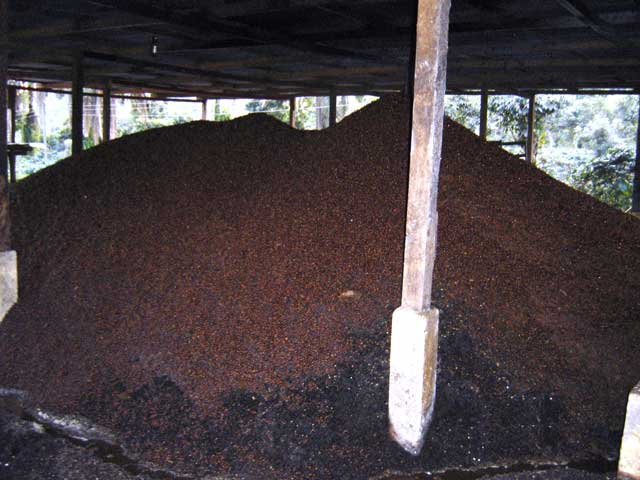
Just because it's a momentary trend now doesn't mean it's going to stop being a trend. If it proves successful, the farms using it for fertilizer will jump into the market to try to capitalize, which will bring the price down, but still bring in more income than just the coffee beans (and certainly more than feed)
My point is that it's not economically feasible at scale. There are mountains and mountains[0][1][2] of organic coffee pulp, the price would plummet once more farms produce it. The pulp isn't waste either, it's 100% reused as fertilizer.
Where's the infeasibility exactly? Currently it's used as fertilizer. As long as they can sell it for higher than the price of new fertilizer, they will be making profit. So really the question is, how much are people willing to pay for it, or how can companies convince people they need to pay more for it?
Arabica coffee is currently 2.962 USD per kilogram, and we pay double that for a cup of coffee using about 8 grams. We're paying 125x more for a cuppa than the cost of the beans. So it's certainly possible someone could come up with a way to make some small profit off the pulp. (Incidentally, tea is 0.0288 USD/kg, but obviously it weighs a lot less and we drink a lot less of it)
What kind of brew uses 8 grams? That’s a seriously weak or very small coffee. 20ish is a lot more civilised.
That price per kg is also not very reflective of what you pay for ok-good coffee if you are buying green beans from an importer. The current batch I have is sold to me from the importer who buys direct from the farmer.
It depends on what he's talking about. A standard single shot of espresso is about 7g[0] for 30 mL. A double espresso takes 14g to 18g of coffee[1] for 60 mL. A latte or cappuccino is just an espresso with some form of milk. A caffe Americano is an espresso in hot water. Traditionally brewed coffee should be 10g per 125 mL of water before brewing[2] which should be 20g to 30g for a basic mug, but 8g can be perfectly reasonable for many types of "civilized" coffee.
Yeah, I make Americano out of an Aeropress. Because I constantly try different beans and grind sizes, one ratio of coffee-to-water just doesn't work, so I make the shot of coffee and add water to taste. I don't need more than a cup because I drink slowly, and if I really want more I'll make another one. Wastes less, tastes fresher, and it's more adjustable in general.
Who's your importer? I've worked with a couple people to try to set up a direct from farmer import in the United States, and it's difficult for quantities less than a shipping container.
I found them by chatting to a local coffee roaster and getting the name off them.
It’s often written on the coffee sacks too.
I know it’s a different country but if you wanted advice, a friendly email to them might serve you well. They are a great company.
They sell by the kg to me and have often chatted about how they work. Road trips around various countries with a grinder and espresso machine - sounds fun.
As someone trying to drink more tea I find the retail price for Lipton loose tea is about $21 USD per kilogram and other brands are considerably more expensive.
>As someone trying to drink more tea I find the retail price for Lipton loose tea is about $21 USD per kilogram and other brands are considerably more expensive.
I advice against Lipton: it's overpriced because it's a familiar brand even to people who aren't tea enthusiasts. I'd recommend going to tea stores where loose leaf tea is sold by the pound.
For packaged black tea, I can highly recommend the following two: at about $9/pound, they are an excellent bang for the buck for high quality loose leaf OPA (many grades[3] above Lipton teabags):
-Ahmad OPA [1]
-Zarrin OPA [2]
As a note, $21/kilo really not that much once you convert it to cups of tea. With green teas especially, since one can brew them several times. So the Lipton you're talking about isn't expensive per se, just for the grade you get (dust in teabags, FBOP loose).
Any advice on how to chose loose leaves tea, especially green tea? I'm scared to be taken advantage of going to one of those fancy tea shop; they seem tailored for people who prefer pretty over quality, when I just want basic green tea, not laced with cadmium, and not 20% twigs and dust.
Brands maybe irrelevant, as I'm not in North America.
Tea gets complicated quickly. Unfortunately, there is no such thing as a basic green tea. There is basic crappy bagged dust green tea, but you're saying you don't want to buy that. Start here: https://www.artoftea.com/what-is-tea/what-is-green-tea Then google around for some guides of online sellers, such as this one https://www.seriouseats.com/2015/02/best-tea-where-to-buy.ht... Though to be perfecly honest you can get respectable green tea from the fancy tea shops, or even Wegman's. You can also find decent loose leaf teas in Asian grocery stores, but good luck reading the labels.
The bigger, the better and usually higher quality. You will see that after the leaves open, under hot water. Oolng teas usually have the biggest leaves - they are normally rolled into balls and also quite expensive. If you want something cheaper (under 5 euros/100 g) but still very good, try Gunpowder (also rolled) or Chun Mee. These have a strong taste characteristic to pan oxidized Chinese tea. If you don't like the strong taste, then you're either infusing it too much (infuse for two minutes or less) or should try some of the Yunnan varieties, specifically Mao Feng.
If you don't like pan oxidized Chinese tea at all, try Formosa (Taiwan), Korean or Japanese steam oxidized tea: Sencha, Bancha. Speaking of twigs, there's also a variety of Japanese twig tea which actually tastes very good - it's called Kukicha. Theese tend to have a milder taste.
I can second the idea of trying to get kukicha for a milder taste. I tried it a while ago and have been buying it since then because I rather enjoyed it.
FYI, Ahmad and Zarrin aren't American brands (I get them in Middle-Eastern stores here).
Don't be scared going into a tea shop: the point of going there is to try teas before you buy them. A proper tea shop will let you sample the teas.
Start tasting from the cheapest ones, find the kind you like, and then try the more expensive versions of that kind until you no longer can taste the difference.
With loose leaf tea, just brew it to instructions (again, tea shops will provide timing/temperature for multiple infusions) - and you can see and taste the quality with your eyes. I've never experienced anything remotely close to "20% twigs and dust" even in store-bought cheapest loose leaf teas - anything that's not in teabags usually unwraps beautifully.
Of course, get a ceramic teapot if you don't already own one. For temperature control, if you don't want to get a kettle with a thermostat, add a splash of cold water to the kettle before brewing green teas: if the water is colder than necessary, green tea will take longer to brew, but usually will turn out OK, but overly hot water can make it taste badly/bitterly (black teas are brewed with boiling water).
If you know people from China or Taiwan, ask them! Not everyone there is a tea aficionado, but those who are will be a great source of information (..and possibly samples, especially if they get to travel there regularly). And in any case, best way to find out about tea is having tea with someone who knows a bit about it.
To my taste, one can rarely go wrong with a Taiwanese tea (the ones that make it to the US at least). High-mountain oolongs are my favorite kind of tea currently, but it's just one kind.
But the only way to get into tea - just like into anything - is try, try, try. If you need ratings/reviews, there is RateTea[1] - you can go to any Asian store, grab a can, and see if you can find the description (although that website can be a bit snobby at times).
I second the advice others have given (go to any Asian store, grab any middle-priced package). I've found some great tea that way (and if it doesn't taste good - try another one!). Also, I had good luck with using Google Translate / OCR apps to decipher the labels.
Well, there is no "basic green tea", there are many different variants which are all quite different. Start by comparing a solid Chinese tea (eg. longjing) with a Japanese one (eg. sencha), brew them exactly as instructed (Japanese tea in particular turns bitter and soupy if you let it steep too long), see which one you like more and go from there. And instead of fancy tea stores, go to an Asian grocery and pick up any random mid-priced package.
If you're trying to drink more tea, I might recommend at least getting Twinings or something. Lipton tea is one of those things I wouldn't really ever choose for myself.
I’ve found a great secret - go to a distributor that also sells retail. Cafe Moto in San Diego sells pretty good tea in bags by the pound for about $13-20 for most of them, with some premium stuff much higher.
It’s actually comical/criminal how expensive tea by the teabag is vs loose leaf.
There’s also some tea by the pound on Amazon, although not as great quality IMHO.
It is a rather drastically simplified picture to talk about "tea" as one big undifferentiated product rather than an entire class of goods with wildly varying qualities and prices (then again I suppose that's also true of coffee to some extent, but I know less about it).
If stated that way, it true of any nonzero income from these husks, for which it is still feasible to ship them.
What's questionable is whether it will continue to be valued above the bean.
It's certainly not more rare than the bean: each bean produces a husk.
It's artificially rare because the supply chain hasn't fully fired up.
Basically the situation is an impulse response blip at the boundary condition: sudden appearance of a demand without a supply mechanism.
It doesn't seem like it would take much for the coffee producers to save the husks, bag them, and ship them off the same way as beans. Once everyone is doing that, it's unlikely to remain valued above the bean.
Since fertilizer is necesasry, this stuff has to be worth more than whatever fertilizer has to be used to replace it. If not, then it is the fertilizer.