> Christopher is an inmate in a high-security federal prison not far from Atlanta. He’s been in trouble with the law since he was 14. He didn’t finish high school, had an addiction to hard drugs, and at age 21, his involvement in a string of armed robberies landed him in prison with a 32-year sentence.
> Right now, you’ve probably formed a mental image of who Christopher is, and you might be wondering why I’m opening my speech with his story. When you think about who does mathematics–both who is capable of doing mathematics and who wants to do mathematics–would you think of Christopher?
Francis Su's retiring address as the President of the Mathematical Association of America is one of the most powerful things I've ever seen.
I am all for knowledge for knowledge's sake, and these guys are doing an amazing job not only teaching these convicts about important, perhaps even life-changing, math concepts, and by donating their ever-shrinking and increasingly valuable time, something that is in very limited supply in todays age.
But, as I am currently finding out in my life, the odds are very slim to none that life post-prison is going to change for these convicts as they try to rejoin society, as the job markets will be almost totally closed off to them as they seem to be for me.
Even with all this "enlightened" rhetoric here on HN about second-chances and "understanding the struggle", not one person here has contacted me about remote work even though I have make it very clear how desperate my situation is [0]. Please don't misunderstand...I don't really expect anyone to have much sympathy for my situation, but I know plenty of people here are currently looking for IT workers and my posting clearly show I am capable of doing high-quality LAMP work, so I think it's at least notable to discuss my experience.
It's all well and good to provide education and such to people in seek it, and its a great feel-good-story with wonderful social signaling for all you comfortable techies, but the reality is that food and shelter costs real money, and all the education in the world isn't going to help these ex-cons find work, build self-esteem and rejoin society if the common prejudices continue to work against them at every turn.
Although, I cannot comment personally on what employment chances are after serving in prison, I can state with confidence that having a single, felony drug conviction [0] doesn't automatically result in a denial of employment all of the time.
The largest, single reason which I could see as an automatic rejection for chances of employment is the prior criminal history [1]. It's much easier to explain (and look past) a single offense, versus multiple offenses - especially if they're all in the same vein.
My most recent major job search a few years ago (Texas and Florida, ~8 years post-conviction) was basically 50/50, in terms of offers of employment after criminal history was disclosed. The irony is that the majority of potential employers who asked for details were the ones that sent the job offers.
I know that no two situations are exactly the same (I'll provide details if you want them), but hopefully this is proof that there is light at the end of the tunnel.
I teach at a prison on occasion, and our program results in a dramatically lower recividism rate. Could come from a number of variables but take that evidence as you will.
They probably don't have a 30 year history as a software developer/engineer either do they?
And a exceptional work history that include IBM Advanced Technology, AT&T, and TransUnion along with more current cutting edge gigs using systems like Fastlane, Jenkins, and React as a very successful remote IC?
Yes what I've learned is that most HNers just like to virtue-signal their support and aren't really interested in actually involving themselves...but a serious and heartfelt THANK YOU for the ones that do.
Blackthorn, it's fantastic you are involved in a active and successful program that is helping people coming out of prison find a job and stay out...that's God's work for sure.
But in my experience many are almost surely being exploited by employers whom are using their desperation against starving and living in the streets, violating parole and going back to prison, and going back to a life of crime against them to offer them a employment at below market-rate jobs.
Many if not most of these jobs are actually designed for the ex-con to fail at and to be easily replaceable with the next crop of paroles and new releases as the revolving door spins in-and-out. Halfway houses seems to be the worse offenders here as they often take a large portion of the ex-cons take home pay in the name of "protecting" them against themselves but its often just a raw money grab.
Very few of these jobs pay anything close to a decent living wage that will allow the newly released convict a good chance at rejoining society in a meaningful way anyway.
It's so easy for even a very empathetic person who wants to help to take a hard look at these problems and eventually decide "well damn...there is no solution here so let's just go back to the old attitude that is their fault for breaking <insert random bullshit non-violent offense here> so they deserve to be social outcasts, shit on forever living on the margins of society with very little hope of redemption."
You guys just don't know how much I hate knowing all this shit...I truly don't believe I am the person that my background suggests I am to most employers but as always, the very few ruin it for the most.
As I recall, Neil Stephenson commissioned Bruce Schneier to come up with a reasonably secure cryptosystem that could be computed using a deck of cards, so that a character in Cryptonomicon could do something similar while imprisoned.
Reminds me of high school dropout buddies who couldn't math at all, yet would compute weed ratios, prices in fake currencies on the fly while bantering. Irony.
Speaking as someone with a graduate-level education in mathematics, I definitely can't make change as quickly as an experienced cashier, and I'm sure a drug dealer would be able to judge the profit or loss expected from a series of transactions more quickly than I would. Some respect for those skills is warranted, I think, even if they just boil down to being fast at arithmetic.
parent is right, its not really impressive, but these guys didn't know the maths they were doing, they didn't even learn or try, it was just natural to devise rules, ratios, conversion because they just wanted it was inspired by a strong desire. I'm sure some dealers have nice economic skills.
The fallacy is in equating criminal activity with stupidity. This fallacy might stem from assuming that the risk was immeasurable and the profit therefore potentially negligible (bayesian inference).
Arithmetically inclined individuals being advantaged as sellers leads to survivorship bias. It's not actually surprising that a salesman can do that. It's surprising that drug sales can score huge gains and that some people see hardly any alternative to make a living even if small time dealers hardly make a profit because of oversupply in competition, much less if they are addicted.
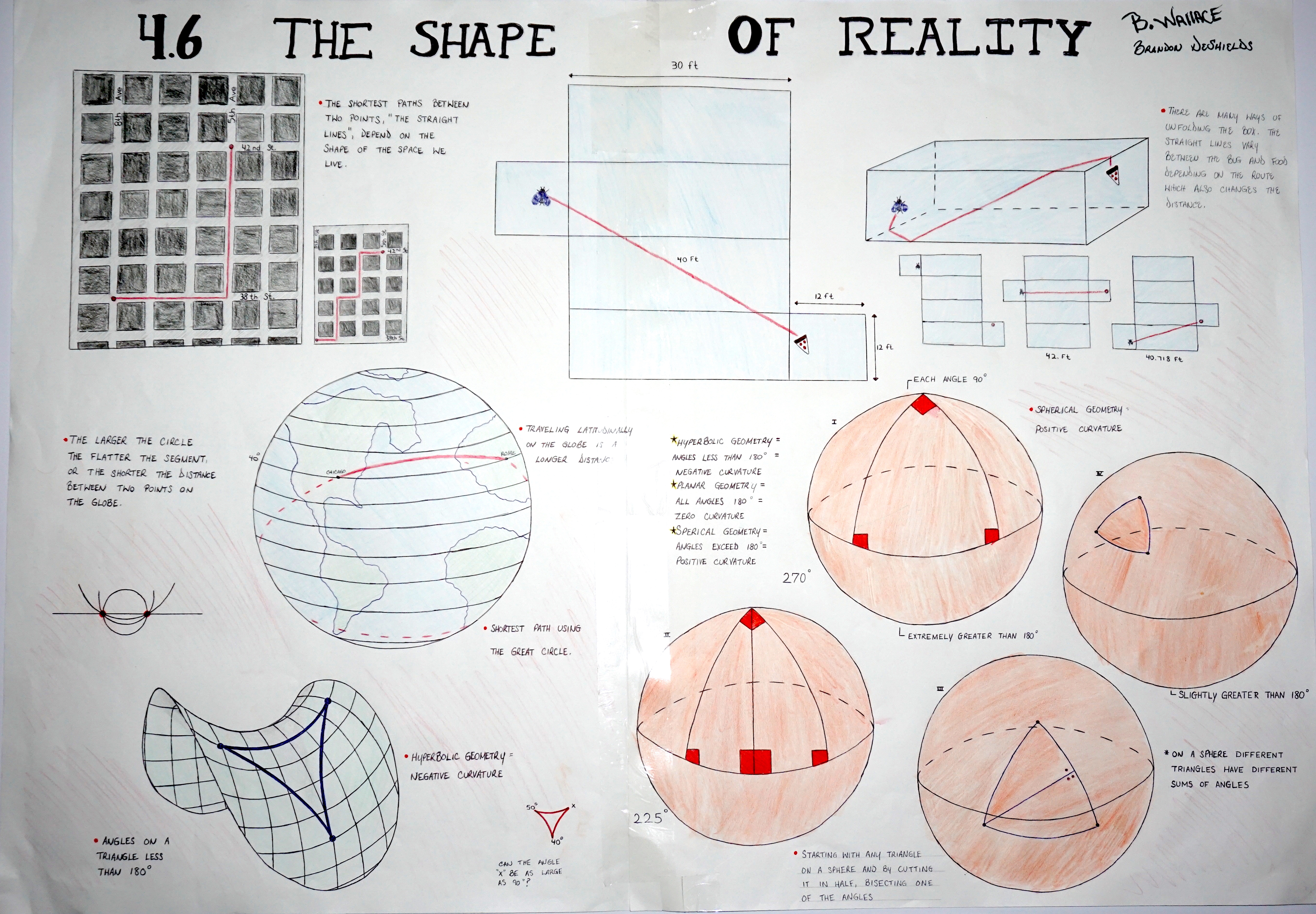
This poster presentation of non-Euclidean geometry is really one of the best demonstrations that I've ever seen of these ideas. The precision and clarity of the hand drawn figures is lovely.
oh I read too much in your comment. I thought you meant it isn't a good idea to allow inmates to access advanced knowledge, lest they make - being irreducibly criminal mind - criminal use of it. Well, that's to morning caffeine abstinence syndrome.
Your reply is filled with emotion and while prison time is an emotional matter, laws and rules must be based upon logic to be effective and good for society.
Crimimals serving prison time have violated the laws of society. They have a responsibility for this and they will indeed be marked for life, and rightly so. That doesn't mean that they should be restricted from any job, but it makes sense to limit their career options. You don't want a pedo in day care, a bank robber in banking, or a wife beater as a carpenter.
As for teaching inmates about mathematics, this is probably a good idea. Many inmates suffer from low education, which makes it hard for them to understand today's society. Mathematics is fine, but it will only be useful to a percent of the inmates. Most of them have other, more basic educational needs.
But hey, who doesn't need a clappy-happy sunshine story about a convicted felon every now and then? You could be next, you never know when they are gonna come for you, bad boy.
I think the fundamental problem you have here is that you're assuming you're on the unemotional side of the argument. Actually, you're proposing the anti-science, knee-jerk cruelty of the American system, which is as far from a rational prison system as a first world country gets.
Ultimately, everything needs to be judged on results. There are definitely groups that benefit from the US prison system, but the public at large and taxpayers are not among them.
> I think the fundamental problem you have here is that you're assuming you're on the unemotional side of the argument.
You had me . . .
> Actually, you're proposing the anti-science, knee-jerk cruelty of the American system, which is as far from a rational prison system as a first world country gets.
And then you lost me. You pack a lot of shallow, sloppy thinking into that second sentence.
I'd recommend to watch this talk about the German prison system from an American perspective. The main point is the difference between European resocialization and US retributive justice. Although this may show the bright sides here in Germany a little bit too bright, they do exist.
> laws and rules must be based upon logic to be effective and good for society
Yeah, but let's not forget that "civilized society" is a necessary evil - we accept it simply because we know no better way to minimize suffering, on average. For any one particular individual, the laws of the particular society (s)he happens to be living in are probably far from the laws that would be best for him/her in particular... Some individuals would flourish better in societies where stealing is accepted. Other in ones where murder is accepted, etc.
There's nothing absolutely better about out set of rules and moral values made of o concepts like "don't kill", "don't rape", "don't steal" etc. They are just a good local average maximum... Maybe the actual global maximum of human flourishing would be achieved in a society where rape and murder are allowed in a certain circumstances. I'd personally bet it is, though the definition of that set of circumstances is probably too complex to allow optimal practical implementation of such policies.
I mostly like our current set of rules, but let's not delude ourselves into seeing them as anything other than a local average optimization! The "criminals" are just the unlucky fellas whose traits don't correspond well with flourishing while playing by the rules in our little play pen we call civilized society. Nothing more.
A sadistic murdering rapist can at the same time be a great mathematician, and, judged by the global maximum of the universe, may have a much greater positive contribution to the betterment of the human race through his mathematical discoveries and their consequences (than the relatively minor negative contribution done by taking some of his unlucky victims out of the population a few decades sooner than their natural death) and judged by this one could say he could be a better human being than you in total, even if he/she may have directly killed 20 people, and you may have killed 0.
And be honest with yourself if you think the society we live in is anything but a necessary evil: you know you've felt the desire to murder, or torture, or rape, one time or another, just as any other human being, and that you've been hurt by society because it didn't let you exercise the freedom to do these things. (Yeah, you've been hurt less than the victims of such actions would've been hurt, hence the optimal average given by the current set of rules. But maybe it's not the optimal average for you as and individual.)
(And to put thing in better context: the character that started the talk, Christopher, was far from a sadistic murdering rapist, he was convicted for armed robbery... basically "stealing some crap while holding a gun in your hand to look more terrifying, or for self-defense against the shopkeeper who might have a gun himself and shoot you instead"... something with less negative moral value than most actions of most heads of state I'd guess, and far from "a true monster")
Man people could have probably agreed with what you wrote until "And be honest with yourself if you think the society we live in is anything but a necessary evil: you know you've felt the desire to murder, or torture, or rape, one time or another, just as any other human being, and that you've been hurt by society because it didn't let you exercise the freedom to do these things."
I agree with this "I mostly like our current set of rules, but let's not delude ourselves into seeing them as anything other than a local average optimization!".
> Man people could have probably agreed with what you wrote until "And be honest with yourself
...yeah, that's the bigger problem imho, most people are far from honest with themselves :) And then some people, instead of doing some "harmless rape & murder" bending "slightly" some rules of society to let off some steam (like medieval warlords did, chopping some heads off doing a big party "for the lulz", and moving on, maybe even building some churches later to "atone their sins"), choose instead to be "civilized", and go sign some orders to deport millions to concentration camps, or order the stockpiling of nuclear weapons, or some other shit "civilized" people do.
I think you have your local and global optima reversed. I might feel better in the short-term if I'm allowed to murder someone. Longer-term it's likely to be worse for me.
Generally you don't refer to the time dimension when talking about local/global optima, you're talking about "points in the space of possible parameters" or here "particular combinations of laws/rules from all the ones possible".
Probably not obvious for folks not into machine-learning (or other compsci areas with similar terminology), I know... not the best cross-disciplinary metaphor :)
What you refer to I would call "current/local reward" vs "total (lifetime) reward", or "punishment" if you take the negative.
And, by "local optima" I mean that "any small tweak/modification to the current set of laws" would result in worse systems, even if there probably are combinations of laws/rules that would make a better society further away in the space of possibilities. To get from current state to a higher local optima (or to an imaginary global one), would involve going through much worse intermediary states - things like near destruction of civilization or other stuff nobody would want to live through...
I get all of that but it seems a distinction without a difference. We are all on this planet together, so whether or not I'm brilliant and get to kill or rape a little bit (or not) in exchange for my brilliance seems beside the point.
Maximizing human well-being seems axiomatic to our project here; not a 'playpen'.


> Right now, you’ve probably formed a mental image of who Christopher is, and you might be wondering why I’m opening my speech with his story. When you think about who does mathematics–both who is capable of doing mathematics and who wants to do mathematics–would you think of Christopher?
Francis Su's retiring address as the President of the Mathematical Association of America is one of the most powerful things I've ever seen.
https://www.youtube.com/watch?v=xEtDvc1SWm8
There's a transcript on his blog, too:
https://mathyawp.wordpress.com/2017/01/08/mathematics-for-hu...