When is Europe going to finally recognize it has agency? Blaming the US for waves vaguely things while being mostly stagnant for decades isn't a good look, especially when you've been either an active participant or wholly complicit in those things.
If you like arresting your political adversaries I'd recommending moving to a country like Belarus. I hear they also like disappearing journalists who expose truth regardless of the political inconvenience.
ends-justifying-the-means thinking leads to very ugly things.
Korea ended in a draw b/c the soviet union was entering the conflict in support of mostly defeated NK/PRC forces and the fear was it could escalate into a nuclear war.
Vietnam is more interesting but I think it's very unlikely that a conflict with the PLA today would unfold in the same way.
Figuring out what type of conflict would force China into a nuclear exchange is probably the only question worth asking. would liberating Tibet and Xinjiang do that? Probably, but it also could be the case that Beijing wouldn't risk being vaporized themselves for a people and place they deem so inferior.
Fighting an adversary like the PLA in occupied areas like Tibet, Xinjiang, HK and maybe Taiwan someday plays to the strengths of the US armed forces. It would be an embarrassing disaster for the PRC that would very likely lead to a collapse of the party and force them into some type of hermit kingdom, like NK.
The US has been in near constant war for almost 100 years, having big parades with uniforms doesn't make up for that.
A thing of note - this "near constant war" has always been fought against weaker nations, which the US military industrial complex has been able to outproduce utterly.
China is a completely different kind of adversary and has historically proved that it can match the US - again I refer you to the Korean war, where China was able to check and drive back the US forces.
I've also noticed a large influx of new accounts posting low quality, politically charged comments in the past few months. You can find plenty of those in this thread.
I think its pretty likely that we're headed for an extinction type event for upvote based "anonymous" message boards like HN, reddit ... or at least a significant decline in their usefulness
What's a good alternative architecture that promotes quality content/comments and prevents regression short of manual compilation, moderation and curation?
Edit: Jotting down some ideas:
1) Occlude/Delude/Fog-up the votes for newly created accounts. Mature accounts get to see gray posts.
2) Consesus amongst mature accounts has higher weight over newly created accounts.
3) Penalty for being flagged is higher for mature accounts as with power comes responsibility of good behavior.
4) Karma should have more meaning that just a tally of points. Upvoting costs Karma (-1 from balance). So, people are more careful and have to strongly agree to upvote. Probably some caveats and downsides here.
5) Buffer out the oscillations of upvotes/downvotes. Sort of like a mass-spring-damper system.
6) Hire moderators that are vetted and publicly funded by HN members.
7) Verified accounts with work email or some other means. These accounts would have the highest weight in anything they do.
I think you essentially need something pseudonymous and reputation based. Something where getting banned has a reasonably high cost in terms of re-acquiring reputation required to post.
Slashdot only gave out a small number of moderator points per day (5 IIRC). Also you could not moderate and post on the same topic, which means you cannot downvote opposing views so easily.
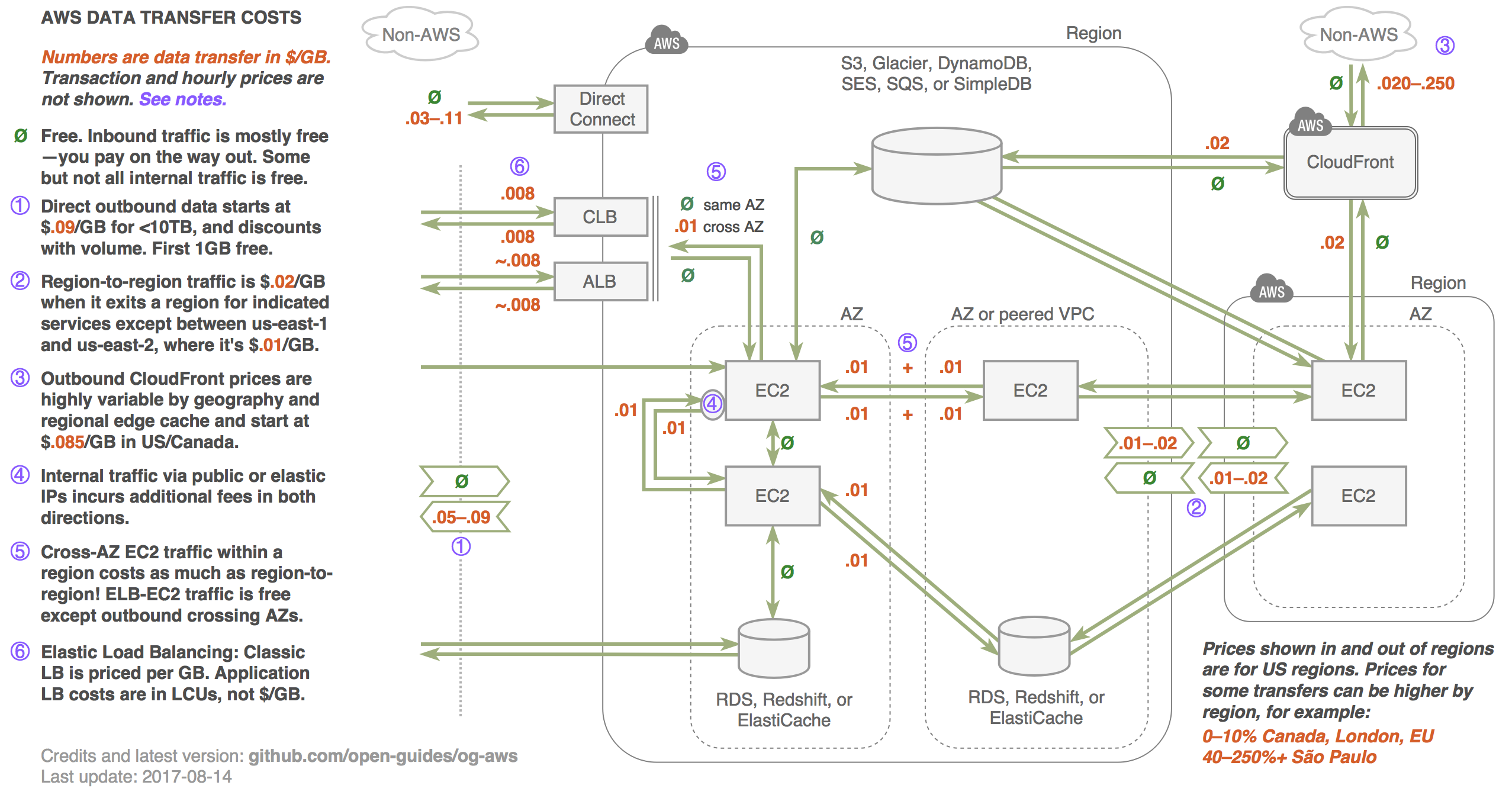
Customers are also to blame, when comparing the costs of two services they tend to look at the cost of an instance hour, or lambda execution and often don't look at transfer costs.
Even if a cloud provider had competitive transfer costs they likely wouldn't attract any new customers and would have less margin left over to subsidize the main cost customers look at, $ per instance hour.
The less attention is paid to transfer costs the better for AWS/GCP/Azure. Why hasn't a spot-market for transfer been introduced? Same reason why I can't sell my unused home internet bandwidth to my neighbors, the money is in controlling the means of transportation/communication and the providers want to keep as tight a control on that as possible.
This seems a little deliberately obtuse -- for example, showing two arrows from an EC2 instance to an EC2 instance that exits the VPC. But I generally don't find this too hard to follow? Traffic within an AZ is generally free, but there are some cases where it's not and they generally make sense to me (leaving the VPC, pushing data from your CDN back upstream, etc.)
Then again, I worked for AWS for years, so maybe I'm just used to thinking this way so I'm not really surprised by it.
There was a time when you paid for available bandwidth. Then network operators realized they could oversell their capacity and not spend the money to upgrade their network.
You still see paying for bandwidth with residential connections, though some operators (like Comcast) are trying to do away with it.
Disagree. It's much more wasteful to have an outage. Roll back asap, fix the issue, roll forward, do post mortem, grow as an organization. Never repeat the same mistake.
What I'm saying is that for a hosting architecture to make it difficult to predict the cost of any code change is a downside compared to an architecture that makes such predictions easy and intuitive.
Of course you will try to mitigate any downsides and learn what you can from any mistakes. But unpredictability makes learning far more difficult than it should, which inevitably means a waste of development resources.
I don't think this is true. At $JOB the extent of our cloud cost management is me reading a breakdown by SKU and looking for obvious inefficiencies, and we are very aware of transit fees. I would imagine that anyone in the 5MM+ range has actual models that account for this stuff.
I think this has more to do with collusion than consumer behavior. On average consumers are very rational, even if their rationality is hard to explain.
The issue with per-bit pricing is that a fair agreement for network use would probably look like paying a fee that makes up for the amortization of the network equipment. Anything else is an artificially restricted market created in an attempt to extract more value out of consumers by having them bid against each other.
At some point, yes, we will run out of places to put the switches and routers and then the cost of connectivity will be closer to the cost of land use and will mimic rent, but we are a ways away from that.
Why do you think that bandwidth costs should only cover the hardware? What about the electricity, rent, payroll, sales, marketing, administrative staff, insurance, accountants, lawyers, etc.
> arguing that disclosing the records would violate laws that prohibit the transfer of data potentially containing state secrets to foreign entities.
If there is fraud its likely state sponsored fraud, I have a hard time imagining another reason to explain this type of position; open to hearing other ideas. Honestly it's quite brilliant, instead of selling bonds just list another company in the west and skim money off the capital raised there.
Well there are satellite photos, construction workers can be questioned about their wage, material prices are semi-public (you don't know exactly what was negotiated in each contract but there is something of a market)... Too bad there is no public institution that estimates these things as far as I know. Although I bet most hedge funds along with the CIA have worked it out.


That the CCP attitude towards privacy, civil liberties and the legal rights of its citizens gets exported to the rest of the world.