I have an account with no friends and that is an admin of one page, which I buy ads for. It’s not my real name, but obviously has my real CC info in there.
Interestingly, a friend showed me his contact list entry for me (I believe created through a 3rd party OSX app), and in the Facebook field it had the name used on the admin/ads account I have. Given I don’t use my real email address on the Facebook account I am amazed (but not particularly surprised) that the connection was made.
This movement is the output of a combined R&D lab for LVMH watch brands (Tag, Zenith, Hublot, Bulgari). So the movement will likely to be rolled out to watches by all of those brands.
It doesn’t clearly show the mainspring, however at around 10:45 you can see the small gear spinning. That is being driven by the mainspring, and if you removed the escapement it would spin super quick until the mainspring was unwound.
It’s the constant rocking back and forth of the regulator that limits the speed that small gear (called the escape wheel) can rotate, therefore limiting how quickly the mainspring releases it’s energy.
Much as I like Eno (this project is more Eno-lite than Eno-like imho) the story of generative music goes back some way before his time. To explore, start here:
So many publishers still have such a long way to go in working out how to do native content well.
While the study is interesting, I reckon that piece took Matt Yglesias (an otherwise great writer) all of about 10 minutes to write. And the token "make sure to save enough, own stocks for the long term, and stick to passive strategies rather than trying to beat the market." is just awkward.
This is only one of many things that Volvo does to improve the safety of passengers and those outside of their vehicles. I have a 2010 Volvo that has a feature called City Safety [1], an automatic braking system that prevents low speed collisions in city environments, and BLIS which indicates the presence of a person or vehicle in your blind spot. They also have a new cyclist detection system that engages the brakes [3]. I think if drivers can be more aware of others, pedestrians and cyclists, in combination with smarter vehicles that assist drivers in accident avoidance, it's a win-win.
Second this. A Volvo engineer invented the modern 3-point seat belt, then made the new seat belt design patent open in the interest of safety. as well as countless other innovations
Pushing the responsibility from cyclists onto drivers is bad here because the responsibility not to maim and kill people with these one-ton death machines should mostly be the driver's.
After the cyclist has taken appropriate measures (riding correctly; correct lights and reflectors) there's not much more they can do to protect themselves. If they're not riding correctly that's the problem you should be trying to fix - an idiot on a bike is still at great risk of death, even if they're ultra-reflective.
You're assuming that this reflective spray increases safety. You're then telling people who don't buy and use this product that they're stupid. And you're not saying anything about the dangerous vehicle drivers who cause most road deaths.
The Euro NCAP safety rating was heavily updated a few years ago (2007-ish) to improve pedestrian and cyclist safety. That's why most new cars that come out have those ridiculously tall and flat noses.
Indeed. I try to be as courteous as possible toward cyclists and bikers but during the day they can be damn near impossible to notice. Making them more visible means that there would be one less accident with someone who does try to take notice of them.
How did you conclude that I speed? Do comments like that cause you to be less of a presumptuous dick?
Maybe, just maybe, humans are not biologically equipped to be moving at the speeds that we do on the roads as well as the complexity of situations faced on the road. Both you, me and the bikers. Supplementing those biological shortcomings, in any way possible, is a clear win for those who care (possibly not for people who don't and would rather just pointlessly argue by positing that people speed without never having seen them actually drive).
Maybe, just maybe, that is why robots have been shown to be better drivers and maybe until we get to the point of entirely replacing human drivers we could have less accidents as a result of supplementing our inadequacies. Despite whatever presumptuous and pointless argument people like you make in order to try make me a villain simply by virtue of me choosing to be behind a wheel and not handlebars.
Arguments like yours really make we wonder if there actually are brains in this community. That level of discussion is something I would expect from an ignorant child.
Let's assume that your juvenile outburst was, indeed, true. What have you then added to the discussion? Nothing. More visible cyclists are still more visible to the type of lunatic that I am. This means that I would more likely avoid them. Saving lives.
If all you care about is finding out who to blame, go right ahead. The rest of the intelligent world will carry on trying to find solutions.
I think it probably is in good faith, but it’s still pushing responsibility onto other road users for driver error: implicitly the logic runs something like “I didn’t see them, but they weren’t wearing reflective spray so it’s their fault I hit them.” It’s a pernicious line of thinking that if you’re a regular cyclist you realise is everywhere in the discussion of road safety issues.
You see the same thing with helmets, which are designed to reduce (not eliminate) the impact of a cyclist falling from a standing (or riding) position to the ground, ie a 12mph impact, to the point where brain damage is less likely to occur. Thanks to the v² scaling of energy that has to be dissipated, even a 20mph impact exceeds the design limits of a cycle helmet to absorb impact energy by nearly a factor of 3 which means that helmets make little difference in direct collisions with vehicles travelling at normal traffic speeds. Yet I’ve seen cyclists called out for “not wearing a helmet” when they’ve been run over by a cement truck. Cyclists tend to be a tad hyper-sensitive to victim blaming as a result of this kind of thing!
Where there's multiple crashes in the same place it often is the road design that's at fault, not the drivers of the cars.
One vaguely relevant example is that roundabouts are safer than 4-way crossings for cars, though I think the evidence is a bit more mixed for cyclists.
Well, knowing that roundabouts are safer, if the manufacturer of 4 way stop-lights suggested that cars should be painted brighter colors to prevent crashes, I'd consider that in about as poor taste, and as likely to have a positive impact, as volvo trying to repaint bicycles as a PR pitch.
My initial reaction was dismay that Google seemingly didn't consult any decent auto designers on this. But then I wonder if that's actually fine.
My kids will likely be baffled by the idea that we attached so much of our own identity to our cars. The financial investment in cars to make a statement about ourselves (over and above getting us from A to B) is immensely irrational.
With self driving cars ownership will likely disappear, and be replaced with time sharing. At that point the connection between our view of ourselves, and the car we ride in disappears.
I'm not sure that completely excuses the lack of modern car aesthetic here, but it could go some way to explaining it.
Forget your kids... I'm baffled. I'm baffled that people are willing to squander so much money on cars, especially people who have relatively little of it. If you think about it I'm sure you pay tens of thousands of dollars on a thing that moves you around but ultimately, sits around way more than not.
I am somewhat anxious to see how this plays out financially and economically otherwise. Will these cars cost the same as a car that every person now buys for themselves with maybe a little higher cost of maintenance and operation (M&O)? Will there essentially be one manufacturer because one vehicle can support 10 people and we don't need millions of these things pumped out? And will the collapse of competition mean that there will be a monopoly (dare I say it, Über) that over-charges all of humanity after they have essentially captured the market in the exact way that an evil empire like Über would?
An even bigger question I have, will this kind of development essentially mean the doom for anonymous movements? We can all imagine that there will essentially be no way that you will be able to ride in one of these without identifying yourself and at some point manual vehicles will be banned; very likely in most of our lifetimes. At which point you, the guy who rides his bike or walks will be highly suspect if you are even able to at all, since you must be hiding something since you don't want to use the government tracker transporter.
All possessions are fundamentally irrational. I'm baffled why people would collect vinyl, buy overpriced designer clothing, pay for expensive tickets to sport, buy expensive kitchen implements - and on and on and on.
I like cars. I like driving. There are some cars I'd be happy to own, even if they didn't go. I spend money on buying, maintaining and driving cars because it's something I like doing.
This is no more or less irrational than any number of other discretionary spends. So you shouldn't be baffled anymore.
> I'm baffled that people are willing to squander so much money on cars, especially people who have relatively little of it.
Yes, but if you have to have a car, and some people do (to commute to work, etc) then what a car costs is what you have to pay. It's not squandered money if there aren't any other options.
If you pay too little, chances are you end up with a lemon that will just die on you after a week, and then where are you?
> Forget your kids... I'm baffled. I'm baffled that people are willing to squander so much money on cars, especially people who have relatively little of it. If you think about it I'm sure you pay tens of thousands of dollars on a thing that moves you around but ultimately, sits around way more than not.
It's a status symbol. If you don't understand them or why cars function as such...you probably don't understand people :)
| Google's new fleet was intentionally designed to look adorable... By turning self-driving cars into an adorable Skynet Marshmallow Bumper Bots, Google hopes to spiritually disarm other drivers. I also suspect the cuteness is used to quell some of the road rage that might emerge from being stuck behind one of these things. They're intended as moderate-distance couriers, not open-road warriors, so their max speed is 25 miles per hour.
Is the 25mph limit a US thing? In the UK the normal minimum (aside from select residential zones where the neighbours complain) is 30mph. Many people would be very annoyed to sit behind a car doing 5 below the speed limit.
Many people in the US are very annoying to sit behind someone doing 5 above the speed limit in many places (and I don't mean just highways, where the speed limit is just an unlimited police funding scheme through being able to ticket anyone whenever you want).
I imagine they did 25mph because its slow enough to appease representatives in letting them put the car on the road. Nobody with the ability to actually make this happen is rational or knowledgeable about this, and will behave like psychotic monkeys when confronted with autos, so Google is using every trick in the book to make these look innocent, including Grandma grade speed limits.
A lot of golf cart like vehicles operate at this speed. We had a few dozen at the university and all of the "street legal" ones had a limit stamped on them of 25mph.
25 miles per hour classifies it as a slow moving vehicle which is much less regulated. It also puts it in the same class as bicycles, golf carts, tractors, etc, which are all perfectly road legal.
> With self driving cars ownership will likely disappear
That's a bold statement. It might become more of a luxury, i.e. something you buy when you reach a certain income, rather than something you need to live. But disappear, no, it won't.
As anecdote, I can bring the experience of European life. In a lot of European towns and cities, you can live quite comfortably without a car, today -- after all, they were built for people and horses. Rich people (or people who want to be seen as wealthy) still buy huge SUVs -- and then struggle to park them, because they're not as thin as a horse.
In London, a lot of people simply use cabs to move around most of the time; but sure enough, if they have a decent income, they'll buy a car and park it somewhere, ready to be driven during their countryside weekends.
Already today, car ownership has very little to do with convenience; it's mostly about ownership and individualism, something that is completely opposite to the concept of sharing. My wife is absolutely horrified at the thought of sharing anything ("germs! ruined things!" etc etc), and that will not change because of Google or Uber.
In London I know a fair few people that earn over £100,000. None of them own cars. Aside from the fact that the tube or a bike is generally far faster for A-B the drinking culture means that people really don't want to be stuck having to drive a car home.
> Rich people (or people who want to be seen as wealthy) still buy huge SUVs -- and then struggle to park them, because they're not as thin as a horse.
Do Europeans really by SUVs like that? I was under the impression a sports car like a Porsche (or even Ferrari) would be the grander status symbol?
Don't underestimate the influence of US culture; SUVs are the new "estate Mercedes" over here.
Sports car are really quite gauche, the realm of sheiks, footballers and crass salesmen. Old Money, industrialists, politicians and affluent professionals will buy SUVs for the day-to-day.
I often wonder how much of it is a human trait. Transportation has many sides, it's a psycho-physiological wonder (push a pedal while sitting, and move faster than running), it's a moving private space, a technical and aesthetic source of pleasure, obviously a social status sign also. Were people as attached to their horses, boats ? was it a rite of passage or just a mundane thing ?
I don't want to own a self-driving car. I want the self-driving equivalent of a taxi or Uber. Press a button on my phone, the closest one shows up, drives me where I want to go, and then hangs out nearby for the next person or goes back to the closest designated parking location.
These self-driving cars will be cheaper than even UberX/Lyft/whatever, as there is no driver to have to pay. They can be smaller than a cab, taking up much less parking room (they can park too close for their doors to open, and they don't need to including seating for a driver), which can actually be a fairly significant cost in the city, where convenient parking spaces can sell for as much as a house does elsewhere.
Good points but some people just enjoy the act of driving and take a lot of pride in customizing their cars to match their tastes. A fundamentally human trait that will of course adjust to changing technology, but won't go away as staunchly as you think.
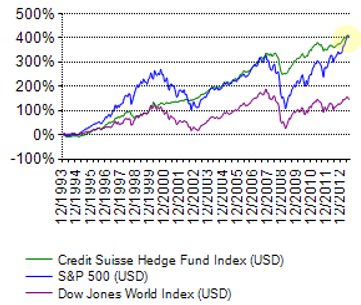
> Sliced democratizes access to hedge funds. Even though hedge funds have outperformed S&P 500 over the past decade, very few investors have access to them.
Hedge Funds on average do not outperform market indices such as S&P 500. I'm curious as to whether this was TechCrunch's take on the problem, or the startup's?
It can make sense to invest in hedge funds even if you don't expect your hedge fund portfolio to beat the market on average, if the hedge fund is uncorrelated with market returns. This is a basic result of Modern Portfolio Theory, but the intuition is that sometimes with the stock market down you will have better performance in your hedge funds (and vice versa), so your account will be less risky in the sense of having shallower troughs. If you want to take on the same risk (i.e. have troughs that are the same depth as if you just held stocks) you can invest more of your capital in stocks/hedge funds vs. bonds/cash, which means you are making better returns. It should be noted that the hedge fund universe is extremely broad, and different funds have different risk/return characteristics.
Venture capital is different because it is both correlated with market returns and the average fund significantly underperforms the market,[1] so getting good returns in venture capital is pretty much a question of getting allocations in the top 20 funds, which are persistently the best. They have the best returns in part because they have the best reputations and thus access to the deals that provide the highest returns (top entrepreneurs would take Andreesen Horowitz's money over money from Unknown Partners on the same terms).
I agree. I recall reading somewhere that warren buffet took a bet with a hedge fund guy a d his premise was also that a hedge fund cannot beat S&P index over a long term .
But a sucker is born every minute and I think sliced will do well for itself.
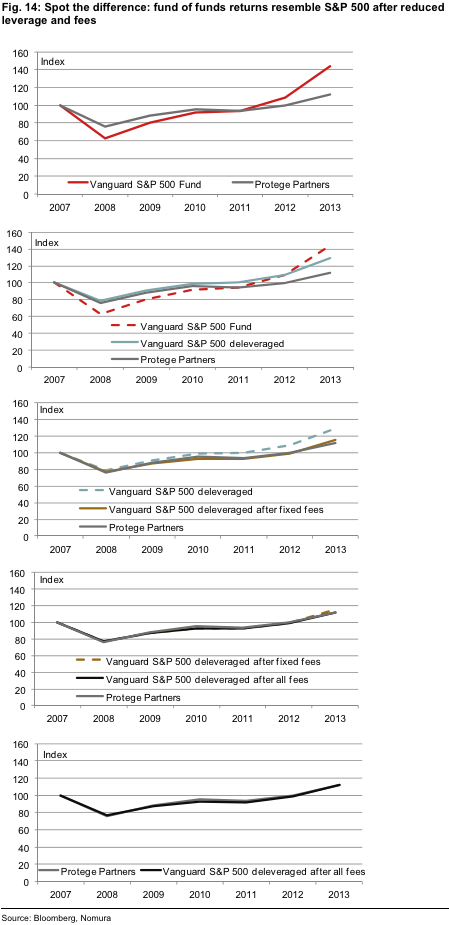
The bet between Warren Buffett and New York based asset manager Protégé Partners is that in the 10 years starting January 1, 2008 Protégé’s five hedge funds of funds will give a higher averaged returns to investors (after all fees) compared to Buffet's choice of the S&P index fund Vanguard Admiral. As of June 2014, Buffet's pick is up by 43.8% while Protégé is up only 12.5%.
It's mostly irrelevant. No one is investing in the hedge fund average, they are investing in the hedge funds that they think will do well. It's actually the same if you look at VC funds -- the overall returns of venture funds is poor, but the returns of the top quartile of funds is outstanding. In any case, the S&P 500 is not an appropriate benchmark for the hedge fund industry as a whole, because many hedge funds do not invest (solely) in equities and those that do theoretically have different risk characteristics from the market.
I think it is unlikely that hedge fund picking is possible for the following reasons. First, if a fund consistently produces outsized risk-adjusted returns the fund would increase their fees to capture most of those returns (Rentech, formerly Bridgewater). Second, a fund which has outsized risk adjusted returns net of fees would become very popular, receive more investment which creates a drag on returns until either the fund closes to new investors (Rentech) or returns reverted to the mean.
Funds frequently return capital or close to new money in order to stay below their investment capacity. Funds also sometimes charge less than the maximum they can get away with for various reasons. The premise of your argument is simply wrong. Moreover, you are ignoring the very real excess profits that are made on the way to this hypothetical equilibrium. Berkshire Hathaway shares aren't going to make you rich if you buy them today, but I'm guessing the people who bought them in 1970 don't care.
> Funds frequently return capital or close to new money in order to stay below their investment capacity.
The point is they are not open to investment once you have historical evidence that they are "good".
> Funds also sometimes charge less than the maximum they can get away with for various reasons.
The only reason I can think of is to increase investment. But that will happen even for minimal excess return.
> Moreover, you are ignoring the very real excess profits that are made on the way to this hypothetical equilibrium. Berkshire Hathaway shares aren't going to make you rich if you buy them today, but I'm guessing the people who bought them in 1970 don't care.
Obviously there are excess returns the question is if they can be reliably identified before hand and are accessible.
Are you invested in hedge funds? Which ones do you think are good now?
The cliche among hedge fund guys is to be "long term greedy" not "short term greedy", which explains why some funds try to be more investor friendly with fees. You also have flukes like Berkshire that seem to have undercharged simply out of benevolence. I don't really discuss my investments much, but I mostly do not invest in hedge funds for reasons of tax efficiency--a restriction that doesn't apply to many institutional investors. The one fund I am invested in has significantly outperformed with low risk during my holding period. The funds that I would invest in are small funds that probably no one here has heard of.
How do you suppose one tell which hedge fund will do better and which won't beforehand? Past performance? We know that's not a good indicator. If you can tell which hedge funds will do better in the future, you probably can tell which stocks will do better, and then why not just got it yourself without giving someone else 2 and 20?
We agree that S&P500 and hedge funds have different risk factors.
The point is that S&P500 is a lot less riskier and with better returns than an average hedge fund.
Investing in stocks is more labor-intensive than investing in funds. I can identify a few great managers that will do very well over time, write them a check, and be done. By your logic, why should anyone give YC or a16z money? I mean, if I know that YC is better at picking startups, why don't I just go pick my own startups? It's two different skillsets.
It's clearly not the case that I cannot select a set of hedge funds that is less risky than the S&P500. Fixed income funds, for example are much less risky (ignoring for argument's sake some details like inflation risk). I don't know if the "average" hedge fund is more or less risky than the S&P500. Depends how you define average. But no one is investing in the average, you couldn't do so even if you wanted to.
On the other side of the coin, there are index funds for fixed income too. That would be a better compare against hedge fund that primarily uses fixed income assets. (For hybrid hedge funds, there are hybrid index funds too.) Once again, the 2 and 20 payment structure makes it very hard for it to beat a 0.2 fee index fund.
And as for clearly better funds like A16Z and YC now, there have many numerous that have held that crown before. Fees and fund expansion have resulted in worse results -- allowing newer players like A16Z and YC to take off.
My argument is that I don't think it's clear who'll beat the broad market (for their asset class) once the fees are taken out. I suppose we disagree about the value of high-fee managed funds (whether VC, PE, Hedge, etc.). That's fine.
Anyway, enough digression from the discussion on hand.
Good luck to the founders in making their value proposition clear. I am sure there are lots of people want to invest in hedge funds but don't have the funds to invest directly. They will find this appealing.
I didn't say hedge funds shouldn't be benchmarked to their appropriate index, I said that hedge funds as a whole shouldn't be benchmarked to the S&P500 because they're not all equity funds. In fact, the majority of hedge fund allocated dollars are NOT invested in directional equity (not including strategies like merger arb that technically invest in equities but have totally different risk/reward from the market). It's not "the other side of the coin", it's my point exactly.
This is so great. I have a text file named "1000 Things" that I update weekly. The file has headings "I am an aspiring ____", and I list the things I did that week to move closer to that goal, counting down from 1000.
So my questions...Is it possible to load up a bunch of existing data in to the app? And would there be a way to implement a count of the achievements for each category?


Interestingly, a friend showed me his contact list entry for me (I believe created through a 3rd party OSX app), and in the Facebook field it had the name used on the admin/ads account I have. Given I don’t use my real email address on the Facebook account I am amazed (but not particularly surprised) that the connection was made.