> A 2x4 LEGO brick manufactured in 1958 will snap perfectly onto a brick molded this morning in Denmark, China, Hungary, Mexico, or the Czech Republic.
In the late 90ies, I regularly played with my uncle's old LEGOs from the late 60ies and early 70ies. They were stored in an unheated attic for 25 years. I remember that some of the old bricks didn't "snap" at all anymore to my newer bricks. They were either extremely difficult to stack onto a new brick, or didn't have any friction left.
There were some bricks from the very early days that were not made from ABS, nor did they have the current box and pin style. Those are often loose (or broken).
There is your problem right there. A family member worked for a large German company which used in-house developed software for exchanging and preparing lab reports for customers. The software worked well since the 90ies, was perfectly tailored to the company, and the people writing it were in the same building and could ship bug fixes within hours. Everyone was happy. Around 2015, someone in management had the idea to move the entire process to a customized off-the-shelf SAP product because of <buzzwords>. The software engineers were in effect degraded to administrators. The new system missed so many edge cases of the lab process that they had to fall back to pen, paper and phone. Customer complaints and employee turnover started to skyrocket immediately afterwards.
> it is appalling how much these people are not interested in who actually gives their enterprise money
After we bought our house, the property tax was still billed to the previous owner for some time. We called our local city hall, and their answer was basically "just talk to the previous owner and pay the tax for them, we don't care where the money comes from".
ALDI TALK offers EU-wide unlimited calls & SMS with 60 GB of data for 69.99 EUR per year. That is 5.80 EUR per month for unlimited calls/SMS and 5 GB of data [0]. I switched last year from O2 (they use the same network) after I realized that I only used more than 3 GB of data in two months during the last 3 years. I essentially cut my mobile phone costs by 70% for the same service. Compare to the O2 bloatware, the ALDI web interface is lightweight, fast and simple.
For 8.25 EUR/month, you get 250 GB of data per year, and for 12.40 EUR 450 GB/year.
We had a nice family vacation last year in the UK (beach town in Wales). One day, we wanted to make reservations in a restaurant just a few blocks away. This was only possible by calling them. They asked for my phone number, then replied: "Sorry, is this a UK number?" When I said no, we are tourists here, the reply was that they could not make reservations for us, sorry! Same experience with two other restaurants.
We ended up preparing some hamburgers from Aldi UK that evening.
A year or two ago I had a similar issue booking to see a Broadway show in NYC... baffling because surely a large percentage of their custom is international tourists. It must have been some kind of temporary glitch, but we had to do something else in the end.
We assumed that they charge some kind of penalty fee if you do not show up via your phone number, and this (most likely 3rd party) system only works with UK numbers.
There's no such service, and it's very unlikely that there ever would be given the attitude of the UK telecoms regulator.
There are things like premium rate phone lines (which you can dial for entering competitions) and special SMS short codes that allow you to send small amounts which get charged to your phone bill (typically used for charity campaigns - eg. "Text 'GIVE £5' to 71234").
But both of those systems require you to take specific action - there's nothing that would allow someone else to apply a charge to your bill on your behalf without your direct involvement. OfCom would have kittens if anyone were ever to suggest setting up something like that.
It's likely that the restaurants in this case were simply confused by a number starting with a + rather than a digit.
I've never got a number with them though. I know some of them do, but not all. I did find an app that gave me a voip number when I was in Canada which was handy.
> Today, [young people] like to spend time with the smartphone; they even take it to bed when they go to sleep.
Recently my parents (in their mid-60ies) were visiting us. At some point I realized that both of them had been quietly sitting at our dinner table for over on hour, eyes glued on their smartphones. They are massively addicted. I have noticed that they get nervous as soon as the smartphone is out of reach, or even in silent mode. They mostly talk to friends via Whatsapp and are in constant fear that they miss out on something or that these friends (which also seem to spend most of their days on Whatsapp) will be offended if they don't reply within 5 minutes to the latest Whatsapp trivia. It is quite a struggle to even get them to turn off their phones when we are having dinner. The Whatsapp messages just keep coming in. My wife recently learned that her mother mostly spends her evenings with posting photos of her life on social media, and broke off contact with her brothers for a few days because they failed to quickly and enthusiastically react to some photos she posted on a family Whatsapp group.
But I guess for Anna Possi, our parents are "young people" and could be her grandchildren...
I feel like she's comparing the young people she sees today with the young people she saw 20/30/40/50 years ago. Not today's young people with today's older people. As you point out - people in their 50's/60's tend to be addicted to their phones too and in my experience have even less etiquette when in public or company.
And it's probably notable bc youth is marked by the energy and spirit you have that becomes hard to maintain as your body grows old and weary. Old people swapped reading and knitting and cards and yapping for smartphones, while the youth swapped dancing and singing and meeting new people for smartphones.
I agree with you, the infection hit quite a lot of older people very hard as well. I have problem getting some 40somethings to meet in person, even in professional contexts, they are just so soaked in a WhatsApp maelström of utterly irrelevant messages that they are conditioned to answer NOW!
That said, the core of the message should not be judgments between the young and the old, but the problem that we have introduced digital fentanyl into our pockets.
You're right, as is your parent comment, in saying that this isn't something only the young suffer from. In fact it's everywhere; the people with the worst smartphone addictions near me personally are an 11 year old and a 70 year old...
That said the message, when taken as a general progression between how life was then and how it is now, stands.
The same thing happened with TV in the 80s/90s. It will eventually fix itself, Gen Alfa will grow tired of smartphones when they will be in their thirties, I'm pretty sure.
(that doesn't mean that there should not be active campaigning to point out the risks of smartphone addiction)
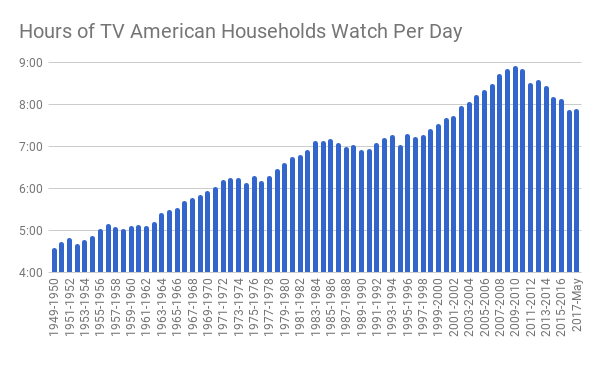
TV use was higher in the 2000s than it was in the 1980s/1990s. TV viewing hours steadily rose from 1949 until finally peaking in 2010.[1]
But when TV finally peaked in 2010, did overall screen time go down? No. It kept going up.[2] Obviously, this is when the masses went all-in on smartphones, social media, and the internet.
Screen usage basically never went down. It has only gone up.
So I only see anyone getting tired of smartphones and actually using them less if they've found something more addictive to replace them.
You have a good point I overlooked, thanks for the correction. I actually missed the "TV was just displaced" angle, which makes sense both statistically and anecdotally, if I think about family and friends.
TV also had a social aspect that internet does not have by construction: You had the same program on only a few TV channels and this was funneling people to talk about similar things or have discussions about the previous day show.
These things rarely happen organically anymore unless "forced" in one way or the other...
A friend of mine's kid (maybe 10 years ago) started crying when he watched regular TV for the first time. He literally thought the TV was broken when the commercials came on with the volume cranked up.
It's the same now with fb and these other old format social media sites. People just stop doing it. With that said I literally think fb will be with us for another 50 years as the people who are still on there are great marks and they won't be leaving until they 'age out'.
It seems we (America) are in some kind of “middle”, or at least a phase change in a larger wave of the addiction cycle, with different stages affecting different generations and countries based on arrival of what can be described as the addiction dealers, “Big American social media”. It reminds me of the effects of the crack epidemic rippling through different generations differently from the late 70s to this very day still.
I don’t have hard data to substantiate it and my theory is based on anecdotal conversations but it seems, e.g., where there is some recovery going on amidst something like American millennials, who have both dealt with their own addiction and were the first generation that is also dealing with the neglect of addicted parents, they are also to some degree recovering (“reparenting” themselves), to some degree probably also spurred on by realizations shot the deleterious effects of phones and SM that come from exhaustion and different life stages. On the other hand, other generations of Americans, like those now elderly parents of millennials, not only are still, but increasing number of them are entering the earlier stages of “phone addiction” (which encompasses many different things), with the most tragic part being that they are in the latter quarter of their life and are unlikely to even realize, let alone recover from the addiction.
I also see this cycle and these stages emerging in other western societies in particular. My theory is that it is a particular effect or amplifier of the underlying culture to some degree, i.e., adoption, degree, impacts. It seems particularly pernicious in America because the underlying culture (if you can call it that, after decades of it being poisoned and corrupted by corporations and the government) was and is fertile ground for the societal rot caused by social media and its amplifier, smart phones, to have taken hold and spread like the virus it is.
It was even all described as “viral”, and yet we still engaged in it as if unfamiliar and investigated viruses spreading in an uncontrolled manner are a perfectly acceptable thing that should not even give anyone pause, especially if money can be made, regardless of whether it is something like HIV, with a very long lead-time, a delayed ETA for the reaper.
What happens now that we are in some kind of middle stage of the “smartphone“/Social Media civilization wildfire, with the first to have been affected looking over the devastation it has left in their wake, Shell shocked by the neglect and destruction, as the inferno is still raging on off in the distance as it consumes their parents and new generations, and even toppling whole countries through the “Color Revolution” playbook?
English has ae in Maelstrom but the contemporary word in Danish, Swedish and Norwegian is Malstrøm/Malström. I wonder when it lost it's ae, I see Mahlströmn from 1698, reading the etymology it says dutch but I wonder if they just wrote it down first. Everything about the sea is always filled with mythology.
I think social media needs a less poetic word though.
I would say that the ae comes from Dutch, it was the way the open a sound used to be spelled before it became aa (maalstroom). You can still see it in place names (Aerdenhout which is pronounced Aardenhout).
It never had the ae in swedish and danish. Its from male/mala, to grind or to mill. English somehow changed it to ae, maybe through dutch where its maalstroom.
The OED agrees about the Dutch idea, giving the etymology as:
"early modern Dutch maelstrom (now maalstroom) whirlpool < malen to grind, to whirl round (compare meal n.1) + stroom stream n"
and also thinks Dutch is the origin, with Swedish/Danish etc taking it from Dutch too:
"The use of maelstrom as a proper name (also in French) seems to come from Dutch maps, e.g. that in Mercator's Atlas (1595). There is little doubt that the word is native to Dutch (compare synonymous German regional (Low German) Maling). It is true that it is found in all the modern Scandinavian languages as a common noun, but in them it is purely literary, and likely to have been adopted from Dutch."
Yes, it seems to be everywhere. Like an epidemic. When I pick up my daughter from school, I have to wait outside the entrance for about 10 minutes with other adult parents. Nine out of ten parents just stare at their smartphones and don't even look at me. In the past, people would have started a conversation out of boredom and gotten to know each other. We are really losing so much.
In the context of the above posts, which is young people eschewing dancing in favor of using smartphones, old is an adult that is expected to behave at or near peak maturity compared to a younger person whose is just coming into their own (presumably 20s).
My parents were like that, in a different way. They couldn’t sit in a room without a tv on, even if they had visitors and everyone was talking and not paying attention to the TV. Living room TV was on at least 16 hours a day, just about every day, I bet. So weird. Also had TVs in every bedroom, including rarely-used spare bedrooms. Like they had six TVs in their house at peak. WTF.
(Actually, my in-laws also do the TV thing, or else a laptop playing YouTube trash… plus phones)
Weeds on the lawn: just use a lawnmower each week, the grass will usually handle being cut on a weekly basis much better than any weed.
Weeds between tiles / slabs or on gravel: just pour boiling water over them. The weeds will become mushy and die within 1-2 days. Repeat every 6 weeks during summer.
Source: we bought a house with a garden full of goutweed [0], which I consider the final boss of any garden owner, and which we have in control now through regular mowing / hot water. Goutweed will just laugh at any herbicide you throw at it, and regrow from its underground rhizomes. I also doesn't seem to require sun, because I have seen plants grow to a height of 10cm completely underground. The joke in my family is that it could grow on foreign planets. As Wikipedia dryly puts it: "Once established, goutweed is difficult to eradicate."
You can also use just heat. Like a long propane torch or one of the newer electric infrared ones. It doesn't need a lot of heat, a short burn (like a bit less than a second) is perfectly sufficient to make them wilt within a few days.
Weeds are the flora equivalent of VC-hype-startups. All growth, no substance and no plan B. They pop-up everywhere, with seemingly infinite growth resources and hope you'll despair and do nothing.
Just going around plucking leaves from everything that looks like you won't like it for a few weeks twice a year works wonders.
Basically regulatory capture for your lawn. No need to help along your darlings (in the beginning), just make everyone else play with stupid rules. And once things start going down the drain, it's time for subsidies (fertilizer) and public contracts (pre-germination).
Thank you for making my morning coffee, consumed while looking down on downtown San Francisco, presently chock full of "AI" weeds, substantially more entertaining.
I've burned them before. It's pretty effective if you understand the true goal. Despite the name you do *not* want to actually burn the weed! Burning the weed is no better than cutting off the part you burned--which obviously doesn't work very well. The objective is to give as much as possible of the weed a light singe--it takes a bit of experience to even see anything. The weed spends all it's energy healing the damage and dies.
Unless you mow your grass too low. Always assume the old rule of "your grass reaches just as far underground as it reaches up in the air" still holds.
Also if you mow your grass drastically shorter or you let it grow for a long time before mowing, do not fail to fertilize it from above right or soon after, start aggressively plucking the leaves of weeds (or other selective methods of fighting them) for a few weeks and (optimally, but highly recommended) verticulate it no sooner than 1 week after cutting. Also time it well to grant your lawn at least 3 weeks of ideal growing weather and climate (It won't die because of a week or two of awful weather, but you'll have A LOT more work fighting weeds ahead of yourself).
I don't understand. What we call "weeds" are plants that evolved to grow quickly and spread quickly. Many gave segmented stems/leaves to resist core damage from cuts and pulls.
I will hate the ground elder as long as I live (but did manage to eradicate it from our garden thru hard work, only to see it spring back up in our neighbor's yard, it's their problem (for) now).
> Fever is used by organisms as diverse as fish, amphibians, reptiles and mammals (see for reference Basu and Srivastava, 2003). Since fever is metabolically expensive, it must provide substantial advantage to the host. Surprisingly little is known about immunological effects mediated by fever, a lack of understanding that might be attributable in part to the common ignorance in clinical practice with respect to benefits fever might provide. Post-operative infections can be prolong survival: patients developing empyema after lung cancer
surgery have improved 5-year survival (50% (n = 18) vs 22%
(n = 411)) (Ruckdeschel et al, 1972). In this light, it seems
unfortunate that fever is usually suppressed in hospital routine.
> The phenomenon of spontaneous regression and remission from cancer has been observed by many physicians and was described in hundreds of publications. However, suggestive clues on cause or trigger are sparse and not substantiated by much experimental evidence. [...] At least in a larger fraction of cases a hefty feverish infection is linked with spontaneous regression in time and is investigated as putative trigger.
> Professor Busch in 1868 introduced the infection of cancer patients by purpose as a novel strategy to treat cancer. He achieved a dramatic regression with his first patient using live Streptococcus pyogenes bacteria, the pathogen leading to erysipelas, published in the German Journal ‘Berliner Klinische Wochenschrift’ (Busch, 1868). Beginning in 1891, this strategy was exploited by Coley, who had some reading knowledge of German (Hall, 1998). Coley systematically applied Streptococcus pyogenes extracts – later called ‘Coley’s toxin’ – to cancer patients and achieved a remarkable rate of regressions. A retrospective compilation of cases considered inoperable at the time of treatment between 1891 and 1936, which was conducted by Wiemann and Starnes (1994, Table 2), determined a remission rate of 64% (108/170) and a 5-year survival rate of larger than 44%. Coley used to inject his extract once or twice a week over a period ranging from a few weeks to several months. His method became quite famous and was tested on hundreds of patients by him and contemporary physicians, but overshadowed by the development of X-ray treatment which was regarded to be much more powerful and of broader applicability.
> Since cancer is usually a slowly progressing disease with
occasionally long periods of dormancy, putative beneficial fever
effects should also precipitate as preventive efficacy. This can
indeed be found. In a cohort of 603 melanoma patients compared
to 627 population controls, an inverse correlation was found
between melanoma risk and number of recorded infections on the
one hand and between melanoma risk and fever height on the
other hand, leading to a combined reduction of melanoma risk of
about 40% for people with a history of three or more infections
with high fever above 38.51C (Koelmel et al, 1999). Mastrangelo
et al (1998) report a striking inverse correlation between the
number of infections and mortality from tumours in Italy in the
period 1890 –1960: every 2% reduction in the number of infectious diseases was followed by a 2% increase in tumours about 10 years
later.


In the late 90ies, I regularly played with my uncle's old LEGOs from the late 60ies and early 70ies. They were stored in an unheated attic for 25 years. I remember that some of the old bricks didn't "snap" at all anymore to my newer bricks. They were either extremely difficult to stack onto a new brick, or didn't have any friction left.
reply