The software, on and off tablet, feels like it was an MVP and now they are improving it gradually. The quality of the existing software is actually pretty good, everything is smooth and polished. It is just not very packed with features.
It is incredibly easy to come up with must-have and would-be-nice features for this device. The hardware is a dream and there is clearly a huge potential. I saw they are hiring software developers, hopefully that will speed up development.
> The quality of the existing software is actually pretty good, everything is smooth and polished. It is just not very packed with features.
I would say it's very far from polished, but it's finally okay now. It took a long time to get there though. I don't even want any particular features for the device, it should be just like a paper notebook, with minimalistic software. It was only in this spring's update, a few months ago, that they finally shipped features to manage notebook pages, such as moving a page or inserting a blank page. It's one of the very basic features the device should have, but I had owned the RM for over a year before finally getting that.
I understand they're a small company with a small software team, but I think it's still important to point out the software weaknesses while saying that the hardware is indeed amazing.
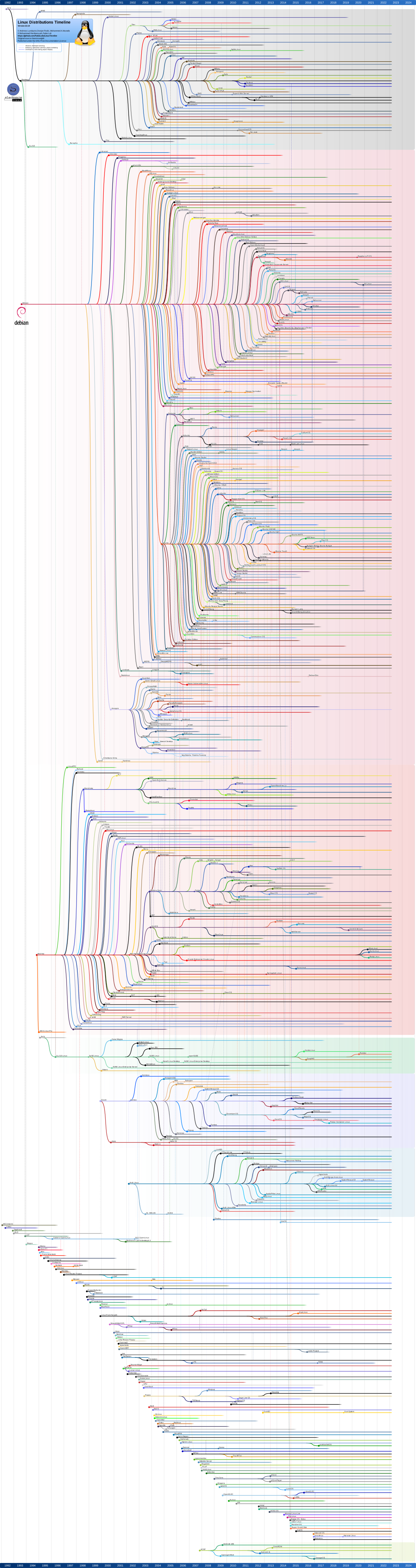
(I recommend MATE for the desktop interface, it's basically the software that Ubuntu [a Debian "derivative", hem hem] used when people thought it was great.)
Used to be the goto distro for those who just wanted a "plug-n-go" experience was Ubuntu. Unfortunately, Ubuntu has lost their minds when it comes to the desktop interface. But - you may like it. Try it out (live thumbdrive or such). It's possible to go back to the "old" interface if you want, and it doesn't take much effort - but may be more than you really want to play with.
The other distro I have heard great reviews on that still has a sane interface is Linux Mint - again, try it before you "buy" it.
Virtually every distro except for a few niche ones have Live boot versions, that will allow you to try them out on your system, get a feel for what works, what doesn't (hardware and software-wise), and how the overall system "feels" - before committing to an install.
Your other option (to handle your use cases) might be to keep a windows partition (or on a separate drive) around and use that. Another option would be to use Microsoft's online Office360 suite (I think that's what it is called?). Or run VirtualBox on the Linux system, and run a version of Windows inside that. Any or all of these could be done together, in addition to using Crossover and/or Wine. You have a ton of choices here.
Also - for your documents - you say you are worried about formatting when they go to the client - does the client need to be able to edit them? If not, then dumping them out as a PDF might be able to work for you, if they'll accept PDF copies vs Word docs. The other thing to do would be to take a few of your old copies of docs you have sent to clients, and run them thru LibreOffice or something - see what they look like when you import them, then export them back out to a new file in the various Office formats, and load them back up in Word and see what it looks like. You might be surprised at what you find (you might be disappointed as well). This is all something you can try with the Live boot versions of Linux distros.
Oh - and games - besides using Crossover/Wine - there are a ton of native games available, plus plenty of "old-school" conversions and ports (some quite fun and amazing - some of the Doom/Doom 2 ports are pretty amazing). Also, there are a ton of Steam games on Linux available, too. If all you do is casual gaming, and don't care about always running the latest AAA shooter/fps/mmorpg or such - you'll usually be able to find something worthwhile and fun to play.
Unadjusted looks correct for me in Chrome and Firefox in Fedora. I have an nvidia card so I'm not using Wayland, I'm not sure if that would make a difference.
The Tesla charging station where I live is located at traditional style shopping mall, which is in deep decline. I'm certain they are appreciative of any captive customer, and I wouldn't be surprised if they preferred increased quantity at the expense of 'quality'.
It only takes 30 minutes to fill up a gas-powered vehicle if it's an RV. Plus, you need to babysit the RV while it's filling and can't really wander off to go shopping for 30–60 minutes.
An EEPROM (Electrically Erasable Programmable Read Only Memory) is erased electrically rather than with UV light like an EPROM. Even if there isn't a possible attack with light, there might be a way to alter the contents of the EEPROM if you can manage some amount of control over the signals entering the IC.
It turns out that part of the attack does exactly that. It was glossed over in the Wired article, but the slides describe how the lockout-penalty feature in the lock was defeated by manipulating the EEPROM. Basically, if you kill power to the lock at just the right time (i.e., midway through the EEPROM erase cycle as part of the larger/longer EEPROM write cycle), those bytes in EEPROM will be left with a value of 0 instead of whatever had been there.
If a compiler supports ARM and Thumb, it covers a majority of modern embedded platforms. The days of 8- and 16-bit microcontrollers are coming to an end -- 32-bit Cortex-Mx chips are very competitive on price and power consumption and much more capable.
As a C magician, rust provides too many clear improvements over C to ignore it. I certainly don't feel like I am 'throwing everything away and starting from zero,' as much of my C (and other language) knowledge transfers over to rust.
I'm not a C++ guru, but I think modern C++ is powerful enough that it doesn't feel lacking in features compared to rust, like C does. There is less of a draw for seasoned C++ programmers.
Rust seems to be gaining a lot of momentum and I am becoming more and more confident that it will be regarded as a major language for embedded and general systems programming and possibly even a successor to C.
If Digikey doesn't have it, no one else does either.
I don't think that is really true. Digikey does have an impressive inventory, but there are plenty of brands that they don't stock aggressively (first thing that comes to mind is Lattice).
Digikey ships things out extremely fast. Not many other places offer overnight shipping
Digikey's major competitors, like Newark and Mouser, offer essentially the same shipping options. All 3 can get things shipped out late in the day (say 5:30PM) for next-day early AM delivery.
If you are doing real engineering and not just screwing around in your basement, you don't really care that much about price. The last thing you want to do is order from multiple vendors because it eats time and is more expensive in the end because you will be raped by shipping costs.
This is the opposite of my experience. When buying for production, price is a primary concern. When buying for R&D, there are usually other orders that can by added to, so there is no shipping concern.
If you are buying parts for production from Digikey, Newark, or Mouser, then you must have very low production runs. Most companies buy production parts from major distributors who don't sell in low quantities.
It all depends on the scale of your operation. If you work for a big firm, you don't order parts yourself. Someone else does that from whomever the company has relationships with. If you are at small to medium-sized company, you may order parts yourself and your order may be delayed to combine with other orders. If you are are a consultant, you really don't have the time to pour through different catalogs searching for the best price. You just stick with a few companies for most items.
In the end, most people don't order resistors from one company and capacitors from another just to save a few bucks. The time it takes to do this outweighs any price savings. This was the point I was trying to make. Many hobbyists don't like Digikey because they are expensive. I used to feel the same way until I had to order parts for freelance work. Ordering parts sucks and sticking with one company makes it easier.
Unlike others posters, I don't think this Octopart deal is going to cut into Digikey's bottom line. Like I said, Digikey doesn't compete on price, they compete on inventory.


It is incredibly easy to come up with must-have and would-be-nice features for this device. The hardware is a dream and there is clearly a huge potential. I saw they are hiring software developers, hopefully that will speed up development.