I'm aware that they expect one of their customers to be stock market companies where lower latency is highly important. Are you referring to that or something else?
The "stock market companies" is a fantasy promoted by random people, not SpaceX.
What SpaceX shared is that they plan to be "fiber cable" except via space. They'll carry a backbone traffic e.g. between Australia and U.S. via laser links.
Companies that currently pay for undersea fiber cable to carry traffic will pay Starlink for the same service.
High frequency traders would look into this, but I don't think it would be a big revenue stream for SpaceX.
I used to work for a company doing microwave backhaul and they liked us as the speed of light through air is faster than fiber, and they could get more direct links. It was important enough that we had special low latency builds of our firmware with some features removed.
Eventually, with satellite to satellite laser links, and full global coverage with this efficient number of highly inclined orbit satellites, they intend to capture the entire market that is right now addressed by various very expensive motorized tracking geostationary dishes mounted on offshore vessels, plus L/S band inmarsat, iridium, and others.
Offshore oil and gas, cargo ships, Cruise ships, coastal vessels, medium-distance ferries such as in Greece, business jets, airliners, portable military applications, data links to offshore scientific applications for buoys and weather, all sorts of stuff.
I understand that’s a lot of use cases, but is it a lot of REVENUE?
Verizon and AT&T built multi billion of dollars a year of sales from cookie cutter DSL (simplistically). All these crazy edge cases…are they material? Does it make sense to shoot thousands of satellites in space for ferry boats in Greece? Financially that is.
That being said it’s really cool what a “catch all” solution we’re getting as a humanity for basically free. This feels like Google Maps / Gmail / WhatsApp where all humans get like value for free (especially in the developing world) due to one company creating a massive positive externality due to their business strategy. So cool.
Go look at the combined revenue in billions per year from all the geostationary satellite owning companies like Inmarsat, thuraya, Intelsat, ses, eutelsat, arabsat, amos, etc. Most are publicly traded
ompanies. LEO properly implemented will beat the pants off it in performance and speed.
HFT already uses HF radio bands between the UK and USA which is lower latency than either submarine fiber or starlink will be. Although much more limited in kbps.
Big ass yagi uda antennas in certain locations with totally custom rf chains and modems.
Experimental licenses so far or straight up illegal, they're making much more money than any FCC fines would be. The FCC enforcement bureau is actually pretty small and doesn't come after you until you really screw up someone else's pre existing licensed service.
All FCC fines are public info (called a notice of apparent liability and published in their daily data dumps), I've yet to hear of one getting fined.
I'd venture a guess they could mean using Starlink as the backbone for off-planet comms? I've heard that referenced a few times. The true end game is probably all of the above and more. If the need fits the bill and the pockets are deep enough, it'll probably be using Starlink.
I’m very ignorant about HFT, but https://www.starlink.com/ says “latency as low as 20ms in most locations”. Isn’t that many many orders of magnitude too much for HFT?
As I understand it, HFT justified digging new tunnels between NYC and Chicago to take advantage of the shorter distance the signal would have to go. And that was transmitting at or near the speed of light. Somehow, I doubt bouncing on a roundtrip to a satellite is worth it.
> And that was transmitting at or near the speed of light. Somehow, I doubt bouncing on a roundtrip to a satellite is worth it.
That's the thing, the speed of light in fiber is actually significantly slower than the speed of light through air, which itself is slightly slower than the speed of light through a vacuum.
Over long enough distances this adds up to the point that high frequency traders already have built radio relay networks between New York and Chicago. You can't easily build radio towers across oceans, but a satellite relay network that could follow a nearly line-of-sight path is almost the same thing.
Also fiber isn't run as the crow flies, sometimes it has to take a winding path which adds even more distance to the run than you might think, on top of the reduced speed of light.
If Starlink manages to get their satellite to satellite laser link tech working, which is a MASSIVE if, they're in a very good place.
Mark Handley[1] has done a number of videos running the numbers based on published Starlink numbers, both with and without the inter-satellite laser links.
It's been a while since I watched them, but I recall that even without laser links, they can beat any of the terrestrial links over a certain distance - because the terrestrial links can't get direct-LOS.
Based on what math? Tokyo and New-York are 10,848.68 km apart, terrestrially (though cables don't go as the crow flies), but LEO is only 2,000km off the surface. If Starlink can get connect Tokyo to New York in fewer than 3 hops, and thus over shorter distance, then you can bet that HFT firms will be falling over themselves to sign up.
The speed of light in fibre (I.e. glass) is substantially slower speed of light than near vacuum .
So yes bouncing up a few hundred km is faster for medium and long range connections .
It will not be faster than fibre for Manhattan to Princeton , but it would be faster for London - New York or London-Frankfurt
I think it’s more like cross-world latency. Where going from one side of the world to the other will be slower going via fibre optic vs through space as with starlink? I think this is reliant on the satellite-satellite latency being low and the ground to satellite being not insanely high.
Musk has said there's a risk of bankruptcy if both Starlink 2 and Starship don't work.
> The consequences for SpaceX if we can’t get enough reliable Raptors made is that we then can’t fly Starship, which means we then can’t fly Starlink Satellite V2 (Falcon has neither the volume nor the mass to orbit needed for satellite V2). Satellite V1 by itself is financially weak, whereas V2 is strong.
I very much hope they both do work but let's be clear there's still a lot of risk to get through before that's clear.
Starlink orbits are far too low for kessler syndrome. Atmospheric drag would clear them out in <10 years, probably much less. In fact, Starlink satellites are far too numerous for anti-satellite weapons to be effective (at least, until countries decide it's worthwhile to start mass producing orbital-class rockets to attack enemy satellite constellations, which would almost certainly lead to a loss of their own satellites as well). Russia would love to be able to take out Starlink right now, but they can't.
Nobody has enough asw weapons, and probably can't afford to build enough, quickly enough individual asw missiles, to take out even 15% of starlink. They launched four batches of 53 satellites each just in May and the month hasn't ended yet.
Additionally the US and NATO would see an act like that as barely one step below declaring nuclear war.
People with ASW don't want to use them against Starlink, they want to use them against spy satellites. Starlink would just be collateral damage.
If anyone in NATO considers blowing up satellites to be one step below killing hundreds of millions of people, I want that person fired. Because they have completely lost touch with reality, and should not be allowed anywhere near a weapon, or a job where they manage people with weapons.
Ukraine is using Starlink to control drones and Russia has tried jamming the service. Given that its not outlandish to contemplate Russia escalating. They might destroy one and say they'll do worse unless Ukraine is kicked off.
The reason taking out spy satellites is taken so seriously is it is considered a likely prelude to an attack.
Are spy satellites actually intended to detect ongoing icmb attacks? Isn't the overwhelming majority of that job done by ground and sea-based radar stations?
There is no meaningful difference between detecting a launch from Siberia, and detecting it once it's over the Bering sea. Either way, everyone on both sides will die.
I wonder how many Starlink sats one would have to take out to start a cascade to destroy the usefulness of the constellation? Of course there would be a lot of other collateral damage.
This strikes me as a rather odd comparison to make.
4G serves an entire nation of cell phones, using generally similar wireless technology and limitations LEO satellite comms have. 4G towers are closer to the users than LEO satellites, meaning the power requirements are lower, this is a desirable thing for the people in terms of both battery life and radiation power levels.
5G takes it even further in this direction using more towers; shorter distances and lower power levels, AIUI.
Unless I'm utterly mistaken, LEO satellites are at a severe disadvantage when it comes to competing with the cell network for handheld mobile customers.
Satellite connectivity has its place, and it's basically where you won't have cell service, since that's obviously the preferable option if it's available.
Why not both. Have a 4G tower with a starlink on top. Give internet to a whole rural village. That might not be fast enough for the first world, but in other places that will be a much more viable solution compared to building physical infrastructure on the ground.
But those satellites cover everywhere, including places where no carrier would consider erecting a cell tower because it's not dense enough to be profitable or further out into the boonies than would be cost effective (or politically viable) to run cable.
It's an expensive upfront cost, but once the full constellation is up, they'll have basically full world coverage, and anywhere that's not a big city charges big money for internet. See how much internet in rural Canada costs.
Except their network is extremely limited in capacity. 4G/5G is a much better solution for 99.9% of use-cases. Starlink is better for the extremely rural locations where installing a tower just isn't feasible.
I have a pretty rural property and there are areas nearby that get 5G UW with speeds in excess of 1Gbps. Most of the area is covered by 4G with download speeds of over 40Mbps.
5G is already replacing wired home internet for many people. Give it a few more years to expand coverage and I bet 5G will make Starlink obsolete for most of its US users.
A few things to note are that Starlink is by far the best option for airplanes and boats, and the percentage of very rural customers is probably closer to 5-10% than .1%. Putting up towers is expensive, and space is pretty close. If you want the tower to be much closer than a leo satellite, it needs to <<200 miles away, and in non-flat areas, having the signal go up gives much better results than trying to send it through a mountain.
> It's an expensive upfront cost, but once the full constellation is up, they'll have basically full world coverage
This is wrong. Years before they have a full constellation they will already have started needing to replace previously launched satellites. It's not like they just launch them once and they're done and those satellites last forever. Just to maintain a constellation they'll need to be replacing something like 20% every year.
Are you counting how expensive it is to keep replenishing the sattelites?
Anyway, for spacex to make bank off of this they need customers. Extreme rural living areas are not that common, and when they do become common more cost effective methods such as cell towers make more sense than starlink.
Yeah I wonder if there will be a service like "send your data into space" which sounds equally stupid (use radio waves) but yeah... just longevity woes (sculpt a rock and burry it).
Some of my code is in the arctic vault though a piece of crap Todo List.
There's so many levels of wrong in this post I don't know where to begin. Data isn't being cached. Encrypted data doesn't help anything. It's a flying network router. If you're worried about "cached" data, then don't use the internet (don't actually worry because routers don't substantially cache either).
I said in another comment of mine that I didn't care about it being cached. I wanted it to be there "cached" to be remembered. Like a fragment of data (my data) found that exists long after I'm gone.
The satellite is like a piece of debris/wreckage which someone pointed out it would have deorbited anyway at some point.
Imagine your data gets on a server in the cloud and it dies (gets replicated/replaced/decommissioned ...)
What's special about satellites (and how much caching are they gonna do) and why are you worried about data you have chosen to send in the clear over a network you don't own?
Oh I wasn't implying I was worried about it. It was an indirect reference to a Cowboy Bebop episode (sentient satellite they connect to from decades ago).
This video[0] seems to disagree with this. In particular it seems like there's a lot of recurring costs involved and this infrastructure is not super stable (the video talks about satelites having a shelf life of 5 years. We're not rebuilding fiber out every 5 years!)
The videos "has an agenda" but it seems a bit easy to accept the idea that constantly launching satelites into space is pretty expensive. Infrastructure on the ground is expensive, but most people tend to not move around so at one point just building out lots of wires everywhere can work pretty well.
Having great coverage across the globe is great! But especially after seeing that (super crappy!) satelite internet providers getting the same shit done with 3 satelites.... you're looking at the intersection of people needing access to fast internet who can't somehow take advantage of existing infra, _and_ who won't eventually get covered by ground infra (and I guess don't have trees around their house).
Here's the thing - the launch costs are only an insurmountable issue if you aren't SpaceX. The math might not be great if you assume dependence on dedicated Falcon launches, but SpaceX gets a lot of Starlink satellites to orbit by piggybacking on top of contracted commercial launches basically for free. You also need to consider that Starship will likely be orbital-ready next year with a launch cost of only the fuel and parts refurbishment, and a single Starship launch could put an absolutely stupid number of Starlink satellites in orbit.
Basically, cost calculations assuming traditional launch economics are incorrect. That's pretty much the whole point of SpaceX as a company - their business proposition is massive reduction in kg-to-space costs.
It is so much worse than that. The video doesn't use SpaceX cost. It uses their cost to others. It categorically rules out using their new rocket, even though their stated plans call for them to use it. It rules out ride sharing, even though they have been doing that. The video creator /knows/ they are doing that. They know they are lying. I can tell, because I've looked at some of the articles they posted screen captures of. They edited the fucking headlines to remove the rocket launch price. The video is absolute garbage. It even posits a government conspiracy, because it has to, because it lied about the speed test numbers that are used to decide eligibility for funding. Yet despite all that when they talk about their choice of numbers they pretend they are being generous to SpaceX by using conservative numbers when nothing could be further from the truth.
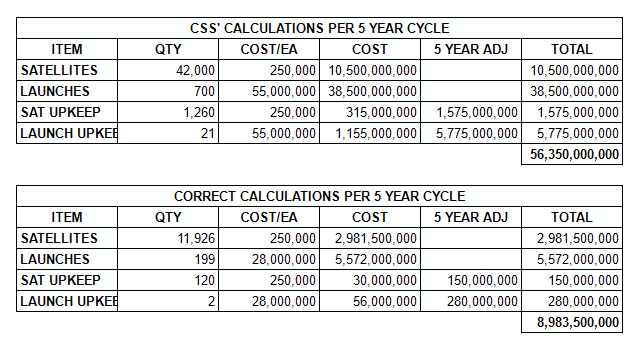
Eh, you can do your own math. 5k satellites / 5 years lifetime = expect to replace 1k per year. Each launch of ~50 satellites costs around $35M (conservative estimate). So overall capex required to maintain the system is $700M/year. SpaceX would need 530k subscribers at $110/mo just to keep the lights on - and each satellite would have to handle ~106 customers concurrently, assuming a uniform distribution (best-case scenario for SpaceX). According to some sleuths on Reddit [1], each Starlink satellite can deliver around 20Gbps bandwidth, which gives each of those customers around 188 megabit speeds, assuming absolute best case geographical distribution. In practice people will be clustered so it won't be that great.
Surprisingly not that bad. The real cost could be double and they would still have enough capacity to serve high speed internet and break even.
Just to give a sense of scale, because it is crazy. Your estimate? It is 0.000621118012422 of his one year estimate. You arrived at a figure more than three orders of magnitude lower than his figure. So I hope you'll understand why I have so little respect for his estimate.
To just restate that to try to get across how extremely different your estimate is from his. If you convert to percentage and round at two decimal places... your estimate is 0.06% of his estimate. To try and make this different a little more real for people lets try to convert it into more familiar figures. If were talking about a house rather than rocket launches and cp thought the price was $100,000 for a house then CSS would have an estimate more than three orders of magnitude different. Something more like $100,000,000. Translating this level of difference in evaluation means the disagreement in 'real object' terms is roughly equivalent to this much difference in cost estimation: $120,000,000 home https://www.zillow.com/homedetails/329-Albion-Ave-Woodside-C...? versus $125,000 home https://www.zillow.com/homedetails/31235-Manton-Rd-Manton-CA...
The difference in estimates is absurd. The reason it is that absurd is that CSS tries to argue that SpaceX couldn't work because it would cost more than the entire economy in the world. It's like a comedy thing where he tries to use rhetoric about how stupid SpaceX must be to strengthen his argument that they could succeed without an overarching conspiracy helping them lie about everything. This is absolutely a conspiracy video, not a factual video.
IIRC, he moves on from this topic shortly after that to talk about how since Shotwell is a woman she isn't worth respect. It hits harder, if you believe him, because he just made a 'strong as long as you are delusional' case that anyone who thinks SpaceX might ever be profitable is insane.
One key factor you didn't include in this calculation is "overprovisioning", the industry term for the fact that you only need to spec your total network capacity based on peak load times, and at peak times it's not actually going to be the case that every customer is using their maximum contractually available bandwidth. The typical industry assumption is that this is something like a 10x factor, although as network connections get faster, this becomes more pronounced.
If anyone is about to watch this video, I want to warn you before you do that saying this guy "has an agenda" is like saying that a flat earther "has an agenda" in that they will absolutely be giving you "facts" and whenever the "facts" disagree with reality they will give you "facts" that are designed to make you abandon reality.
If I were to state my actual opinion on him on Hacker News, I would be downvoted. If I were to try and express how I feel about someone else finding him at all reasonable, I would be downvoted. So in the kindest possible way let me direct your attention to the kind of techniques he uses.
At 7:16 in that video he posts a screen capture of an article headline. It is a screen capture? Honest right? Great data. Not so fast. The screengrab was photoshopped. He edited out part of the title. In particular, he edited out the price for SpaceX to launch a satellite to orbit. Why, you might wonder, would he do something like that? Well... he was lying about the price just before that, so it would be kind of inconvenient to let people see the truth, wouldn't it? Here is the article whose title he photoshopped: https://www.nextbigfuture.com/2019/12/spacex-starlink-satell...
This isn't an uncommon thing for this liar. He regularly and willfully does things like this all throughout the video. You should be taking every number he gives with an enormous amount of salt. Dump the entire fucking salt container on this meal. He lies about the cost for SpaceX to launch, a material fact, but he also double counts the number of rockets they will need to launch, another material fact. He lies about the speed test results for SpaceX (by using numbers from months before the video, rather than the actual numbers). Since he lied about that, his reported numbers didn't agree with, ya know, reality. In particular they didn't agree with the reality of SpaceX qualifying for various government funding initiatives for rural internet. So if you want to believe him you're going to need choke down a helping of "enormous conspiracy" in order to get onboard his hate train. He also lies about the cost of competitors. And... it's bad. It is so bad that I have 0% confidence that he operates in good faith and I assume anyone who trusts this person is truly lazy, because he isn't trustworthy. Not even close to it, at all, whatsoever.
If anyone wants to climb out of the rabbit hole rather than into it, someone wrote a multi-part essay debunking this video. There are /a lot/ of mischaracterizations, outright lies, and deception. It has three parts, because there was so many times that were deceptive as to demand multiple articles.
It wasn't me who wrote the long rebuttal. I watched this video months back and noticed the same thing I'm sure you did. I ended up finding this rebuttal to it way back then and because of how often a certain segment of the population who is adequately described as "misinformed and full of hate" has this guy as their 'source' for various conspiracies I tend to remember the debunking.
I watched the video, and agree with all of your points. He strongly implies that Starlink is no better than existing satellite providers. My parents live in a rural area where the best non-satellite internet is 3mb/s DSL. They subscribe to Starlink, since there are no other viable options that allow things like video calling or HD video streaming.
Viasat offers 30mb/s download for $199/mo with a 150GB data cap.
HughesNet offers 25mb/s download for $159/mo with a 75GB data cap.
Starlink offers ~100mb/s download for $110/mo with no data cap.
Viasat/HughesNet have geostationary satellites which results in almost unusable ping (300-600ms), compared to the 50ms ping from Starlink.
But, hilariously, despite the channel being called "Common Sense Skeptic" (thought it might be a science-y channel), every video is an Elon Musk takedown.
There are a bunch of reasons to believe this is wrong, in addition to the things other people have pointed out:
- Starship will further reduce SpaceX's already low launch costs.
- Economies of scale by producing 10,000+ satellite.
- Industries willing to pay a lot for truly global coverage (maritime, aviation, oil, military)
- With the laser network, high frequency traders willing to pay a massive premium for the lowest latency connections between financial hubs.
- A "fully and rapidly reusable" Starship, if achieved, will change the economics even more. Not only will it further reduce the initial launch cost, but you could imagine potentially servicing/refueling or recovering aging Starlink satellites.
- Starlink (plus increasing work-from-home opportunities) has the potential to (slightly) redistribute where humans are willing to live to more sparsely populated areas.
I believe during the video he uses pricing offered by Tesla(EDIT: SpaceX rather) as the optimistic pricing for Starship! So taking the "cheap" numbers!
Tesla doesn't have anything to do with Starship launch prices. Let's look at costs to SpaceX for launches, since those are the most relevant numbers:
Reused Falcon 9 launch: $15M[1] in the best case, but let's double it just to ballpark the average, so $30M. Falcon 9 can loft around 50 satellites per launch. 30M/50 = $600k/satellite.
Starship: Aspirational goal of $2M cost to launch. Let's just round that up to $10M for whatever might be more expensive than expected. Starship has been predicted to be able to launch around 400 Starlink satellites at a time, the last figure I saw was that Starship launches would carry "100 plus" Starlinks[2]. $10M/100 = $100k/satellite. This is assuming Starship is launching v2.0 satellites though, rather than the current v1.5, which are way heavier (1 metric ton vs ~290kg)[3].
OK, yeah so the video mentioned an optimistic price of $250k/satelite. $100k is definitely better! It sounds like $250k would be matching the v1.5 satelite cost.
I guess the overall thing would be to break things down and figure it out. I'm skeptical mainly from a "possible market share" perspective ($99/month works well for some, way less for others, and honestly the competition is not wired broadband but cell networks). But I am here to be proven wrong!
>you're looking at the intersection of people needing access to fast internet who can't somehow take advantage of existing infra, _and_ who won't eventually get covered by ground infra (and I guess don't have trees around their house).
Ground infra can suck. It will probably be stuck at 6Mbps down forever since it is not economical to upgrade it. I would literally cut down trees by hand if it meant I could have fast internet.
> Ground infra can suck. It will probably be stuck at 6Mbps down forever since it is not economical to upgrade it.
Having competition changes the economics, at least somewhat. Look how fast AT&T rolled out fibers to all the cities Google announced they were going to do fiber in. It's still expensive to do new runs everywhere, but it may be worthwhile to keep some business. In some areas, as some customers leave, staying customers may be able to have better access to bonded lines. In other areas, the carrier just needs a kick in the pants to use more flexible/generous profiles to let customers use the speed that's available.
Common sense skeptic is a "hit channel" dedicated to producing and monetizing anti-Musk-related fake news. He has a captured market in a similar vein to anti-vaccine propaganda. So you should watch anything produced by him with that idea in mind.
The videos produced as a general rule will cherry pick information and also use outdated pieces of information and then mash them together to produce the illusion of something being much worse than it is.
Not to mention that (someone can fill in the accurate numbers) some rather significant number of satellites are expected to be lost every year due to various factors at a rate that will require several rocket launches just for maintenance of the current state. My understanding when I was reading about that, is that it did not even consider the "shelf life" issue.
He doesn't just include those calculations in. He overcounts them to a pretty large degree. He also photoshops screengrabs of articles and lies about launch prices and lies about the number of launches and lies about the speed of SpaceX service and lies about a government conspiracy because the speed test numbers were too low, and he is a misogynist towards Shotwell, mocking her for being female, and he lies about the cost of the competitor services.
You don't need to worry. Every angle for making the comparison unflattering to SpaceX, including taking screen grabs of Elon Musk with funny faces and making character attacks on him on the basis of his face looking funny, are more then covered in that cesspit designed to radicalize and monetize the gullible.
But as I use my internet, I never worry about what the CEO looks like, I never worry about if there is a male or female controlling matters. All I am concern with is the speed of my connection and the uptime. Keep the costs in check and those are the only things that matter.
I completely understand your point; a reasonable video author would have stuck to the things that matter. This person isn't reasonable. As the GP put it he "has an agenda" but as the GP didn't warn you he has no issue with lying when the facts disagree with him.
To get a sense of the scale for overcounting elsewhere in this thread someone pointed out we could do the calculation ourselves. They determined a reasonable number of satellites. Their estimate of the needed number of satellites was 37,000 less than CSS's estimate.
Whatever lie, whatever unflattering take, whatever deception - this video tries every angle. If you want to be delusional, this is your video author. He will help you get there.
The video lies about the connection speed. The video lies about the latency advantages. The video lies about the costs (by several orders of magnitude). The video lies about a government conspiracy (claiming one exists). The video lies about the ability of women to make effective decisions (implying they can't).
It’s rallying because there are a lot of undervalued stocks. There have been really good deals the past 2 months. And stocks are a great inflation hedge.
I don’t know why I’m being downvoted - Amazon FBA does not commingle seller inventory. The products sold by a seller are only the ones they shipped to FBA. If you request your inventory back, you will only get the ones back you sell. So if a seller sends in a bunch of counterfeit items for a listing, those are physically separated and don’t get mixed with the good inventory that is there.
There are multiple sellers for the same product and they could definitely have bad/old inventory - and they will win the buy box with the lowest price - but it’s still not commingled.
I think you’re being downvoted because what you state is contrary to what most people have heard: i.e. that inventory for the same SKU from different sellers is in fact commingled. You might want to provide some citations if you want to convince people otherwise.
Zero traffic congestion, close to free to operate, fulfillment in minutes? Under 1 hour order delivery? There’s obviously downsides like sound and then falling out of the sky, but getting anything under 5 pounds two orders of magnitudes faster is a big deal.
If they tried to introduce cars now, there is no way they would get through. Because they are truly ridiculous and horrible. A million deaths around the world directly, and another million due to pollution? Imagine trying to convince everyone that was a good idea.
Compared to walking dozens of miles everywhere? Remember that the only existing modes of transportation were bicycles and horse-drawn carriages. The car absolutely needed to happen to aid our progress as a civilization.
Everything looks bad in hindsight right? But it is the car that enabled the progression that makes the car impractical.
I agree. This invention does nothing of real value. Perhaps it makes you life a bit more convenient but it's the difference between ordering a pizza in 30 minutes and ordering a pizza in 10 minutes. This can't enhance human well-being- it's simply a toy for rich techies who can afford to pay a premium to get their stuff all the faster.
I wish Mr Bezos would focus on something of real value- asteroid mining and transferal of polluting industries off-world.
One might say they're raking it in, but I do wonder how many people with rakes it would take to rake up 0.7 billion dollars per day. Top of my head says, "a small city". (Alright, back-of-the-napkin whizzes...)
To make the number as big as we can, we can use pennies. $700M/day = $8101/s = 810,100 pennies @ 2.5g per = 2025kg or 2 metric tons of pennies per second. I honestly have no idea how many pennies a person can rake per second. Pennies are pretty small, so maybe a few thousand at a time with a special rake? I'm imagining that you would have to rake these pennies 100 meters at about 1 meter per second (average walking speed 1.4 - having to rake pennies), so we would have to be raking at any given time 100 seconds worth of pennies (=81M). If a given person can rake a few thousand at a time, then that's about 40,000 people, approximately a small city