There are 172 million acres of land in Texas. That means you could give every American man woman and child a half an acre of land to themselves in Texas, with land to spare. The US is really big.
You could also (in theory) put every human on Earth in Texas with a population density of only 26,000 people per square mile, about the same density as New York City.
If it's an equilateral square pyramid, the volume would be about a quarter of a cubic kilometer. If we assume humans have an average mass of 65 kg and the same density as water, that gives us room for just under 4 billion humans.
I'm glad I wasn't the only one. I was very confused for a moment after reading that comment. Never seen the acronym "SF" used for science fiction before.
(And people also want to go to Antarctica... There are multiple "colonies" there, by Chile and Argentina, thousands live there in the summer, and about a thousand people winter over there, and tens of thousands of tourists travel there annually... All this in a place that is illegal to mine, illegal to claim nationally, and even illegal to build new permanent structures by international treaty, thus essentially illegal to build a city or anything like a real economy, which would require mining at least for gravel.)
The interesting thing about people is that there are many different kinds with many different motivations.
Although I do suspect that space settlements will be even more urbanized and centralized than Earth cities. The extra costs associated with living in space are reduced by living in larger settlements/cities (think surface area to volume ratio), and just like on Earth, economic productivity will increase with increasing population density.
I think most people who want to live off-planet have a very romanticised notion of what that entails. Mars isn't going to be terraformed within our lifetimes, even if it was possible. Living on Mars = living permanently in a tunnel. And if you don't get along with the small community you'll be living with, you'll be screwed. And if you don't like living a fairly regimented lifestyle, you'll be screwed as well; there'll be no equivalent of "let's see what cafes are down this alleyway!".
I think far more people actually want a 'holiday' off-planet, than actually live off-planet.
As far as the latter point, that's fine & perhaps expected. That's why we need to make transport cheap enough so people can come and go.
I know what it's like to live life in a tunnel. That's the Twin Cities in Minnesota during the winter. Minnesota is where the modern indoor shopping mall was invented. The entire downtown of Minneapolis is still walkable in the middle of the winter because all the buildings are connected by temperature controlled skyways and tunnels. No reason you can't see what cafes are in the next building or indoor level.
Not all people. No one expects everyone to drop everything and move to Mars but there will be some pioneer types who would probably want that kind of endeavor. If comfort was everything, people would have remained in Africa.
Or how Asimov's "The Caves of Steel", from 1953, was set on an Earth of 3000 years from now, and that was overpopulated, horribly full of people, living on contiguous, adjoining underground cities covering entire continents. And had 8 billion people (which we are actually about to reach in about 7 years from now, somewhere around 2024).
I haven't met many people who have knowledge beyond watching Friends reruns who actually want to live in Manhattan.
The highest population growth places in the US are places like Dallas, TX and Greenville, SC. That's been the case for a long time. NYC and SFO are treading water and are at risk as their economies have de-diversified over the last 40 years.
I could see that that might have an impact as well. It will be interesting to see to what degree people move to metro areas because that's where the jobs are and to what degree they move there because it's a more interesting place to live. While I'd love to have a little more space and pay less for housing I'd get pretty depressed living outside a metro area. If that's what I wanted I could move back to the visit where my parents live, live in their second house or in-law unit and live off a few hours months of remote consulting work. Curious to see how that's the case for others.
A lot of Chicago's population loss is on the South Side where violence is high. Also the elimination of the projects has moved a lot of Section 8 housing to the suburbs, as it gives low income families a chance at a better life in a less dire situation. Investment in new infrastructure is at an all time high in the Loop / North / West sides. Young people are moving out the suburbs and into the core. Chicago's population isn't increasing at the rate of places like Houston because of the lack of annexation, the suburbs in Cook County generally don't want to join the city.
...if this was the only condition for "what city becomes a capital." Looking at Germany, there's Hamburg, Köln, München...all on nice rivers, but none of them were the capital of Prussia when Germany was first unified - since Prussia was the essential driver of that political process, Berlin became the capital. Something of a coincidence in the grand scheme of things, really.
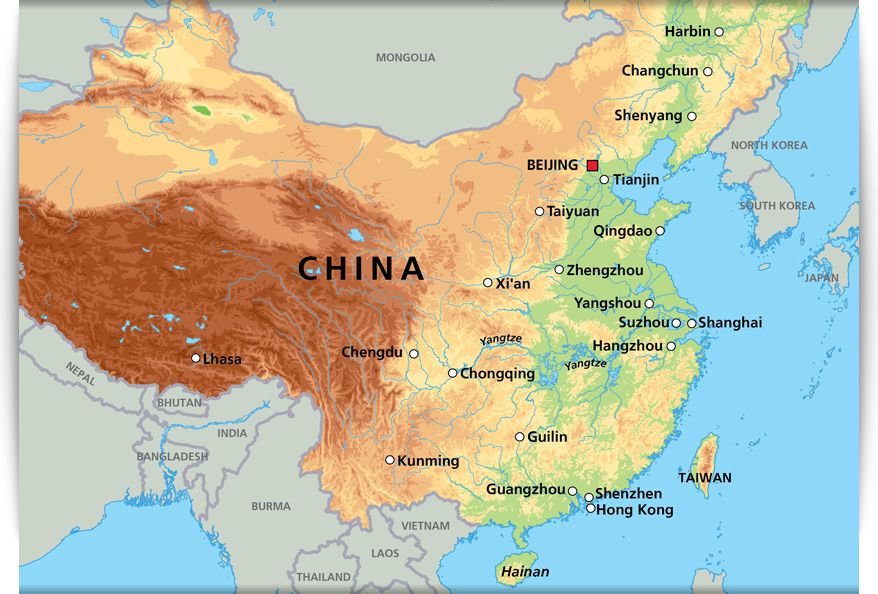
Beijing has multiple rivers traversing the current municipal area, and they were dammed and directed into channels, or directed underground as the city grew (same for London, by the way - London has multiple historical rivers that are now entirely or almost entirely underground, not just the Thames)
London, Rome, Athens, Lisbon, Dublin, Istanbul, Amsterdam, Venice, the list goes on and on (with the last two historic capitals being right in the water, not even coastal; and while I'm aware that Venice is not a capital these days, theirs was a formidable empire)
London used to be the seaport of England (before railways outsourced this to Southampton); whence do you consider the name Docklands (the huge area downriver of the Tower)? The rest is just nitpicking ("modern Piraeus is not part of Athens") and moving the goalposts (first it's "historic capitals", now it doesn't matter because Istanbul is not a de-iure capital at present, even though it de-facto is? Plus, there's a major stretch of history between Constantinople and present day)
Good harbors happen to be full of wetlands. The current reality, where there are practically no wetlands near large coastal cities, is very artificial.
> I'd like to see the same map but excluding national parks/public spaces.
This is a major aspect, I think. A lot of land in the west is federally owned. This NY Times article[0] states that 47% of the land in the western US is owned by the Federal Government. It doesn't look like there's 1-1 overlap between the empty census blocks and the federal land ownership, though.
I grew up in Eastern New Mexico, sparsely populated but also remarkably scant in public land. Noticed a lot of those green spots fell there.
Wasn't for lacking of trying, you drive through and occasionally you'll see the remains of old buildings. Mostly schools I think. For some odd reason the schools were always built with rock while everything else was made out of wood.
Basically what happened is that people came in after the Homestead Act to try and settle, found out that despite all the grasses it's still basically a desert, and gave up after the Depression.
There's also the town of Tolar, New Mexico. That one's special. It got leveled during WWII when a train carrying bombs derailed.
Nowadays I think most of the land between Clovis and Roswell is privately owned by ranchers.
Well twenty eight percent is just in Federal lands. So throw in state, city, and local, properties and we can cover a lot. I wonder how much is considered water way? Not sure if that is defined as federal land, but lakes and rivers eat up a bit too. Top it all off with places no one wants to be
Its an odd article that seems to be more sensational than necessary.
I think it's meant as a response to the election maps that show Trump favorable areas covering about 90% of the US. The fact is very few, if any, people live in much of the US so the map doesn't show what some people think it does.
> Despite having a population of more than 310 million people, no one calls 47 percent of the USA "home".
It's a fairly meaningless number resulting in an arbitrary choice of binning. If I defined "home" as "home is where the heart is" and used bins about the size of a human heart then I could say that no one calls 99.999968 percent of the USA "home".
Boulder isn't that bad, isn't it only a 10-30% cut off base salary? The good strat is to get hired in MTV and then transfer to Boulder, your GSUs will still stay the same size. The better strat is to get hired in Zurich and then transfer, even bigger bonus!
Lower than in Bay/NYC, but still good, partially offset by the lower state tax rate, and (signing) RSUs aren't any lower than in the Bay, which means that take home pay for someone in Colorado after rent can be higher.