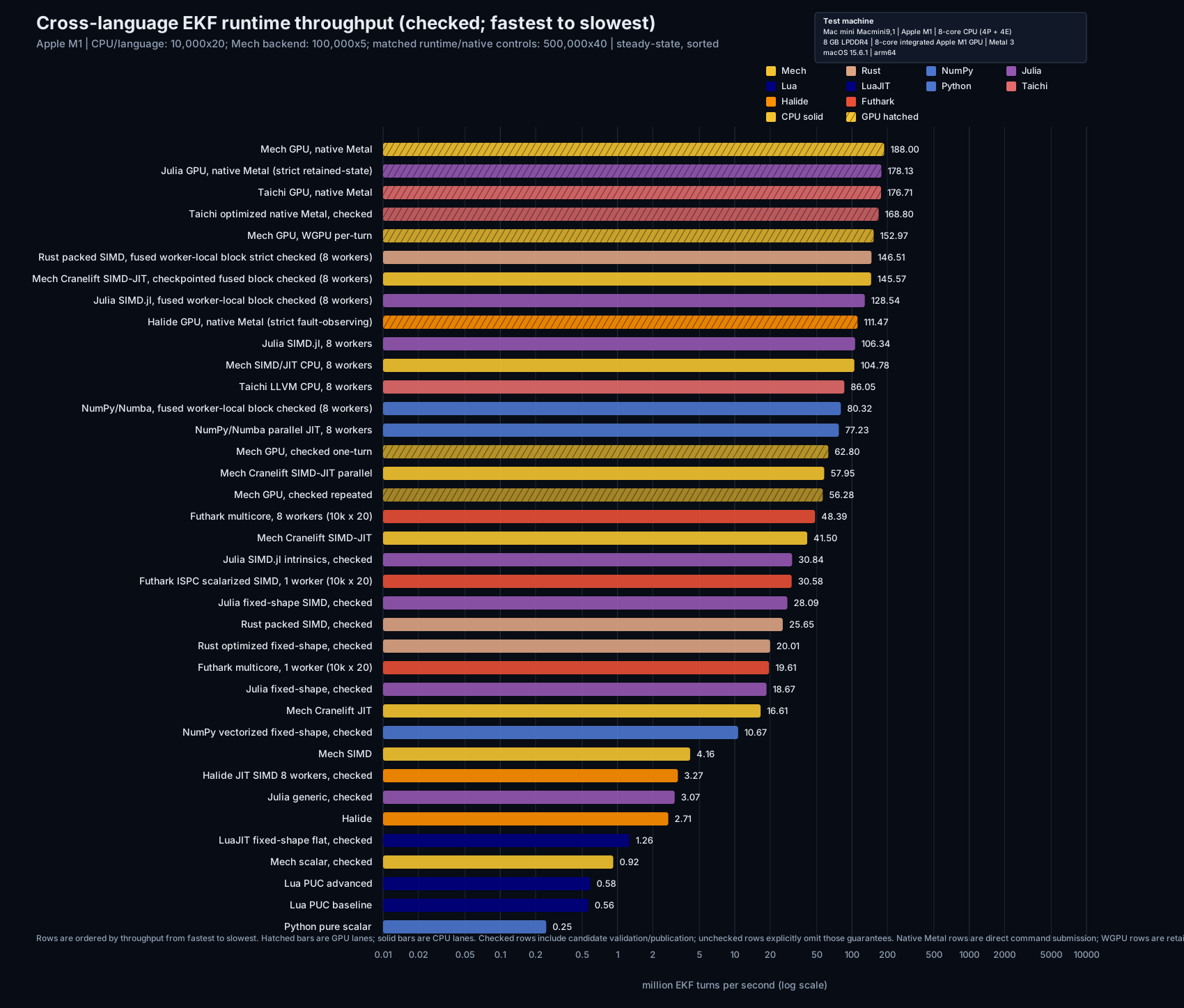
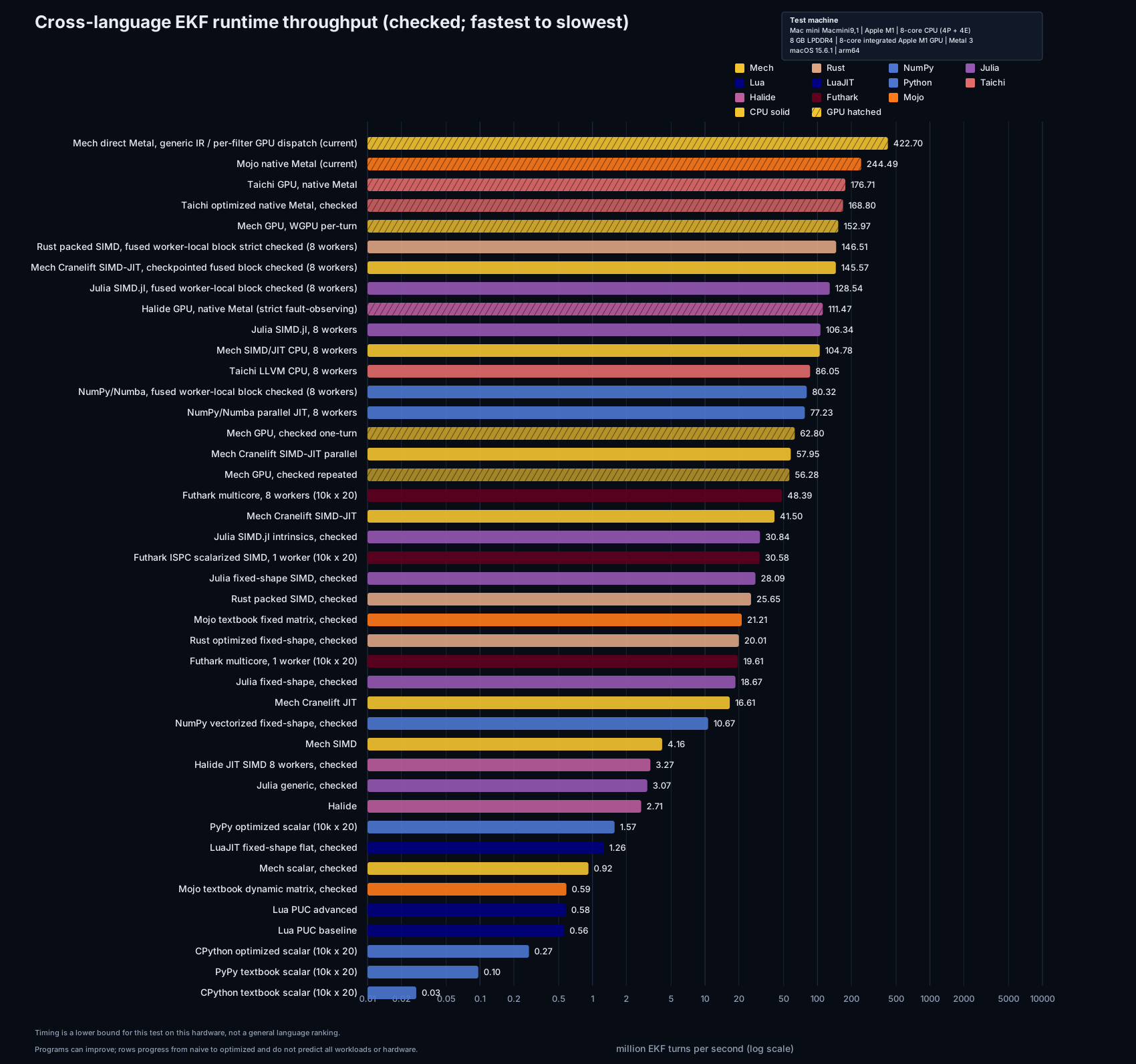
I did some Julia benchmarking over the weekend against a bunch of languages if anyone is interested. The workload is an EKF on an Apple M1, I'm trying to do as many as possible in parallel:
Compared against Taichi, Halide, Futhark, Rust', Lua, LuaJIT, Numpy and pure scalar Python. Julia holds up great it can run basically as fast as you'd like! (These are not apples-to-apples comparisons, picture this as a basket of fruit)
'The Mech results should be understood to be a lower bound on how Rust would perform.
PyPy performs valiantly compared to Cpython -- even better than LuaJIT. I'm sure someone skilled at writing it could do an even better job.
I measured 3 Mojo implementations. The first is a dynamic implementation, it performs like a typical dynamic language. Then when you use Mojo's SIMD intrinsics you can get compiled-tier performance in line with Futhark, Julia, Rust etc.
Then if you use their Max toolchain you can compile Mojo directly to Metal, with performance at the top of the stack (for the amount of money Qualcomm paid they'd better be there!).
The Rust / Mech version was rewritten to put it back on top, but the unchecked test is about equal. Basically if a toolchain can emit direct Metal code there's nothing preventing equal performance it seems, so the magic is in the compiler. Although there is some abstraction overhead depending on how you get there e.g. going wgpu->Metal has a penalty over going directly to Metal.
The big disclaimer again is that all of these measurements should be taken as lower bounds for one algorithm on one machine. I'm sure expert performance engineers could do better.
I feel like this is a good place to bring up the "Have You Tried Rubbing a Database on It?" conf, which deals with this sort of topic. If you'd like to read about the intersection between Databases and X, where X is games, robots, user interfaces, developer tools, etc. there are some good talks there, and they're only 10 minutes each so very easy to consume. Also unlike TFA they are not AI generated.
lol that's funny, I have been working seriously [1] on a feature like this after first writing about it jokingly [2] earlier this year.
The joke was the assistant is a cat who is constantly sabotaging you, and you have to take care of it like a gacha pet.
The seriousness though is that actually, disembodied intelligences are weird, so giving them a face and a body and emotions is a natural thing, and we already see that with various AI mascots and characters coming into existence.
You know, that would actually be pretty fun and cool. Like if you had home automation set up with a "pet assistant", but it would only follow your commands if you made sure to keep it happy.
If it could somehow only work if I maintain the kitchen sink and counter, then maybe I'd be motivated to keep the house clean. The gacha game trains you.
I agree with this. I've been a fan of literate programming for a long time, I just think it is a really nice mode of development, but since its inception it hasn't lived up to its promise because the tooling around the concept is lacking. Two of the biggest issues have been 1) having to learn a whole new toolchain outside of the compiler to generate the documents 2) the prose and code can "drift" meaning as the codebase evolves, what's described by the code isn't expressed by the prose and vice versa. Better languages and tooling design can solve the first problem, but I think AI potentially solves the second.
It's a literate coding tool that is co-designed with the host language Mech, so the prose can co-exist in the program AST. The plan is to make the whole document queryable and available at runtime.
As a live coding environment, you would co-write the program with AI, and it would have access to your whole document tree, as well as live type information and values (even intermediate ones) for your whole program. This rich context should help it make better decisions about the code it writes, hopefully leading to better synthesized program.
You could send the AI a prompt, then it could generate the code using live type information; execute it live within the context of your program in a safe environment to make sure it type checks, runs, and produces the expected values; and then you can integrate it into your codebase with a reference to the AI conversation that generated it, which itself is a valid Mechdown document.
That's the current work anyway -- the basis of this is the literate programming environment, which is already done.
We actually have had literate programming for a while, it just doesn’t look exactly how it was envisioned: Nowadays, it’s common for many libraries to have extensive documentation, including documentation, hyperlinks and testable examples directly inline in the form of comments. There’s usually a well defined convention for these comments to be converted into HTML and some of them link directly back to the relevant source code.
This isn’t to say they’re exactly what is meant by literate programming, but I gotta say we’re pretty damn close. Probably not much more than a pull request away for your preferred languages’ blessed documentation generator in fact.
(The two examples I’m using to draw my conclusions are Rust and Go).
I think that's exactly what is meant, and it's a great example. The two places where literate programming have shined most are 1) documentation because it's a natural fit there and you can get away with having little programs rather than focusing on a book-length narrative as Knuth had originally purposed it for. But also 2) notebook programming environments especially Jupyter and Org mode. I think programs structured in these notebooks really are perfectly situated for LLM analysis and extension, which is where the opportunity lies today.
I remember when Windows Vista had to contend against the same allegations when it was released. It did have a higher memory footprint, but a lot of the ridiculous usage numbers people had published were the SuperFetch just precaching commonly used programs to give better application startup times.
SpeedBoost was supported by vista through windows 10, and although windows 11 regognises a speed boost USB, I do not know it it uses it. When I put windows 11 on two i5 8gb machines and plugged in two speed boost drives, it did not swap a lot to them, whereas in windows 7, under memory load it would use them, at least until I found ChacheMem v2.1 it would manage memory much better than windows ever could.
Windows back to window 2.1 386 supported swapdisks, i.e fake ram.
Contemporary PL designers who have inspired my programming language design journey the most are people like Chris Granger (Eve), Jamie Brandon (Eve/Imp/others), Bret Victor (Dynamicland), Chris Lattner (Swift / Mojo), Simon Peyton Jones (GHC/Verse), Rich Hickey (Clojure), and Jonathan Edwards (Subtext). My favorite researcher is Amy J. Ko for her unique perspective on the nature of languages. Check out her language "Wordplay" which is very interesting.
I'm building something like Lua for robots, you might want to check it out if you're looking to collaborate. I didn't know about Lua when I started it, but I did end up at an "everything is a table" metaphor because it seemed good for robotics. This does allow for cool things like hot reloading and such.
Although, we've since moved to having several distinct data structures which conceptually map to tables, but implementation and syntax-wise have differences (mostly for performance).
BTW Basis was a good idea, I remember reading about Nondeterministic replay is a big problem on platforms like ROS.
I think I could actually build what I was thinking of on top of basis, but need to think about some things. Serialization of internal state was kicked around as a design idea at the start, but didn’t see enough benefit back then. In any case basis isn’t quite dead, I still use the thing as a test bed for ideas.
Thanks for the kind words and keeping the joke going, I laughed at many of these responses. I think they'll make it in to v2.0 which should be out by 4/1
It makes sense that the first thing I'd get to the front page of HN is what amounts to a bad joke :P


reply