If there was a union in place, the massive over hiring that led to this wouldn't have happened and the competent developers would have made less money. So how exactly does everyone come out ahead there?
Despite the downvotes, this is at least partially correct. If unions were ubiquitous in the tech sector, companies would have been a lot more stingy with the hiring during ZIRP or boom eras. Or they would have been more creative with the hiring form - contractors, temporary staff, etc. None of these companies would risk locking in so many employees knowing that they'll be very expensive or impossible to fire.
I don't know about how a union would affect the standard salary being offered. I'd say that it could be higher for those essential enough to be "core staff", those that the company hires permanently knowing they'll be hard to get rid of and who drive the company forward because they're motivated with additional means.
So a union might drive the salaries and employment conditions up for the "core" team, while driving them down for the "temps". I've been through this as a unionized tech worker in both categories, and this is how it played out.
> Ends up in test environment for, what, a month.. nothing using getaddrinfo from glibc is being used to test this environment or anyone noticed that it was broken
This is the part that is shocking to me. How is getaddrinfo not called in any unit or system tests?
I would hazard a guess that their test environment have both the systemd variant and the Unbound variants (Unbound technically does not arrange them, but instead reconstructs it according to RFC "CNAME restart" logic because it is a recursive resolver in itself), but not just plain directly-piped resolv.conf (Presumably because who would run that in this day and age. This is sadly just a half-joke, because only a few people would fall on this category.)
> People want reasonable services from their government
Yes, though the definition of "reasonable" is a real sticking point
> and tighter regulation of markets
This is less clear to me, but I would agree people want less fraud and deception in markets
> with elimination of profit-taking middlemen
I don't think many people think about this at all, and it's another very nebulous term
> They want democratic socialism.
No, democratic socialists want democratic socialism. Most Americans do not.
> Meanwhile, the right wing has been telling them that public libraries and public schools and everything good except profit -- is communism.
I disagree with basically everything the current incarnation of the Republican party is doing or stands for, and silly statements like this aren't helpful.
Healthy economies "should" have a reward for specialization where both supplier and purchaser win. There is no reward anymore for economic specialization in the context of ice cream; its cheaper to make your own, now. This is a troubling long term implication for any *-as-a-service
There's a second even worse economic implication in that ice cream has long been affordable to 100% of US households... Now due to permanent long term economic decline its seen as acceptable losses for some not to afford it anymore. Again, troubling long term implications.
1. Ice cream has never been affordable to 100% of US households.
2. I strongly suspect the couple in the article could afford ice cream if they brought less beef, less name brand items, or were just more savvy shoppers.
3. I don't know how you determined that it's cheaper to make your own ice cream, but I would say that's generally inaccurate based on personal experience and a basic assessment of input costs and a reasonable value on your time.
4. If you really feel like ice cream is overpriced, you have identified an opportunity!
I've reduced my ice cream intake close to 0 solely based on price. Specifically, I remember the prices from long ago to the current just under $10. To me, ice cream should not be the same price of a cheap bottle of wine or other alcohol as an example comparison. We all have our own individual red lines, but ice cream prices crossed mine some time ago
> Most households are able to afford more than the essentials and do care about the cost of entertainment.
1/3 of the households make less than $50k. Mean survival budget is $35k-40k. After taxes, if a third of the population can barely meet a survival budget, an index like this needs to be part of the overall economy.
And the point of the ALICE index is exactly to address what you are pointing out. When wages, social security etc. were increasing proportionally to the essential goods, it made sense to have the CPI include other goods and services, allowing policy makers to use it as a basis for policy directions. However, when essentials become expensive faster than non essentials, it creates a problem for policy makers. It explains the “vibeflation” where policy makers were pushing back hard on economic struggles that most people are feeling by pointing to CPI numbers that show a 2-3% inflation, meanwhile people are struggling and dipping into savings to make things work.
Beyond just the monthly/yearly changes are the cumulative affects of those changes and disparities of wage stagnation with record inflation over time. Increased rent/housing costs are also a massive factor.
Not even counting the number of households who are at credit card and other debt limits at close to 30% interest. Trump has given some lip service to trying to get this down to 10%, but it'll really take congress to make anything happen that has a chance of sticking.
Thinking about the “overall economy” increasingly means focusing on the spending of the rich, and ignoring the poor and struggling. A consequence of increasing inequality is the rich make up more and more consumer spending. Consumer spending can therefore easily look great while most people are struggling to get by. There really is no “overall economy”, there are many many different stories happening all at once, and focusing on simple metrics lets you easily fool yourself.
> Thinking about the “overall economy” increasingly means focusing on the spending of the rich, and ignoring the poor and struggling. A consequence of increasing inequality is the rich make up more and more consumer spending.
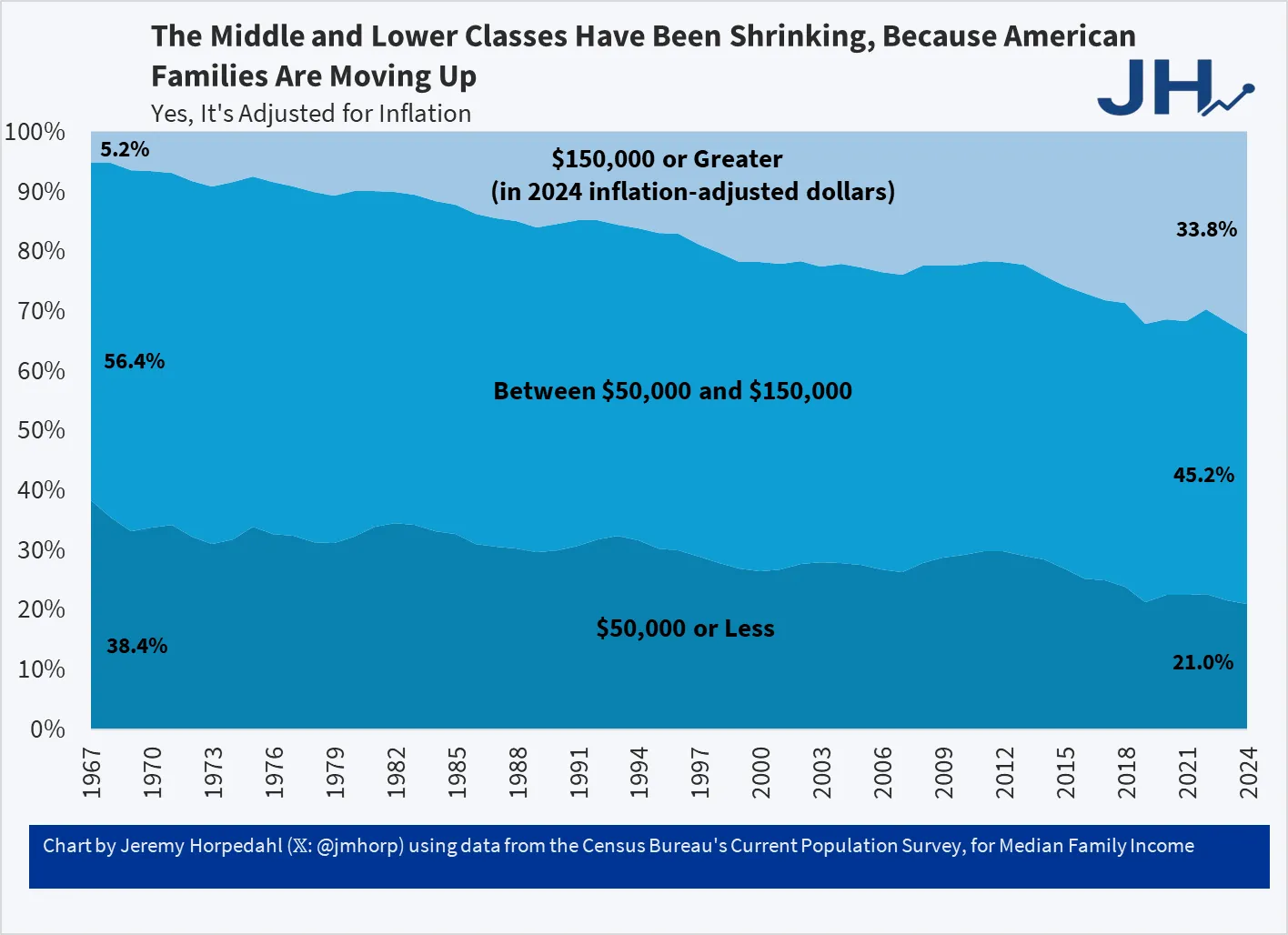
It means increasingly focusing on the spending of the rich, because the population is increasingly richer. Proportion of families making more that 150k (in 2024 dollars) has gone from 5% in 1967 to 33% in 2024, while both middle class (50k-150k) and poor (<50k) have decreased. [1]
Great example. The population as a whole is richer like you say, and also the richest 10% account for half of consumer spending, compared to 36% 30 years ago. [1] So yes, consuming spending has become more of a metric of the wealthy’s spending habits.
No single metric tells the whole story, and by taking them in isolation it’s quite easy to lose the forest for the trees.
It doesn't make a lot of sense to measure the cost of entertainment in terms of monetary inflation though. Hugely price-tiered status-signaling goods like kids toys just don't respond to market forces in the same way commodities do.
1. It sounds like you're just describing a larger "basket of goods"? That data is available, but also valuable, and I'm not sure why the basket of goods tracked by the CPI or NPR would be inadequate.
2. This specific exercise is designed to be relatable to individuals (in general, and specifically ones such as the people interviewed in the article who claimed that their grocery bill went up about 50% in a year, which is implausible to put it politely) so that they can understand the actual level of inflation rather than the one they imagined in their head.
The person you are responding to doesn't acknowledge that the Democratic Party represents the left wing in US politics, presumably because they aren't beholden to the small far left portion of its constituents.
I wouldn't spend time trying to justify your stance to him, which is a very reasonable one IMO.


reply