Fuji has had the film simulations since the original first-gen X100. Every generation gets faster, has better AF and an added film sim or two. The first and second generation are slow by today's standards and AF is not fast or reliable, but generation three ("X100T") and four ("X100F") are quite good and available used. Generation five ("X100V") did get a new lens that's somewhat sharper as well, but it's probably not why you buy an X100.
And the slow AF for the the X100 and X100S wasn’t too much of a problem because the vast majority of the buyers for those two were already film rangefinder enthusiasts who knew how to manual focus/zone focus.
I find it a little interesting that the X100V is blowing up the way it is given that the X100 line is known for its learning curve, but if it means more people learning how to manual focus/zone focus/manual exposure, I’m all for it.
Is there a reason to prefer that the camera applies these effects at capture time, rather than doing it later in a photo management program like Lightroom or Apple Photos?
This is a good question and I was actually thinking about this today. The filters are on camera but you can actually get some filters for the X100V on Lightroom a well. I think the on-camera filters and the filters you can use w/ Lightroom are specifically meant for the RAW files off of the X100V. I am not sure you can apply them to let's say Canon's RAW files, but I haven't tried.
Some would call that "machine learning". I know it's hard to make a distinction, but the term "AI" is too ill-defined to argue about what constitues "real AI" and what is mere machine learning. Are those examples "thinking machines" (~= "artificial _intelligence_"? I'd say no, they are very good statistical pattern matchers without any understanding of the subject matter for the most part.
GPT-3 and image generators that have somewhat of a world-model are, imo, closer.
Intelligence is a Heap Paradox and trying to define where the boundary between Artificial "Intelligence" and "really good pattern matching" is a fool's errand. Intelligence is a continuum from the simplest bang-bang thermostat all the way up to the human brain.
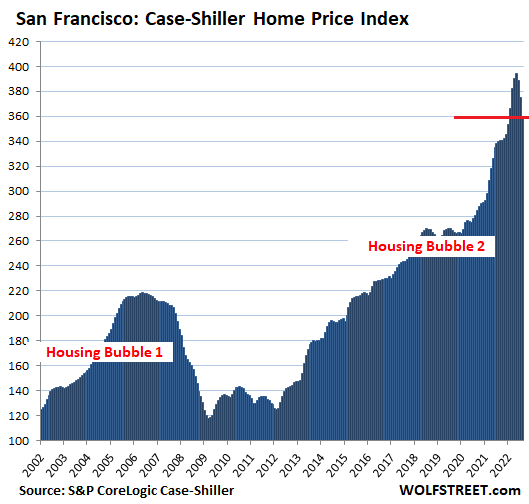
In my opinion, housing is mostly inelastic unless people have to sell due to external circumstances (like being unable to pay mortgage). I don't expect the housing market to decline more than 15-20%, as the more people are "underwater" from their purchase price, the more likely they're to just "wait out the slump". And with low interest rates locked in, many probably don't want to roll their mortgages now. Since we've had such a crazy runup [1] ([2]) in the past few years, a 20% decline still puts many sellers ahead, but I don't think they'd sell at a loss if prices dropped further. SF Case-Schiller is up 25-30% from 2020, and ~50% from 2017, for example.
My personal opinion is that once you've bought in you're locked in and along for the ride. If your house is down 20%, so is most likely the house you consider moving to. Unfortunately housing is often seen as an "investment".
Plus, if you want to fly it "really" legally you often can't. In CA, according to my own research:
- you can't fly over private property,
- pretty much _ALL_ parks&rec departments and counties in the Bay Area prohibit flying in their public parks,
- flying over e.g. public parking lots and the likes is probably a gray area as there's potentially people around,
- airspace at least around here is often regulated anyway, many airports, hospitals with heli pads (not 100% sure about legality of flying within their "zone") and national/state parks that are also no-fly.
I tend to fly in smaller parks and just risk the $500 (?) fine and getting the drone confiscated :( It will just get better once this can happen retroactively :/
But this is mostly why I got a DJI Mini, it's pretty quiet and doesn't draw a lot of attention.
Yes, you can. The FAA regulates airspace; the state has no jurisdiction.
> pretty much _ALL_ parks&rec departments and counties in the Bay Area prohibit flying in their public parks,
They can restrict taking off, landing, and "operating from".
> airspace at least around here is often regulated anyway, many airports, hospitals with heli pads (not 100% sure about legality of flying within their "zone") and national/state parks that are also no-fly.
In most cases it's as easy as a LAANC request, made through a mobile app and approved instantly.
It's worse in some places than others but I had no problem flying in Santa Cruz a few months ago. San Diego is a nightmare, between military bases and the civilian airport there.
It sounds like they need to hire people that have the most basic understanding of security and authentication -- but that's just too expensive when most customers are looking for the cheapest camera and barely care. Also, you know... beg for forgiveness and all.
I wouldn't be surprised if this happened to this company before.
I can definitely tell a big difference in colors and details (sometimes a tad too much) from a 2016 iphone 6 to a 2020 Pixel 4 eg. But the jump from the Pixel 4a 5G to the 6 Pro wasn't that big, maybe 10-20% subjective improvement. I expect the new generation's improvement to be even more marginal and won't update.
Exactly, I wouldn't be surprised if a driver's paycheck is a substantial part of the total cost, so you might end up needing two to four trucks to haul the same payload due to extra weight of the batteries (and there's an 80k combined weight limit afaik). At $25/hour average (googled) trucker pay that 200 mile trip taking 3-4 hours would cost > $75 per driver. Fuel savings are calculated to be $140, every additional driver costs at least $75.
That's maybe the best use-case for FSD I've yet to see.
The average weight of a reasonably new semi is around 20k pounds without fuel which leaves 60k for cargo. Every pound the tesla weighs above 20k is a pound less cargo.
Another consideration is the fact that tesla trucks won't be paying for huge amount of road wear they cause. The national average of state/federal tax on a gallon of diesel is around 65 cents. As things stand now an electric semi (just like electric cars) will be getting a free ride.
Is it any worse than paying $650 literally every month (avg car loan payment now afaict)?
The problem is that people can't save. It'd be prudent to buy the car for $2k and save the remaining $3k somewhere to cover repairs instead of the 5k down payment.
Also, to be fair, what used to be a $2k Toyota was probably more like $5+k lately.
Yes, it is worse. Because if you get a new or newish used car and have to pay $650/month, each month you still have a decently working car.
If you get a piece of junk for $2k and then have to put $1k into it again periodically, during that whole period you have either a pretty lousy car, or a non-working car.
And, as noted by the GP, that will often mean you need to call out from work. Which, for many of the kind of people who would be doing this in the first place, means a) they absolutely don't get paid for that day (all hourly work, no/very little PTO), and b) they will probably get fired if it happens more than once or twice.
Also:
> The problem is that people can't save. It'd be prudent to buy the car for $2k and save the remaining $3k somewhere to cover repairs instead of the 5k down payment.
You.....really don't see the problem with this?
People can't save. Not just "people are bad at it", "people can't manage money", "people don't know what's good for them". People literally do not have enough money to both live, and save. It's nothing to do with "prudence".
I'd estimate about 75% of the US population would have access to an Uber when the car needs to go to the shop (and $650 would buy a few rides). I wouldn't buy a 15 y/o Fiat/Chrysler but a Toyota or Honda should be decent enough not to need repairs every month, maybe every 6?
And (another thing most people skip) that can help a lot is preventative maintenance and regular checkups that you can schedule at your own convenience that would catch a lot of problems proactively. And you'll have to bring in your leased car too lest you want to get dinged even more at the end.
A cheap car isn't just something you buy and forget, it needs some planning and care that i honestly think most people can't handle. Probably because they're so overworked as you said. But is paying be nearly $30k over 3 years really going to get you ahead, just so you to get you reliably to your job every day to pay for that car? Or is it worth the effort to plan and manage a shitty car for 3 years to save 15k?
If VR takes shape as imagined by Meta, though I personally don't believe it will, they will absolutely be in an excellent position to market to and profile you. I think the vision is that everyone spends most of their online time in VR - so interacting with all of one's interests/hobbies/discussions, online contacts, searches. All very valuable for monetization through advertisement and profiling.