Not being able to exclude people because of preexisting conditions and ensuring children have access to coverage seems like a pretty big success story.
Is it perfect? No, probably not. But repealing it would likely increase the budget deficit according to the CBO and put a large number of folks into a much worse situation than they are in now.
Indeed, at the time it was widely understood that Obamacare was about access, not cost. This was a necessary compromise in order to placate the insurance industry.
On the one hand, yeah of course guaranteeing coverage for children and preexisting conditions is an obvious win. And removing coverage caps.
But beyond that... has average life expectancy measurably increased because of this "extra" insurance coverage?
Has the number of medical-related bankruptcies measurably decreased as a result of the expanded coverage?
I can't find solid data but everything I've seen suggests that those haven't really changed at all.
Given that, in the grand scheme of things, has anything actually improved for us, collectively? Healthcare is much more expensive now, but maybe that would have happened regardless.
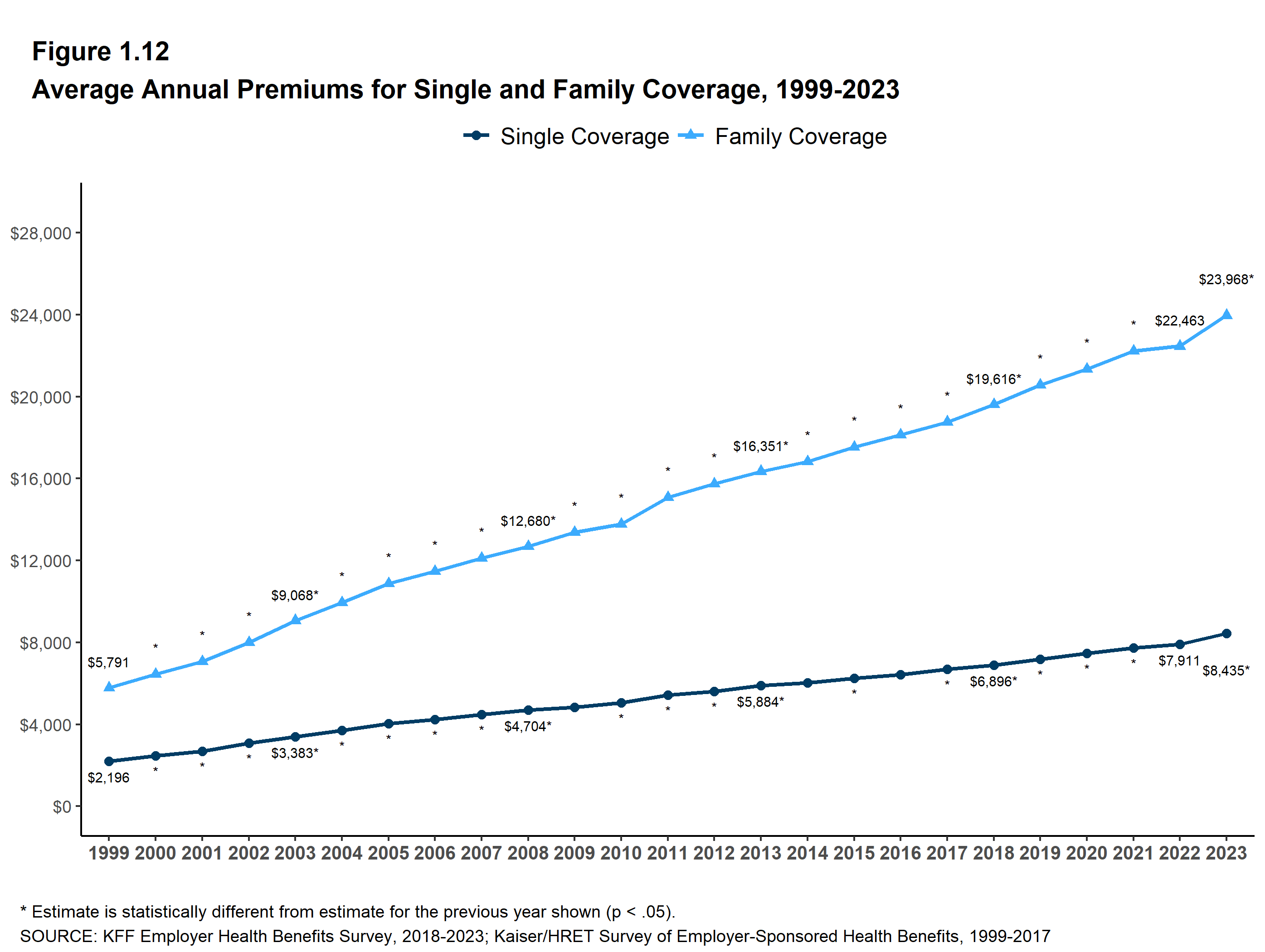
Where on the chart did Obamacare get passed / implemented?
It was always about access, not cost. That pissed me off back then that single payer was not even on the table in negotiations. It was watered down to get it through, but I am still thankful that something got passed... I would still have a messed up rotator cuff from when I was 15 otherwise.
One of the big consequences of government programs is the unseen costs. How many businesses never got created because of the increased burden that Obamacare placed on everyone, how many ideas never came to fruition, how many new technologies never got created? How many young entrepreneurs never took the risk that could have lead to a great new technology, found a cure for cancer, etc.?
Problems like the need for health insurance, and the high cost of health care in general, have only arisen in the first place because unnecessary government-imposed regulation and government-imposed overhead have wiped out nearly all real competition in the health care sector, and introduced numerous other inefficiencies along the way.
Artificially limiting the ability of new participants to enter the market on the supply side, for example, creates an artificially-oligopolistic environment without the natural competitive pressures that force pricing down.
Even worse, this in turn results in an environment that attracts people and organizations who want to exploit these government-created inefficiencies for personal profit, rather than attracting people and organizations who want to provide higher-quality and lower-cost service than their competitors.
The end result of this government intervention is artificially-high costs for abysmal service.
The situation only gets worse when government tries to intervene with even more "solutions" for the problems that government itself created in the first place.
It is objectively a success lol. The elimination of preexisting conditions and annual/lifetime coverage caps alone was huge. Not to mention the tens of millions of people who received health insurance who wouldn't have had any at all.
It is insane to me you are going to sit there and try to act otherwise.
Are you currently playing the premium for a family of four with a decent deductible where it doesn’t feel like you empty your pockets because you want to make sure your pain isn’t going to kill you?
I'm quite naive, isn't the individual mandate being removed the reason why the premiums are going up? i.e. lots of healthy people stopped buying and thusly leaving only the expensive guys?
There were some pandemic era programs that increased the number of insured people, so it is possible things have changed since 2022. Either way, there is no evidence that the repeal of the individual mandate actually resulted in less people with health insurance.
Yes, that's a significant aspect of the problem now.
They were going up before, during, and post ACA mandate, though. They've been on an upwards march alongside the underlying per-capita healthcare costs for decades. https://www.healthsystemtracker.org/chart-collection/u-s-spe... ("Total national health expenditures, US $ per capita, 1970-2022" - $2k/year --> $13k/year per person)
The point is not about insurance in general, it’s the isolation of the individual market from the pools of large employers.
Yes the healthy will always be subsidizing the rest, but it’s a specific subset of healthy bearing that burden. It’s not the system as a whole.
> The US needs a proper public healthcare system. Good luck finding a way to make that happen though.
Ban corporate self insured policies so that the risk pools are unified to contain everyone.
Eliminate the deduction for offering insurance. Right now the same policy is cheaper if paid by the company as its pretax dollars (vs after tax dollars for an individual policy).
I don't deny that it sucks that health insurance is so expensive. Of course it sucks. And I have tons of empathy for anyone who is suffering under the expenses. But blaming our current costs on PPACA is just not supported by the evidence I'm seeing. If you have other evidence I should look at, I welcome it.
Insurance is going up across the board, it’s not a healthcare thing. Obamacare can be successful while premiums go up as well, it is not mutually exclusive.
How do you know that Obamacare isn't the thing that's causing insurance to go up across the board?
If everyone is ensured, no matter the pre-existinf conditions, people take more risks, live more dangerously, drive a little faster, eat a bit worse, etc.
Nobody ever talks about the hidden consequences of these oh so wonderful government programs.
Socialized healthcare systems tend to create stigma around peoples unhealthy choices. It no longer is harming just your health and wallet. It is costing society money.
This creates an incentive to pass laws prohibiting products and lifestyles deemed unhealthy.
Privatized healthcare has the opposite incentive, whereby unhealthy choices may be ignored or even encouraged because they're a money-making opportunity.
It turns into this endless cycle of "we need to ban this and ban this and ban this" and never looking at the actual cause of the problem. Just the government creating more work for itself and creating more laws to control people's actions.
I think the stigma point is definitely true, but it's not doing anything to improve things. Obeise people are looked down at by society, but in the US 70% of the population is obese and the number just keeps growing. The natural incentive system is broken by government programs. Why should I bother eating healthy and limit my diet when I can just get health insurance when I get diabetes?
Obamacare was talked about for YEARS before it was passed, I don't think it would be far fetched to imagine that the insurance companies started raising prices as soon as the topic started getting traction. It's a multi trillion dollar industry after all and they spend big $$$ on analysts to plan for the future.
Of course the price went down after Obamacare got passed. Can you imagine how much outrage there would have been if it had passed and everyone found out that it was going to cost them double or triple what they used to pay? The government took out some loans (using your future and your children's future taxes as collateral) and made sure they were lower. And then a year or two later when everyone stopped focusing on it and it had gotten normalized they stopped propping it up.
Thanks for the share.
I imagine the costs has a high correlation with the American obeisity epidemic, which has continued to get worse and worse. Obamacare creates a disincentive for people to live and eat a healthy lifestyle. Why bother eating a good diet when you can just get health insurance anyways no matter your pre-existing conditions (be they natural, or much more likely, due to your lifestyle choices).
Eg: 90-95% of diabetes cases in the US are Type 2 (Lifestyle related)
I think it’s a bit of a stretch to say people are unhealthy because insurance is cheaper. The average person does not live in a way they want to harm themselves.
I would say it’s because most Americans don’t walk or bike much, food desserts are plenty, transit infrastructure sucks, overworking, and lack of time for vacation/self-care all contribute.
You are forced to have a job if you expect typical medical coverage, and making people do something they don’t want to do won’t incentivize them to take care of their health.
> Nobody ever talks about the hidden consequences of these oh so wonderful government programs.
Are you ok? Did you just wake up from a coma and suffering from some selective amnesia? Have you been living under a rock? Maybe you missed any and all libertarian content? Or the articles about how safety precautions give a sense of safety which result in more risky behaviors? (From bicycle helmets to OSHA stuff.) But maybe you have ran into articles about how car safety standards act as a birth-rate suppressor? No?
Spare us this "why nobody thinks of the consequences".
Premiums are going up because healthcare costs are going up, because there's a growing number of elderly, also because all services related costs are going up. (Because the Baumol effect, and so on.) Not to mention that as economic surplus grows (ie. GDP grows) people are willing and able to spend more on healthcare.
...
Check veterinary service costs and pet insurance premiums. Obama did that too?
The premiums are going up because someone has to pay for the profits of the for profit insurance companies, of the for profit hospitals etc
They all have to report yoy increase of earnings right?
So there enjoy your capitalistic health insurance. Which by the way dumps you once you are old, then I have to pay for you too despite the fact it is you who wanted a completely deregulated health insurance market.
> Can you give me one example of government wealth creation?
I think that's the wrong question, and a loaded one at that. It is probably more objective to think about government's role in providing a stable foundation for the private sector to produce wealth. There are countless examples of that, such as a reliable and just regulatory framework within which to operate, negotating treaties for international trade, creating infrastructure that lead to incredible wealth creation (think the internet), to name just a tiny few.
All right, but apart from the sanitation, the medicine, education, wine, public order, irrigation, roads, a fresh water system, and public health, what has the Rom-- government ever done for us?
At best, government and civilization is a chicken-and-egg relationship, where you could perhaps argue that anywhere civilization occurs, a government does as well. I doubt that's even provably true anyway.
But the idea that a government first forms and then bestows upon us the gift of civilization would be incorrect. I suppose you're being flippant since you didn't bother to justify that comment.
> that anywhere civilization occurs, a government does as well
This is because beyond a certain amount of complexity (e.g. on the path to civilization), you better have a government what orchestrates favorable outcomes.
One way to frame it might be a chicken/egg problem, as you say, but that just begs the question whether one can meaningfully exist without the other?
If we wanted to do this properly, we would have to look at opportunity costs, and see what that money / resources could have done otherwise.
To give a related example: war often leads to innovation. In our current universe, the second world war lead to digital computers.
However, IBM (and others) were already hard at work improving their computing devices and would have landed at electronic, digital computers sooner or later, too. Without spending something like ~50% of world GDP nor killings tens of millions of people.
For another really egregious example: have a look at manned space exploration. Specifically the International Space Station. Google said its total costs were about 150 billion USD. Compare '20 Breakthroughs from 20 Years of Science aboard the International Space Station' https://www.nasa.gov/mission_pages/station/research/news/iss...
That least is pretty meagre. They even have to cite spending money by itself as a 'breakthrough'. Almost all of their 'breakthroughs' could have been done for cheaper with unmanned space flight (and most of them are useless and irrelevant anyway.)
They could have left those 150 billion USD with the taxpayer, and private industry would have surely used them better.
Yes. I didn't bring them up, because most of their customer base is still governments, and that would have muddied the argument.
(I think that (most of) space exploration should be left completely to the private sector, not just the execution, but also the financing.
Even if you think that the government should be involved in the sciences, manned space flight is pretty much a more expensive version of unmanned space flight.
It's useful as entertainment only, so far. Eg the moon landing was great entertainment, better than a Marvel movie. But also more expensive. I don't think the government should be involved in providing entertainment.
But in any case, after the moon landing, the amount of inspiration coming out of manned space flight has dropped dramatically.)
There's more to the private sector than profit seeking corporations. Basically, everything that's not the government 'lives' there: clubs, charities, churches, foundations, etc.
If there's enough will in the population to vote for spending tax payer money on space exploration, surely there's enough willingness to crowdfund the whole thing?
And if people only want space exploration if they can vote other people's money to finance it, but don't want to put their own money where their mouth is, I'm not sure that would be a ringing endorsement?
> If you’re fine with there being no space exploration whatsoever. Which is a reasonable view, it’s very expensive and highly unprofitable.
I like space exploration, but I wouldn't want to force other people to pay for my aberrant preferences.
Yeah, it’s a perfectly reasonable view. We just shouldn’t pretend that space exploration would still be a thing if governments couldn’t finance it (which your previous comment sort of implied)
Manned space exploration would probably not have been (much of) a thing. At least not until much later when the technology has improved.
Unmanned space exploration would probably still have happened to some degree. SpaceX has a lot of private customers.
(And I'm much less against governments financing unmanned space exploration than against them financing manned space exploration. That's just such a money sink.)
There's almost no use of nuclear weapons against two nuclear armed countries that doesn't walk up the tit for tat escalation ladder. Perun did a video about this a while back and it's pretty terrifying.
That is a deal breaker for me. I use auto-fill extensively and my browsing is 50/50 Mac and iPad so having a separate set of passwords on Mac and iPad is super annoying.
“Public Broadcasters Fear ‘Collapse’ if U.S. Drops Support,” announced a New York Times headline in March of 2017. Michael Grynbaum and Ben Sisario reported for the Times:
Public radio and television broadcasters are girding for battle after the Trump administration proposed a drastic cutback that they have long dreaded: the defunding of the Corporation for Public Broadcasting.
The potential elimination of about $445 million in annual funding, which helps local TV and radio stations subscribe to NPR and Public Broadcasting Service programming, could be devastating for affiliates in smaller markets that already operate on a shoestring budget.
In all of this it's a matter of scale.
Products with 100 million users can amortize the costs over a much larger number of deployments. Even the smallest details become valuable at that point. Conversely, at a certain level of deployment, usability is not worth the time investment. Machine Learning researchers can frequently get away with a loose collection of Python scripts with a basic set of instructions that probably worked on their local setup.
Are they really an outlier, or just the best at what they're trying to do? I mean I guess you could always say that the best is an outlier since only one can be the best.
They're the best at what they aim to do. Again, if everyone did it or they were less unique then it would be less exceptional.
The point is, it's hard and rare to get into such a position. Yes, eventually there will be a new Apple, but not yet. So anyone *today* looking to perform well should probably be more practical.