Just to add on the coordination point. Python has a large user base, and that's not to say larger user numbers equals better/superior. So the broadcasting of intention or direction is certainly welcome.
Not only is it a large user base, but a varied one too. Flask, Django, FastAPI, Twisted...and that is just to name the web frameworks! We have scientific use, research use, cli tools. Perhaps in some cases end users (developers or not) of those tools may not be aware Python is the foundation of said tool.
Anecdotally the Erlang users I've met have been incredibly knowledgeable and in tune with the language features and development. I find that pretty cool.
In my opinion, an argument can be made that Elixir is the most prominent web framework for the language, so developers can just keep up with that and not the language if they wish. Compared to the Python ecosystem. As Erlang inevitably grows in popularity, it too may fragment.
Was about to suggest adding Kelsey Hightower to the title, as he's someone in the community many may already know of...then I look at the username! :D
Always enjoy his videos whenever I come across them, even if I'm not working on anything remotely related to the content. Waiting for whatever random tech surprise he throws in sometimes.
Almost everyone you see who has a personal brand that is popular on the conference circuit is willing and able to do this kind of self promotion. It’s not for me, but I don’t see it as objectionable because I see it as part and parcel of the role, and I think the role is a valuable one that should continue to exist. Technologies benefit from having some well known and well liked “names” behind them, and it gives them the confidence to try something new instead of the old thing which moves the industry forward.
Perhaps, but I suppose I'd personally nudge a friend to post it for me? Maybe humility isn't valued much in the Valley, but coming from elsewhere it feels off.
This is a side of me I would like more people to see. The whole person. So I submitted the article. I grew up in the South and don't live in the Valley. It required a bit of humility to even share this side of me, it's very personal, and in someways, not very flattering, but I wish I knew that successful people also come from very average backgrounds.
I'm going to flag this as lazy flamebait, but I hope you think hard about why you felt compelled to post this in this comment thread and then not do so in the future.
Personally I find the idea of asking a friend to post a self-promotional link without disclosing the affiliation, because I'm too "humble" to post it... quite the opposite of humble.
Many of those Tweets reminded me how much I've grown as a person. Those Tweets reminded me that I made the right choice treating everyone with respect and in some cases helped them in their own careers.
It was my way of saying thank you and hoping those stories would inspire others and bring a little joy to their day.
I'm very glad he's getting the attention and hope he keeps getting it. He's an inspiring fellow, and I'm happy that he will be the one who will inspire some folks out there to enter tech.
Humans are weird. We like seeing people succeed against hardship and enjoy reading success stories. But the enjoyment of their success can’t be to excess, otherwise people will see them as unscrupulous or arrogant. Not a slight against you or OP just interesting that we have our own individual thresholds of what kind of self congratulating is acceptable until it turns sour
Hi Kelsey! I love your origin story. You've come a long way. Do you mind if I introduce you to a friend of mine? He's not publicly famous but he hustles pretty hard and he's a great friend... I think you two would get along really well. (I'll get in contact with you on twitter)
Your Udacity course https://youtu.be/zZ2NgJ2-A4c was my first taste of k8s and really got me excited about it. I eventually decided to focus and specialize around it and couldn't be happier. Thank you!
https://www.thirdeyelabs.com/
- real customers
- real money
- multiple-sites
Plus they beat Amazon to this concept by a good few months. https://www.thirdeyelabs.com/news. Granted all the focus/attention in this space is in the US. But it is happening elsewhere too.
"Beat them to this concept"? I can't even remember the first time I heard about this idea. 2003? 1995? I half-suspect I read about the idea in OMNI Magazine.
It's always been a question of when the supporting technology was going to be good enough to make it work. The idea has been around long enough for most of the early patents to expire.
I can speak somewhat for the UK, but I assume the same can be said for most of Continental Europe, Japan and China where (deep) underground tunnels for have been around for a long time.
The deeper tunnels of the London Underground are "bored", that is a full circular profile is cut for the tunnel path. This is contrasted with the "cut and cover" method, which just digs a pit, builds a support structure, and covers it back up [1]. Cut an cover is not feasible for deeper tunnels, too much structure is required to hold up the weight of earth above you. Some of the older lines on the underground were dug this way; fun fact: You'll notice in NYC or Boston for example, that the subway stations are all square in their tunnel shape profile, and you can visibly see the support structures, that's because they are mostly not very deep, and used the cut and cover method. I'd be interested to know if any US cities have deeper tunnels? (Despite not being very deep, cut and cover is a very good way to quickly build mass transport for growing cities.)
The BBC has been doing programmes on the Underground for years, so there has been a steady steam of documentaries on this topic! I apologise if you can't get to any of these links:
^^ looks like this one is no longer available, except on Amazon. The Crossrail project website has some info on the show [2], and in general the Crossrail site tires to put educational info on there for the curious [3]
> I'd be interested to know if any US cities have deeper tunnels
Some NYC subway stations and lines were built with boring as opposed to cut and cover. 90% of the new 2nd Avenue line, for example, is planned to be bored[1]. Here[2] is an article with more details about the tunnel boring machine used -- the comments also have a lot of good discussion. Also, Los Angeles has done some boring for its new subway lines[3].
Only in the handful of most recently constructed stations (like the 2nd Ave line, or the new Hudson Yards extension of the 7 line). The overwhelming majority of the station network is 80+ years old and has no climate control.
The Washington Post has a good graphic [1] on which stations were cut-and-cover and which stations were bored.
You will find that most stations were actually cut-and-cover, with only the Red Line having bored segments: one starting from after Farragut North [2] and running until shortly after the Medical Center [3], and another starting as soon as it leaves the CSX Metropolitan Sub northwest of Silver Spring and continues until the terminus at Glenmont, although that station itself was built from the surface [4].
Also highly recommend the book 'The Great Society Subway: A History of the Washington Metro' [5]
The world's first tunnel under a river was completed by Brunel in 1843 and is still in use today by Transport for London for as part of the London Overground network (ignore the confusing naming - the Overground is like the Underground, but the service operates at longer intervals).
The Wikipedia page has a lot of detail about how it was constructed:
> I'd be interested to know if any US cities have deeper tunnels
The downtown portions of Chicago's Blue Line[1] and Red Line[2] were primarily dug using tunnel boring machines in the 1940s. Here's a better view of the tunnels being not square[3].
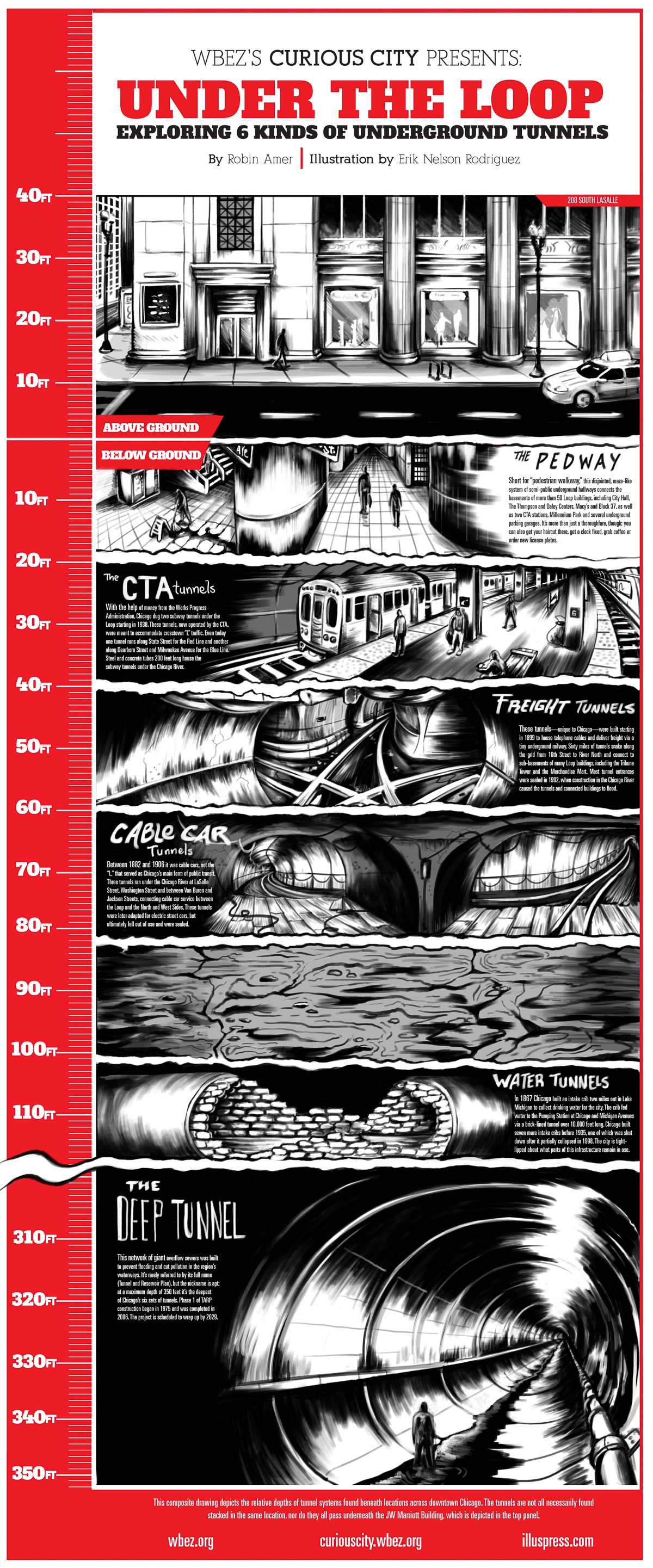
Edit: infographic of various tunnels under Chicago, many of which are even deeper than these bored ones[4]
I do not think it is possible for me to agree with you more! I've always had a hard time trying to articulate it as well as that however.
I came at it from a rather clumsy angle of damage/destruction. Imagine 500 years ago, how much damage could one person do to others. Now as humans have become so much more efficient in almost every aspect, how much damage could be done by a single person? An erratic leader with nukes, a big global tech company running essential services, or even heads of financial institutions and the monetary supply. One wrong move, even if accidental, can be amplified so much in this day and age.
Of all the things to appear on HN! In a kind of joke response to a recent house search with a couple of friends, I made a site that splits the rent based on room size. Rough round the edges, but feel free to try it out. http://whogetsthesmallroom.com/