>> If this - "High-income job losses are cooling housing demand" is true, doesn't this mean UBI would never work?
If UBI were national, it would work beautifully, because depending on the UBI amount, it could allow people to finally untether geographically. You could spur a rebalancing of irrational demand in HCOL cities due to jobs away from HCOL to LCOL
there's a lot of hype around durable execution these days. why do that instead of regular use of queues? is it the dev ergonomics that's cool here?
you can (and people already) model steps in any arbitrarily large workflow and have those results be processed in a modular fashion and have whatever process that begins this workflow check the state of the necessary preconditions prior to taking any action and thus go to the currently needed step, or retry ones that failed, and so forth.
Message queues (e.g. SQS) are inappropriate for tracking long-running tasks/workflows. This is due to the operational requirements such as:
- Checking the status of a task (queued, pending, failed, cancelled, completed)
- Cancelling a queued task (or pending task if the execution environment supports it)
- Re-prioritizing queued tasks
- Searching for tasks based off an attribute (e.g. tag)
We build what is effectively a durable execution "engine" for our orchestrator (ours is backed by boltdb and not SQLite, which I objected to, correctly). The steps in our workflows build running virtual machines and include things like allocating addresses, loading BPF programs, preparing root filesystems, and registering services.
Short answer: we need to be able to redeploy and bounce the orchestrator without worrying about what stage each running VM on our platform is in.
JP, the dev that built this out for us, talks a bit about the design rationale (search for "Cadence") here:
Yup. Being able to write imperative code that automatically resumes where it left off is very valuable. It's best to represent durable turing completeness using modern approaches of authoring such logic - programming languages. Being able to loop, try/catch, apply advanced conditional logic, etc in a crash-proof algorithm that can run for weeks/months/years and is introspectable has a lot of value over just using queues.
Durable execution is all just queues and task processing and event sourcing under the hood though.
As you say it can be done but it's an anti-pattern to use a message queue as a database which is essentially what you are doing for these kinds of long running tasks. The reason is that their are a lot of state your likely going to want to status as a task runs and persist and checkpoint yes you can carefully string together a series of database calls chained with message transactions so you don't lose something when an issue happens but then you also need bespoke logic to restart or retry each step and it can turn into a bit of a mess.
The hype is because DE is such an dev exp improvement over building your own queue. Good DE frameworks come with workflows, pub/sub, notifications, distributed queues with tons of flow control options, etc.
from OP's tone I'd guess personal experience - I lived in one in my late teens/early twenties (Alberta still allowed them at the time, maybe it still does IDK). We had a guy attempt suicide in the kitchen one night. I heard after moving out that another roommate I'd been friendly with got kicked out after relapsing and getting 'back into the crack', according to the landlady's boyfriend.
It is a fact that criminals and addicts will flock towards the cheapest housing options and bring their problems with them. That's just the nature of being the cheapest option.
The main question we need to be asking ourselves is if we prefer these people do crack in those places, or on the street in makeshift camps.
The idea that if we just remove tools from poor people that they go away is patently insane. We want to... kick people while they're already down... and we expect that to help anyone?
I'd prefer they have housing somewhere to live and not in the streets! Just not in my neighborhood, man that's a mouthful, maybe NIMNH? Doesn't really roll off the tongue though...
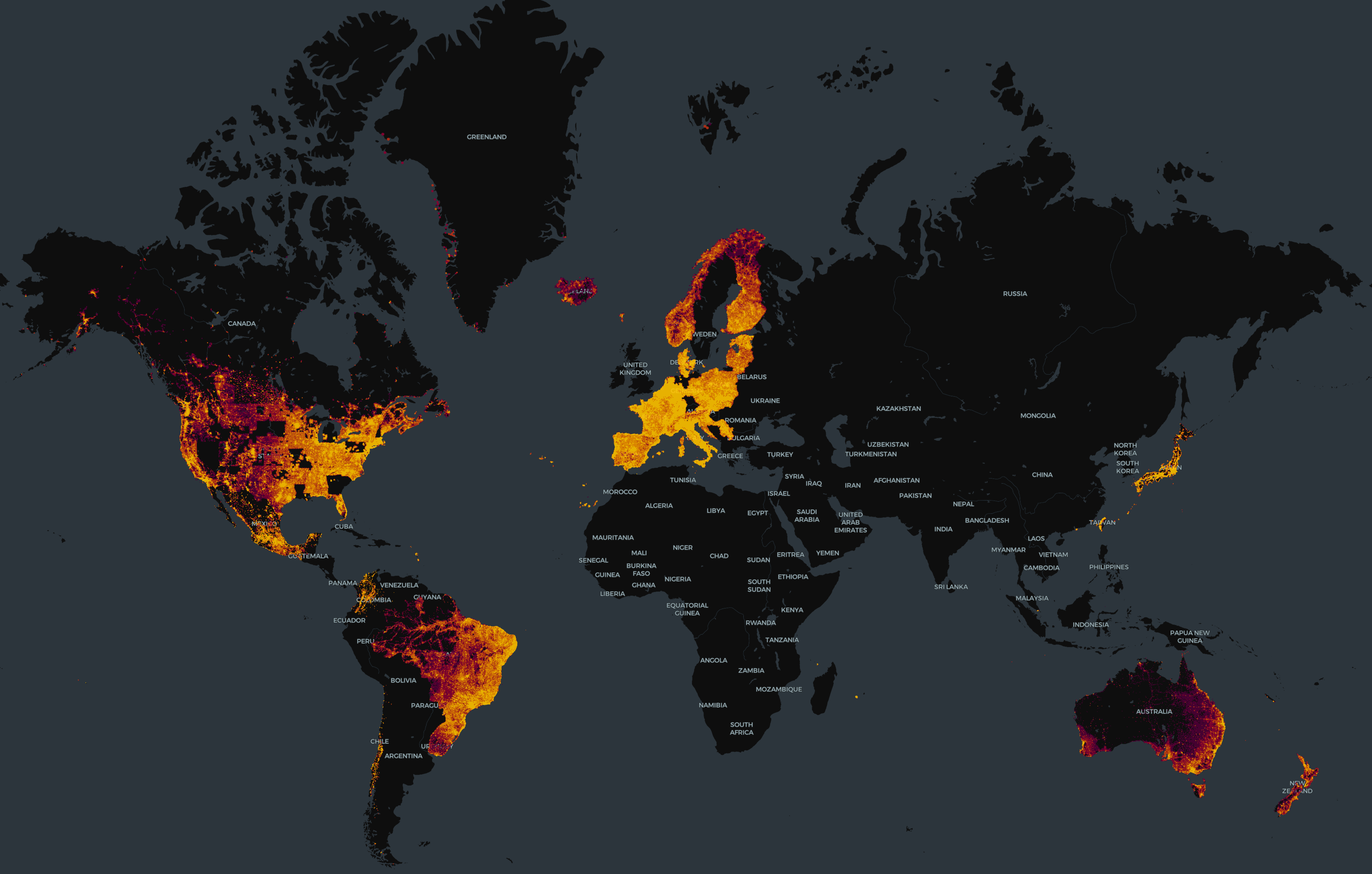
As one example, the U.S. Federal Communications Commission uses it in its Broadband Data Collection program. You can see some of how it's been implemented here: https://broadbandmap.fcc.gov/
Edit: It seems some people get a blocked message when visiting the base url. The home path may work better? https://broadbandmap.fcc.gov/home
H3 was integrated into ClickHouse in 2019, and since then, I have heard many interesting stories. There are unusual ones, e.g., when it is used not to map data on Earth, but for astronomy (stars, galaxies).
amo is using it quite a lot, mainly for the scratch map feature in the Bump Map application, but not only.
Use cases are:
- data storage
- data aggregation/clustering
- spatial indexing
- geometrical computation (as long as you're OK with approximation, you can speed up a lot of things by working with CellID instead of actual geometries)
- data visualization
I've seen it used by Databend, Helium, Breakroom (they did an Erlang binding on top of h3o), beaconDB, Greptime, Meilisearch.
But I don't exactly know what they are using it for (just that they pulled h3o in their projects).
These functions encode and decode latitude/longitude to H3 cells and provide utilities for querying cell properties, neighborhoods, distances, and relationships.
I’ve used h3 for a game. Since they align with an unique hex, I can ensure that one cell grid aligns and is placed on the same place in the world, where players could then compete on.
we have used it at my last 2 companies for most geospatial data analyses. defining and visualizing catchment areas. making maps dividing up service areas. picking out high demand density areas. etc. before h3, both companies were using zipcodes and more ad-hoc data transformations. i'm not saying h3 is perfect. i wouldn't know. but it definitely beats zipcodes.
I don't understand why this even has to charge at all. It makes sense for multiple reasons to give it 3 batteries that say have 1/3 of the capacity, and make at least 1, if not 2 or 3 capable of charging independently on a station.
Then the robot would just go to its station and swap its own batteries. Why even have wireless charging at all? Or even a cable? Or even have it "charge"? Battery swapping seems to make way more sense here. Am I missing something?
Bonus points if the robot has data on the degradation and can order its own replacement batteries, take them out of the box, and ship the old ones to a recycling facility...
More bonus points if the charging station is actually outside under a 1KW solar array pergola thing, that way you don't even have to pay for the electricity either. Don't worry, the robot will lock the door when it goes out to grab its batteries. It'll also bring in the whole setup if the weather isn't great.
It depends on the battery life. If the robot lasts all day, then charging at night via standing on a charging pad makes a lot of sense. Creating a removable battery pack adds extra weight and gives the designers less freedom to place the battery pack exactly where it needs to be in the robot frame, or distribute the cells across the frame in strategic locations.
Also, the charge rate matters. If robot can charge to 80% in say 30 minutes, then it can take small charging breaks during the day between critical tasks.
Also, if the feet have inductive chargers, it's possible to place the robot on a large charging mat that allows it to run indefinitely, like in a factory environment. If your robot takes 30 minutes to fold the laundry or do dishes, why not place a charging mat at these locations so it can work and charge at the same time.
In the future, new homes might include charging coils embedded in the floor every 12 inches so that your robots can work all day.
Almost all of those points are applicable for the battery pack as well. There should be virtually no weight difference, other than the design limitation which is a valid concern.
I suppose an external battery pack adds the bonus of doing a hard shutdown, in the case it decides to go rogue. Though getting to the battery pack might be hard if it resists you.
Yeah so in 2-4 years you can throw out your whole expensive robot because battery wears out? I hate this argument that just to be a bit thinner, the whole device has to be be made throwaway.
Humanoid "maid" robots will never be popular in the home until they can effectively simulate the appearance and form factor of a woman or teenage girl. It is what it is.
That seems like more of a reversal of causation. Women are more likely to be maids or home care workers because "domestic" work is perceived as women's work. Maids are often young women, "teenage girls" as you say, or older women because they either haven't started a family yet or have already raised their children to adulthood. This is because many women are expected to take on the majority of unpaid domestic labor while men take on the traditional wage-earning paid labor.
The sexualization of young women working domestic labor is the result of the general sexualization of most young women in most contexts. It isn't that domestic labor is some sort of pretext to get a young woman into the home. It is that once they are there, men sexualize them.
I'm not saying everyone, everywhere, wants to fuck their robot maid, I'm saying thousands of years of patriarchy, hundreds of years of popular culture, fetishization of domestic labor roles and simple human nature will have an influence on the adoption of humanoid domestic robots that companies ignore at their peril.
Some people are Honda Civic people, only concerned with utility - that's fine, I'm the same way. But the money comes from cars designed to evoke eroticism or animal aggression. The humanoid robot in the article is, aesthetically speaking, horrifying to most people. It doesn't even have a face, it doesn't look pleasant, it doesn't invite an emotional bond, it isn't friend shaped, and that isn't what most people will want, or would spend money on, regardless of how efficient it is.
Humanoid robots will have a context within the same gender and cultural dynamics as human beings, by virtue of looking and acting human enough. People already have relationships with AI, and that will only become more normalized over time. Most people will personify and anthropomorphize humanoid robots just as much as they do AI, and this will be necessary for their popular acceptance and adoption. And yes, many people will want to fuck them, or at the very least, want them to look fuckable.
> Some people are Honda Civic people, only concerned with utility - that's fine, I'm the same way. But the money comes from cars designed to evoke eroticism or animal aggression.
They sell a ton of Civics, and even more of the kind of boring-ass SUV like a Nissan Muranos and Ford Escapes. None of these are the 'sexy' cars you describe. True, individual Lamborghinis sell for an order of magnitude more than a Murano and are sexy cars, but your original comment suggests that only an aesthetically sexy robot maid would be "popular." Would a sexy robot maid be a sensation? I bet it would, but I just don't think adoption is waiting on that necessarily. Rather, usefulness and 'right price' are the current barriers.
> The humanoid robot in the article is, aesthetically speaking, horrifying to most people.
Hard agree, it's for sure gross looking. They could do a lot better by literally just letting an animator design a cute cartoon face to put on a cheap screen. If anybody wants the weirdo look pictured there they can just turn the screen off.
People already buy robot vacuums to do a decent job of vacuuming a decent amount of their floors. It is a $4.48 billion industry. Roombas don't look like people. They don't even look like pets or animals. They look like big hockey pucks. I have one and I have it run as soon as I leave for work because I don't want to interact with it, I want to have clean floors. If there was a robot that could fold clothes, load and unload the dishwasher, dust, and general purpose clean, I would have it run when I wasn't home too and would prefer if it folded up into a little box in the corner when I was home.
Roomba uses AI in some of their models, but people aren't trying to have a relationship with them. Because it is AI to serve a utilitarian purpose that does not involve imitating human behavior. People have relationships with chatbots because they are specifically imitating human behavior. Putting googly eyes on your Roomba isn’t the same as falling in love with a chatbot.
Cars are very very publicly visible, so they are used to project some sort of image to others; like the clothes people wear. Most people don't wear clothes or drive cars for purely utilitarian purposes. Often people will buy clothes or cars that look utilitarian to project an image about themselves. People buy furniture and decorate their homes to project an image. People do not buy their water heater to project a certain image about themselves. Robot vacuums are frustrating to watch. They get the job done in the end (most of the time) but their random zig zags or difficulty navigating around objects is something most people don’t want to see. They just want the result. Huminoid robots will be like that for a significant amount of time, where they can empty the dishwasher, but it will be painfully slow, odd looking, and very unhuman-like. People won’t want to see this but they will want the job done so they don’t have to do it. A robot that can perform utilitarian household chores would be a huge industry and would be used by most people like a dishwasher or water heater, primarily for its utility.
A robot that reaches the level that it could be a companion, operating visibly with/around people (bringing you and your guests refreshments rather than slowly, awkwardly folding clothes alone in a bedroom while you are at work or downstairs watching a movie) would very likely have a huge pressure to fit cultural and gender dynamics.
Swapping requires a lot more moving parts and an additional enclosure to house the battery, and the batteries need to be much more rugged, and now you need two of them.
But a cable is a fair question.. you'd think it could plug itself in...
Maybe that's a hint at the robots actual capabilities at this point... or, they didn't want to bet on the unpredictability of environments: what if there's something in the way of the cable, though something could also be in the way of the inductive charger
I'd appreciate a link. But "we don't trust our robot to be able to locate a power outlet and plug its own charging cord in there" sure is a low confidence play.
There are practical advantages to being able to charge wirelessly, sure. But if they're doing that because of AI limitations? Bad sign.
Tesla showed a prototype of a "snake"/"tentacle" charger that would find its own way to the Tesla's charging port a long time ago. Gotta be 5+ years by now. To my knowledge it has never become a real product or certainly not mainstream among Tesla owners. I believe this gives some credence to Tesla struggling to build robots that can plug a cord in, even in cases where the robot is the cable.
They're building cars, so it's more like ATX 24pin style cables, but this is generally true. Cables, wires, ropes type of objects are like cardboard thin robots with hundred joints in series and under someone else's control, so it's hard for robots to deal with. If you think about it, people hate cables too. We easily get tangled in headphone cables when they're wired, and we fail to coil or untangle Ethernet cables properly all the time.
EV charger style of short, thick cables should not be THAT hard, though. The more likely problem here is that they just can't handle the task of securing and inserting the head of the cable against resistance.
Surely if the cable design was under your control, you could make it a lot easier for an automated system to plug in. Have it be sort of like a TRS jack, but cone-shaped. Then you don't have to get it perfectly aligned, it will align itself when inserted. Put a magnet in the tip to hold it in place, or some sort of electrically actuated lock that the robot can unlock when it wants to unplug the cable
Yeah, immediately after I wrote that I thought now you need a rugged socket, and to mount the cable somewhere on a wall.. and where to even place it on the body that it's easy for it to plug in.. the belly button?
There is empty space in the feet anyway for a coil and a wire..
Forget sockets. My $15 fitness band uses a magnetically-assisted pogo-pin type thing. Works great. Just blow that up to 5x to get nice fat conductors. All you need to do is get it close and it plugs itself in. Knock it off perpendicularly to disconnect.
The most likely reason is that even doing a pre-programmed battery swap with consistent battery and slots is way beyond the capabilities. It also can't even plug itself in to charge.
Yet, it's being sold as capable of doing and folding your laundry.
I would sell th stock to the next idiot the moment they announced this.
> can order its own replacement batteries,
yeah companies would love to exploit this kind of subscription and definitely agree on battery swapping capabilities, it's more efficient .
> Bonus points if the robot has data on the degradation
BMS that can tell battery health is common so this should be there.
What happens if it can't get to the charger in time to do the swap? Same problem roombas have where you have to fish them out from under your couch, except now the damn thing is 5 feet tall and weighs 300 pounds.
Well established and even commercialized (Toyota sells fuel cell cars today IIRC), just not as cost effective in cars from a full infrastructure perspective (fueling specifically).
I think they might mean something closer to a flow battery, where, in principle, you should just be able to replace the electrolytes in a discharged state with new electrolytes in a charged state. Current flow batteries have very low energy density, though.
I've always been partial to fuel cells, and in some ways they're ahead of the curve relative to standard batteries. For instance, solid electrolytes have been a thing for a while in fuel cells, and in both flavors of exchange. The challenge has always been overcoming sluggish kinetics with either better catalysts, or heat. It makes me wonder if there's a useful solid state battery that runs hotter than typical batteries, that would be useful for hybrid automotive applications.
I had a suspicion that there were more idiots on the road after and during covid. good to see this reflected in the data, but sad to know that it's actually true. no matter where I go in the USA I see people speeding easily 50% over the limit, running red lights, blowing through stop signs. it's ridiculous.
given how many people die I'm surprised government's having made safety technology mandatory. things like toyota safety sense are pretty effective - you can check on youtube. people will place random dummys in front of the car and it stops pretty accurately.
I’d like someone to do a deep dive in the data; I suspect that almost all of the fatalities involve some variation of “not following the laws” simply because nobody does.
We need crosswalks enforced by spikes that pop up from the ground or something similarly draconian to get people to wake up.
The US mostly (but not completely) solved the school bus problem (people passing a bus dropping off children) by having exceptionally hard penalties and enforcing them significantly for the first few months.
A similar nation-wide campaign is needed around auto safety.
>The US mostly (but not completely) solved the school bus problem (people passing a bus dropping off children) by having exceptionally hard penalties and enforcing them significantly for the first few months.
They also changed bus routing best practice to alter the sorts of stops that were causing the bulk of the passing. Like for example right side stops on roads divided by any sort of median are avoided where possible these days.
That also had the side effect of moving the stops to side streets; rarely if ever are the “commuting roads” stopped by schoolbusses anymore. Which makes it nicer tot drive, too.
> there were more idiots on the road after and during covid
I don't think the data really supports this, because pedestrian deaths have been rising continuously since 2008 instead of abruptly after 2019; there is at least a bunch of other factors at play.
Most suprising to me was the sharp rise in the "pedestrians on drugs" quota.
Personally, I think that "more distracted pedestrians" (from smartphones) is also an interesting theory which could possibly explain the huge increase in Sedan-lethality.
> Most suprising to me was the sharp rise in the "pedestrians on drugs" quota.
I'd be cautious of reading _too_ much into that, because in that time period the US has largely legalised a popular drug. You'd expect this rate to rise just because a cop asking "were you using cannabis" in the US is now a very different threat level than it was 20 years ago.
We're 30mph through my village but because it is a 'cut through' the local government deem it to be important and the speed cannot be reduced. Even though we had two cars go round a sharp bend into a tree within a month of each other, in dry conditions.
Not Germany here but I witnessed buses of the bus company of my former city driving at 50 or more in a 30 km/h area. Some of those areas have a 30 limit because of a good reason, some probably only to add up kilometers and make the city council look good.
Speed bumps work but putting big flower pots in the way is even better. It forces people to slow down without giving them the feeling that they get slowed down for no reason.
Then to add to that I see every single day people walking doing silly things and walking into the roads where they should not be. One dude I saw just a few days ago was crossing an interstate (see that about 2-3 times a month in the same place). I see jwalking pretty much every day. I see people walking when the signal says to stay put. I see people darting out from between parked cars. I see this every day. Sure they have priority. But a car doing 55 does not care. Keep your head on a swivel. I make sure I cross at the places designated to do so and also make sure there are no cars coming at that moment because some fool decided that was the perfect time to play with their phone.
But most of these issues are highlighting road/driver issues, not pedestrian ones.
People jaywalk because the lights are timed more for the convenience of the drivers. People dart out between parked cars because the nearest crosswalk is a long way away. People cross the interstate because otherwise their 5 minute walk becomes an hour. Drivers shouldn't be going 55 in spots where someone can be obscured by a row of parked cars. etc.
A lot of this is parked cars right beside a 55mph highway. Or stretches of stroad that are a mile long with no pedestrian crossings. In the US we love to zone that 'business over here' and 'residentials over there' which means you have to cross high traffic areas to do anything. And if you're without car you're rightly screwed.
> One dude I saw just a few days ago was crossing an interstate (see that about 2-3 times a month in the same place).
That IS a problem. However, what is the locality doing to fixing an obvious problem of 'nowhere to safely cross a high speed road'? Aside "fuckit, cross halfway when it looks safe" is basically the only sane response. WALKING up or down an interstate or major highway to get to a light or some crossing way would take 1+ hours to do.
> Then to add to that I see every single day people walking doing silly things and walking into the roads where they should not be.
Are they actually obstructing, or just crossing and you don't like that?
> I see people walking when the signal says to stay put.
So in my liberal-ish city in a republican state, we have basically terrible cargo-cult traffic control. They do shit like "dont turn on pedestrian lights when nobody presses the button", no right-turn on reds even if theres no ped crossing, arbitrary bad speed control, stuff like that.
On the city square, its routine to see no cars cause the lights are anti-timed to impede cars. BUT the light will be green allowing all those cars (NONE!) to continue. So yeah, we look the 1 way - its a 1 way road - and we will cross when we're not supposed to.
Again, this is what happens when you mix blaming pedestrians, poor traffic handling, and cargo cult liberal ideas all together. Makes a terrible situation for everyone.
> I see people darting out from between parked cars.
Again, goes back to car companies criminalizing "jaywalking", in order to steer the blame to humans rather than humans driving a 1 ton slab of metal and plastic.
> But a car doing 55 does not care.
Ah hah! And there's the gotcha. You're not talking about downtown and slower streets, like city residential or the city square. You're talking about Stroads, this bastardized terrible mix between a street (slow, humans everywhere) and a road (high speed, no humans, limited entry/exit). Not Just Bikes talks extensively about it. https://www.youtube.com/watch?v=ORzNZUeUHAM
Yes, Stroads kill. And Stroads are EVERYWHERE in the USA. This US-centric anti-pattern is best seen with a state highway going 55MPH, maybe dropping to 40-45MPH with a town built AROUND this bisecting nigh-uncrossable stroad. They are some of the most anti-human infrastructure we have seen.
> I make sure I cross at the places designated to do so and also make sure there are no cars coming at that moment because some fool decided that was the perfect time to play with their phone.
Thats the problem with stroads and the highways that bifurcate towns and cities. There's FEW places to cross, and the lights themselves are almost never set up to actually allow pedestrian traffic. And you're lucky to even get a sidewalk. And if you do, your door prize is face full of vehicles fumes and super loud vehicles.
The USA has sold off and demolished pedestrian infrastructure for implicitly requiring everyone have a motor vehicle, unless you're lucky enough to live in a rare city with great public infra. (And no, bus lines that share the road with regular vehicles will take you 2 hours to get where your car can take you 20 minutes.)
- Jepsen claimed that FDB has more rigorous testing than they could do.
- New programming language, Flow, for testing.
You probably could solve the same problems with FDB, but TigerBeetle I imagine is more optimized for its use case (I would hope...).
AFAIK - the only reason FDB isn't massively popular is because no one has bothered to write good layers on top. I do know of a few folks writing a SQS, DynamoDB and SQLite layers.
The only reason is Apple. They liked the product that was released in 2013 so much they bought the whole company, and all other FoundationDB users were abandoned and were forced to drop it.
Who would trust a database that can be yanked out of you at any moment? Though a lot of products have license terms like this only a handful were ever discontinued so abruptly. It's under Apache license now but the trust is not coming back.
And a more serious comment, to separate it from the silly one below:
Interesting that they didn't release it with an SQL client, is there no way to make it compatible? Even with extensions to SQL, I imagine it would be great for a lot of use cases.
> AFAIK - the only reason FDB isn't massively popular is because no one has bothered to write good layers on top. I do know of a few folks writing a SQS, DynamoDB and SQLite layers.
I started writing this comment:
> It seems interesting, but considering what it's for, why aren't the hyperscalers using it?
And while writing it I started searching for FoundationDB and found this:
Apple bought them, took it down from the web, then quietly open-sourced it a few years later. They tried to make it popular, ran a conference for it, but the adoption was too minor for Apple to care afterwards.
It's still maintained by a sizable team at Apple, GH stats show that the activity is much lower now than it was 3 years ago, but there're about 10 people that contribute on a steady regular basis, which is honestly better than 99% of open source projects out there.


reply